Thank you for visiting SNEWPapers!
Sign up free
Literary
May 27, 1844
The Caledonian
Saint Johnsbury, Caledonia County, Vermont
What is this article about?
Satirical essay from Punch magazine humorously outlining marriage laws: requirements for validity, dissolution via divorce or death, and legal effects like spousal unity, debts, and disabilities, poking fun at legal absurdities and gender roles.
Clipping
OCR Quality
98%
Excellent
Full Text
THE COMIC BLACKSTONE,
OF HUSBAND AND WIFE.
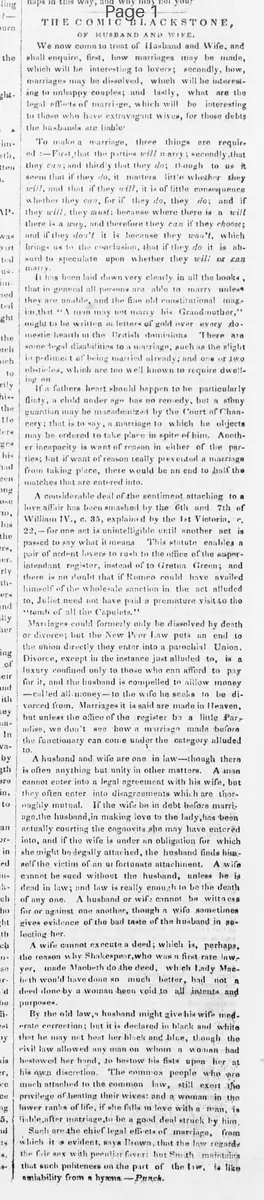
We now come to treat of Husband and Wife, and shall enquire, first, how marriages may be made, which will be interesting to lovers; secondly, how, marriages may be dissolved, which will be interesting to unhappy couples; and lastly, what are the legal effects of marriage, which will be interesting to those who have extravagant wives, for those debts the husbands are liable. To make a marriage, three things are required:--First that the parties will marry; secondly, that they can; and thirdly that they do; though to us it seems that if they do, it matters little whether they will, and that if they will, it is of little consequence whether they can, for if they do, they do; and if they will, they must: because where there is a will there is a way, and therefore they can if they choose; and if they don't it is because they won't, which brings us to the conclusion, that if they do it is absurd to speculate upon whether they will or can marry. It has been laid down very clearly in all the books, that in general all persons are able to marry unless they are unable, and the fine old constitutional maxim, that "a man may not marry his Grandmother," ought to be written in letters of gold over every domestic hearth in the British dominions. There are some legal disabilities to a marriage, such as the slight impediment of being married already; and one or two obstacles, which are too well known to require dwelling on. If a father's heart should happen to be particularly flinty, a child under age has no remedy, but a stubborn guardian may be macadamized by the Court of Chancery; that is to say, a marriage to which he objects may be ordered to take place in spite of him. Another incapacity is want of reason in either of the parties; but if want of reason really prevented a marriage from taking place, there would be an end to half the matches that are entered into. A considerable deal of the sentiment attaching to a love affair has been smashed by the 6th and 7th of William IV., c. 35, explained by the 1st Victoria, c. 22,--for one act is unintelligible until another act is passed to say what it means. This statute enables a pair of ardent lovers to rush to the office of the superintendent register, instead of to Gretna Green; and there is no doubt that if Romeo could have availed himself of the wholesale sanction in the act alluded to, Juliet need not have paid a premature visit to the "tomb of all the Capulets." Marriages could formerly only be dissolved by death or divorce; but the New Poor Law puts an end to the union directly they enter into a parochial Union. Divorce, except in the instance just alluded to, is a luxury confined only to those who can afford to pay for it, and the husband is compelled to allow money--called alimony--to the wife he seeks to be divorced from. Marriages it is said are made in Heaven, but unless the office of the register be a little Paradise, we don't see how a marriage made before the functionary can come under the category alluded to. A husband and wife are one in law--though there is often anything but unity in other matters. A man cannot enter into a legal agreement with his wife, but they often enter into disagreements which are thoroughly mutual. If the wife be in debt before marriage, the husband, in making love to the lady, has been actually courting the cognovit she may have entered into, and if the wife is under an obligation for which she might be legally attached, the husband finds himself the victim of an unfortunate attachment. A wife cannot be sued without the husband, unless he is dead in law: and law is really enough to be the death of any one. A husband or wife cannot be witness for or against one another, though a wife sometimes gives evidence of the bad taste of the husband in selecting her. A wife cannot execute a deed; which is, perhaps, the reason why Shakespear, who was a first rate lawyer, made Macbeth do the deed, which Lady Macbeth would have done so much better, had not a deed done by a woman been void to all intents and purposes. By the old law, a husband might give his wife moderate correction; but it is declared in black and white that he may not beat her black and blue, though the civil law allowed any man on whom a woman had bestowed her hand, to bestow his fists upon her at his own discretion. The common people who are much attached to the common law, still exert the privilege of beating their wives: and a woman in the lower ranks of life, if she falls in love with a man, is liable, after marriage, to be a good deal struck by him. Such are the chief legal effects of marriage, from which it is evident, says Brown, that the law regards the fair sex with peculiar favor: but Smith maintains that such politeness on the part of the law, is like amiability from a hyena.--Punch.
OF HUSBAND AND WIFE.
We now come to treat of Husband and Wife, and shall enquire, first, how marriages may be made, which will be interesting to lovers; secondly, how, marriages may be dissolved, which will be interesting to unhappy couples; and lastly, what are the legal effects of marriage, which will be interesting to those who have extravagant wives, for those debts the husbands are liable. To make a marriage, three things are required:--First that the parties will marry; secondly, that they can; and thirdly that they do; though to us it seems that if they do, it matters little whether they will, and that if they will, it is of little consequence whether they can, for if they do, they do; and if they will, they must: because where there is a will there is a way, and therefore they can if they choose; and if they don't it is because they won't, which brings us to the conclusion, that if they do it is absurd to speculate upon whether they will or can marry. It has been laid down very clearly in all the books, that in general all persons are able to marry unless they are unable, and the fine old constitutional maxim, that "a man may not marry his Grandmother," ought to be written in letters of gold over every domestic hearth in the British dominions. There are some legal disabilities to a marriage, such as the slight impediment of being married already; and one or two obstacles, which are too well known to require dwelling on. If a father's heart should happen to be particularly flinty, a child under age has no remedy, but a stubborn guardian may be macadamized by the Court of Chancery; that is to say, a marriage to which he objects may be ordered to take place in spite of him. Another incapacity is want of reason in either of the parties; but if want of reason really prevented a marriage from taking place, there would be an end to half the matches that are entered into. A considerable deal of the sentiment attaching to a love affair has been smashed by the 6th and 7th of William IV., c. 35, explained by the 1st Victoria, c. 22,--for one act is unintelligible until another act is passed to say what it means. This statute enables a pair of ardent lovers to rush to the office of the superintendent register, instead of to Gretna Green; and there is no doubt that if Romeo could have availed himself of the wholesale sanction in the act alluded to, Juliet need not have paid a premature visit to the "tomb of all the Capulets." Marriages could formerly only be dissolved by death or divorce; but the New Poor Law puts an end to the union directly they enter into a parochial Union. Divorce, except in the instance just alluded to, is a luxury confined only to those who can afford to pay for it, and the husband is compelled to allow money--called alimony--to the wife he seeks to be divorced from. Marriages it is said are made in Heaven, but unless the office of the register be a little Paradise, we don't see how a marriage made before the functionary can come under the category alluded to. A husband and wife are one in law--though there is often anything but unity in other matters. A man cannot enter into a legal agreement with his wife, but they often enter into disagreements which are thoroughly mutual. If the wife be in debt before marriage, the husband, in making love to the lady, has been actually courting the cognovit she may have entered into, and if the wife is under an obligation for which she might be legally attached, the husband finds himself the victim of an unfortunate attachment. A wife cannot be sued without the husband, unless he is dead in law: and law is really enough to be the death of any one. A husband or wife cannot be witness for or against one another, though a wife sometimes gives evidence of the bad taste of the husband in selecting her. A wife cannot execute a deed; which is, perhaps, the reason why Shakespear, who was a first rate lawyer, made Macbeth do the deed, which Lady Macbeth would have done so much better, had not a deed done by a woman been void to all intents and purposes. By the old law, a husband might give his wife moderate correction; but it is declared in black and white that he may not beat her black and blue, though the civil law allowed any man on whom a woman had bestowed her hand, to bestow his fists upon her at his own discretion. The common people who are much attached to the common law, still exert the privilege of beating their wives: and a woman in the lower ranks of life, if she falls in love with a man, is liable, after marriage, to be a good deal struck by him. Such are the chief legal effects of marriage, from which it is evident, says Brown, that the law regards the fair sex with peculiar favor: but Smith maintains that such politeness on the part of the law, is like amiability from a hyena.--Punch.
What sub-type of article is it?
Satire
Essay
What themes does it cover?
Social Manners
Political
What keywords are associated?
Comic Blackstone
Marriage Law
Husband Wife
Legal Satire
Divorce Alimony
Spousal Rights
Punch Magazine
What entities or persons were involved?
Punch
Literary Details
Title
The Comic Blackstone, Of Husband And Wife.
Author
Punch
Subject
Comic Treatise On Marriage Laws
Key Lines
To Make A Marriage, Three Things Are Required: First That The Parties Will Marry; Secondly, That They Can; And Thirdly That They Do;
The Fine Old Constitutional Maxim, That "A Man May Not Marry His Grandmother," Ought To Be Written In Letters Of Gold Over Every Domestic Hearth In The British Dominions.
A Husband And Wife Are One In Law Though There Is Often Anything But Unity In Other Matters.
By The Old Law, A Husband Might Give His Wife Moderate Correction; But It Is Declared In Black And White That He May Not Beat Her Black And Blue,
Such Politeness On The Part Of The Law, Is Like Amiability From A Hyena.