Thank you for visiting SNEWPapers!
Sign up free
Editorial
July 6, 1911
The Sauk Centre Herald
Sauk Centre, Stearns County, Minnesota
What is this article about?
This editorial opposes simplified spelling advocated by Andrew Carnegie, arguing that traditional orthography, determined by majority usage among intelligent speakers and writers, is correct despite being less logical or phonetic. It defends enforcing standard spelling in education and draws parallels to dress customs.
Clipping
OCR Quality
98%
Excellent
Full Text
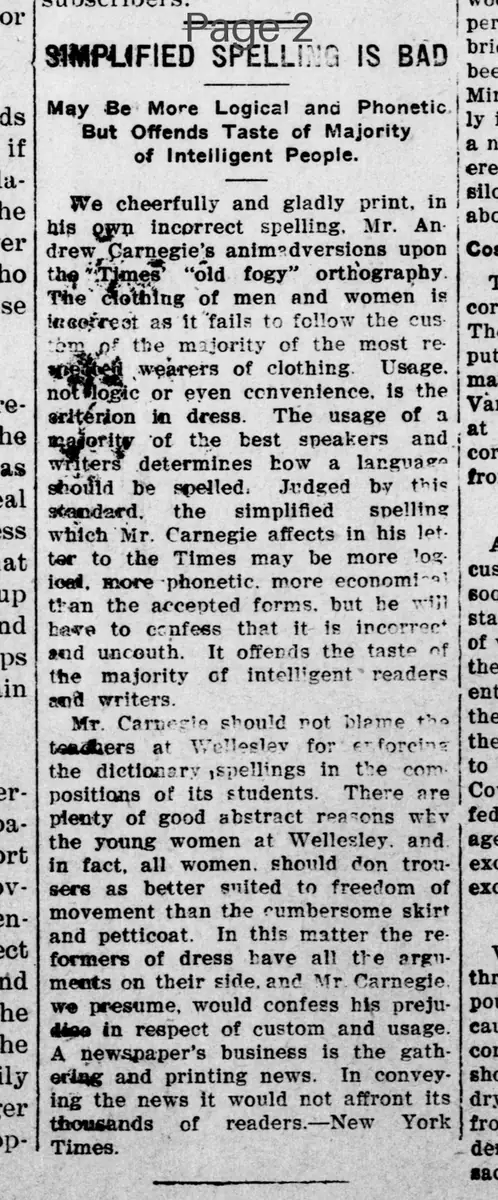
SIMPLIFIED SPELLING IS BAD
May Be More Logical and Phonetic.
But Offends Taste of Majority of Intelligent People.
We cheerfully and gladly print, in his own incorrect spelling. Mr. Andrew Carnegie's animadversions upon the "Times" old fogy" orthography.
The clothing of men and women is incorrect as it fails to follow the custom of the majority of the most recent wearers of clothing. Usage not logic or even convenience, is the criterion in dress. The usage of a majority of the best speakers and writers determines how a language should be spelled. Judged by this standard, the simplified spelling which Mr. Carnegie affects in his letter to the Times may be more logical, more phonetic, more economical than the accepted forms, but he will have to confess that it is incorrect and uncouth. It offends the taste of the majority of intelligent readers and writers.
Mr. Carnegie should not blame the teachers at Wellesley for enforcing the dictionary spellings in the compositions of its students. There are plenty of good abstract reasons why the young women at Wellesley, and in fact, all women, should don trousers as better suited to freedom of movement than the cumbersome skirt and petticoat. In this matter the reformers of dress have all the arguments on their side, and Mr. Carnegie, we presume, would confess his prejudice in respect of custom and usage.
A newspaper's business is the gathering and printing news. In conveying the news it would not affront its thousands of readers.-New York Times.
May Be More Logical and Phonetic.
But Offends Taste of Majority of Intelligent People.
We cheerfully and gladly print, in his own incorrect spelling. Mr. Andrew Carnegie's animadversions upon the "Times" old fogy" orthography.
The clothing of men and women is incorrect as it fails to follow the custom of the majority of the most recent wearers of clothing. Usage not logic or even convenience, is the criterion in dress. The usage of a majority of the best speakers and writers determines how a language should be spelled. Judged by this standard, the simplified spelling which Mr. Carnegie affects in his letter to the Times may be more logical, more phonetic, more economical than the accepted forms, but he will have to confess that it is incorrect and uncouth. It offends the taste of the majority of intelligent readers and writers.
Mr. Carnegie should not blame the teachers at Wellesley for enforcing the dictionary spellings in the compositions of its students. There are plenty of good abstract reasons why the young women at Wellesley, and in fact, all women, should don trousers as better suited to freedom of movement than the cumbersome skirt and petticoat. In this matter the reformers of dress have all the arguments on their side, and Mr. Carnegie, we presume, would confess his prejudice in respect of custom and usage.
A newspaper's business is the gathering and printing news. In conveying the news it would not affront its thousands of readers.-New York Times.
What sub-type of article is it?
Social Reform
Education
What keywords are associated?
Simplified Spelling
Andrew Carnegie
Traditional Orthography
Language Usage
Spelling Reform
Wellesley College
What entities or persons were involved?
Andrew Carnegie
New York Times
Wellesley
Editorial Details
Primary Topic
Opposition To Simplified Spelling
Stance / Tone
Critical Of Spelling Reform, Favoring Traditional Usage
Key Figures
Andrew Carnegie
New York Times
Wellesley
Key Arguments
Usage Of Majority Determines Correctness In Language Spelling
Simplified Spelling Is Logical But Uncouth And Offends Taste
Analogy To Dress Customs Where Usage Trumps Logic
Teachers Should Enforce Standard Dictionary Spelling
Newspapers Should Not Use Non Standard Spelling To Avoid Affronting Readers