Thank you for visiting SNEWPapers!
Sign up free
The New Hampshire Gazette
Portsmouth, Rockingham County, New Hampshire
What is this article about?
In Bengal, English forces under Colonel Clive defeated Dutch attempts to seize control of the saltpetre trade. A naval battle on the river resulted in the capture of seven Dutch ships with no English fatalities but heavy Dutch losses (~100 killed). On land, 500 English troops under Col. Ford routed 1000 Dutch, killing 400 and taking prisoners.
Clipping
OCR Quality
Full Text
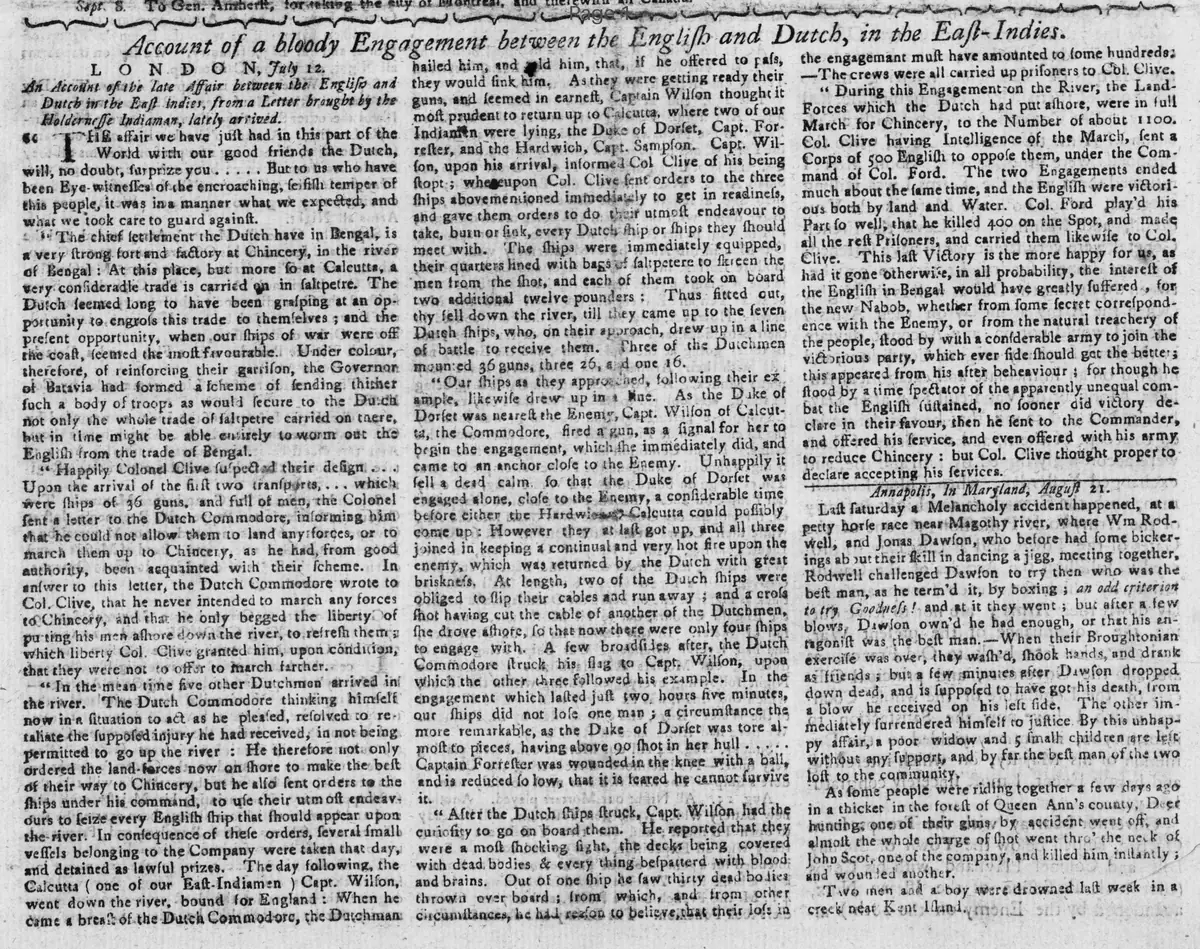
An Account of the late Affair between the English and Dutch in the East Indies, from a Letter brought by the Holderness Indiaman, lately arrived.
The affair we have just had, in this part of the World with our good friends the Dutch, will, no doubt, surprize you. But to us who have been Eye-witnesses of the encroaching, selfish temper of this people, it was in a manner what we expected, and what we took care to guard against.
The chief settlement the Dutch have in Bengal, is a very strong fort and factory at Chinsura, in the river of Bengal: At this place, but more so at Calcutta, a very considerable trade is carried on in saltpetre. The Dutch seemed long to have been grasping at an opportunity to engross this trade to themselves; and the present opportunity, when our ships of war were off the coast, seemed the most favourable. Under colour therefore, of reinforcing their garrison, the Governor of Batavia had formed a scheme of sending thither such a body of troops as would secure to the Dutch not only the whole trade of saltpetre carried on there, but in time might be able entirely to worm out the English from the trade of Bengal.
Happily Colonel Clive suspected their design. Upon the arrival of the first two transports, which were ships of 26 guns, and full of men, the Colonel sent a letter to the Dutch Commodore, informing him that he could not allow them to land any forces, or to march them up to Chinsura, as he had, from good authority, been acquainted with their scheme. In answer to this letter, the Dutch Commodore wrote to Col. Clive, that he never intended to march any forces to Chinsura, and that he only begged the liberty of putting his men ashore down the river, to refresh them, which liberty Col. Clive granted him, upon condition, that they were not to offer to march farther.
In the mean time five other Dutchmen arrived in the river. The Dutch Commodore thinking himself now in a situation to act as he pleased, resolved to retaliate the supposed injury he had received, in not being permitted to go up the river: He therefore not only ordered the land-forces now on shore to make the best of their way to Chinsura, but he also sent orders to the ships under his command, to use their utmost endeavours to seize every English ship that should appear upon the river. In consequence of these orders, several small vessels belonging to the Company were taken that day, and detained as lawful prizes. The day following, the Calcutta (one of our East-Indiamen) Capt. Wilson, went down the river, bound for England: When he came abreast of the Dutch Commodore, the Dutchman hailed him, and told him, that if he offered to pass, they would sink him. As they were getting ready their guns, and seemed in earnest, Captain Wilson thought it most prudent to return up to Calcutta, where two of our Indiamen were lying, the Duke of Dorset, Capt. Forrester, and the Hardwick, Capt. Sampson. Capt. Wilson, upon his arrival, informed Col. Clive of his being stopped; whereupon Col. Clive sent orders to the three ships abovementioned immediately to get in readiness, and gave them orders to do their utmost endeavour to take, burn or sink, every Dutch Ship or ships they should meet with. The ships were immediately equipped, their quarters lined with bags of saltpetre to screen the men from the shot, and each of them took on board two additional twelve pounders. Thus fitted out, they fell down the river, till they came up to the seven Dutch ships, who, on their approach, drew up in a line of battle to receive them. Three of the Dutchmen mounted 36 guns, three 26, and one 16.
Our ships as they approached, following their example, likewise drew up in a line. As the Duke of Dorset was nearest the Enemy, Capt. Wilson of Calcutta, the Commodore, fired a gun, as a signal for her to begin the engagement, which she immediately did, and came to an anchor close to the Enemy. Unhappily it fell a dead calm, so that the Duke of Dorset was engaged alone, close to the Enemy, a considerable time before either the Hardwick or Calcutta could possibly come up: However they at last got up, and all three joined in keeping a continual and very hot fire upon the enemy, which was returned by the Dutch with great briskness. At length, two of the Dutch ships were obliged to slip their cables and run away; and a cross fire having cut the cable of another of the Dutchmen, he drove ashore, so that now there were only four ships to engage with. A few broadsides after, the Dutch Commodore struck his flag to Capt. Wilson, upon which the other three followed his example. In the engagement which lasted just two hours five minutes, our ships did not lose one man; a circumstance the more remarkable, as the Duke of Dorset was tore almost to pieces, having above 50 shot in her hull.
Captain Forrester was wounded in the knee with a ball, and is reduced so low, that it is feared he cannot survive it.
After the Dutch ships struck, Capt. Wilson had the curiosity to go on board them. He reported that they were a most shocking sight, the decks being covered with dead bodies & every thing bespattered with blood and brains. Out of one ship he saw thirty dead bodies thrown over board; from which, and from other circumstances, he has reason to believe, that their loss in the engagement must have amounted to 100.
The crews were all carried up prisoners to Col. Clive.
During this Engagement on the River, the Land-Forces which the Dutch had put ashore, were in full March for Chinsura, to the Number of about 1000. Col. Clive having Intelligence of the March, sent a Corps of 500 English to oppose them, under the Command of Col. Ford. The two Engagements ended much about the same time, and the English were victorious both by land and Water. Col. Ford play'd his Part so well, that he killed 400 on the Spot, and made all the rest Prisoners, and carried them likewise to Col. Clive. This last Victory is the more happy for us, as had it gone otherwise, in all probability, the interest of the English in Bengal would have greatly suffered, for the new Nabob, whether from some secret correspondence with the Enemy, or from the natural treachery of the people, stood by with a considerable army to join the victorious party, which ever side should get the better; this appeared from his after behaviour; for though he stood by a time spectator of the apparently unequal combat the English sustained, no sooner did victory declare in their favour, than he sent to the Commander, and offered his service, and even offered with his army to reduce Chinsura: but Col. Clive thought proper to decline accepting his services.
What sub-type of article is it?
What keywords are associated?
What entities or persons were involved?
Where did it happen?
Foreign News Details
Primary Location
Bengal
Key Persons
Outcome
english: no fatalities in naval engagement, capt. forrester wounded (possibly fatal); dutch: approximately 100 killed in naval battle, 400 killed on land, remaining land forces and ship crews taken prisoner; seven dutch ships captured.
Event Details
Dutch forces attempted to reinforce Chinsura to monopolize saltpetre trade in Bengal, landing troops and seizing English vessels. Colonel Clive ordered three English Indiamen (Calcutta, Duke of Dorset, Hardwick) to engage seven Dutch ships on the river, resulting in English victory after two hours of fighting with Dutch ships striking colors. Simultaneously, 500 English under Col. Ford defeated 1000 Dutch land troops marching to Chinsura, killing 400 and capturing the rest. The Nabob offered aid post-victory but was declined.