Thank you for visiting SNEWPapers!
Sign up free
Editorial
October 9, 1812
Norfolk Gazette And Publick Ledger
Norfolk, Virginia
What is this article about?
This editorial critiques the justification for the War of 1812, arguing that British Orders in Council do not adequately cause war given American prosperity in farming, mechanics, and trade, and questions the delay in declaration and true motives behind the conflict.
Clipping
OCR Quality
65%
Fair
Full Text
Without reserve, two or three causes receive the eye, they have divided opinion in long council: Their ins and outs we will discuss them. For really the subject has been as often tho-
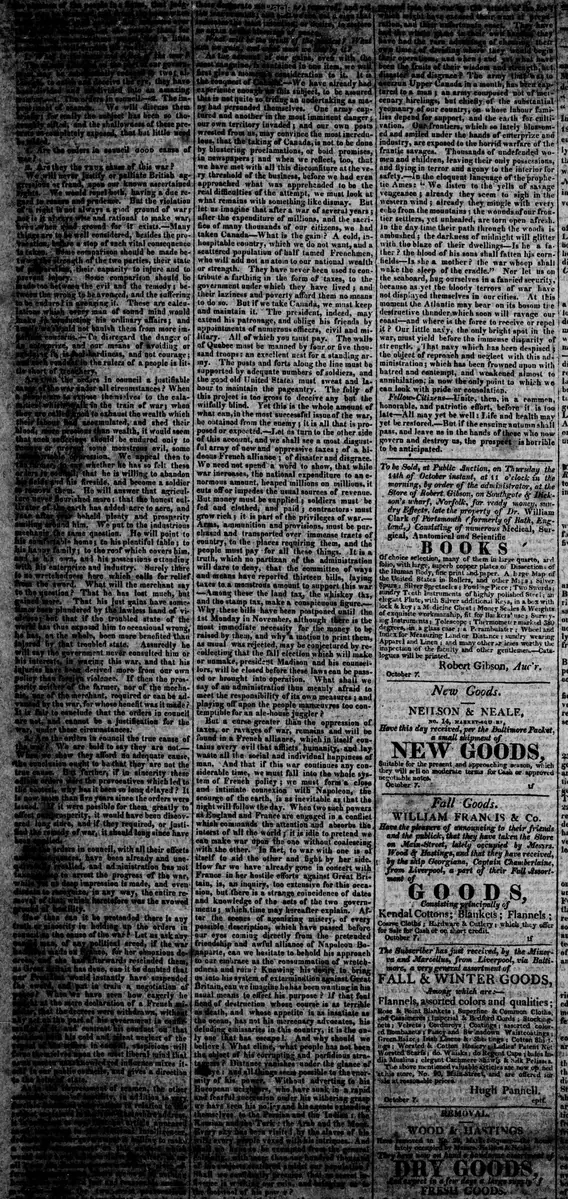
sounded, and the shrill voices of the captious have not been silent, but it would be flat to go over causes. The true cause of this war will never justify or palliate British aggression or fraud upon our known ascertained rights. We would repel both, having a due regard to decency and prudence. But the violation of right is not always a good ground of war; nor is it always wise and rational to make war, even when good ground for it exists. Many things to well considered, besides the protection of bare rights, or such vital consequence in taking it, some comparison should be made between the situation of the two parties, their state and their capacity to injure and to prevent injury. Some comparison should be made between the evil and the remedy: between the wrong to be avenged, and the suffering to endure in revenging it. These are calculations, which every man of sound mind should make, in directing his ordinary affairs; and we would not banish them from more important concerns. To disregard the danger of error and our means of avoiding or abiding it, is hardiness, and not courage; which candor in the rulers of a people is little short of treachery. Are then the orders in council a justifiable cause of the war under all circumstances? When people are alert to themselves to the calamities in the train of wars, when they are called on to exhaust the wealth which their industry has accumulated, and shed their blood in support of British wealth, it would seem that such hazards should be endured only to remove or prevent some monstrous evil, some intolerable oppression. We appeal then to this farmer, any whether he has so felt these pressures so invasively that he is willing to abandon his held and his fireside, and become a soldier to remove them. How will answer that agriculture never flourished more, that the honest cultivator of the earth has added acre to acre, and greater he beholds plenty and prosperity around him. We put to the industrious mechanic the same question. How will he point to comfort at his plentiful table; to his happy family; to the roof which covers him, safe and his possessions extending with his enterprise and industry. Surely there is no wretchedness here which calls for relief from the sword. What will the merchant say to the question? That he has lost much, but more that his just gains have been plundered by the lawless hand of violence, but that if the troubled state of the world has thus exposed him to occasional wrong, he has on the whole, been more benefited than hurt by that troubled state. Assuredly he will say the government never consulted him or his interests in waging this war, and that he has derived more from our own policy than from foreign violence. If then the prosperity either of the farmer nor of the mechanic, nor of the merchant, required or can be aided by the war, for whose benefit was it made? It is fair to conclude that the orders in council cannot be a justification, for the war under these circumstances. Are the orders in council the true cause of the war? We are bold to say they are not, nor do they afford no adequate cause. Our conclusion ought to be that they are not the true cause. But further, if in sincerity these were the provocatives which led to the contest, why has it been so long delayed? It is now more than five years since the orders were issued. If it were possible for them greatly to affect our prosperity, it would have been discovered long since, and if they required, or justified the remedy of war, it should long since have been resorted to. Orders in council with all their effects ceased, have been already and unnecessarily administered has not got arrest the progress of the war. While no impression is made, and even while they to recognize in any way, the entire repeal but which heretofore was the avowed ground. Can it be pretended there is any truth in holding up the orders in council as cause of the war. Let us ask any man of political creed, if the war ended on once, for her obnoxious decrees afterwards rescinded them. Great Britain has done, can it be doubted the war would instantly have suspended. Spain trains as negotiation of peace. When we have seen how eagerly the British government seized on the declaration of a French war, when the decrees were withdrawn, without regard or remembrance of former controversies, contrast the conduct of that cold and calculating ministry of the concessions suspicious mind that must acknowledge influence mixes it. Our policy ought to demand gives a direction to calm counsel men the exotic state relation to their rights no ordinary stake nor ultimate make.
sounded, and the shrill voices of the captious have not been silent, but it would be flat to go over causes. The true cause of this war will never justify or palliate British aggression or fraud upon our known ascertained rights. We would repel both, having a due regard to decency and prudence. But the violation of right is not always a good ground of war; nor is it always wise and rational to make war, even when good ground for it exists. Many things to well considered, besides the protection of bare rights, or such vital consequence in taking it, some comparison should be made between the situation of the two parties, their state and their capacity to injure and to prevent injury. Some comparison should be made between the evil and the remedy: between the wrong to be avenged, and the suffering to endure in revenging it. These are calculations, which every man of sound mind should make, in directing his ordinary affairs; and we would not banish them from more important concerns. To disregard the danger of error and our means of avoiding or abiding it, is hardiness, and not courage; which candor in the rulers of a people is little short of treachery. Are then the orders in council a justifiable cause of the war under all circumstances? When people are alert to themselves to the calamities in the train of wars, when they are called on to exhaust the wealth which their industry has accumulated, and shed their blood in support of British wealth, it would seem that such hazards should be endured only to remove or prevent some monstrous evil, some intolerable oppression. We appeal then to this farmer, any whether he has so felt these pressures so invasively that he is willing to abandon his held and his fireside, and become a soldier to remove them. How will answer that agriculture never flourished more, that the honest cultivator of the earth has added acre to acre, and greater he beholds plenty and prosperity around him. We put to the industrious mechanic the same question. How will he point to comfort at his plentiful table; to his happy family; to the roof which covers him, safe and his possessions extending with his enterprise and industry. Surely there is no wretchedness here which calls for relief from the sword. What will the merchant say to the question? That he has lost much, but more that his just gains have been plundered by the lawless hand of violence, but that if the troubled state of the world has thus exposed him to occasional wrong, he has on the whole, been more benefited than hurt by that troubled state. Assuredly he will say the government never consulted him or his interests in waging this war, and that he has derived more from our own policy than from foreign violence. If then the prosperity either of the farmer nor of the mechanic, nor of the merchant, required or can be aided by the war, for whose benefit was it made? It is fair to conclude that the orders in council cannot be a justification, for the war under these circumstances. Are the orders in council the true cause of the war? We are bold to say they are not, nor do they afford no adequate cause. Our conclusion ought to be that they are not the true cause. But further, if in sincerity these were the provocatives which led to the contest, why has it been so long delayed? It is now more than five years since the orders were issued. If it were possible for them greatly to affect our prosperity, it would have been discovered long since, and if they required, or justified the remedy of war, it should long since have been resorted to. Orders in council with all their effects ceased, have been already and unnecessarily administered has not got arrest the progress of the war. While no impression is made, and even while they to recognize in any way, the entire repeal but which heretofore was the avowed ground. Can it be pretended there is any truth in holding up the orders in council as cause of the war. Let us ask any man of political creed, if the war ended on once, for her obnoxious decrees afterwards rescinded them. Great Britain has done, can it be doubted the war would instantly have suspended. Spain trains as negotiation of peace. When we have seen how eagerly the British government seized on the declaration of a French war, when the decrees were withdrawn, without regard or remembrance of former controversies, contrast the conduct of that cold and calculating ministry of the concessions suspicious mind that must acknowledge influence mixes it. Our policy ought to demand gives a direction to calm counsel men the exotic state relation to their rights no ordinary stake nor ultimate make.
What sub-type of article is it?
War Or Peace
Foreign Affairs
Trade Or Commerce
What keywords are associated?
Orders In Council
War Justification
British Aggression
American Prosperity
Trade Impacts
War Of 1812
What entities or persons were involved?
British Government
Orders In Council
American Farmers
American Mechanics
American Merchants
U.S. Administration
Editorial Details
Primary Topic
Critique Of British Orders In Council As Justification For The War Of 1812
Stance / Tone
Opposition To The War, Arguing It Is Unjustified And Prosperity Unaffected
Key Figures
British Government
Orders In Council
American Farmers
American Mechanics
American Merchants
U.S. Administration
Key Arguments
Violation Of Rights Does Not Always Justify War; Consider Consequences And Comparisons
American Agriculture, Mechanics, And Trade Are Prosperous Despite Troubles
War Benefits No Major Sector Of Society
Orders In Council Not True Cause Due To Five Year Delay In War Declaration
Repeal Of Orders Would Likely End Hostilities, As Seen In Other Cases
True Motives Influenced By Political Intrigue Rather Than Genuine Provocations