Thank you for visiting SNEWPapers!
Sign up free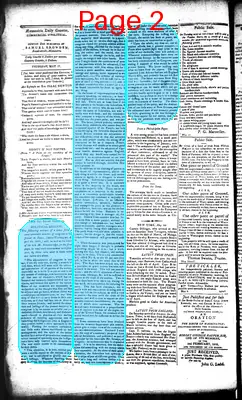
Editorial
May 17, 1810
Alexandria Daily Gazette, Commercial & Political
Alexandria, Virginia
What is this article about?
A 1810 letter from a U.S. Congress member critiques the session's failures, including the end of embargo and non-intercourse policies, party divisions, weakened military, and administration under Madison, expressing pessimism about national prospects amid tensions with England and France.
Clipping
OCR Quality
95%
Excellent
Full Text
FROM THE SALEM GAZETTE.
POLITICAL REVIEW.
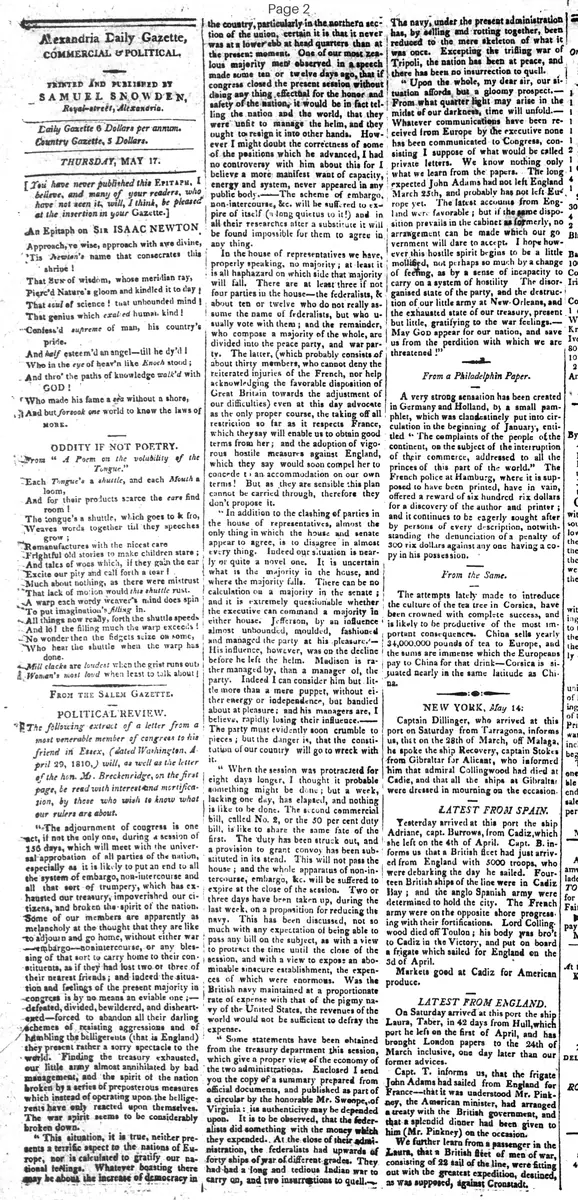
The following extract of a letter from a most venerable member of congress to his friend in Essex, (dated Washington, April 29, 1810,) will, as well as the letter of the hon. M. Breckenridge, on the first page, be read with interest and mortification, by those who wish to know what our rulers are about.
"The adjournment of congress is one act, if not the only one, during a session of 156 days, which will meet with the universal approbation of all parties of the nation, especially as it is likely to put an end to all the system of embargo, non-intercourse and all that sort of trumpery, which has exhausted our treasury, impoverished our citizens, and broken the spirit of the nation. Some of our members are apparently as melancholy at the thought that they are like to adjourn and go home, without either war-embargo-nonintercourse,or any blessing of that sort to carry home to their constituents, as if they had lost two or three of their nearest friends; and indeed the situation and feelings of the present majority in congress is by no means an enviable one; defeated, divided, bewildered, and disheartened-forced to abandon all their darling schemes of, resisting aggressions and of humbling the belligerents (that is England) they present rather a sorry spectacle to the world. Finding the treasury exhausted, our little army almost annihilated by bad management, and the spirit of the nation broken by a series of preposterous measures which instead of operating upon the belligerents have only reacted upon themselves. The war spirit seems to be considerably broken down.
"This situation, it is true, neither presents a terrific aspect to the nations of Europe, nor is calculated to gratify our national feelings. Whatever boasting there may be about the increase of democracy in the country, particularly in the northern section of the union, certain it is that it never was at a lower ebb at head quarters than at the present moment. 'One of our most zealous majority men' observed in a speech made some ten or twelve days ago, that if congress closed the present session without doing any thing effectual for the honor and safety of the nation, it would be in fact telling the nation and the world, that they were unfit to manage the helm, and they ought to resign it into other hands, However I might doubt the correctness of some of the positions which he advanced, I had no controversy with him about this for I believe a more manifest want of capacity, energy and system, never appeared in any public body. The scheme of embargo, non-intercourse, &c. will be suffered to expire of itself (a long quietus to it!) and in all their researches after a substitute it will be found impossible for them to agree in any thing:
In the house of representatives we have, properly speaking, no majority; at least it is all haphazard on which side that majority will fall. There are at least three if not four parties in the house-the federalists. & about ten or twelve who do not really assume the name of federalists, but who usually vote with them; and the remainder, who compose a majority of the whole, are divided into the peace party, and war party. The latter, (which probably consists of about thirty members, who cannot deny the reiterated injuries of the French, nor help acknowledging the favorable disposition of Great Britain towards the adjustment of our difficulties) even at this day advocate as the only proper course, the taking off all restriction so far as it respects France, which they say will enable us to obtain good terms from her; and the adoption of vigorous hostile measures against England, which they say would soon compel her to concede an accommodation on our own terms! But as they are sensible this plan cannot be carried through, therefore they don't propose it.
"In addition to the clashing of parties in the house of representatives, almost the only thing in which the house and senate appear to agree, is to disagree in almost every thing. Indeed our situation is nearly or quite a novel one. It is uncertain what is the majority in the house, and where the majority falls. There can be no calculation on a majority in the senate; and it is extremely questionable whether the executive can command a majority in either house: Jefferson, by an influence almost unbounded, moulded, fashioned and managed the party at his pleasure. His influence, however, was on the decline before he left the helm. Madison is rather managed by, than a manager of, the party. Indeed I can consider him but a little more than a mere puppet, without either energy or independence, but bandied about at pleasure; and his managers are, I believe, rapidly losing their influence. The party must evidently soon crumble to pieces; but the danger is, that the constitution of our country will go to wreck with it.
"When the session was protracted for eight days longer, I thought it probable something might be done; but a week, lacking one day, has elapsed, and nothing is like to be done. The second commercial bill, called No. 2. or the 50 per cent duty bill, is like to share the same fate of the first. The duty has been struck out, and a provision to grant convoy has been substituted in its stead. This will not pass the house: and the whole apparatus of non-intercourse. embargo, &c. will be suffered to expire at the close of the session. Two or three days have been taken up, during the last week, on a proposition for reducing the navy. This has been discussed, not so much with any expectation of being able to pass any bill on the subject, as with a view to protract the time until the close of the session, and with a view to expose an abominable sinecure establishment, the expenses of which were enormous. Was the British navy maintained at a proportionate rate of expense with that of the pigmy navy of the United States, the revenues of the world would not be sufficient to defray the expense.
Some statements have been obtained from the treasury department this session, which give a proper view of the economy of the two administrations. Enclosed I send you the copy of a summary prepared from official documents, and published as part of a circular by the honorable Mr. Swoope, of Virginia: its authenticity may be depended upon. It is to be observed, that the federalists did something with the money which they expended. At the close of their administration, the federalists had upwards of forty ships of war of different grades. They had had a long and tedious Indian war to carry on, and two insurrections to quell.
The navy, under the present administration has, by selling and rotting together, been reduced to the mere skeleton of what it was once. Excepting the trifling war of Tripoli, the nation has been at peace, and there has been no insurrection to quell.
"Upon the whole, my dear sir, our situation affords, but a gloomy prospect. From what quarter light may arise in the midst of our darkness, time will unfold. Whatever communications have been received from Europe by the executive none has been communicated to Congress, consisting I suppose of what would be called private letters. We know nothing only what we learn from the papers. The long expected John Adams had not left England March 25th, and probably has not left Europe yet. The latest accounts from England were favorable; but if the same disposition prevails in the cabinet as formerly, no arrangement can be made which our government will dare to accept. I hope however this hostile spirit begins to be a little mollified, not perhaps so much by a change of feeling, as by a sense of incapacity to carry on a system of hostility The disorganized state of the party, and the destruction of our little army at New Orleans, and the exhausted state of our treasury, present but little, gratifying to the war feelings. May God appear for our nation, and save us from the perdition with which we are threatened!"
POLITICAL REVIEW.
The following extract of a letter from a most venerable member of congress to his friend in Essex, (dated Washington, April 29, 1810,) will, as well as the letter of the hon. M. Breckenridge, on the first page, be read with interest and mortification, by those who wish to know what our rulers are about.
"The adjournment of congress is one act, if not the only one, during a session of 156 days, which will meet with the universal approbation of all parties of the nation, especially as it is likely to put an end to all the system of embargo, non-intercourse and all that sort of trumpery, which has exhausted our treasury, impoverished our citizens, and broken the spirit of the nation. Some of our members are apparently as melancholy at the thought that they are like to adjourn and go home, without either war-embargo-nonintercourse,or any blessing of that sort to carry home to their constituents, as if they had lost two or three of their nearest friends; and indeed the situation and feelings of the present majority in congress is by no means an enviable one; defeated, divided, bewildered, and disheartened-forced to abandon all their darling schemes of, resisting aggressions and of humbling the belligerents (that is England) they present rather a sorry spectacle to the world. Finding the treasury exhausted, our little army almost annihilated by bad management, and the spirit of the nation broken by a series of preposterous measures which instead of operating upon the belligerents have only reacted upon themselves. The war spirit seems to be considerably broken down.
"This situation, it is true, neither presents a terrific aspect to the nations of Europe, nor is calculated to gratify our national feelings. Whatever boasting there may be about the increase of democracy in the country, particularly in the northern section of the union, certain it is that it never was at a lower ebb at head quarters than at the present moment. 'One of our most zealous majority men' observed in a speech made some ten or twelve days ago, that if congress closed the present session without doing any thing effectual for the honor and safety of the nation, it would be in fact telling the nation and the world, that they were unfit to manage the helm, and they ought to resign it into other hands, However I might doubt the correctness of some of the positions which he advanced, I had no controversy with him about this for I believe a more manifest want of capacity, energy and system, never appeared in any public body. The scheme of embargo, non-intercourse, &c. will be suffered to expire of itself (a long quietus to it!) and in all their researches after a substitute it will be found impossible for them to agree in any thing:
In the house of representatives we have, properly speaking, no majority; at least it is all haphazard on which side that majority will fall. There are at least three if not four parties in the house-the federalists. & about ten or twelve who do not really assume the name of federalists, but who usually vote with them; and the remainder, who compose a majority of the whole, are divided into the peace party, and war party. The latter, (which probably consists of about thirty members, who cannot deny the reiterated injuries of the French, nor help acknowledging the favorable disposition of Great Britain towards the adjustment of our difficulties) even at this day advocate as the only proper course, the taking off all restriction so far as it respects France, which they say will enable us to obtain good terms from her; and the adoption of vigorous hostile measures against England, which they say would soon compel her to concede an accommodation on our own terms! But as they are sensible this plan cannot be carried through, therefore they don't propose it.
"In addition to the clashing of parties in the house of representatives, almost the only thing in which the house and senate appear to agree, is to disagree in almost every thing. Indeed our situation is nearly or quite a novel one. It is uncertain what is the majority in the house, and where the majority falls. There can be no calculation on a majority in the senate; and it is extremely questionable whether the executive can command a majority in either house: Jefferson, by an influence almost unbounded, moulded, fashioned and managed the party at his pleasure. His influence, however, was on the decline before he left the helm. Madison is rather managed by, than a manager of, the party. Indeed I can consider him but a little more than a mere puppet, without either energy or independence, but bandied about at pleasure; and his managers are, I believe, rapidly losing their influence. The party must evidently soon crumble to pieces; but the danger is, that the constitution of our country will go to wreck with it.
"When the session was protracted for eight days longer, I thought it probable something might be done; but a week, lacking one day, has elapsed, and nothing is like to be done. The second commercial bill, called No. 2. or the 50 per cent duty bill, is like to share the same fate of the first. The duty has been struck out, and a provision to grant convoy has been substituted in its stead. This will not pass the house: and the whole apparatus of non-intercourse. embargo, &c. will be suffered to expire at the close of the session. Two or three days have been taken up, during the last week, on a proposition for reducing the navy. This has been discussed, not so much with any expectation of being able to pass any bill on the subject, as with a view to protract the time until the close of the session, and with a view to expose an abominable sinecure establishment, the expenses of which were enormous. Was the British navy maintained at a proportionate rate of expense with that of the pigmy navy of the United States, the revenues of the world would not be sufficient to defray the expense.
Some statements have been obtained from the treasury department this session, which give a proper view of the economy of the two administrations. Enclosed I send you the copy of a summary prepared from official documents, and published as part of a circular by the honorable Mr. Swoope, of Virginia: its authenticity may be depended upon. It is to be observed, that the federalists did something with the money which they expended. At the close of their administration, the federalists had upwards of forty ships of war of different grades. They had had a long and tedious Indian war to carry on, and two insurrections to quell.
The navy, under the present administration has, by selling and rotting together, been reduced to the mere skeleton of what it was once. Excepting the trifling war of Tripoli, the nation has been at peace, and there has been no insurrection to quell.
"Upon the whole, my dear sir, our situation affords, but a gloomy prospect. From what quarter light may arise in the midst of our darkness, time will unfold. Whatever communications have been received from Europe by the executive none has been communicated to Congress, consisting I suppose of what would be called private letters. We know nothing only what we learn from the papers. The long expected John Adams had not left England March 25th, and probably has not left Europe yet. The latest accounts from England were favorable; but if the same disposition prevails in the cabinet as formerly, no arrangement can be made which our government will dare to accept. I hope however this hostile spirit begins to be a little mollified, not perhaps so much by a change of feeling, as by a sense of incapacity to carry on a system of hostility The disorganized state of the party, and the destruction of our little army at New Orleans, and the exhausted state of our treasury, present but little, gratifying to the war feelings. May God appear for our nation, and save us from the perdition with which we are threatened!"
What sub-type of article is it?
Partisan Politics
Foreign Affairs
Economic Policy
What keywords are associated?
Congressional Adjournment
Embargo System
Non Intercourse
Party Divisions
Foreign Policy Failures
Navy Reduction
Madison Administration
What entities or persons were involved?
Congress
Madison
Jefferson
Federalists
England
France
John Adams
Editorial Details
Primary Topic
Critique Of Congressional Session Failures And Foreign Policy
Stance / Tone
Critical And Pessimistic Of Democratic Republican Administration
Key Figures
Congress
Madison
Jefferson
Federalists
England
France
John Adams
Key Arguments
Adjournment Ends Ineffective Embargo And Non Intercourse Policies That Harmed The U.S.
Majority In Congress Is Divided, Defeated, And Unable To Agree On Measures.
War Party Advocates Hostility Toward England But Lacks Support.
Madison Lacks Influence And Energy Compared To Jefferson.
Navy Reduction Exposes Wasteful Spending Under Current Administration.
Federalist Administration Achieved More With Expenditures Despite Wars.
Gloomy National Prospects Amid European Tensions.