Thank you for visiting SNEWPapers!
Sign up free
Gazette Of The United States, & Philadelphia Daily Advertiser
Philadelphia, Philadelphia County, Pennsylvania
What is this article about?
In June 1799, Methlogey, a Creek Indian chief, delivers a message to James Seagrove expressing alarm over a US-Spanish boundary line threatening Creek lands and potential enslavement. Seagrove responds reassuring them that the line poses no harm to Indian territories and urges peace.
Merged-components note: Sequential components form a single continuous article on Indian discontents and U.S.-Spanish boundary line discussions.
Clipping
OCR Quality
Full Text
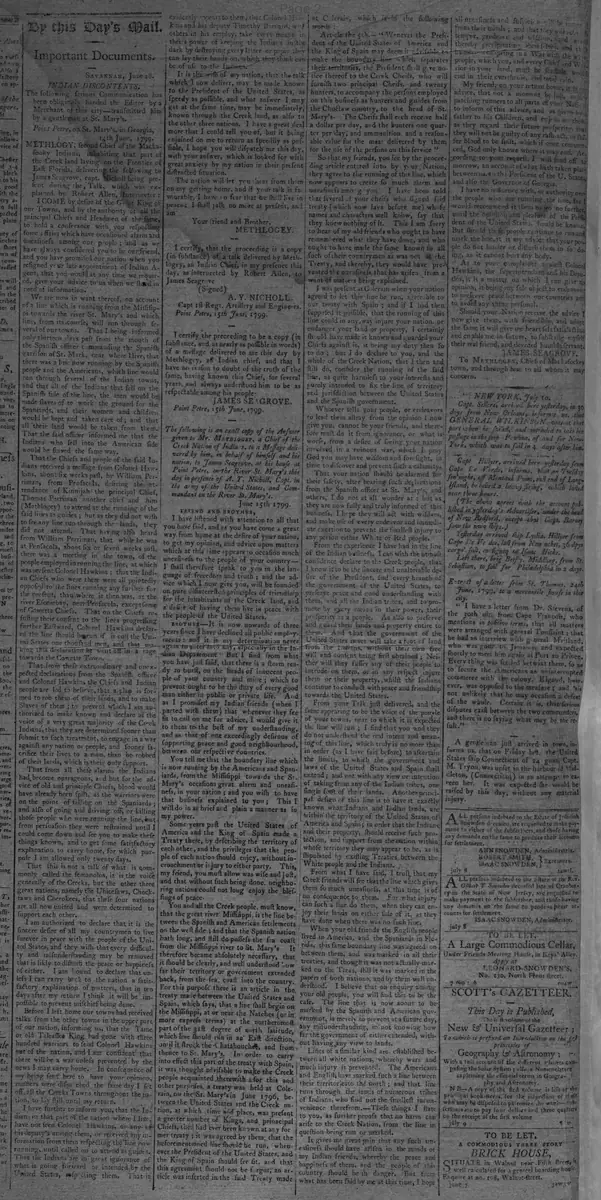
Important Documents.
SAVANNAH, June 28.
INDIAN DISCONTENTS.
The following serious Communication has been obligingly handed the Editor by a Merchant of this city—transmitted him by a gentleman at St. Mary's.
Point Petre, on St. Mary's, in Georgia,
18th June, 1799.
METHLOGEY, second Chief of the Mackaooky Indians, inhabiting that part of the Creek land lying on the Frontier of East Florida, delivering the following to James Seagrove, capt. Nicholl being present during the Talk, which was explained by Robert Allen, Interpreter:
I COME by desire of the Great King of our Towns, and by the authority of all the principal Chiefs and Headmen of the same, to hold a conference with you respecting some affairs which have occasioned alarm and uneasiness among our people; and as we have always considered you to be our friend, and you have promised our nation when you resigned your late appointment of Indian Agent, that you would at any time we required, give your advice to us when we stood in need of information.
We are now in want thereof, on account of a line which is running from the Mississippi towards the river St. Mary's and which line, from its course, will run through several of our towns. That I being informed only thirteen days past from the mouth of the Spanish officer commanding the Spanish garrison of St. Mark, near where I live, that there was a line now running by the Spanish people and the Americans, which line would run through several of the Indian towns, and that all of the Indians that fell on the Spanish side of the line, the men would be made slaves of to work the ground for the Spaniards, and their women and children would be kept and taken care of; and that all their land would be taken from them. That the said officer informed me that the Indians who fell into the American side would be served the same way.
That the Chiefs and people of the said Indians received a message from Colonel Hawkins, about six weeks past, by William Perryman, from Pensacola, desiring the attendance of Kinijah the principal Chief, Thomas Perryman another chief and him (Methlogey) to attend at the running of the said lines as guides; but as they did not wish to see any line run through the lands, they did not attend. That having also heard from William Perryman, that while he was at Pensacola, about six or seven weeks past, there was a meeting in the town, of the people employed in running the line, at which was present Colonel Hawkins; that the Indian Chiefs who were there were all pointedly opposed to the lines running any further for the present, than where it then was, at the river Escambia, near Pensacola, except some of Coweta Chiefs. That on the Chiefs refusing their consent to the lines progressing further Eastward, Colonel Hawkins declared the line should be run if it cost the United States one thousand men, and that making this declaration he went off in a rage towards the Coweta Town.
That from these extraordinary and unexpected declarations from the Spanish officer and Colonel Hawkins the Chiefs and Indian people are led to believe, that a plan is formed to rob them of their lands, and to make slaves of them; to prevent which I am authorized to make known and declare as the voice of a very great majority of the Creek Indians, that they are determined sooner than submit to such treatment, to engage in a war against any nation or people, and sooner sacrifice their lives to a man, than be robbed of their lands, which is their only support.
That from all these alarms the Indians had become outrageous, and but for the advice of old and principal Chiefs, blood would have already been spilt, as the warriors were on the point of falling on the Spaniards; and also of going and driving off, or killing those people who were running the line, but from persuasion they were restrained until I could come down and see you to make these things known, and to get some satisfactory explanation to carry home, for which purpose I am allowed only twenty days.
That this is not a talk of what is commonly called the femanolos, it is the voice generally of the Creeks, but the other three great nations, namely the Uchees, Choctaws and Cherokees, that these four nations are all now united and were determined to support each other.
I am authorized to declare that it is the sincere desire of all my countrymen to live forever in peace with the people of the United States, and they wish that every difficulty and misunderstanding may be removed that is likely to disturb the peace or happiness of either. I am bound to declare that unless I can carry back to the nation a satisfactory explanation of matters, that in ten days after my return I think it will be impossible to prevent mischief being done.
Before I left home our towns had received talks from the other towns in the upper part of our nation, informing us, that the Tame or old Talasse King had gone with three hundred warriors to send Colonel Hawkins out of the nation, and I am confident that there will be a war unless prevented by the news I may carry home. In consequence of my being sent here to have your opinion, runners were dispatched the same day I set off, all the Creek Towns throughout the nation, to stay still until my return.
I have further to inform you, that the Indians in that part of the nation where I live, have not seen Colonel Hawkins, or any of his deputy's among them, or received any information from them respecting the line now running, until called on to attend as guides.
That the Indians are in great ignorance of what is going forward or intended by the United States, respecting them, That it evidently means to them, that Colonel Hawkins and his deputy Timothy Barnard, with others in his employ, take every means in their power of keeping the Indians in the dark by destroying every letter or paper they can lay their hands on, which they think can be of use to the Indians.
It is the wish of my nation, that the talk which I now deliver, may be made known to the President of the United States, as speedy as possible, and what answer I may get at the same time, may be immediately known through the Creek land, as also to the other three nations. I have a great deal more that I could tell you of, but it being enjoined on me to return as speedily as possible, I hope you will dispatch me this day, with your answer, which is looked for with great anxiety by my nation in their present distracted situation.
The nation will let you hear from them on my getting home, and if your talk is favorable, I have no fear that we shall live in peace: I shall talk no more at present, and am
Your friend and Brother,
METHLOGEY.
I certify, that the proceeding is a copy (in substance) of a talk delivered by Methlogey, an Indian Chief, in my presence this day, as interpreted by Robert Allen, to James Seagrove
(Signed)
A. Y. NICHOLL.
Capt 1st Regt. Artillery and Engineers.
Point Petre, 15th June, 1799
I certify the preceding to be a copy (in substance, and, as nearly as possible in words of a message delivered to me this day by Methlogey, a said Indian chief, and that I have no reason to doubt of the truth of the same, having known this Chief, for several years, and always understood him to be as respectable among his people—
JAMES SEAGROVE.
Point Petre, 15th June, 1799.
The following is an exact copy of the Answer given to Mr. Methlogey, a Chief of the Creek Nation of Indians, to a Message delivered by him, in behalf of himself and his nation, to James Seagrove, at his house at Point Petre, on the River St. Mary's this day in presence of A. Y. Nicholl, Capt. in the army of the United States, and Commandant on the River St. Mary's.
June 15th 1799.
FRIEND AND BROTHER,
I have listened with attention to all that you have said, and as you have come a great way from home at the desire of your nation, to get my opinion, and advice upon matters which at this time appears to occasion much uneasiness to the people of your country— I shall therefore speak to you in the language of freedom and truth : and the advice which I now give you, will be founded on pure disinterested principles of friendship for the inhabitants of the Creek land, and a desire of having them live in peace with the people of the United States.
BROTHER—It is now upwards of three years since I have declined all public employment: and it is my determination never again to enter into any, especially in the Indian Department. But I find from what you have just said, that there is a storm ready to burst, on the heads of innocent people of your country and mine ; which to prevent ought to be the duty of every good man either in public or private life. And as I promised my Indian friends (when I parted with them) that whenever they see fit to call on me for advice, I would give it to them to the best of my understanding, and as that of one exceedingly desirous of supporting peace and good neighbourhood, between our respective countries.
You tell me that the boundary line which is now running by the Americans and Spaniards, from the Mississippi towards the St. Mary's occasions great alarm and uneasiness, in your nation ; and you wish to have that business explained to you; This I will do in as brief and plain a manner as in my power.
Some years past the United States of America and the King of Spain made a Treaty between them, by describing the territory of each other, and the privileges that the people of each nation should enjoy, without encroachment or injury to either party. This, my friend, you must allow was wise and just, and that without such being done, neighboring nations could not long enjoy the blessings of peace.
You and all the Creek people, must know, that the great river Mississippi, is the line between the Spanish and American settlements on the west side ; and that the Spanish nation hath long, and still do possess the sea coast from this Mississippi river to St. Mary's It therefore became absolutely necessary, that it should be clearly, and well understood how far their territory or government extended back, from the sea, coast into the country.
For this purpose there is an article in the treaty made between the United States and Spain, which says, that a line shall begin on the Mississippi, at or near the Natches (or in more express terms) at the northernmost part of the 31st degree of north latitude, which line should run in an East direction, until it struck the Chatahouche, and from thence to St. Mary's. In order to carry into effect this part of the treaty with Spain, it was thought advisable to make the Creek people acquainted therewith : for this and other purposes. a treaty was held at Colerain, on the St. Mary's in June 1796, between the United States and the Creek nation, at which time and place, was present a greater number of Kings, and principal Chiefs, then had ever been known at any former treaty ; it was agreed by them, that the beforementioned line should be run, whenever the President of the United States, and the King of Spain should see fit, and that this agreement should not be forgot, an article was inserted in the said Treaty made at Colerain, which is in the following words:
Article the 5th.— "Whenever the President of the United States of America and the King of Spain may deem it advisable to make the boundary line which separates their territories, the President will give notice thereof to the Creek Chiefs, who will furnish two principal Chiefs, and twenty hunters, to accompany the persons employed on this business as hunters and guides from the Choctaw country, to the head of St. Mary's— The Chiefs shall each receive half a dollar per day, and the hunters one quarter per day, and ammunition. and a reasonable value for the meat delivered by them for the use of the persons on this service"
So that my friends, you see by the preceding article entered into by your Nation, they agree to the running of this line, which now appears to create so much alarm and uneasiness among you. I have been told that several of your chiefs who signed said treaty (which now lays before me) whose names and characters well known, say that they knew nothing of it. This I am sorry to hear of my old friends who ought to have remembered what they have done, and who ought to have made the same known to all such of their countrymen as was not at the Treaty, and thereby, they would have prevented the uneasiness that has arisen from a want of matters being explained.
I was present at Colerain when your nation agreed to let this line be run, agreeable to our treaty with Spain ; and if I had then supposed it possible, that the running of this line could in any, way injure your nation. or endanger your land or property, I certainly should have made it known and guarded your Chiefs against it, it being my duty then so to do ; but I do declare to you, and the whole of the Creek Nation, that I then and still do, consider the running of the said line, as quite harmless to your interests and purely intended to fix the line of territory and jurisdiction between the United States and the Spanish government.
Whoever tells your people, or endeavors to lead them astray from the opinion I now give you, cannot be your friends, and therefore must do it from ignorance, or what is worse, from a desire of seeing your nation involved in a ruinous war, which I pray God you may have wisdom and foresight, in time to discover and prevent such a calamity.
That your nation should be alarmed for their safety, after hearing such declarations from the Spanish officer at St. Mary's, and others, I do not at all wonder at : but as they are now fully and truly informed of this business, I hope they will act with wisdom, and make use of every endeavor and immediate exertion to prevent the smallest injury to any person either White or Red people.
From the experience I have had in the line of the Indian business, I can with the utmost confidence declare to the Creek people, that I know it to be the sincere and unalterable desire of the President, and every branch of the government of the United States, to preserve peace and good understanding with them, and all the Indian tribes, and to promote by every means in their power, their prosperity as a people. As also to preserve and guard their lands and property entire to them. And that the government of the United States never will take a foot of land from the Indians, without their own free will and consent being first obtained ; Neither will they suffer any of their people to intrude on them, or in any respect injure them or their property, whilst the Indians continue to conduct with peace and friendship toward the United States.
From your Talk just delivered, and the same appearing to be the voice of the people of your towns, near to which it is expected the line will run ; I find that you and they do not understand the real intent and meaning of this line, which truly is no more than in order (as I have said before) to ascertain the limits, to which the government and laws of the United States and Spain shall extend; and not with any view or intention of taking from any of the Indian tribes, one single foot of their lands. Another principal design of this line is to have it exactly known what Indians and Indian lands, are within' the territory of the United States of America and Spain; in order that the Indians. and their property, should receive such protection, and support from the nation within; whose territory they may appear to be, as is stipulated by existing Treaties between the White people and the Indians.
From what I have said, I trust that my Creek friends will see that the line which gives them so much uneasiness, at this time is of no consequence to them. For what injury can such a line do them, when they can enjoy their lands on either side of it, as they have done when there was no such line.
When your old friends the English people lived in America, and the Spaniards in Florida, this same boundary line was agreed on between them, and was marked in all their treaties, and though it was not actually marked on the Trees, till it was marked in the papers of both nations, and by them well understood. I believe that on enquiry among your old people, you will find this to be the case. The line that is now about to be marked by the Spanish and American government, is merely to prevent at a future day, any misunderstanding, in not knowing how far the government of either extended, without having any view to lands.
Lines of a similar kind are established between all white nations, whereby wars and much injury is prevented. The Americans and English have marked such a line between their territories to the north ; and that line runs through the lands of numerous tribes of Indians, who find not the smallest inconvenience therefrom.—These things I state to you, as further proofs that no harm can arise to the Creek Nation, from the line in question being run or marked.
It gives me great pain that any such uneasiness should have arisen in the minds of my Indian friends, whereby the peace and happiness of them, and the people of this country should be in danger. But from what has been said by me at this time, I hope all uneasiness and suspicion be removed from their minds; and that they will act with temper, prudence and wisdom, and avoid thereby precipitating themselves, and their numerous offspring in a War with the white people, which you, and every Chief and Warrior in your land, must be sensible would end in their overthrow, and total ruin.
My friend, on your return home, it is my advice, that not a moment be lost, in dispatching runners to all parts of your Nation to inform of this advice, and as given by a father to his Children, and enjoin on them as they regard their future prosperity, that they will not be guilty of any rash act. or suffer blood to be spilt, which if once commenced, God only knows where it may end.
According to your request, I will send off to morrow, an account of what hath taken place between us, to the President of the U. States and also the Governor of Georgia. I have no influence with, or authority over the people who are running the line, for I would recommend it them to go no further. until the opinion and pleasure of the President of the United States, should be known. But should these people continue to run and mark the line, it is my advice that your people do not hinder or disturb them in so doing, as. it cannot hurt any body.
As to your complaints against Colonel Hawkins, the superintendent and his Deputies, it is a matter on which I can give no opinion, it being my sole object to endeavor to preserve peace between our countries and to avoid any thing personal.
Should your Nation receive. the advice I now give them, with friendship, and adopt the same it will give me heart felt satisfaction and enable me in future, to subscribe myself their real friend, and devoted humble servant.
JAMES SEAGROVE.
To Methlogy, Chief of Mackaooky town, and through him to all whom it may concern.
What sub-type of article is it?
What keywords are associated?
What entities or persons were involved?
Where did it happen?
Domestic News Details
Primary Location
Point Petre, On St. Mary's, In Georgia
Event Date
18th June, 1799
Key Persons
Outcome
no immediate casualties; potential war averted through reassurance and advice to maintain peace; line running continues without indian interference recommended.
Event Details
Methlogey delivers a talk on behalf of Creek chiefs expressing fears over a US-Spanish boundary line running through Indian lands, based on reports of enslavement threats from Spanish officer and aggressive statements by Colonel Hawkins. Creeks threaten war if lands are taken. Seagrove explains the line's purpose per treaties, assures no harm to Indian lands, and advises against violence to preserve peace.