Thank you for visiting SNEWPapers!
Sign up free
Story
July 18, 1851
The Liberator
Boston, Suffolk County, Massachusetts
What is this article about?
An Anti-Slavery Convention at Foxboro' on July 14, presided by Edmund Quincy, featured speeches by Parker Pillsbury, Rev. Edwin Thompson, Rev. Mr. Slade, G.W. Putnam, and Lewis Ford, condemning churches' support for slavery and urging moral action against it.
Clipping
OCR Quality
98%
Excellent
Full Text
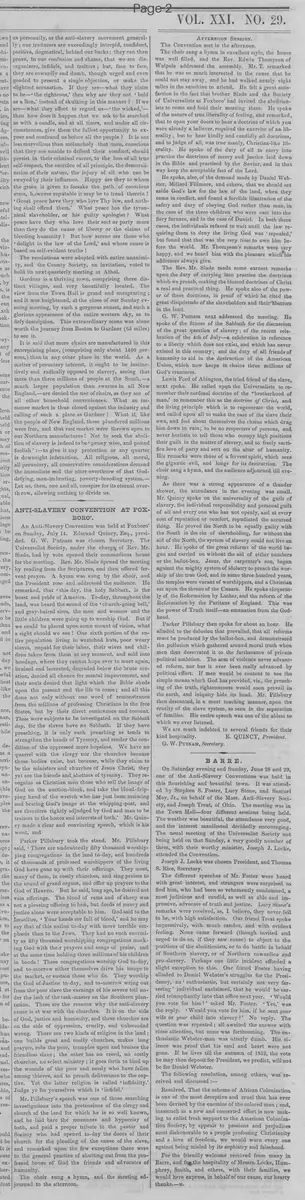
ANTI-SLAVERY CONVENTION AT FOXBORO'.
An Anti-Slavery Convention was held at Foxboro' on Sunday, July 14. Edmund Quincy, Esq., presided. G. W. Putnam was chosen Secretary. The Universalist Society, under the charge of Rev. Mr. Slade, had by vote opened their commodious house for the meeting. Rev. Mr. Slade opened the meeting by reading from the Scriptures, and then offered fervent prayer. A hymn was sung by the choir, and the President rose and addressed the audience. He remarked, that 'this day, the holy Sabbath, is the boast and pride of America. To-day, throughout the land, was heard the sound of the 'church-going bell,' and gray-haired sires, the men and women and the little children were going up to worship God. But if we could be placed upon some mount of vision, what a sight should we see! One sixth portion of the entire population living in wretched huts, poor weary slaves, unpaid for their labor, their wives and children taken from them at any moment, and sold into bondage, where they cannot hope ever to meet again, bruised and lacerated, degraded below the brute creation, denied all chance for mental improvement, and their souls denied that light which the Bible sheds upon the present and the life to come; and all this done not only without one word of remonstrance from the millions of professing Christians in the free States, but by their direct connivance and consent. These were subjects to be investigated on the Sabbath day, for the slaves have no Sabbath. If they have preaching, it is only such preaching as tends to strengthen the hands of Tyranny, and render the condition of the oppressed more hopeless. We have no quarrel with the clergy nor the churches because those bodies exist, but because, while they claim to be the ministers and churches of Jesus Christ, they yet are the friends and abettors of tyranny. They recognize as Christian men those who sell the image of God on the auction-block, and take the blood-dripping hand of the wretch who has just been maiming and beating God's image at the whipping-post, and are therefore rightly adjudged by God and man to be traitors to the honor and interests of both.' Mr. Quincy made a clear and convincing speech, which is his wont, and
Parker Pillsbury took the stand. Mr. Pillsbury said, There are undoubtedly fifty thousand worshipping congregations in the land to-day, and hundreds of thousands of professed worshippers of the living God have gone up with their offerings. They meet, many of them, in costly churches, and sing praises to the sound of grand organs, and offer up prayers to the God of Heaven. But he said, long ago, he desired not vain offerings. The blood of rams and of sheep was not a pleasing offering to him, but deeds of mercy and justice alone were acceptable to him. God said to the Israelites, 'Your hands are full of blood,' and he may say that of this nation to-day with more terrible emphasis than to the Jews. They had no such enormity as fifty thousand worshipping congregations mocking God with their prayers and songs of praise, and at the same time holding three millions of his children in bonds! These congregations worship God to-day, and to-morrow either themselves drive his image to the market, or sustain those who do. They worship the God of Justice to-day, and to-morrow wring out from the poor slave the earnings of his severe toil under the lash of the task-master on the Southern plantation. These are the reasons why the anti-slavery cause is at war with the churches. It is on the side of God, justice and humanity, and these churches are on the side of oppression, cruelty, and unbounded wrong. There are two kinds of religion in the land; one builds great and costly churches, makes long prayers, robs the poor, tramples upon and bruises the friendless slave; the other has no creed, no costly churches, no select ministry; it goes forth to bind up the wounds of the poor and needy who have fallen among thieves, and to preach deliverance to the captive. Yet the latter religion is called 'infidelity.' Judge ye for yourselves which is 'infidel.'
Mr. Pillsbury's speech was one of those searching investigations into the pretensions of the clergy and church of the land for which he is so well known, and he laid bare the meanness and hypocrisy of both, and paid a proper tribute to the pastor and Society who had opened to-day the doors of their church for the pleading of the cause of the slave, and remarked upon the few exceptions there were to the general practice of shutting out from the professed house of God the friends and advocates of humanity.
The choir sung a hymn, and the meeting adjourned to the afternoon.
Afternoon Session.
The Convention met in the afternoon. The choir sang a hymn in excellent style, the house was well filled, and the Rev. Edwin Thompson of Walpole addressed the assembly. Mr. T. remarked that he was so much interested in the cause that he could not stay away, and he had walked nearly eight miles in the sunshine to attend. He felt a great satisfaction in the fact that brother Slade and the Society of Universalists at Foxboro' had invited the abolitionists to come and hold their meeting there. He spoke of the nature of true liberality of feeling, and remarked, that to open your doors to hear a doctrine of which you were already a believer, required the exercise of no liberality; but to hear kindly and candidly all doctrines, and to judge of all, was true manly, Christian-like liberality. He spoke of the duty of all to carry into practice the doctrines of mercy and justice laid down in the Bible and practised by the Savior, and in that way keep the acceptable fast of the Lord.
He spoke, also, of the demand made by Daniel Webster, Millard Fillmore, and others, that we should set aside God's law for the law of the land, when they came in conflict, and found a forcible illustration of the safety and duty of obeying God rather than man, in the case of the three children who were cast into the fiery furnace, and in the case of Daniel. In both these cases, the individuals refused to wait until the law requiring them to deny the living God was 'repealed,' but found that that was the very time to own him before the world. Mr. Thompson's remarks were very happy, and we heard him with the pleasure which his addresses always give.
The Rev. Mr. Slade made some earnest remarks upon the duty of carrying into practice the doctrines which we preach, making the blessed doctrines of Christ a real and practical thing. He spoke also of the power of these doctrines, in proof of which he cited the great disquietude of the slaveholders and their abettors in the land.
G. W. Putnam next addressed the meeting. He spoke of the fitness of the Sabbath for the discussion of the great question of slavery; of the recent celebration of the 4th of July--a celebration in reference to a liberty which does not exist, and which has never existed in this country; and the duty of all friends of humanity to aid in the destruction of the American Union, which now keeps in chains three millions of God's creatures.
Lewis Ford of Abington, the tried friend of the slave, next spoke. He called upon the Universalists to remember their cardinal doctrine of the 'brotherhood of man,' to remember this as the doctrine of Christ, and the living principle which is to regenerate the world, and called upon all to make the case of the slave their own, and feel about themselves the chains which drag him down to ruin; to be no respecters of persons, and never hesitate to tell those who occupy high positions their guilt in the matter of slavery, and to freely sacrifice love of party and sect on the altar of humanity. His remarks were those of a fervent spirit, which sees the gigantic evil, and longs for its destruction. The choir sang a hymn, and the audience adjourned till evening.
As there was a strong appearance of a thunder shower, the attendance in the evening was small. Mr. Quincy spoke on the universality of the guilt of slavery, the individual responsibility and personal guilt of all and every one who has not openly, and at every cost of reputation or comfort, repudiated the accursed thing. He proved the North to be equally guilty with the South in the sin of slaveholding, for without the aid of the North, the system of slavery could not live an hour. He spoke of the great reforms of the world begun and carried on without the aid of either numbers or the ballot-box. Jesus, the carpenter's son, began against the mighty system of idolatry to preach the worship of the true God, and in some three hundred years, the temples were vacant of worshippers, and a Christian sat upon the throne of the Caesars. He spoke eloquently of the Reformation by Luther, and the reform of the Reformation by the Puritans of England. This was the power of Truth itself--an emanation from the Godhead.
Parker Pillsbury then spoke for about an hour. He alluded to the delusion that prevailed, that all reforms must be produced by the ballot-box, and demonstrated the pollution which gathered around moral truth when men thus desecrated it to the furtherance of private political ambition. The arm of violence never advanced reform, nor has it ever been really advanced by political effort. If men would be content to use the simple means which God has provided, viz., the preaching of the truth, righteousness would soon prevail in the earth, and iniquity hide its head. Mr. Pillsbury then descanted, in a most touching manner, upon the cruelty of the slave system, as seen in the separation of families. His entire speech was one of the ablest to which we ever listened.
We are much indebted to several friends for their kind hospitality.
E. QUINCY, President.
G. W. PUTNAM, Secretary.
An Anti-Slavery Convention was held at Foxboro' on Sunday, July 14. Edmund Quincy, Esq., presided. G. W. Putnam was chosen Secretary. The Universalist Society, under the charge of Rev. Mr. Slade, had by vote opened their commodious house for the meeting. Rev. Mr. Slade opened the meeting by reading from the Scriptures, and then offered fervent prayer. A hymn was sung by the choir, and the President rose and addressed the audience. He remarked, that 'this day, the holy Sabbath, is the boast and pride of America. To-day, throughout the land, was heard the sound of the 'church-going bell,' and gray-haired sires, the men and women and the little children were going up to worship God. But if we could be placed upon some mount of vision, what a sight should we see! One sixth portion of the entire population living in wretched huts, poor weary slaves, unpaid for their labor, their wives and children taken from them at any moment, and sold into bondage, where they cannot hope ever to meet again, bruised and lacerated, degraded below the brute creation, denied all chance for mental improvement, and their souls denied that light which the Bible sheds upon the present and the life to come; and all this done not only without one word of remonstrance from the millions of professing Christians in the free States, but by their direct connivance and consent. These were subjects to be investigated on the Sabbath day, for the slaves have no Sabbath. If they have preaching, it is only such preaching as tends to strengthen the hands of Tyranny, and render the condition of the oppressed more hopeless. We have no quarrel with the clergy nor the churches because those bodies exist, but because, while they claim to be the ministers and churches of Jesus Christ, they yet are the friends and abettors of tyranny. They recognize as Christian men those who sell the image of God on the auction-block, and take the blood-dripping hand of the wretch who has just been maiming and beating God's image at the whipping-post, and are therefore rightly adjudged by God and man to be traitors to the honor and interests of both.' Mr. Quincy made a clear and convincing speech, which is his wont, and
Parker Pillsbury took the stand. Mr. Pillsbury said, There are undoubtedly fifty thousand worshipping congregations in the land to-day, and hundreds of thousands of professed worshippers of the living God have gone up with their offerings. They meet, many of them, in costly churches, and sing praises to the sound of grand organs, and offer up prayers to the God of Heaven. But he said, long ago, he desired not vain offerings. The blood of rams and of sheep was not a pleasing offering to him, but deeds of mercy and justice alone were acceptable to him. God said to the Israelites, 'Your hands are full of blood,' and he may say that of this nation to-day with more terrible emphasis than to the Jews. They had no such enormity as fifty thousand worshipping congregations mocking God with their prayers and songs of praise, and at the same time holding three millions of his children in bonds! These congregations worship God to-day, and to-morrow either themselves drive his image to the market, or sustain those who do. They worship the God of Justice to-day, and to-morrow wring out from the poor slave the earnings of his severe toil under the lash of the task-master on the Southern plantation. These are the reasons why the anti-slavery cause is at war with the churches. It is on the side of God, justice and humanity, and these churches are on the side of oppression, cruelty, and unbounded wrong. There are two kinds of religion in the land; one builds great and costly churches, makes long prayers, robs the poor, tramples upon and bruises the friendless slave; the other has no creed, no costly churches, no select ministry; it goes forth to bind up the wounds of the poor and needy who have fallen among thieves, and to preach deliverance to the captive. Yet the latter religion is called 'infidelity.' Judge ye for yourselves which is 'infidel.'
Mr. Pillsbury's speech was one of those searching investigations into the pretensions of the clergy and church of the land for which he is so well known, and he laid bare the meanness and hypocrisy of both, and paid a proper tribute to the pastor and Society who had opened to-day the doors of their church for the pleading of the cause of the slave, and remarked upon the few exceptions there were to the general practice of shutting out from the professed house of God the friends and advocates of humanity.
The choir sung a hymn, and the meeting adjourned to the afternoon.
Afternoon Session.
The Convention met in the afternoon. The choir sang a hymn in excellent style, the house was well filled, and the Rev. Edwin Thompson of Walpole addressed the assembly. Mr. T. remarked that he was so much interested in the cause that he could not stay away, and he had walked nearly eight miles in the sunshine to attend. He felt a great satisfaction in the fact that brother Slade and the Society of Universalists at Foxboro' had invited the abolitionists to come and hold their meeting there. He spoke of the nature of true liberality of feeling, and remarked, that to open your doors to hear a doctrine of which you were already a believer, required the exercise of no liberality; but to hear kindly and candidly all doctrines, and to judge of all, was true manly, Christian-like liberality. He spoke of the duty of all to carry into practice the doctrines of mercy and justice laid down in the Bible and practised by the Savior, and in that way keep the acceptable fast of the Lord.
He spoke, also, of the demand made by Daniel Webster, Millard Fillmore, and others, that we should set aside God's law for the law of the land, when they came in conflict, and found a forcible illustration of the safety and duty of obeying God rather than man, in the case of the three children who were cast into the fiery furnace, and in the case of Daniel. In both these cases, the individuals refused to wait until the law requiring them to deny the living God was 'repealed,' but found that that was the very time to own him before the world. Mr. Thompson's remarks were very happy, and we heard him with the pleasure which his addresses always give.
The Rev. Mr. Slade made some earnest remarks upon the duty of carrying into practice the doctrines which we preach, making the blessed doctrines of Christ a real and practical thing. He spoke also of the power of these doctrines, in proof of which he cited the great disquietude of the slaveholders and their abettors in the land.
G. W. Putnam next addressed the meeting. He spoke of the fitness of the Sabbath for the discussion of the great question of slavery; of the recent celebration of the 4th of July--a celebration in reference to a liberty which does not exist, and which has never existed in this country; and the duty of all friends of humanity to aid in the destruction of the American Union, which now keeps in chains three millions of God's creatures.
Lewis Ford of Abington, the tried friend of the slave, next spoke. He called upon the Universalists to remember their cardinal doctrine of the 'brotherhood of man,' to remember this as the doctrine of Christ, and the living principle which is to regenerate the world, and called upon all to make the case of the slave their own, and feel about themselves the chains which drag him down to ruin; to be no respecters of persons, and never hesitate to tell those who occupy high positions their guilt in the matter of slavery, and to freely sacrifice love of party and sect on the altar of humanity. His remarks were those of a fervent spirit, which sees the gigantic evil, and longs for its destruction. The choir sang a hymn, and the audience adjourned till evening.
As there was a strong appearance of a thunder shower, the attendance in the evening was small. Mr. Quincy spoke on the universality of the guilt of slavery, the individual responsibility and personal guilt of all and every one who has not openly, and at every cost of reputation or comfort, repudiated the accursed thing. He proved the North to be equally guilty with the South in the sin of slaveholding, for without the aid of the North, the system of slavery could not live an hour. He spoke of the great reforms of the world begun and carried on without the aid of either numbers or the ballot-box. Jesus, the carpenter's son, began against the mighty system of idolatry to preach the worship of the true God, and in some three hundred years, the temples were vacant of worshippers, and a Christian sat upon the throne of the Caesars. He spoke eloquently of the Reformation by Luther, and the reform of the Reformation by the Puritans of England. This was the power of Truth itself--an emanation from the Godhead.
Parker Pillsbury then spoke for about an hour. He alluded to the delusion that prevailed, that all reforms must be produced by the ballot-box, and demonstrated the pollution which gathered around moral truth when men thus desecrated it to the furtherance of private political ambition. The arm of violence never advanced reform, nor has it ever been really advanced by political effort. If men would be content to use the simple means which God has provided, viz., the preaching of the truth, righteousness would soon prevail in the earth, and iniquity hide its head. Mr. Pillsbury then descanted, in a most touching manner, upon the cruelty of the slave system, as seen in the separation of families. His entire speech was one of the ablest to which we ever listened.
We are much indebted to several friends for their kind hospitality.
E. QUINCY, President.
G. W. PUTNAM, Secretary.
What sub-type of article is it?
Historical Event
Heroic Act
What themes does it cover?
Justice
Moral Virtue
Bravery Heroism
What keywords are associated?
Anti Slavery Convention
Foxboro Meeting
Abolitionist Speeches
Church Hypocrisy
Slavery Critique
Moral Reform
What entities or persons were involved?
Edmund Quincy
G. W. Putnam
Rev. Mr. Slade
Parker Pillsbury
Rev. Edwin Thompson
Lewis Ford
Where did it happen?
Foxboro'
Story Details
Key Persons
Edmund Quincy
G. W. Putnam
Rev. Mr. Slade
Parker Pillsbury
Rev. Edwin Thompson
Lewis Ford
Location
Foxboro'
Event Date
Sunday, July 14
Story Details
The convention opened with prayer and hymns in the Universalist church. Speakers including Quincy and Pillsbury criticized churches' complicity in slavery, emphasized moral duty over political action, and called for abolition, highlighting slavery's cruelties and northern guilt.