Thank you for visiting SNEWPapers!
Sign up free
Literary
February 10, 1892
Mower County Transcript
Austin, Lansing, Mower County, Minnesota
What is this article about?
Rev. Samuel A. Barnett reflects on his world travels in The Nineteenth Century, observing diverse civilizations: India's poverty and conquest, China's stalled progress, Japan's courtesy and energy without religion, and America's aggressive individualism with a promising future. He gains a firmer belief in humanity.
Clipping
OCR Quality
98%
Excellent
Full Text
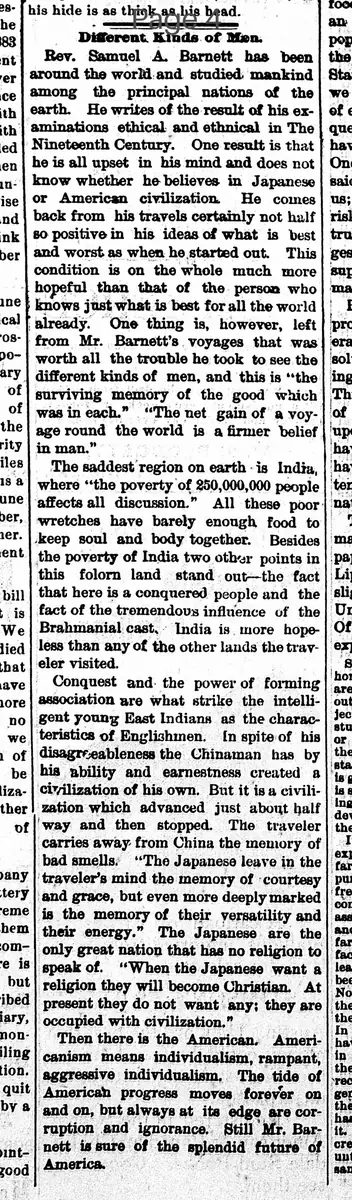
Different Kinds of Men:
Rev. Samuel A. Barnett has been around the world and studied mankind among the principal nations of the earth. He writes of the result of his examinations ethical and ethnical in The Nineteenth Century. One result is that he is all upset in his mind and does not know whether he believes in Japanese or American civilization. He comes back from his travels certainly not half so positive in his ideas of what is best and worst as when he started out. This condition is on the whole much more hopeful than that of the person who knows just what is best for all the world already. One thing is, however, left from Mr. Barnett's voyages that was worth all the trouble he took to see the different kinds of men, and this is "the surviving memory of the good which was in each." "The net gain of a voyage round the world is a firmer belief in man."
The saddest region on earth is India, where "the poverty of 250,000,000 people affects all discussion." All these poor wretches have barely enough food to keep soul and body together. Besides the poverty of India two other points in this forlorn land stand out—the fact that here is a conquered people and the fact of the tremendous influence of the Brahmanical cast. India is more hopeless than any of the other lands the traveler visited.
Conquest and the power of forming association are what strike the intelligent young East Indians as the characteristics of Englishmen. In spite of his disagreeableness the Chinaman has by his ability and earnestness created a civilization of his own. But it is a civilization which advanced just about half way and then stopped. The traveler carries away from China the memory of bad smells. "The Japanese leave in the traveler's mind the memory of courtesy and grace, but even more deeply marked is the memory of their versatility and their energy." The Japanese are the only great nation that has no religion to speak of. "When the Japanese want a religion they will become Christian. At present they do not want any; they are occupied with civilization."
Then there is the American. Americanism means individualism, rampant, aggressive individualism. The tide of American progress moves forever on and on, but always at its edge are corruption and ignorance. Still Mr. Barnett is sure of the splendid future of America.
Rev. Samuel A. Barnett has been around the world and studied mankind among the principal nations of the earth. He writes of the result of his examinations ethical and ethnical in The Nineteenth Century. One result is that he is all upset in his mind and does not know whether he believes in Japanese or American civilization. He comes back from his travels certainly not half so positive in his ideas of what is best and worst as when he started out. This condition is on the whole much more hopeful than that of the person who knows just what is best for all the world already. One thing is, however, left from Mr. Barnett's voyages that was worth all the trouble he took to see the different kinds of men, and this is "the surviving memory of the good which was in each." "The net gain of a voyage round the world is a firmer belief in man."
The saddest region on earth is India, where "the poverty of 250,000,000 people affects all discussion." All these poor wretches have barely enough food to keep soul and body together. Besides the poverty of India two other points in this forlorn land stand out—the fact that here is a conquered people and the fact of the tremendous influence of the Brahmanical cast. India is more hopeless than any of the other lands the traveler visited.
Conquest and the power of forming association are what strike the intelligent young East Indians as the characteristics of Englishmen. In spite of his disagreeableness the Chinaman has by his ability and earnestness created a civilization of his own. But it is a civilization which advanced just about half way and then stopped. The traveler carries away from China the memory of bad smells. "The Japanese leave in the traveler's mind the memory of courtesy and grace, but even more deeply marked is the memory of their versatility and their energy." The Japanese are the only great nation that has no religion to speak of. "When the Japanese want a religion they will become Christian. At present they do not want any; they are occupied with civilization."
Then there is the American. Americanism means individualism, rampant, aggressive individualism. The tide of American progress moves forever on and on, but always at its edge are corruption and ignorance. Still Mr. Barnett is sure of the splendid future of America.
What sub-type of article is it?
Essay
Journey Narrative
What themes does it cover?
Political
Moral Virtue
Liberty Freedom
What keywords are associated?
World Travel
Civilizations
India Poverty
China Progress
Japan Energy
American Individualism
Human Belief
What entities or persons were involved?
Rev. Samuel A. Barnett
Literary Details
Title
Different Kinds Of Men
Author
Rev. Samuel A. Barnett
Subject
Observations On Civilizations From World Travels
Key Lines
The Surviving Memory Of The Good Which Was In Each.
The Net Gain Of A Voyage Round The World Is A Firmer Belief In Man.
The Poverty Of 250,000,000 People Affects All Discussion.
The Japanese Leave In The Traveler's Mind The Memory Of Courtesy And Grace, But Even More Deeply Marked Is The Memory Of Their Versatility And Their Energy.
Americanism Means Individualism, Rampant, Aggressive Individualism.