Thank you for visiting SNEWPapers!
Sign up free
The Salt Lake Herald
Salt Lake City, Salt Lake County, Utah
What is this article about?
At the 1904 Democratic state convention in Santa Cruz, CA, anti-Hearst forces narrowly secured temporary chairman Frank L. Gould over W. T. Jeter by 545-541, signaling resistance to instructing the delegation for W. R. Hearst's presidential bid. Hearst supporters vowed no compromise.
Clipping
OCR Quality
Full Text
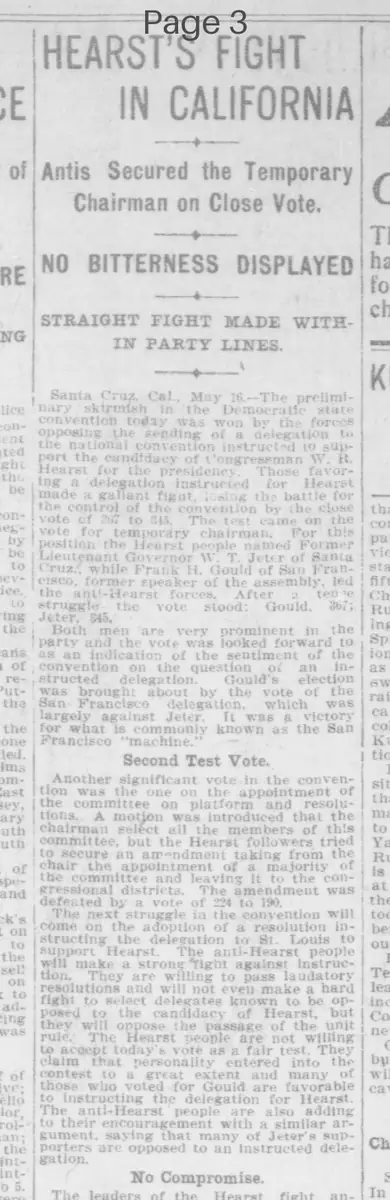
Antis Secured the Temporary Chairman on Close Vote.
NO BITTERNESS DISPLAYED
STRAIGHT FIGHT MADE WITHIN PARTY LINES.
Santa Cruz, Cal., May 16.—The preliminary skirmish in the Democratic state convention today was won by the forces opposing the sending of a delegation to the national convention instructed to support the candidacy of Congressman W. R. Hearst for the presidency. Those favoring a delegation instructed for Hearst made a gallant fight although the battle for the control of the convention by the close vote of 545 to 541. The test came on the vote for temporary chairman. For this position the Hearst people named Former Lieutenant Governor W. T. Jeter of Santa Cruz while Frank L. Gould of San Francisco, former speaker of the assembly, led the anti-Hearst forces. After a few struggle the vote stood Gould 545, Jeter, 545.
Both men are very prominent in the party and the vote was looked forward to as an indication of the sentiment of the convention on the question of an instructed delegation. Gould's election was brought about by the vote of the San Francisco delegation, which was largely against Jeter. It was a victory for what is commonly known as the San Francisco machine.
Second Test Vote.
Another significant vote in the convention was the one on the appointment of the committee on platform and resolutions. A motion was introduced that the chairman select all the members of this committee, but the Hearst followers tried to secure an amendment taking from the chair the appointment of a majority of the committee and leaving it to the congressional districts. The amendment was defeated by a vote of 441 to 190.
The next struggle in the convention will come on the adoption of a resolution instructing the delegation to St. Louis to support Hearst. The anti-Hearst people will make a strong fight against instruction. They are willing to pass laudatory resolutions and will not even make a hard fight to select delegates known to be opposed to the candidacy of Hearst, but they will oppose the passage of the unit rule. The Hearst people are not willing to accept today's vote as a fair test. They claim that personality entered into the contest to a great extent and many of those who voted for Gould are favorable to instructing the delegation for Hearst. The anti-Hearst people are also adding to their encouragement with a similar argument, saying that many of Jeter's supporters are opposed to an instructed delegation.
No Compromise.
The leaders of the Hearst fight announce that they will make no compromise but must have an instructed delegation. The closeness of the vote in organization indicates that the final result will be very close and precludes any forecast. After completing temporary organization the convention took a recess until 8 p. m.
While Chairman Gould is regarded as friendly to Hearst, he is opposed to instructing the delegation and to the adoption of the unit rule.
What sub-type of article is it?
What themes does it cover?
What keywords are associated?
What entities or persons were involved?
Where did it happen?
Story Details
Key Persons
Location
Santa Cruz, Cal.
Event Date
May 16
Story Details
In the Democratic state convention, anti-Hearst forces won the vote for temporary chairman by 545 to 541, with Frank L. Gould defeating W. T. Jeter. Hearst supporters fought for an instructed delegation to support Hearst's presidential candidacy but faced opposition, especially from the San Francisco machine. A motion to alter the platform committee appointment was defeated. The convention recessed, with the next battle over instructing the delegation to St. Louis.