Thank you for visiting SNEWPapers!
Sign up free
Story
April 2, 1915
Malvern Times=Journal
Malvern, Hot Spring County, Arkansas
What is this article about?
Governor Hays of Arkansas vetoes $595,000 from legislative appropriations, reducing them from $3,086,000 to $2,490,000 to balance the state budget and achieve a cash basis, projecting a $150,000 surplus. Cuts affect printing, salaries, and institutions, drawing criticism but defended as economical.
Clipping
OCR Quality
98%
Excellent
Full Text
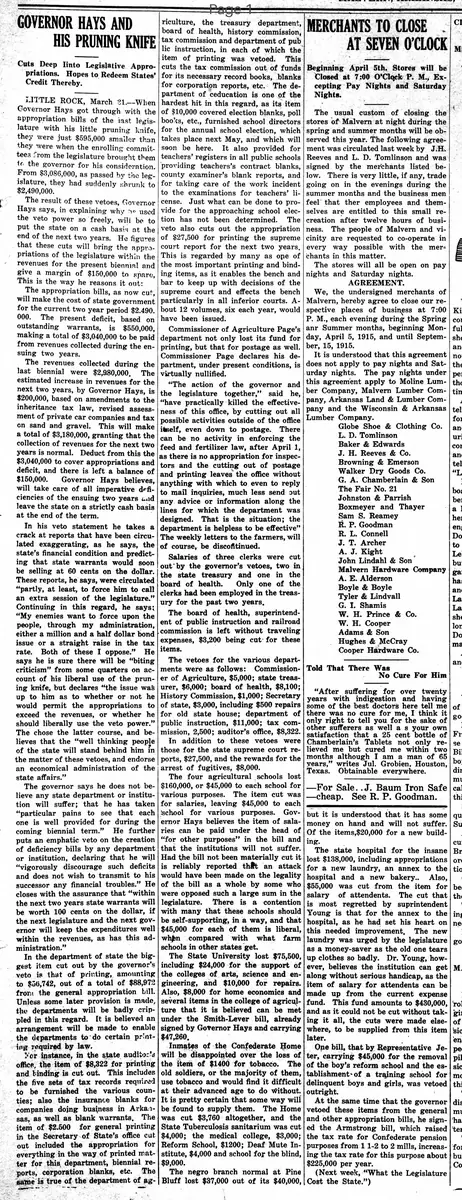
GOVERNOR HAYS AND HIS PRUNING KNIFE
Cuts Deep Into Legislative Appropriations. Hopes to Redeem State's Credit Thereby.
LITTLE ROCK, March 31.--When Governor Hays got through with the appropriation bills of the last legislature with his little pruning knife, they were just $595,000 smaller than they were when the enrolling committees from the legislature brought them to the governor for his consideration. From $3,086,000, as passed by the legislature, they had suddenly shrunk to $2,490,000.
The result of these vetoes, Governor Hays says, in explaining why he used the veto power so freely, will be to put the state on a cash basis at the end of the next two years. He figures that these cuts will bring the appropriations of the legislature within the revenues for the present biennial and give a margin of $150,000 to spare. This is the way he reasons it out:
The appropriation bills, as now cut, will make the cost of state government for the current two-year period $2,490,000. The present deficit, based on outstanding warrants, is $550,000, making a total of $3,040,000 to be paid from revenues collected during the ensuing two years.
The revenues collected during the last biennial were $2,980,000. The estimated increase in revenues for the next two years, by Governor Hays, is $200,000, based on amendments to the inheritance tax law, revised assessment of private car companies and tax on sand and gravel. This will make a total of $3,180,000, granting that the collection of revenues for the next two years is normal. Deduct from this the $3,040,000 to cover appropriations and deficit, and there is left a balance of $150,000. Governor Hays believes, will take care of all imperative deficiencies of the ensuing two years and leave the state on a strictly cash basis at the end of the term.
In his veto statement he takes a crack at reports that have been circulated exaggerating, as he says, the state's financial condition and predicting that state warrants would soon be selling at 60 cents on the dollar. These reports, he says, were circulated "partly, at least, to force him to call an extra session of the legislature." Continuing in this regard, he says: "My enemies want to force upon the people, through my administration, either a million and a half dollar bond issue or a straight raise in the tax rate. Both of these I oppose." He says he is sure there will be "biting criticism" from some quarters on account of his liberal use of the pruning knife, but declares "the issue was up to him as to whether or not he would permit the appropriations to exceed the revenues, or whether he should liberally use the veto power." He chose the latter course, and believes that the "well thinking people of the state will stand behind him in the matter of these vetoes, and endorse an economical administration of the state affairs."
The governor says he does not believe any state department or institution will suffer; that he has taken "particular pains to see that each one is well provided for during the coming biennial term." He further puts an emphatic veto on the creation of deficiency bills by any department or institution, declaring that he will "vigorously discourage such deficits and does not wish to transmit to his successor any financial troubles." He closes with the assurance that "within the next two years state warrants will be worth 100 cents on the dollar, if the next legislature and the next governor will keep the expenditures well within the revenues, as has this administration."
In the department of state the biggest item cut out by the governor's veto is that of printing, amounting to $56,742, out of a total of $88,972 from the general appropriation bill. Unless some later provision is made, the departments will be badly crippled in this regard. It is believed an arrangement will be made to enable the departments to do certain printing required by law. For instance, in the state auditor's office, the item of $8,322 for printing and binding is cut out. This includes the five sets of tax records required to be furnished the various counties; also the insurance blanks for companies doing business in Arkansas, as well as blank warrants. The item of $2,500 for general printing in the Secretary of State's office cut out included the appropriation for everything in the way of printed matter for this department, biennial reports, corporation blanks, etc. The same is true of the department of agriculture, the treasury department, board of health, history commission, tax commission and department of public instruction, in each of which the item of printing was vetoed. This cuts the tax commission out of funds for its necessary record books, blanks for corporation reports, etc. The department of education is one of the hardest hit in this regard, as its item of $10,000 covered election blanks, poll books, etc., furnished school directors for the annual school election, which takes place next May, and which will soon be here. It also provided for teachers' registers in all public schools providing teachers' contract blanks, county examiner's blank reports, and for taking care of the work incident to the examinations for teachers' license. Just what can be done to provide for the approaching school election has not been determined. The veto also cuts out the appropriation of $27,500 for printing the supreme court report for the next two years. This is regarded by many as one of the most important printing and binding items, as it enables the bench and bar to keep up with decisions of the supreme court and effects the bench particularly in all inferior courts. About 12 volumes, six each year, would have been issued.
Commissioner of Agriculture Page's department not only lost its fund for printing, but that for postage as well. Commissioner Page declares his department, under present conditions, is virtually nullified.
"The action of the governor and the legislature together," said he, "have practically killed the effectiveness of this office, by cutting out all possible activities outside of the office itself, even down to postage. There can be no activity in enforcing the feed and fertilizer law, after April 1, as there is no appropriation for inspectors and the cutting out of postage and printing leaves the office without anything with which to even reply to mail inquiries, much less send out any advice or information along the lines for which the department was designed. That is the situation: the department is helpless to be effective."
The weekly letters to the farmers, will of course, be discontinued.
Salaries of three clerks were cut out by the governor's vetoes, two in the state treasury and one in the board of health. Only one of the clerks had been employed in the treasury for the past two years. The board of health, superintendent of public instruction and railroad commission is left without traveling expenses, $3,200 being cut for these items.
The vetoes for the various departments were as follows: Commissioner of Agriculture, $5,000; state treasurer, $6,000; board of health, $8,100; History Commission, $1,000; Secretary of state, $3,000, including $500 repairs for old state house; department of public instruction, $11,000; tax commission, $2,500; auditor's office, $8,322. In addition to these vetoes were those for the state supreme court reports, $27,500, and the rewards for the arrest of fugitives, $8,000.
The four agricultural schools lost $160,000, or $40,000 to each school for various purposes. The item cut was for salaries, leaving $45,000 to each school for various purposes. Governor Hays believes the item of salaries can be paid under the head of "for other purposes" in the bill and that the institutions will not suffer. Had the bill not been materially cut it is reliably reported that an attack would have been made on the legality of the bill as a whole by some who were opposed such a large sum in the legislature. There is a contention with many that these schools should be self-supporting, in a way, and that $45,000 for each of them is liberal, when compared with what farm schools in other states get.
The State University lost $75,500, including $24,000 for the support of the colleges of arts, science and engineering, and $10,000 for repairs. Also, $8,000 for home economics and several items in the college of agriculture that it is believed can be met under the Smith-Lever bill, already signed by Governor Hays and carrying $47,260.
Inmates of the Confederate Home will be disappointed over the loss of the item of $1,400 for tobacco. The old soldiers, or the majority of them, use tobacco and would find it difficult at their advanced age to do without. It is pretty certain that some way will be found to supply them. The Home was cut $3,760 altogether, and the State Tuberculosis sanitarium was cut $4,000; the medical college, $3,000; Reform School, $1,200; Deaf Mute Institute, $4,000 and school for the blind, $9,000.
The negro branch normal at Pine Bluff lost $37,000 out of its $40,000, but it is understood that it has some money on hand and will not suffer. Of the items, $20,000 for a new building.
The state hospital for the insane lost $138,000, including appropriations for a new laundry, an annex to the hospital and a new bakery. Also, $55,000 was cut from the item for salary of attendants. The cut that is most regretted by superintendent Young is that for the annex to the hospital, as he had set his heart on this needed improvement. The new laundry was urged by the legislature as a money-saver as the old one tears up clothes so badly. Dr. Young, however, believes the institution can get along without serious handicap, as the item of salary for attendants can be made up from the current expense fund. This fund amounts to $430,000, and as it could not be cut without taking it all, the cuts were made elsewhere, to be supplied from this item later.
One bill, that by Representative Jeter, carrying $45,000, for the removal of the boy's reform school and the establishment of a training school for delinquent boys and girls, was vetoed outright.
At the same time that the governor vetoed these items from the general and other appropriation bills, he signed the Armstrong bill, which raised the tax rate for Confederate pension purposes from 1 1-2 to 2 mills, increasing the tax rate for this purpose about $225,000 per year.
(Next week, "What the Legislature Cost the State.")
Cuts Deep Into Legislative Appropriations. Hopes to Redeem State's Credit Thereby.
LITTLE ROCK, March 31.--When Governor Hays got through with the appropriation bills of the last legislature with his little pruning knife, they were just $595,000 smaller than they were when the enrolling committees from the legislature brought them to the governor for his consideration. From $3,086,000, as passed by the legislature, they had suddenly shrunk to $2,490,000.
The result of these vetoes, Governor Hays says, in explaining why he used the veto power so freely, will be to put the state on a cash basis at the end of the next two years. He figures that these cuts will bring the appropriations of the legislature within the revenues for the present biennial and give a margin of $150,000 to spare. This is the way he reasons it out:
The appropriation bills, as now cut, will make the cost of state government for the current two-year period $2,490,000. The present deficit, based on outstanding warrants, is $550,000, making a total of $3,040,000 to be paid from revenues collected during the ensuing two years.
The revenues collected during the last biennial were $2,980,000. The estimated increase in revenues for the next two years, by Governor Hays, is $200,000, based on amendments to the inheritance tax law, revised assessment of private car companies and tax on sand and gravel. This will make a total of $3,180,000, granting that the collection of revenues for the next two years is normal. Deduct from this the $3,040,000 to cover appropriations and deficit, and there is left a balance of $150,000. Governor Hays believes, will take care of all imperative deficiencies of the ensuing two years and leave the state on a strictly cash basis at the end of the term.
In his veto statement he takes a crack at reports that have been circulated exaggerating, as he says, the state's financial condition and predicting that state warrants would soon be selling at 60 cents on the dollar. These reports, he says, were circulated "partly, at least, to force him to call an extra session of the legislature." Continuing in this regard, he says: "My enemies want to force upon the people, through my administration, either a million and a half dollar bond issue or a straight raise in the tax rate. Both of these I oppose." He says he is sure there will be "biting criticism" from some quarters on account of his liberal use of the pruning knife, but declares "the issue was up to him as to whether or not he would permit the appropriations to exceed the revenues, or whether he should liberally use the veto power." He chose the latter course, and believes that the "well thinking people of the state will stand behind him in the matter of these vetoes, and endorse an economical administration of the state affairs."
The governor says he does not believe any state department or institution will suffer; that he has taken "particular pains to see that each one is well provided for during the coming biennial term." He further puts an emphatic veto on the creation of deficiency bills by any department or institution, declaring that he will "vigorously discourage such deficits and does not wish to transmit to his successor any financial troubles." He closes with the assurance that "within the next two years state warrants will be worth 100 cents on the dollar, if the next legislature and the next governor will keep the expenditures well within the revenues, as has this administration."
In the department of state the biggest item cut out by the governor's veto is that of printing, amounting to $56,742, out of a total of $88,972 from the general appropriation bill. Unless some later provision is made, the departments will be badly crippled in this regard. It is believed an arrangement will be made to enable the departments to do certain printing required by law. For instance, in the state auditor's office, the item of $8,322 for printing and binding is cut out. This includes the five sets of tax records required to be furnished the various counties; also the insurance blanks for companies doing business in Arkansas, as well as blank warrants. The item of $2,500 for general printing in the Secretary of State's office cut out included the appropriation for everything in the way of printed matter for this department, biennial reports, corporation blanks, etc. The same is true of the department of agriculture, the treasury department, board of health, history commission, tax commission and department of public instruction, in each of which the item of printing was vetoed. This cuts the tax commission out of funds for its necessary record books, blanks for corporation reports, etc. The department of education is one of the hardest hit in this regard, as its item of $10,000 covered election blanks, poll books, etc., furnished school directors for the annual school election, which takes place next May, and which will soon be here. It also provided for teachers' registers in all public schools providing teachers' contract blanks, county examiner's blank reports, and for taking care of the work incident to the examinations for teachers' license. Just what can be done to provide for the approaching school election has not been determined. The veto also cuts out the appropriation of $27,500 for printing the supreme court report for the next two years. This is regarded by many as one of the most important printing and binding items, as it enables the bench and bar to keep up with decisions of the supreme court and effects the bench particularly in all inferior courts. About 12 volumes, six each year, would have been issued.
Commissioner of Agriculture Page's department not only lost its fund for printing, but that for postage as well. Commissioner Page declares his department, under present conditions, is virtually nullified.
"The action of the governor and the legislature together," said he, "have practically killed the effectiveness of this office, by cutting out all possible activities outside of the office itself, even down to postage. There can be no activity in enforcing the feed and fertilizer law, after April 1, as there is no appropriation for inspectors and the cutting out of postage and printing leaves the office without anything with which to even reply to mail inquiries, much less send out any advice or information along the lines for which the department was designed. That is the situation: the department is helpless to be effective."
The weekly letters to the farmers, will of course, be discontinued.
Salaries of three clerks were cut out by the governor's vetoes, two in the state treasury and one in the board of health. Only one of the clerks had been employed in the treasury for the past two years. The board of health, superintendent of public instruction and railroad commission is left without traveling expenses, $3,200 being cut for these items.
The vetoes for the various departments were as follows: Commissioner of Agriculture, $5,000; state treasurer, $6,000; board of health, $8,100; History Commission, $1,000; Secretary of state, $3,000, including $500 repairs for old state house; department of public instruction, $11,000; tax commission, $2,500; auditor's office, $8,322. In addition to these vetoes were those for the state supreme court reports, $27,500, and the rewards for the arrest of fugitives, $8,000.
The four agricultural schools lost $160,000, or $40,000 to each school for various purposes. The item cut was for salaries, leaving $45,000 to each school for various purposes. Governor Hays believes the item of salaries can be paid under the head of "for other purposes" in the bill and that the institutions will not suffer. Had the bill not been materially cut it is reliably reported that an attack would have been made on the legality of the bill as a whole by some who were opposed such a large sum in the legislature. There is a contention with many that these schools should be self-supporting, in a way, and that $45,000 for each of them is liberal, when compared with what farm schools in other states get.
The State University lost $75,500, including $24,000 for the support of the colleges of arts, science and engineering, and $10,000 for repairs. Also, $8,000 for home economics and several items in the college of agriculture that it is believed can be met under the Smith-Lever bill, already signed by Governor Hays and carrying $47,260.
Inmates of the Confederate Home will be disappointed over the loss of the item of $1,400 for tobacco. The old soldiers, or the majority of them, use tobacco and would find it difficult at their advanced age to do without. It is pretty certain that some way will be found to supply them. The Home was cut $3,760 altogether, and the State Tuberculosis sanitarium was cut $4,000; the medical college, $3,000; Reform School, $1,200; Deaf Mute Institute, $4,000 and school for the blind, $9,000.
The negro branch normal at Pine Bluff lost $37,000 out of its $40,000, but it is understood that it has some money on hand and will not suffer. Of the items, $20,000 for a new building.
The state hospital for the insane lost $138,000, including appropriations for a new laundry, an annex to the hospital and a new bakery. Also, $55,000 was cut from the item for salary of attendants. The cut that is most regretted by superintendent Young is that for the annex to the hospital, as he had set his heart on this needed improvement. The new laundry was urged by the legislature as a money-saver as the old one tears up clothes so badly. Dr. Young, however, believes the institution can get along without serious handicap, as the item of salary for attendants can be made up from the current expense fund. This fund amounts to $430,000, and as it could not be cut without taking it all, the cuts were made elsewhere, to be supplied from this item later.
One bill, that by Representative Jeter, carrying $45,000, for the removal of the boy's reform school and the establishment of a training school for delinquent boys and girls, was vetoed outright.
At the same time that the governor vetoed these items from the general and other appropriation bills, he signed the Armstrong bill, which raised the tax rate for Confederate pension purposes from 1 1-2 to 2 mills, increasing the tax rate for this purpose about $225,000 per year.
(Next week, "What the Legislature Cost the State.")
What sub-type of article is it?
Historical Event
What themes does it cover?
Triumph
Moral Virtue
What keywords are associated?
Governor Vetoes
State Appropriations
Budget Cuts
Arkansas Finances
Fiscal Responsibility
What entities or persons were involved?
Governor Hays
Commissioner Page
Dr. Young
Representative Jeter
Where did it happen?
Little Rock, Arkansas
Story Details
Key Persons
Governor Hays
Commissioner Page
Dr. Young
Representative Jeter
Location
Little Rock, Arkansas
Event Date
March 31
Story Details
Governor Hays extensively vetoes appropriation bills, cutting $595,000 to balance Arkansas state budget, projecting a $150,000 surplus and cash basis within two years, despite impacts on departments and institutions.