Thank you for visiting SNEWPapers!
Sign up free
Summit County Labor News
Akron, Summit County, Ohio
What is this article about?
The AFL-CIO Economic Policy Committee criticizes President Eisenhower's 1960 Economic Report and Budget for ignoring unemployment and idle capacity, predicting stagnation and recession, and urges Congress to reject restrictive policies favoring full employment.
Merged-components note: Merged continuation from page 1 to page 4 due to 'Continued on Page Four' indicator.
Clippings
1 of 2
OCR Quality
Full Text
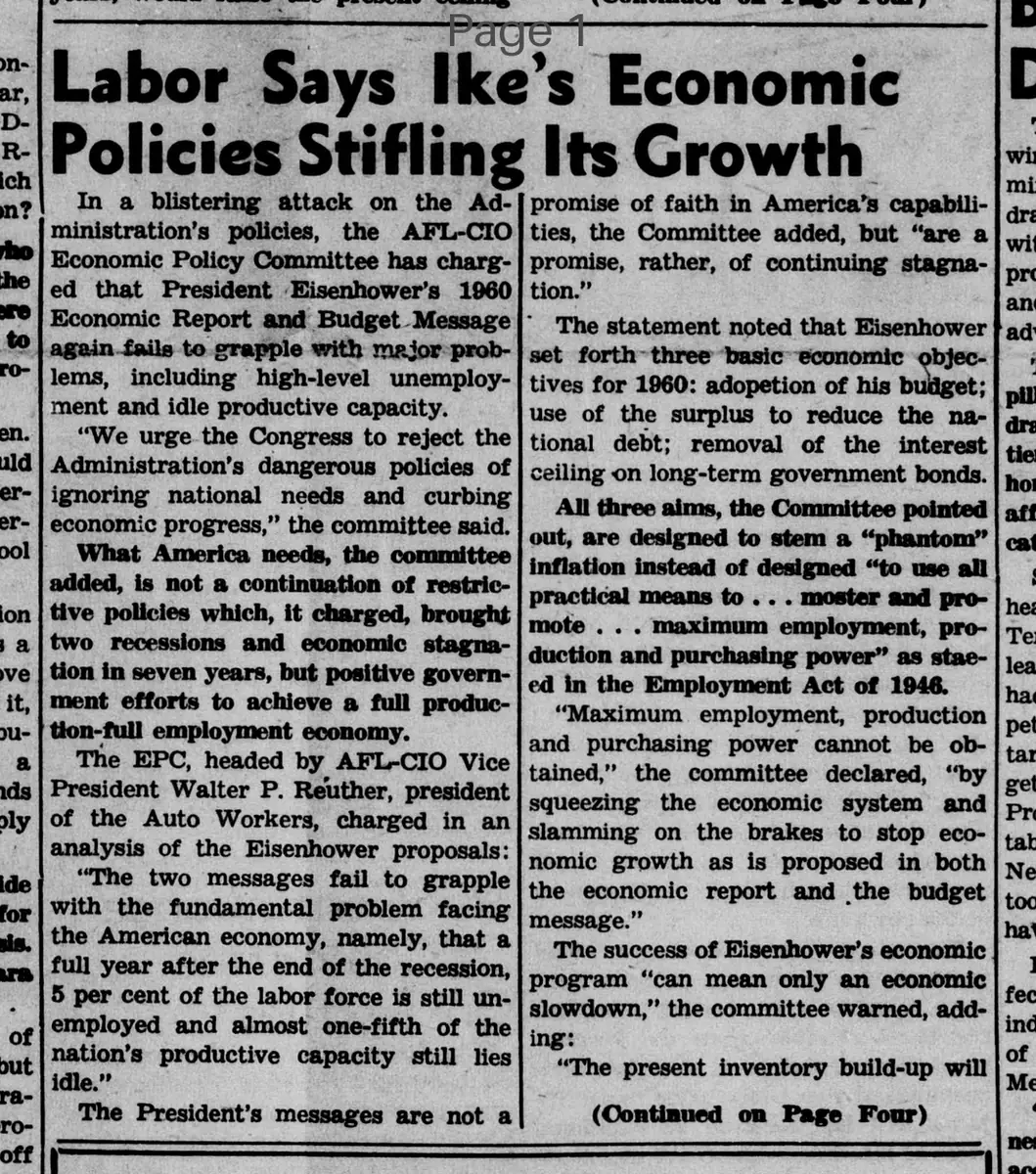
Says
Ike's
Economic
Policies
Stifling
Its
Growth
In a blistering attack on the Administration's policies, the AFL-CIO Economic Policy Committee has charged that President Eisenhower's 1960 Economic Report and Budget Message again fails to grapple with major problems, including high-level unemployment and idle productive capacity.
"We urge the Congress to reject the Administration's dangerous policies of ignoring national needs and curbing economic progress," the committee said.
What America needs, the committee added, is not a continuation of restrictive policies which, it charged, brought two recessions and economic stagnation in seven years, but positive government efforts to achieve a full production-full employment economy.
The EPC, headed by AFL-CIO Vice President Walter P. Reuther, president of the Auto Workers, charged in an analysis of the Eisenhower proposals:
"The two messages fail to grapple with the fundamental problem facing the American economy, namely, that a full year after the end of the recession, 5 per cent of the labor force is still unemployed and almost one-fifth of the nation's productive capacity still lies idle."
The President's messages are not a promise of faith in America's capabilities, the Committee added, but "are a promise, rather, of continuing stagnation."
The statement noted that Eisenhower set forth three basic economic objectives for 1960: adoption of his budget; use of the surplus to reduce the national debt; removal of the interest ceiling on long-term government bonds.
All three aims, the Committee pointed out, are designed to stem a "phantom" inflation instead of designed "to use all practical means to ... master and promote ... maximum employment, production and purchasing power" as stated in the Employment Act of 1946.
"Maximum employment, production and purchasing power cannot be obtained," the committee declared, "by squeezing the economic system and slamming on the brakes to stop economic growth as is proposed in both the economic report and the budget message."
The success of Eisenhower's economic program "can mean only an economic slowdown," the committee warned, adding:
"The present inventory build-up will
ease after mid-year. The danger of another recession in 1961, before America fully recovers from the ravages of the sharp 1957-58 decline, seems a distinct possibility."
The committee said economic stagnation under the present Administration has reduced the growth of per capita national production since 1953 "to merely six-tenths of one per cent a year."
This is, the AFL-CIO group noted, one-seventh the rate of the Soviet Union's economic progress.
The President's approach, the committee said, is a blend of "penny-pinching" for national defense and public services combined with postal rate and gasoline tax increases.
Stifles Growth
(Continued from Page One)
What sub-type of article is it?
What keywords are associated?
What entities or persons were involved?
Story Details
Key Persons
Event Date
1960
Story Details
The AFL-CIO Economic Policy Committee, led by Walter P. Reuther, attacks Eisenhower's 1960 economic report and budget for failing to address 5% unemployment and idle capacity, predicting continued stagnation, slowdown, and possible 1961 recession, contrasting U.S. growth rate unfavorably with the Soviet Union, and urging positive policies for full employment.