Thank you for visiting SNEWPapers!
Sign up free
Story
October 28, 1815
Norfolk Gazette And Publick Ledger
Norfolk, Virginia
What is this article about?
A 1815 letter from a US Navy officer critiques the Board of Navy Commissioners' establishment, arguing for clearer separation of powers from the Secretary of the Navy to avoid inefficiency, including the full congressional act creating the board.
Clipping
OCR Quality
95%
Excellent
Full Text
FROM NILES' WEEKLY REGISTER.
INTERESTING LETTER
From an officer of the U. States' navy, to his friend, a member of congress, dated
WASHINGTON, 2d Sept. 1815.
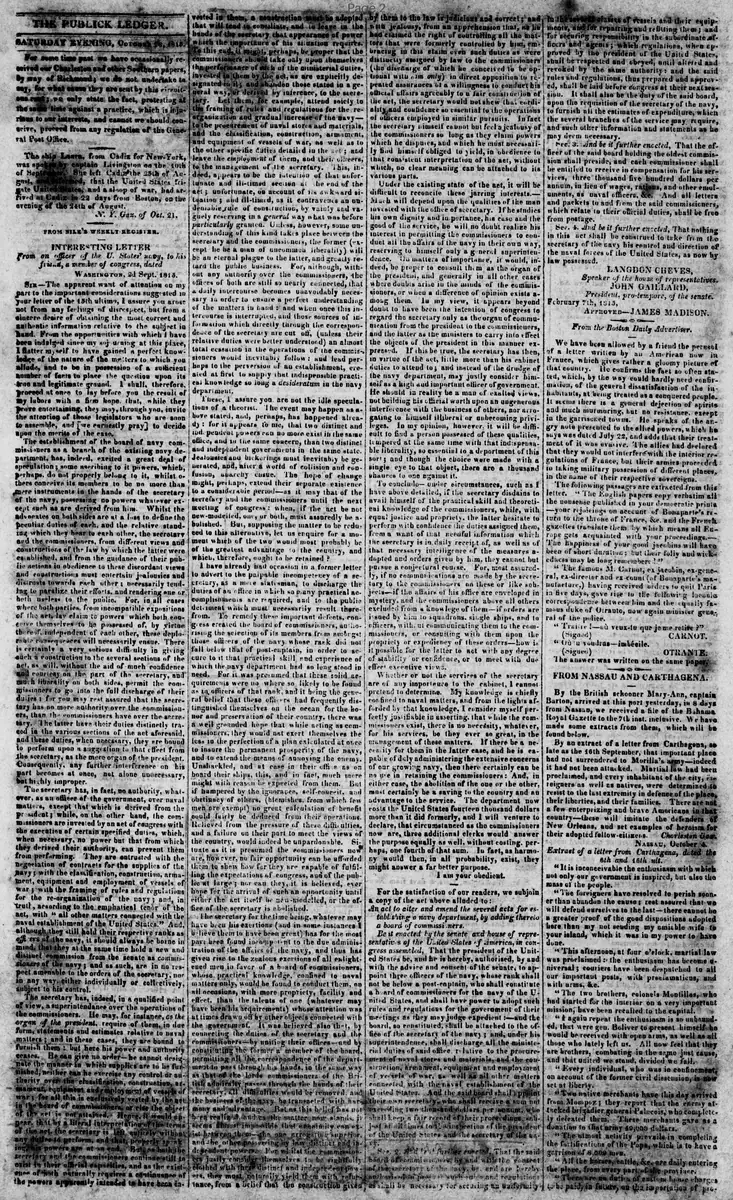
Sir—The apparent want of attention on my part to the important considerations suggested in your letter of the 15th ultimo, I assure you arose not from any feelings of disrespect, but from a sincere desire of obtaining the most correct and authentic information relative to the subject in hand. From the opportunities with which I have been indulged since my sojourning at this place, I flatter myself to have gained a perfect knowledge of the nature of the matters to which you allude, and to be in possession of a sufficient number of facts to place the question upon its true and legitimate ground. I shall, therefore, proceed at once to lay before you the result of my labors with a firm hope, that, while they prove entertaining, they may, through you, invite the attention of those legislators who are soon to assemble, and [I earnestly pray] to decide upon the merits of the case.
The establishment of the board of navy commissioners as a branch of the existing navy department, has, indeed, excited a great deal of speculation; some ascribing to it powers, which, perhaps, do not properly belong to it, whilst others conceive its members to be no more than mere instruments in the hands of the secretary of the navy, possessing no powers whatever except such as are derived from him. Whilst the advocates on both sides are at a loss to define the peculiar duties of each, and the relative standing which they bear to each other, the secretary and the commissioners, from different views and constructions of the law by which the latter were established, and from the guidance of their public actions in obedience to these discordant views and constructions must entertain jealousies and distrusts towards each other; necessarily tending to paralyze their efforts, and rendering one or both useless to the public. For, in all cases where both parties, from incompatible expositions of the act, lay claim to powers which both conceive themselves to be possessed of, by virtue thereof, independent of each other, these deplorable consequences will necessarily ensue. There is certainly a very serious difficulty in giving such a construction to the several sections of the act, as will, without the aid of much confidence and courtesy on the part of the secretary, and much liberality on both sides, permit the commissioners to go into the full discharge of their duties; or you may rest assured that the secretary has no more authority over the commissioners, than the commissioners have over the secretary. The latter have their duties distinctly traced in the various sections of the act aforesaid, and these duties, when necessary, they are bound to perform upon a suggestion to that effect from the secretary, as the mere organ of the president. Consequently, any further interference on his part becomes at once, not alone unnecessary, but highly improper.
The secretary has, in fact, no authority, whatever, as an officer of the government, over naval matters, except that which is derived from the president; while, on the other hand, the commissioners are invested by an act of congress with the execution of certain specified duties, which, when necessary, no power but that from which they derived their authority, can prevent them from performing. They are entrusted with the negotiation of contracts for the supplies of the navy; with the classification, construction, armament, equipment and employment of vessels of war; with the framing of rules and regulations for the re-organization of the navy; and, in truth, according to the emphatical tenor of the act, with "all other matters connected with the naval establishment of the United States." And, although they still hold their respective ranks as officers of the navy, it should always be borne in mind that they at the same time hold a new and distinct commission from the senate as commissioners of the navy; and as such, are in no respect amenable to the orders of the secretary, nor in any way either individually or collectively subject to his control.
"The secretary has, indeed, in a qualified point of view, a superintendence over the operations of the commissioners. He may, for instance, as the organ of the president, require of them, in due form, statements and estimates relative to naval matters; and in these cases, they are bound to furnish them: but here his power and authority ceases. He can give no order—he cannot designate the manner in which supplies are to be furnished, neither can he exercise any control or authority over the classification, construction, armament, equipment and employment of vessels of war; for all this is exclusively vested by the act in the board of commissioners—or else the object of the act is not attained. Hence, it would appear, that by a literal interpretation the terms of the act the secretary is left wholly without any duty to perform, and that his career as secretary are at an end. But as both the secretary and the commissioners continue still to exist in their official capacities, and as the existence of such naturally requires a continuance of the powers apparently intended to have been invested in them, a construction must be adopted that will tend to conciliate, and to vest in the hands of the secretary that appearance of power which the importance of his situation requires.
To this end it might, perhaps, be proper that the commissioners should take only upon themselves the performance of such of the ministerial duties, invested in them by the act, as are explicitly designated; and should abandon those stated in a general way, or derived by inference, to the secretary. Let them for example, attend solely to framing of rules and regulations for the re-organization and gradual increase of the navy—to the procurement of naval stores and materials, and the classification, construction, armament, and equipment of vessels of war, as well as to the other specific duties detailed in the act; and leave the employment of them, and their officers, to the management of the secretary.—This, indeed, appears to be the intention of that unfortunate and ill-timed section at the end of the act; unfortunate, on account of its awkward situation; and ill-timed, as it contravenes an understandable rule of construction, by vainly and vacuously reserving in a general way what was before particularly granted. Unless, however, some understanding of this kind takes place between the secretary and the commissioners, the former (except he be a man of uncommon liberality) will be an eternal plague to the latter, and greatly retard the public business. For, although, without any authority over the commissioners, the offices of both are still so nearly connected, that a daily intercourse becomes unavoidably necessary in order to ensure a perfect understanding of the matters in hand: and when once this intercourse is interrupted, and those sources of information which directly through the correspondence of the secretary are cut off, (unless their relative duties were better understood) an almost total cessation in the operations of the commissioners would inevitably follow: and lead perhaps to the perversion of an establishment, created at first to supply that indispensable practical knowledge so long a desideratum in the navy department.
These, I assure you, are but the idle speculations of a theorist. The event may happen as above stated, and, perhaps, has happened already: for it appears to me, that two distinct and independent powers can no more exist in the same office, and in the same concern, than two distinct and independent governments in the same state. Jealousies and bickerings must inevitably be generated, and, after a world of collision and confusion, anarchy ensue. The hope of change might, perhaps, extend their separate existence to a considerable period—as it may that of the secretary and the commissioners until the next meeting of congress: when, if the act be not new-modelled, one or both, must assuredly be abolished. But, supposing the matter to be reduced to this alternative, let us enquire for a moment which of the two would most probably be of the greatest advantage to the country, and which, therefore, ought to be retained?
I have already had occasion in a former letter to advert to the palpable incompetency of a secretary, as a mere statesman, to discharge the duties of an office in which so many practical accomplishments are required, and to the public detriment which must necessarily result therefrom. To remedy these important defects, congress created the board of commissioners, authorizing the selection of its members from amongst those officers of the navy whose rank did not fall below that of post-captain, in order to secure to it that practical skill and experience of which the navy department had so long stood in need. For it was presumed that these solid acquirements were no where so likely to be found as in officers of that rank, and it being the general belief that these officers had frequently distinguished themselves on the ocean for the honor and preservation of their country, there was a well grounded hope that while acting as commissioners, they would not exert themselves the less in the perfection of a plan calculated at once to insure the permanent prosperity of the navy, and to extend the means of annoying the enemy. Unshackled, and at ease in their office as on board their ships, this, and in fact, much more might with reason be expected from them. But if hampered by the ignorance, self-conceit, and obstinacy of others, (blemishes, from which few men are exempt) no great calculation of benefit could fairly be deduced from their operations.
Relieved from the pressure of these difficulties, and a failure on their part to meet the views of the country, would indeed be unpardonable. Situated as it is presumed the commissioners now are, however, no fair opportunity can be afforded them to shew how far they are capable of fulfilling the expectations of congress, and of the public at large; nor can they, it is believed, ever hope for the arrival of such an opportunity until either the act itself be new-modelled, or the office of the secretary is abolished.
The secretary for the time being, whatever may have been his exertions (and in some instances I believe them to have been great) has for the most part been found incompetent to the due administration of the affairs of the navy, and thus has given rise to the zealous exertions of all enlightened men in favor of a board of commissioners whose practical knowledge, confined to naval matters only, would be found to conduct them, on all occasions, with more propriety, facility and effect, than the talents of one (whatever may have been his acquirements) whose attention was at times drawn off by other objects connected with the government. It was believed also that, by connecting the duties of the secretary and the commissioners—by uniting their offices and by constituting the former a member of the board, permitting all the correspondence of the department to pass through his hands, in the same way as that to the lords commissioners of the British admiralty passes through the hands of their secretary, all difficulties would be removed, and the business of the navy be transacted with harmony and advantage. But as this belief has not been realized, and as matters now stand, it seems almost impossible that certainty can exist between them—the one possessing superior, and the other possessing by law distinct and independent powers. And while the commissioners justly consider themselves as rightfully clothed with these distinct and independent powers, they must reluctantly yield them with reluctance.
If the construction put upon the law by them is judicious and correct; and what jealousy, from an apprehension that, he had claimed the right of controlling on the part of the secretary would not shew that cordiality and confidence so essential to the operations of officers employed in similar pursuits. In fact the secretary himself cannot but feel a jealousy of the commissioners so long as they claim powers which he disputes, and which he must necessarily find himself obliged to yield, in obedience to that consistent interpretation of the act, without which, no clear meaning can be attached to its various parts.
Under the existing state of the act, it will be difficult to reconcile these jarring interests. Much will depend upon the qualities of the man invested with the office of secretary. If he studies his own dignity and importance, his ease and the good of the service, he will no doubt realize his interest in permitting the commissioners to conduct all the affairs of the navy in their own way, reserving to himself only a general superintendence. On matters of importance, it would, indeed, be proper to consult him as the organ of the president, and generally in all other cases where doubts arise in the minds of the commissioners, or when a difference of opinion exists among them. In my view, it appears beyond doubt to have been the intention of congress to regard the secretary only as the organ of communication from the president to the commissioners, and the latter as the ministers to carry into effect the objects of the president in this manner expressed. If this be true, the secretary has then, in virtue of the act, little more than his cabinet duties to attend to; and instead of the drudge of the navy department, may justly consider himself as a high and important officer of government. He should in reality be a man of exalted views, not building his official worth upon an ungnerous interference with the business of others, nor arrogating to himself illiberal or unbecoming privileges. In my opinion, however, it will be difficult to find a person possessed of these qualities, tempered at the same time with that indispensable liberality, so essential to a deportment of this sort; and though the choice were made with a single eye to that object, there are a thousand chances to one against it.
To conclude—under circumstances, such as I have above detailed, if the secretary disdains to avail himself of the practical skill and theoretical knowledge of the commissioners, while, with equal justice and propriety, the latter hesitate to perform with confidence the duties assigned them, from a want of that needful information which the secretary is in daily receipt of, as well as of that necessary intelligence of the measures adopted and orders given by him, they cannot but pursue a conjectural course. For, most assuredly, if no communications are made by the secretary to the commissioners on these or like subjects—if the affairs of his office are enveloped in mystery, and the commissioners above all others excluded from a knowledge of them—if orders are issued by him to squadrons, single ships, and to officers, without communicating them to the commissioners, or consulting with them upon the propriety or expediency of these orders—how is it possible for the latter to act with any degree of stability or confidence, or to meet with due effect executive views.
Whether or not the services of the secretary are of any importance to the cabinet, I cannot pretend to determine. My knowledge is chiefly confined to naval matters, and from the lights afforded by that knowledge, I consider myself perfectly justifiable in asserting, that while the commissioners exist, there is no necessity, whatever, for his services, be they ever so great, in the management of these matters. If there be a necessity for them in the latter case, and he is capable of duly administering the extensive concerns of our growing navy, then there certainly can be no use in retaining the commissioners: And, in either case, the abolition of the one or the other, must certainly be a saving to the country and an advantage to the service. The department now costs the United States fourteen thousand dollars more than it did formerly, and I will venture to declare, that circumstanced as the commissioners now are, three additional clerks would answer the purpose equally as well, without costing, perhaps, one fourth of that sum. In fact, as harmony would then, in all probability, exist, they might answer a far better purpose.
I am your obedient.
For the satisfaction of our readers, we subjoin a copy of the act above alluded to:
An act to alter and amend the several acts for establishing a navy department, by adding thereto a board of commissioners.
Be it enacted by the senate and house of representatives of the United States of America, in congress assembled, That the president of the United States be, and he is hereby, authorised, by and with the advice and consent of the senate, to appoint three officers of the navy, whose rank shall not be below a post-captain, who shall constitute a board of commissioners for the navy of the United States, and shall have power to adopt such rules and regulations for the government of their meetings as they may judge expedient: and the board, so constituted, shall be attached to the office of the secretary of the navy; and, under his superintendence, shall discharge all the ministerial duties of said office, relative to the procurement of naval stores and materials; and the construction, armament, equipment and employment of vessels of war; as well as all other matters connected with the naval establishment of the United States. And the said board shall appoint their own secretary who shall receive a sum not exceeding two thousand dollars per annum, who shall keep a fair record of their proceedings, &c. subject at all times to the inspection of the president of the United States and the secretary of the navy.
Sec. 2. And be it further enacted, That the said board of commissioners, by and with the consent of the secretary of the navy be, and are hereby authorised to make such rules and regulations as to them shall seem necessary for the safety, regularity and government of the navy; for the classification of vessels of war, their equipment and for repairing and restoring them; and for securing responsibility in the subordinate officers and seamen; which regulations, when approved by the president of the United States, shall be respected and obeyed, until altered and revoked by the same authority: and the said rules and regulations, thus prepared and approved, shall be laid before congress at their next session. It shall also be the duty of the said board, upon the requisition of the secretary of the navy, to furnish all the estimates of expenditure, which the several branches of the service may require, and such other information and statements as he may deem necessary.
Sec. 3. And be it further enacted, That the officer of the said board holding the oldest commission shall preside, and each commissioner shall be entitled to receive in compensation for his services, three thousand five hundred dollars per annum, in lieu of wages, rations, and other emoluments, as naval officers, &c. And all letters and packets to and from the said commissioners, which relate to their official duties, shall be free from postage.
Sec. 4. And be it further enacted, That nothing in this act shall be construed to take from the secretary of the navy his control and direction of the naval forces of the United States, as now by law possessed.
LANGDON CHEVES
Speaker of the house of representatives.
JOHN GAILLARD,
President pro tempore, of the senate.
February 7th, 1815,
APPROVED—JAMES MADISON
INTERESTING LETTER
From an officer of the U. States' navy, to his friend, a member of congress, dated
WASHINGTON, 2d Sept. 1815.
Sir—The apparent want of attention on my part to the important considerations suggested in your letter of the 15th ultimo, I assure you arose not from any feelings of disrespect, but from a sincere desire of obtaining the most correct and authentic information relative to the subject in hand. From the opportunities with which I have been indulged since my sojourning at this place, I flatter myself to have gained a perfect knowledge of the nature of the matters to which you allude, and to be in possession of a sufficient number of facts to place the question upon its true and legitimate ground. I shall, therefore, proceed at once to lay before you the result of my labors with a firm hope, that, while they prove entertaining, they may, through you, invite the attention of those legislators who are soon to assemble, and [I earnestly pray] to decide upon the merits of the case.
The establishment of the board of navy commissioners as a branch of the existing navy department, has, indeed, excited a great deal of speculation; some ascribing to it powers, which, perhaps, do not properly belong to it, whilst others conceive its members to be no more than mere instruments in the hands of the secretary of the navy, possessing no powers whatever except such as are derived from him. Whilst the advocates on both sides are at a loss to define the peculiar duties of each, and the relative standing which they bear to each other, the secretary and the commissioners, from different views and constructions of the law by which the latter were established, and from the guidance of their public actions in obedience to these discordant views and constructions must entertain jealousies and distrusts towards each other; necessarily tending to paralyze their efforts, and rendering one or both useless to the public. For, in all cases where both parties, from incompatible expositions of the act, lay claim to powers which both conceive themselves to be possessed of, by virtue thereof, independent of each other, these deplorable consequences will necessarily ensue. There is certainly a very serious difficulty in giving such a construction to the several sections of the act, as will, without the aid of much confidence and courtesy on the part of the secretary, and much liberality on both sides, permit the commissioners to go into the full discharge of their duties; or you may rest assured that the secretary has no more authority over the commissioners, than the commissioners have over the secretary. The latter have their duties distinctly traced in the various sections of the act aforesaid, and these duties, when necessary, they are bound to perform upon a suggestion to that effect from the secretary, as the mere organ of the president. Consequently, any further interference on his part becomes at once, not alone unnecessary, but highly improper.
The secretary has, in fact, no authority, whatever, as an officer of the government, over naval matters, except that which is derived from the president; while, on the other hand, the commissioners are invested by an act of congress with the execution of certain specified duties, which, when necessary, no power but that from which they derived their authority, can prevent them from performing. They are entrusted with the negotiation of contracts for the supplies of the navy; with the classification, construction, armament, equipment and employment of vessels of war; with the framing of rules and regulations for the re-organization of the navy; and, in truth, according to the emphatical tenor of the act, with "all other matters connected with the naval establishment of the United States." And, although they still hold their respective ranks as officers of the navy, it should always be borne in mind that they at the same time hold a new and distinct commission from the senate as commissioners of the navy; and as such, are in no respect amenable to the orders of the secretary, nor in any way either individually or collectively subject to his control.
"The secretary has, indeed, in a qualified point of view, a superintendence over the operations of the commissioners. He may, for instance, as the organ of the president, require of them, in due form, statements and estimates relative to naval matters; and in these cases, they are bound to furnish them: but here his power and authority ceases. He can give no order—he cannot designate the manner in which supplies are to be furnished, neither can he exercise any control or authority over the classification, construction, armament, equipment and employment of vessels of war; for all this is exclusively vested by the act in the board of commissioners—or else the object of the act is not attained. Hence, it would appear, that by a literal interpretation the terms of the act the secretary is left wholly without any duty to perform, and that his career as secretary are at an end. But as both the secretary and the commissioners continue still to exist in their official capacities, and as the existence of such naturally requires a continuance of the powers apparently intended to have been invested in them, a construction must be adopted that will tend to conciliate, and to vest in the hands of the secretary that appearance of power which the importance of his situation requires.
To this end it might, perhaps, be proper that the commissioners should take only upon themselves the performance of such of the ministerial duties, invested in them by the act, as are explicitly designated; and should abandon those stated in a general way, or derived by inference, to the secretary. Let them for example, attend solely to framing of rules and regulations for the re-organization and gradual increase of the navy—to the procurement of naval stores and materials, and the classification, construction, armament, and equipment of vessels of war, as well as to the other specific duties detailed in the act; and leave the employment of them, and their officers, to the management of the secretary.—This, indeed, appears to be the intention of that unfortunate and ill-timed section at the end of the act; unfortunate, on account of its awkward situation; and ill-timed, as it contravenes an understandable rule of construction, by vainly and vacuously reserving in a general way what was before particularly granted. Unless, however, some understanding of this kind takes place between the secretary and the commissioners, the former (except he be a man of uncommon liberality) will be an eternal plague to the latter, and greatly retard the public business. For, although, without any authority over the commissioners, the offices of both are still so nearly connected, that a daily intercourse becomes unavoidably necessary in order to ensure a perfect understanding of the matters in hand: and when once this intercourse is interrupted, and those sources of information which directly through the correspondence of the secretary are cut off, (unless their relative duties were better understood) an almost total cessation in the operations of the commissioners would inevitably follow: and lead perhaps to the perversion of an establishment, created at first to supply that indispensable practical knowledge so long a desideratum in the navy department.
These, I assure you, are but the idle speculations of a theorist. The event may happen as above stated, and, perhaps, has happened already: for it appears to me, that two distinct and independent powers can no more exist in the same office, and in the same concern, than two distinct and independent governments in the same state. Jealousies and bickerings must inevitably be generated, and, after a world of collision and confusion, anarchy ensue. The hope of change might, perhaps, extend their separate existence to a considerable period—as it may that of the secretary and the commissioners until the next meeting of congress: when, if the act be not new-modelled, one or both, must assuredly be abolished. But, supposing the matter to be reduced to this alternative, let us enquire for a moment which of the two would most probably be of the greatest advantage to the country, and which, therefore, ought to be retained?
I have already had occasion in a former letter to advert to the palpable incompetency of a secretary, as a mere statesman, to discharge the duties of an office in which so many practical accomplishments are required, and to the public detriment which must necessarily result therefrom. To remedy these important defects, congress created the board of commissioners, authorizing the selection of its members from amongst those officers of the navy whose rank did not fall below that of post-captain, in order to secure to it that practical skill and experience of which the navy department had so long stood in need. For it was presumed that these solid acquirements were no where so likely to be found as in officers of that rank, and it being the general belief that these officers had frequently distinguished themselves on the ocean for the honor and preservation of their country, there was a well grounded hope that while acting as commissioners, they would not exert themselves the less in the perfection of a plan calculated at once to insure the permanent prosperity of the navy, and to extend the means of annoying the enemy. Unshackled, and at ease in their office as on board their ships, this, and in fact, much more might with reason be expected from them. But if hampered by the ignorance, self-conceit, and obstinacy of others, (blemishes, from which few men are exempt) no great calculation of benefit could fairly be deduced from their operations.
Relieved from the pressure of these difficulties, and a failure on their part to meet the views of the country, would indeed be unpardonable. Situated as it is presumed the commissioners now are, however, no fair opportunity can be afforded them to shew how far they are capable of fulfilling the expectations of congress, and of the public at large; nor can they, it is believed, ever hope for the arrival of such an opportunity until either the act itself be new-modelled, or the office of the secretary is abolished.
The secretary for the time being, whatever may have been his exertions (and in some instances I believe them to have been great) has for the most part been found incompetent to the due administration of the affairs of the navy, and thus has given rise to the zealous exertions of all enlightened men in favor of a board of commissioners whose practical knowledge, confined to naval matters only, would be found to conduct them, on all occasions, with more propriety, facility and effect, than the talents of one (whatever may have been his acquirements) whose attention was at times drawn off by other objects connected with the government. It was believed also that, by connecting the duties of the secretary and the commissioners—by uniting their offices and by constituting the former a member of the board, permitting all the correspondence of the department to pass through his hands, in the same way as that to the lords commissioners of the British admiralty passes through the hands of their secretary, all difficulties would be removed, and the business of the navy be transacted with harmony and advantage. But as this belief has not been realized, and as matters now stand, it seems almost impossible that certainty can exist between them—the one possessing superior, and the other possessing by law distinct and independent powers. And while the commissioners justly consider themselves as rightfully clothed with these distinct and independent powers, they must reluctantly yield them with reluctance.
If the construction put upon the law by them is judicious and correct; and what jealousy, from an apprehension that, he had claimed the right of controlling on the part of the secretary would not shew that cordiality and confidence so essential to the operations of officers employed in similar pursuits. In fact the secretary himself cannot but feel a jealousy of the commissioners so long as they claim powers which he disputes, and which he must necessarily find himself obliged to yield, in obedience to that consistent interpretation of the act, without which, no clear meaning can be attached to its various parts.
Under the existing state of the act, it will be difficult to reconcile these jarring interests. Much will depend upon the qualities of the man invested with the office of secretary. If he studies his own dignity and importance, his ease and the good of the service, he will no doubt realize his interest in permitting the commissioners to conduct all the affairs of the navy in their own way, reserving to himself only a general superintendence. On matters of importance, it would, indeed, be proper to consult him as the organ of the president, and generally in all other cases where doubts arise in the minds of the commissioners, or when a difference of opinion exists among them. In my view, it appears beyond doubt to have been the intention of congress to regard the secretary only as the organ of communication from the president to the commissioners, and the latter as the ministers to carry into effect the objects of the president in this manner expressed. If this be true, the secretary has then, in virtue of the act, little more than his cabinet duties to attend to; and instead of the drudge of the navy department, may justly consider himself as a high and important officer of government. He should in reality be a man of exalted views, not building his official worth upon an ungnerous interference with the business of others, nor arrogating to himself illiberal or unbecoming privileges. In my opinion, however, it will be difficult to find a person possessed of these qualities, tempered at the same time with that indispensable liberality, so essential to a deportment of this sort; and though the choice were made with a single eye to that object, there are a thousand chances to one against it.
To conclude—under circumstances, such as I have above detailed, if the secretary disdains to avail himself of the practical skill and theoretical knowledge of the commissioners, while, with equal justice and propriety, the latter hesitate to perform with confidence the duties assigned them, from a want of that needful information which the secretary is in daily receipt of, as well as of that necessary intelligence of the measures adopted and orders given by him, they cannot but pursue a conjectural course. For, most assuredly, if no communications are made by the secretary to the commissioners on these or like subjects—if the affairs of his office are enveloped in mystery, and the commissioners above all others excluded from a knowledge of them—if orders are issued by him to squadrons, single ships, and to officers, without communicating them to the commissioners, or consulting with them upon the propriety or expediency of these orders—how is it possible for the latter to act with any degree of stability or confidence, or to meet with due effect executive views.
Whether or not the services of the secretary are of any importance to the cabinet, I cannot pretend to determine. My knowledge is chiefly confined to naval matters, and from the lights afforded by that knowledge, I consider myself perfectly justifiable in asserting, that while the commissioners exist, there is no necessity, whatever, for his services, be they ever so great, in the management of these matters. If there be a necessity for them in the latter case, and he is capable of duly administering the extensive concerns of our growing navy, then there certainly can be no use in retaining the commissioners: And, in either case, the abolition of the one or the other, must certainly be a saving to the country and an advantage to the service. The department now costs the United States fourteen thousand dollars more than it did formerly, and I will venture to declare, that circumstanced as the commissioners now are, three additional clerks would answer the purpose equally as well, without costing, perhaps, one fourth of that sum. In fact, as harmony would then, in all probability, exist, they might answer a far better purpose.
I am your obedient.
For the satisfaction of our readers, we subjoin a copy of the act above alluded to:
An act to alter and amend the several acts for establishing a navy department, by adding thereto a board of commissioners.
Be it enacted by the senate and house of representatives of the United States of America, in congress assembled, That the president of the United States be, and he is hereby, authorised, by and with the advice and consent of the senate, to appoint three officers of the navy, whose rank shall not be below a post-captain, who shall constitute a board of commissioners for the navy of the United States, and shall have power to adopt such rules and regulations for the government of their meetings as they may judge expedient: and the board, so constituted, shall be attached to the office of the secretary of the navy; and, under his superintendence, shall discharge all the ministerial duties of said office, relative to the procurement of naval stores and materials; and the construction, armament, equipment and employment of vessels of war; as well as all other matters connected with the naval establishment of the United States. And the said board shall appoint their own secretary who shall receive a sum not exceeding two thousand dollars per annum, who shall keep a fair record of their proceedings, &c. subject at all times to the inspection of the president of the United States and the secretary of the navy.
Sec. 2. And be it further enacted, That the said board of commissioners, by and with the consent of the secretary of the navy be, and are hereby authorised to make such rules and regulations as to them shall seem necessary for the safety, regularity and government of the navy; for the classification of vessels of war, their equipment and for repairing and restoring them; and for securing responsibility in the subordinate officers and seamen; which regulations, when approved by the president of the United States, shall be respected and obeyed, until altered and revoked by the same authority: and the said rules and regulations, thus prepared and approved, shall be laid before congress at their next session. It shall also be the duty of the said board, upon the requisition of the secretary of the navy, to furnish all the estimates of expenditure, which the several branches of the service may require, and such other information and statements as he may deem necessary.
Sec. 3. And be it further enacted, That the officer of the said board holding the oldest commission shall preside, and each commissioner shall be entitled to receive in compensation for his services, three thousand five hundred dollars per annum, in lieu of wages, rations, and other emoluments, as naval officers, &c. And all letters and packets to and from the said commissioners, which relate to their official duties, shall be free from postage.
Sec. 4. And be it further enacted, That nothing in this act shall be construed to take from the secretary of the navy his control and direction of the naval forces of the United States, as now by law possessed.
LANGDON CHEVES
Speaker of the house of representatives.
JOHN GAILLARD,
President pro tempore, of the senate.
February 7th, 1815,
APPROVED—JAMES MADISON
What sub-type of article is it?
Historical Event
What themes does it cover?
Justice
Misfortune
What keywords are associated?
Navy Commissioners
Secretary Of Navy
Administrative Conflict
Us Navy Reform
Congress Act
Power Separation
Naval Establishment
What entities or persons were involved?
Board Of Navy Commissioners
Secretary Of The Navy
James Madison
Langdon Cheves
John Gaillard
Where did it happen?
Washington
Story Details
Key Persons
Board Of Navy Commissioners
Secretary Of The Navy
James Madison
Langdon Cheves
John Gaillard
Location
Washington
Event Date
1815
Story Details
A naval officer's letter analyzes the 1815 act establishing the Board of Navy Commissioners, arguing that ambiguous powers lead to conflicts with the Secretary of the Navy, inefficiency, and potential abolition of one office, advocating for clear separation to ensure effective administration.