Thank you for visiting SNEWPapers!
Sign up free
Letter to Editor
July 29, 1858
Green Mountain Freeman
Montpelier, Washington County, Vermont
What is this article about?
A mechanic writes to the Green Mountain Freeman advocating for a temperance reform: amend liquor laws to restrict sales to pure alcohol only, as it meets all legitimate needs without the risks of adulterated beverages, reducing abuse and dishonesty. (248 characters)
Clipping
OCR Quality
98%
Excellent
Full Text
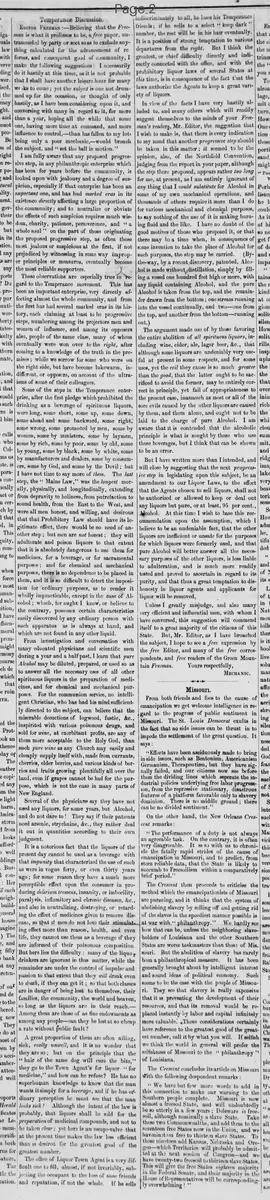
Temperance Discussion,
Editor Freeman:--Believing that the Freeman is what it professes to be, a free paper, untrammeled by party or sect so as to exclude anything calculated for the advancement of reforms, and consequent good of community, I make the following suggestions: I necessarily do it hastily at this time, as it is not probable that I shall have another leisure hour for many weeks to come; yet the subject is one not drummed up for the occasion, or thought of only hastily, as I have been considering upon it, and conversing with many in regard to it, for more than a year, hoping all the while that some one, having more time at command, and more influence to control,—than has fallen to my lot, being only a poor mechanic,—would broach the subject, and "set the ball in motion."
I am fully aware that any proposed progressive step, in any philanthropic enterprise which has been for years before the community, is looked upon with jealousy and a degree of suspicion, especially if that enterprise has been an important one, and has had marked eras in its existence directly affecting a large proportion of the community; and to neutralize or obviate the effects of such suspicion requires much wisdom, charity, patience, perseverance, and "a whole soul" on the part of those originating the proposed progressive step, as often those most jealous or suspicious at the first, if not prejudiced by witnessing in some way improper principles or measures, eventually become the most reliable supporters.
These observations are especially true in regard to the Temperance movement. This has been an important enterprise, very directly affecting almost the whole community, and from the first has had several marked eras in its history, each claiming at least to be progressive steps, numbering among its projectors men and women of influence, and among its opposers also, people of the same class, many of whom eventually were won over to the right, after coming to a knowledge of the truth in the premises; while we sorrow for some who were on the right side, but have become lukewarm, indifferent, or opposers, on account of the ultra-isms of some of their colleagues.
Some of the steps in the Temperance enterprise, after the first pledge which prohibited the drinking as a beverage of spirituous liquors, were long, some short, some up, some down, some ahead and some backward, some right; some wrong, some promoted by men, some by women, some by ministers, some by laymen, some by rich, some by poor, some by old, some by young, some by black, some by white, some by manufacturers and dealers, some by consumers, some by God, and some by the Devil; but I have not time to say more of them. The last step, the "Maine Law," was the longest morally, physically, and longitudinally, extending from depravity to holiness, from putrefaction to sound health, from the East to the West, and were all men honest, and willing, and desirous that that Prohibitory Law should have its legitimate effect, there would be no need of another step; but men are not honest; they will adulterate and poison liquors to that extent that it is absolutely dangerous to use them for medicines, for a beverage, or for sacramental purposes; and for chemical and mechanical purposes, there is no dependence to be placed in them, and it is so difficult to detect the imposition for ordinary purposes, as to render it wholly impracticable, except in the case of Alcohol; which, for aught I know, or believe to the contrary, possesses certain characteristics easily discovered by any ordinary person with such apparatus as is always at hand, and which are not found in any other liquid.
From investigation and conversation with many educated physicians and scientific men during a year and a half past, I learn that pure Alcohol may be diluted, prepared, or used so as to answer all the necessary uses of all other spirituous liquors in the preparation of medicines, and for chemical and mechanical purposes. For the communion service, no intelligent Christian, who has had his mind sufficiently directed to the subject, can believe that the miserable decoctions of logwood, fustic, &c., inspirited with various poisonous drugs, and sold for wine, at exorbitant profits, are any of them more acceptable to the Holy God, than such pure wine as any Church may easily and cheaply supply itself with, made from currants, cherries, elder berries, and various kinds of berries and fruits growing plentifully all over the land, even if grapes cannot be had for the purpose, which is not the case in many parts of New England.
Several of the physicians say they have not used any liquors, for some years, but Alcohol, and do not dare to! They say if their patients need arsenic, strychnine, &c., they rather deal it out in quantities according to their own judgment.
It is a notorious fact that the liquors of the present day cannot be used as a beverage with that impunity that characterized the use of such as were in vogue forty, or even thirty years ago; for some reason they have a much more perceptible effect upon the consumer in producing delirium tremens, insanity, or imbecility, paralysis, inflammatory and chronic diseases, &c., and also in neutralizing, destroying, or retarding the effect of medicines given to remove disease, so that if men do not love their stimulating effect more than reason, health, and even life, they cannot use them as a beverage if they are informed of their poisonous composition. But here lies the difficulty: many of the liquor drinkers are ignorant in this matter, while the remainder are under the control of impulse and passion to that extent that they will drink ever to death, if they can get it; so that both classes are in danger of being lost to themselves, their families, the community, the world and heaven, so long as the liquors are in their reach.--Among them are those of as fine endowments as among any people—can they be lost at so cheap a rate without public fault?
A great proportion of them are often ailing, sick, really unwell, and it is no wonder that they are so; but on the principle that the "hair of the same dog will cure the bite," they go to the Town Agent's for liquor "for medicine," and how can he refuse? He has no superhuman knowledge to know that the man wants it simply for a beverage, and if he has ordinary perception he must see that the man looks sick! Although the intent of the law is probably, that liquors shall be sold for the preparation of medicinal compounds, and not to be taken clear; yet here is an escape-valve that at the present time makes the law less efficient than is desired for the greatest good of the greatest number.
The office of Liquor Town Agent is a very difficult one to fill, almost, if not invariably, subjecting the occupant to the loss of some friends and reputation, if not the whole. If he sells indiscriminately to all, he loses his Temperance friends; if he sells to a select "keep dark" number, the rest will be in his hair eventually. It is a position of strong temptation to various departures from the right. But I think the greatest, or chief difficulty directly and indirectly connected with the office, and with the prohibitory liquor laws of several States at this time, is in consequence of the fact that the laws authorize the Agents to keep a great variety of liquors.
In view of the facts I have very hastily alluded to, and many others which will readily suggest themselves to the minds of your Freeman's readers, Mr. Editor, the suggestion that I wish to make is, that there is every indication to my mind that another progressive step should be taken in this matter; it seemed to be the opinion, also, of the Northfield Convention, judging from the report in your paper, although the step there proposed, appears rather too long for me, at present, as I am entirely ignorant of anything that I could substitute for Alcohol in some of my own mechanical operations, and thousands of others require it more than I do for various mechanical and chemical purposes, to say nothing of the use of it in making burning fluid and the like. I have no doubt of the good motives of those who proposed it, or that there may be a time when, in consequence of some invention to take the place of Alcohol for such purposes, the step may be carried. (By-the-way, by a recent discovery, patented, Alcohol is made without distillation, simply by filling a vessel one hundred feet high or more, with any liquid containing Alcohol, and the pure Alcohol is taken from the top, and the remainder drawn from the bottom; one stream running into the vessel continually, and two--one from the top, and another from the bottom-running out.)
The argument made use of by those favoring the entire abolition of all spirituous liquors, including wine, cider, ale, lager beer, &c., that although some liquors are undeniably very useful at present in some respects, and for some uses, yet the evil they cause is so much greater than the good, that the latter ought to be sacrificed to avoid the former, may be entirely correct in principle, yet fail of appropriateness to the present case, inasmuch as most or all of the sore evils caused by the other liquors are caused by them, and them alone, and ought not to be laid to the charge of pure Alcohol. I am aware that it is contended that the alcoholic principle is what is sought by those who use those beverages, but I think that can be shown to be an error.
But I have written more than I intended, and will close by suggesting that the next progressive step in legislating upon this subject, be an amendment to our Liquor Laws, to the effect that the Agents chosen to sell liquors, shall not be authorized or allowed to keep or deal out any liquors but pure, or at least, 95 per cent. Alcohol. At this time I wish to base this recommendation upon the assumption, which I believe to be an undeniable fact, that the other liquors are inefficient or unsafe for the purposes for which liquors were formerly used, and that pure Alcohol will better answer all the necessary purposes of the other liquors, is less liable to adulteration, and is much more readily tested and proved to ascertain in regard to its purity, and that thus a great temptation to dishonesty in liquor agents and applicants for liquor will be removed.
Unless I greatly misjudge, and also many very efficient and influential men, with whom I have conversed, this suggestion will commend itself to a great majority of the citizens of this State. But, Mr. Editor, as I have broached the subject, I hope to see a free expression by the free Editor, and many of the free correspondents, and free readers of the Green Mountain Freeman.
Yours respectfully,
Mechanic.
Editor Freeman:--Believing that the Freeman is what it professes to be, a free paper, untrammeled by party or sect so as to exclude anything calculated for the advancement of reforms, and consequent good of community, I make the following suggestions: I necessarily do it hastily at this time, as it is not probable that I shall have another leisure hour for many weeks to come; yet the subject is one not drummed up for the occasion, or thought of only hastily, as I have been considering upon it, and conversing with many in regard to it, for more than a year, hoping all the while that some one, having more time at command, and more influence to control,—than has fallen to my lot, being only a poor mechanic,—would broach the subject, and "set the ball in motion."
I am fully aware that any proposed progressive step, in any philanthropic enterprise which has been for years before the community, is looked upon with jealousy and a degree of suspicion, especially if that enterprise has been an important one, and has had marked eras in its existence directly affecting a large proportion of the community; and to neutralize or obviate the effects of such suspicion requires much wisdom, charity, patience, perseverance, and "a whole soul" on the part of those originating the proposed progressive step, as often those most jealous or suspicious at the first, if not prejudiced by witnessing in some way improper principles or measures, eventually become the most reliable supporters.
These observations are especially true in regard to the Temperance movement. This has been an important enterprise, very directly affecting almost the whole community, and from the first has had several marked eras in its history, each claiming at least to be progressive steps, numbering among its projectors men and women of influence, and among its opposers also, people of the same class, many of whom eventually were won over to the right, after coming to a knowledge of the truth in the premises; while we sorrow for some who were on the right side, but have become lukewarm, indifferent, or opposers, on account of the ultra-isms of some of their colleagues.
Some of the steps in the Temperance enterprise, after the first pledge which prohibited the drinking as a beverage of spirituous liquors, were long, some short, some up, some down, some ahead and some backward, some right; some wrong, some promoted by men, some by women, some by ministers, some by laymen, some by rich, some by poor, some by old, some by young, some by black, some by white, some by manufacturers and dealers, some by consumers, some by God, and some by the Devil; but I have not time to say more of them. The last step, the "Maine Law," was the longest morally, physically, and longitudinally, extending from depravity to holiness, from putrefaction to sound health, from the East to the West, and were all men honest, and willing, and desirous that that Prohibitory Law should have its legitimate effect, there would be no need of another step; but men are not honest; they will adulterate and poison liquors to that extent that it is absolutely dangerous to use them for medicines, for a beverage, or for sacramental purposes; and for chemical and mechanical purposes, there is no dependence to be placed in them, and it is so difficult to detect the imposition for ordinary purposes, as to render it wholly impracticable, except in the case of Alcohol; which, for aught I know, or believe to the contrary, possesses certain characteristics easily discovered by any ordinary person with such apparatus as is always at hand, and which are not found in any other liquid.
From investigation and conversation with many educated physicians and scientific men during a year and a half past, I learn that pure Alcohol may be diluted, prepared, or used so as to answer all the necessary uses of all other spirituous liquors in the preparation of medicines, and for chemical and mechanical purposes. For the communion service, no intelligent Christian, who has had his mind sufficiently directed to the subject, can believe that the miserable decoctions of logwood, fustic, &c., inspirited with various poisonous drugs, and sold for wine, at exorbitant profits, are any of them more acceptable to the Holy God, than such pure wine as any Church may easily and cheaply supply itself with, made from currants, cherries, elder berries, and various kinds of berries and fruits growing plentifully all over the land, even if grapes cannot be had for the purpose, which is not the case in many parts of New England.
Several of the physicians say they have not used any liquors, for some years, but Alcohol, and do not dare to! They say if their patients need arsenic, strychnine, &c., they rather deal it out in quantities according to their own judgment.
It is a notorious fact that the liquors of the present day cannot be used as a beverage with that impunity that characterized the use of such as were in vogue forty, or even thirty years ago; for some reason they have a much more perceptible effect upon the consumer in producing delirium tremens, insanity, or imbecility, paralysis, inflammatory and chronic diseases, &c., and also in neutralizing, destroying, or retarding the effect of medicines given to remove disease, so that if men do not love their stimulating effect more than reason, health, and even life, they cannot use them as a beverage if they are informed of their poisonous composition. But here lies the difficulty: many of the liquor drinkers are ignorant in this matter, while the remainder are under the control of impulse and passion to that extent that they will drink ever to death, if they can get it; so that both classes are in danger of being lost to themselves, their families, the community, the world and heaven, so long as the liquors are in their reach.--Among them are those of as fine endowments as among any people—can they be lost at so cheap a rate without public fault?
A great proportion of them are often ailing, sick, really unwell, and it is no wonder that they are so; but on the principle that the "hair of the same dog will cure the bite," they go to the Town Agent's for liquor "for medicine," and how can he refuse? He has no superhuman knowledge to know that the man wants it simply for a beverage, and if he has ordinary perception he must see that the man looks sick! Although the intent of the law is probably, that liquors shall be sold for the preparation of medicinal compounds, and not to be taken clear; yet here is an escape-valve that at the present time makes the law less efficient than is desired for the greatest good of the greatest number.
The office of Liquor Town Agent is a very difficult one to fill, almost, if not invariably, subjecting the occupant to the loss of some friends and reputation, if not the whole. If he sells indiscriminately to all, he loses his Temperance friends; if he sells to a select "keep dark" number, the rest will be in his hair eventually. It is a position of strong temptation to various departures from the right. But I think the greatest, or chief difficulty directly and indirectly connected with the office, and with the prohibitory liquor laws of several States at this time, is in consequence of the fact that the laws authorize the Agents to keep a great variety of liquors.
In view of the facts I have very hastily alluded to, and many others which will readily suggest themselves to the minds of your Freeman's readers, Mr. Editor, the suggestion that I wish to make is, that there is every indication to my mind that another progressive step should be taken in this matter; it seemed to be the opinion, also, of the Northfield Convention, judging from the report in your paper, although the step there proposed, appears rather too long for me, at present, as I am entirely ignorant of anything that I could substitute for Alcohol in some of my own mechanical operations, and thousands of others require it more than I do for various mechanical and chemical purposes, to say nothing of the use of it in making burning fluid and the like. I have no doubt of the good motives of those who proposed it, or that there may be a time when, in consequence of some invention to take the place of Alcohol for such purposes, the step may be carried. (By-the-way, by a recent discovery, patented, Alcohol is made without distillation, simply by filling a vessel one hundred feet high or more, with any liquid containing Alcohol, and the pure Alcohol is taken from the top, and the remainder drawn from the bottom; one stream running into the vessel continually, and two--one from the top, and another from the bottom-running out.)
The argument made use of by those favoring the entire abolition of all spirituous liquors, including wine, cider, ale, lager beer, &c., that although some liquors are undeniably very useful at present in some respects, and for some uses, yet the evil they cause is so much greater than the good, that the latter ought to be sacrificed to avoid the former, may be entirely correct in principle, yet fail of appropriateness to the present case, inasmuch as most or all of the sore evils caused by the other liquors are caused by them, and them alone, and ought not to be laid to the charge of pure Alcohol. I am aware that it is contended that the alcoholic principle is what is sought by those who use those beverages, but I think that can be shown to be an error.
But I have written more than I intended, and will close by suggesting that the next progressive step in legislating upon this subject, be an amendment to our Liquor Laws, to the effect that the Agents chosen to sell liquors, shall not be authorized or allowed to keep or deal out any liquors but pure, or at least, 95 per cent. Alcohol. At this time I wish to base this recommendation upon the assumption, which I believe to be an undeniable fact, that the other liquors are inefficient or unsafe for the purposes for which liquors were formerly used, and that pure Alcohol will better answer all the necessary purposes of the other liquors, is less liable to adulteration, and is much more readily tested and proved to ascertain in regard to its purity, and that thus a great temptation to dishonesty in liquor agents and applicants for liquor will be removed.
Unless I greatly misjudge, and also many very efficient and influential men, with whom I have conversed, this suggestion will commend itself to a great majority of the citizens of this State. But, Mr. Editor, as I have broached the subject, I hope to see a free expression by the free Editor, and many of the free correspondents, and free readers of the Green Mountain Freeman.
Yours respectfully,
Mechanic.
What sub-type of article is it?
Persuasive
Informative
Political
What themes does it cover?
Temperance
Morality
Politics
What keywords are associated?
Temperance Reform
Pure Alcohol
Maine Law
Liquor Agents
Prohibitory Laws
Adulterated Liquors
Town Agent
Northfield Convention
What entities or persons were involved?
Mechanic
Editor Freeman
Letter to Editor Details
Author
Mechanic
Recipient
Editor Freeman
Main Argument
the letter proposes amending prohibitory liquor laws so that town agents sell only pure or 95% alcohol, arguing it is safer, less adulterable, sufficient for medicinal, chemical, mechanical, and sacramental uses, and would reduce temptations to dishonesty and abuse compared to other adulterated liquors.
Notable Details
References The Maine Law As The Last Major Step In Temperance
Cites Conversations With Physicians Who Use Only Alcohol In Medicines
Mentions Northfield Convention's Report Advocating Broader Abolition
Describes A Patented Discovery For Producing Alcohol Without Distillation
Discusses Historical Eras And Steps In The Temperance Movement
Highlights Dangers Of Modern Adulterated Liquors Causing Diseases Like Delirium Tremens