Thank you for visiting SNEWPapers!
Sign up free
The Searchlight
Culbertson, Roosevelt County, Montana
What is this article about?
In 'Diva's Ruby,' Baraka seeks revenge on the man who deserted her after discovering a ruby mine in Asia. She encounters Konstantin Logotheti, who helps her. Entwined with romances involving opera singer Margaret Donne, financier Logotheti, American tycoon Rufus Van Torp, and Lady Maud, whose presumed-dead husband is impersonated by his twin brother, leading to revelations, arrests, marriages, and fortunes from the rubies.
Merged-components note: Merging images that spatially overlap with the serialized literary story 'Diva's Ruby', likely illustrations.
Clipping
OCR Quality
Full Text
By F. MARION CRAWFORD,
AUTHOR OF "SARACINESCA," "ARETHUSA," ETC.
COPYRIGHT, 1907
ILLUSTRATIONS BY A. W. WELLS
Synopsis.
Baraka, a Tartar girl, became enamored of a golden-bearded stranger who was prospecting and studying herbs in the vicinity of her home in central Asia, and revealed to him the location of a mine of rubies, hoping that the stranger would love her in return for her disclosure.
They were followed to the cave by the girl's relatives, who blocked up the entrance and drew off the water supply, leaving the couple to die. Baraka's cousin Saad, her betrothed, attempted to climb down a cliff overlooking the mine; but the traveler shot him. The stranger was revived from a water gourd Saad carried, dug his way out of the tunnel, and departed, deserting the girl and carrying a bag of rubies.
Baraka gathered all the gems she could carry, and started in pursuit. Margaret Donne ("Margarita" da Cordova), a famous prima donna, became engaged in London to Konstantin Logotheti, a wealthy Greek financier. Her intimate friend was Countess Leven, known as Lady Maud, whose husband had been killed by a bomb in St. Petersburg; and Lady Maud's most intimate friend was Rufus Van Torp, an American, who had become one of the richest men in the world.
Van Torp was in love with Margaret, and rushed to London as soon as he heard of her betrothal. He offered Lady Maud $500,000 for her pet charity if she would aid him in winning the singer from Logotheti. Baraka approached Logotheti at Versailles with rubies to sell. He presented a ruby to Margaret. Van Torp bought a yacht and sent it to Venice. He was visited by Baraka in male attire. She gave him a ruby after the American had told her of having seen in the United States a man answering the description of the one she loved. The American followed Margaret to the Bayreuth "Parsifal" festival. Margaret took a liking to Van Torp, who presented her with the ruby Baraka had given him.
Count Kralinsky, a Russian, arrived at Bayreuth. Van Torp believed him to be the one Baraka was pursuing. Baraka was arrested in London on the charge of stealing from Pinney, a jeweler, the ruby she had sold to Logotheti. Two strangers were the thieves. Lady Maud believed that Logotheti's associations with Baraka were open to suspicion, and so informed Margaret. Van Torp believed that Kralinsky was the cowboy he had known in his young manhood. Logotheti secured Baraka's release, and then, with her as his guest, went to sea on his yacht Erinna. Baraka explains her plans for revenge on the man who had deserted her and left her to die. Logotheti succeeds in moderating her rage. Lady Maud arrived in Bayreuth. Margaret and Van Torp entered into an agreement to build a tremendous opera house in New York. The thief who stole the ruby from Mr. Pinney was arrested in New York and the stone recovered. Lady Maud confided to Van Torp that she believed Kralinsky to be the husband she had believed dead. Van Torp promised his help to unravel the mystery. The party gathered on Van Torp's yacht and Lady Maud discovered that Kralinsky is her husband. He offered to rejoin and be true to her. She refused. Logotheti took Baraka ashore at Naples to procure her a proper outfit. He proposed to marry her, half in jocularity, and she agreed to do so if she could find the man she sought. Van Torp's yacht arrived at Messina, and not finding Logotheti there the party went on to Naples. The yachts met and Baraka recognized in Kralinsky the man she sought. Logotheti, Baraka and Spiro went aboard the Lancashire Lass.
CHAPTER XV.—Continued.
But now, at the very moment of meeting Margaret, he knew that if he found her very angry with him, he would simply listen to what she had to say, make a humble apology, state the truth coldly, and return to his own yacht with Baraka, under her very eyes, and in full sight of Lady Maud and Mrs. Rushmore.
Besides, he felt tolerably sure that when Spiro failed to carry out the young Tartar girl's murderous instructions, she would forget all about the oath she had sworn by the "inviolable water of the Styx" and try to kill him with her own hands, so that it would be necessary to take her away abruptly, and even forcibly.
Before the Erinna had quite lost her way, Logotheti had his naphtha launch puffing alongside, and he got into it with Baraka and Spiro, and the Lancashire Lass had barely time to lower her ladder, while still moving slowly, before the visitors were there.
Baraka bade Logotheti go up first and trod daintily on the grated steps as she followed him. The chief mate and chief steward were waiting at the gangway. The mate saluted; the steward led the visitors to the main saloon, ushered them in and shut the door.
Spiro was left outside, of course.
Mr. Van Torp shook hands coldly with Logotheti; Baraka walked directly to Kralinsky, and then stood stone-still before him, gazing up steadily into his eyes.
Neither Margaret nor Mrs. Rushmore was to be seen. Van Torp and Logotheti both watched the other two, looking from one face to the other.
Kralinsky, with his eye-glass in his eye, surveyed the lovely young barbarian unmoved, and the silence lasted half a minute. Then she spoke in her own language and Kralinsky answered her, and only Logotheti understood what they said to each other. Probably it did not occur to Kralinsky that the Greek knew Tartar.
"You are not Ivan. You are fatter, and you have not his eyes."
Logotheti drew a long breath.
"No," answered Kralinsky. "I am Yuryi, his brother. I never saw you, but he told me of you."
"Where is Ivan?"
"Dead."
The proud little head was bowed down for a moment and Baraka did not speak till several seconds had passed. Then she looked up again suddenly. Her dark eyes were quite dry.
"How long?"
"More than four months."
"You know it?"
"I was with him and buried him."
"It is enough."
She turned, her head high, and went to the door, and no one hindered her.
"Monsieur Logotheti!" Lady Maud called him, and the Greek crossed the saloon and stood by her. "He is not the man, I see," she said, with a vague doubt in her voice.
"No."
Van Torp was speaking with Kralinsky in low tones. Lady Maud spoke to Logotheti again, after an instant, in which she drew a painful breath and grew paler.
"Miss Donne knows that you are on board," she said, "but she wishes me to say that she will not see you, and that she considers her engagement at an end, after what you have done."
Logotheti did not hesitate.
"Will you kindly give a message to Miss Donne from me?" he asked.
"That quite depends on what it is."
Lady Maud answered coldly. She felt that she herself had got something near a death-wound, but she would not break down.
"I beg you to tell Miss Donne that I yield to her decision," said Logotheti with dignity. "We are not suited to each other, and it is better that we should part. But I cannot accept as the cause of our parting the fact that I have given my protection to a young girl whom I have extracted from great trouble and have treated, and still treat, precisely as I should have treated Miss Donne if she had been my guest. Will you tell her that?"
"I will tell her that."
"Thank you. Good-morning."
He turned and went towards the door, but stopped to speak to Van Torp.
"This gentleman," he said, "is not the man my guest was anxious to find, though he is strikingly like him. I have to thank you for giving her an opportunity of satisfying herself. Good morning."
Mr. Van Torp was extremely grateful to Logotheti for having ruined himself in Margaret's eyes, and would in any case have seen him to the gangway, but he was also very anxious to know what Kralinsky and Baraka had said to each other in Tartar. He therefore opened the door for the Greek, followed him out and shut it behind him. Baraka and Spiro had disappeared; they were already in the launch, waiting.
"Now what did they say, if it isn't a rude question?" asked the American.
Logotheti repeated the short conversation almost word for word.
"He said that his name was Yuryi," he concluded. "That is George in English."
"Oh, he's George, is he? And what's his dead brother's name, again, please?"
"Ivan. That is John. Before we part, Van Torp, I may as well tell you that my engagement with Miss Donne is at an end. She was good enough to inform me of her decision through Lady Maud. One thing more, please. I wish you to know, as between man and man, that I have treated Baraka as I would my own sister since I got her out of prison, and I beg that you won't encourage any disagreeable talk about her."
"Well, now," said the American slowly, "I'm glad to hear you say that, just in that way. I guess it'll be all right about any remarks on board my ship, now you've spoken."
"Thank you," said Logotheti, moving towards the gangway.
They shook hands with some cordiality, and Logotheti ran down the steps like a sailor, without laying his hand on the man-rope, stepped on board his launch and was off in a moment.
"Good-by! good-by, Miss Baraka, and good luck to you!" cried Van Torp, waving his cap.
Logotheti translated his words to Baraka, who looked back with a grateful smile, as if she had not just heard that the man she had risked her life to find in two continents had been dead four months.
"It was his portion," she said gravely, when she was alone with Logotheti on the Erinna, and the chain was coming in fast.
Van Torp went back to the main saloon and found Lady Maud and Kralinsky there. She was apparently about to leave the count, for she was coming towards the door, and her eyes were dark and angry.
"Rufus," she said, "this man is my husband, and insists that I should take him back. I will not. Will you kindly have me put ashore before you start again? My things are ready now."
"Excuse me," answered Mr. Van Torp, digging his large thumbs into his waistcoat pockets, "there's a mistake. He's not your husband."
"He is, indeed!" cried Lady Maud, in a tone her friend never forgot.
"I am Boris Leven," said Kralinsky in an authoritative tone, and coming forward almost defiantly.
"Then why did you tell the Tartar girl that your name was George?" asked Mr. Van Torp unmoved.
"I did not."
"You've evidently forgotten. That Greek gentleman speaks Tartar better than you. I wonder where you learned it! He's just told me you said your name was George."
"My name is George Boris," answered Kralinsky less confidently.
Kralinsky had never been face to face with Van Torp when he meant business, and the terrible American cowed him.
"My husband's name is only Boris—nothing else," said Lady Maud.
"Well, this isn't your husband; this is George, whoever he is, and if you don't believe it, I'm going to give you an object lesson."
Thereupon Mr. Van Torp pressed the button of a bell in the bulk-head near the door, which he opened, and he stood looking out. A steward came at once.
"Send me Stemp," said Van Torp in a low voice, as he stepped outside.
"Yes, sir."
"And, see here, send six sailors with him."
"Very good, sir."
Mr. Van Torp went in again and shut the door. Kralinsky disdained flight, and was looking out of a window. Lady Maud had sat down again. For the first time in her life she felt weak.
In less than one minute the door opened and Stemp appeared, impassive and respectful. Behind him was the boatswain, a huge Northumbrian, and five young seamen in perfectly new guernseys, with fair quiet faces.
"Stemp."
"Yes, sir."
"Take that man somewhere and shave him. Leave his mustache on."
Van Torp pointed to Kralinsky.
For once in his life Stemp gasped for breath. Kralinsky turned a greenish white, and seemed paralyzed with rage.
"Take his beard off, sir, you mean?"
"Yes. Leave his mustache. Here, men," added Van Torp, "take that fellow outside and hold him down in a chair while Stemp shaves him. See?"
The boatswain looked doubtful. "He's pretending to be somebody he's not," said Van Torp, "on my ship, and I want to see his face. It's mutiny if you don't obey orders!"
"Aye, aye, sir," responded the boatswain cheerfully, for he rather liked the job since there was a good reason for it.
But instead of going about his business gently, the Northumbrian giant suddenly dashed past Van Torp in a flash, and jumped and hurled himself head foremost at Kralinsky's legs, exactly as if he were diving. In the count's violent fall the revolver he had drawn was thrown from his hand and went off in the air. The boatswain had seen it in time. The big man struggled a little, but the five seamen held him fast and carried him out kicking.
"Stemp."
The valet was preparing to follow the prisoner, and was quite calm again.
"Yes, sir."
"If he won't sit still to be shaved, cut his head off."
"Yes, sir."
Van Torp's eyes were awful to see. He had never been so angry in his life. He turned and saw Lady Maud pressing her handkerchief to her right temple.
The ball had grazed it, though it had certainly not been meant for her.
"Rufus!" she cried in great distress, "what have you done?"
"The question is what he's done to you," answered Van Torp. "I believe the blackguard has shot you!"
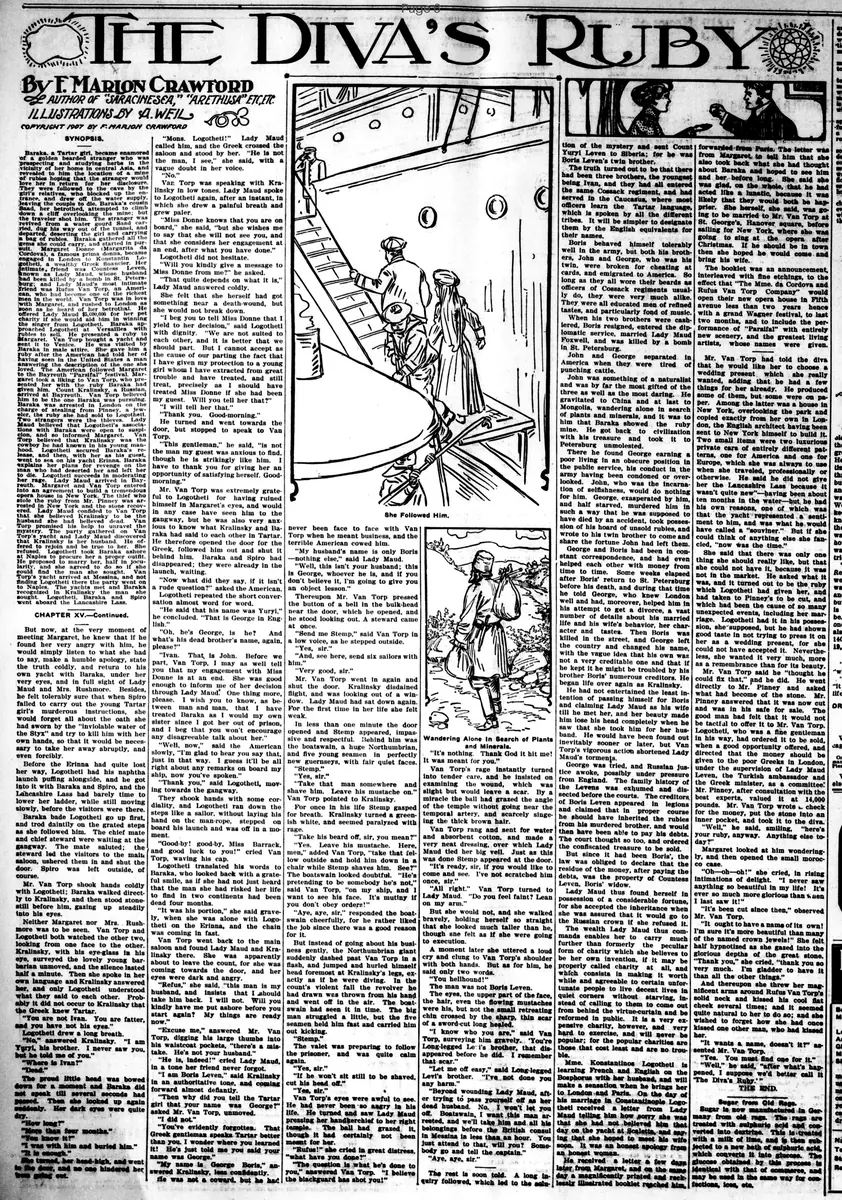
Wandering Alone In Search of Plants and Minerals.
"It's nothing. Thank God it hit me! It was meant for you."
Van Torp's rage instantly turned into tender care, and he insisted on examining the wound, which was slight but would leave a scar. By a miracle the ball had grazed the angle of the temple without going near the temporal artery, and scarcely singeing the thick brown hair.
Van Torp rang and sent for water and absorbent cotton, and made a very neat dressing, over which Lady Maud tied her big veil. Just as this was done Stemp appeared at the door.
"It's ready, sir, if you would like to come and see. I've not scratched him once, sir."
"All right." Van Torp turned to Lady Maud. "Do you feel faint? Lean on my arm."
But she would not, and she walked bravely, holding herself so straight that she looked much taller than he, though she felt as if she were going to execution.
A moment later she uttered a loud cry and clung to Van Torp's shoulder with both hands. But as for him, he said only two words.
"You hellhound!"
The man was not Boris Leven. The eyes, the upper part of the face, the hair, even the flowing mustaches were his, but not the small retreating chin crossed by the sharp, thin scar of a sword-cut long healed.
"I know who you are," said Van Torp, surveying him gravely. "You're Long-legged Levi's brother, that disappeared before he did. I remember that scar."
"Let me off easy," said Long-legged Levi's brother. "I've not done you any harm."
"Beyond wounding Lady Maud, after trying to pass yourself off as her dead husband. No. I won't let you off. Boatswain, I want this man arrested, and we'll take him and all his belongings before the British consul in Messina in less than an hour. You just attend to that, will you? Somebody go and tell the captain."
"Aye, aye, sir."
The rest is soon told. A long inquiry followed, which led to the solution of the mystery and sent Count Yuryi Leven to Siberia; for he was Boris Leven's twin brother.
The truth turned out to be that there had been three brothers, the youngest being Ivan, and they had all entered the same Cossack regiment, and had served in the Caucasus, where most officers learn the Tartar language, which is spoken by all the different tribes. It will be simpler to designate them by the English equivalents for their names.
Boris behaved himself tolerably well in the army, but both his brothers, John and George, who was his twin, were broken for cheating at cards, and emigrated to America. So long as they all wore their beards as officers of Cossack regiments usually do, they were very much alike.
They were all educated men of refined tastes, and particularly fond of music. When his two brothers were cashiered, Boris resigned, entered the diplomatic service, married Lady Maud Foxwell, and was killed by a bomb in St. Petersburg.
John and George separated in America when they were tired of punching cattle. John was something of a naturalist and was by far the most gifted of the three as well as the most daring. He gravitated to China and at last to Mongolia, wandering alone in search of plants and minerals, and it was to him that Baraka showed the ruby mine. He got back to civilization with his treasure and took it to Petersburg unmolested.
There he found George earning a poor living in an obscure position in the public service, his conduct in the army having been condoned or overlooked. John, who was the incarnation of selfishness, would do nothing for him. George, exasperated by him, and half starved, murdered him in such a way that he was supposed to have died by an accident, took possession of his hoard of unsold rubies, and wrote to his twin brother to come and share the fortune John had left them.
George and Boris had been in constant correspondence, and had even helped each other with money from time to time. Some weeks elapsed after Boris' return to St. Petersburg before his death, and during that time he told George, who knew London well and had, moreover, helped him in his attempt to get a divorce, a vast number of details about his married life and his wife's behavior, her character and tastes. Then Boris was killed in the street, and George left the country and changed his name, with the vague idea that his own was not a very creditable one and that if he kept it he might be troubled by his brother Boris' numerous creditors. He began life over again as Kralinsky.
He had not entertained the least intention of passing himself for Boris and claiming Lady Maud as his wife till he met her, and her beauty made him lose his head completely when he saw that she took him for her husband. He would have been found out inevitably sooner or later, but Van Torp's vigorous action shortened Lady Maud's torments.
George was tried, and Russian justice awoke, possibly under pressure from England. The family history of the Levens was exhumed and dissected before the courts. The creditors of Boris Leven appeared in legions and claimed that in proper course he should have inherited the rubies from his murdered brother, and would then have been able to pay his debts. The court thought so too, and ordered the confiscated treasure to be sold. But since it had been Boris', the law was obliged to declare that the residue of the money, after paying the debts, was the property of Countess Leven, Boris' widow.
Lady Maud thus found herself in possession of a considerable fortune, for she accepted the inheritance when she was assured that it would go to the Russian crown if she refused it.
The wealth Lady Maud thus commands enables her to carry much further than formerly the peculiar form of charity which she believes to be her own invention, if it may be properly called charity at all, and which consists in making it worth while and agreeable to certain unfortunate people to live decent lives in quiet corners without starving, instead of calling to them to come out from behind the virtue-curtain and be reformed in public. It is a very expensive charity, however, and very hard to exercise, and will never be popular; for the popular charities are those that cost least and are no trouble.
Mme. Konstantin Logotheti is learning French and English on the Bosphorus with her husband, and will make a sensation when he brings her to London and Paris. On the day of his marriage in Constantinople Logotheti received a letter from Lady Maud telling him how sorry she was that she had not believed him that day on the yacht at Scaletta, and saying that she hoped to meet his wife soon. It was an honest letter from an honest woman.
He received a letter a few days later from Margaret, and on the same day a magnificently printed and recklessly illustrated booklet received forwarded from Paris.
The letter was from Margaret to tell him that she also took back what she had thought about Baraka and hoped to see him and her before long. She said she was glad, on the whole, that he had acted like a lunatic, because it was likely that they would both be happier. She herself, she said, was going to be married to Mr. Van Torp at St. George's, Hanover Square, before sailing for New York, where she was going to sing at the opera after Christmas. If he should be in town then she hoped he would come and bring his wife.
The booklet was an announcement, interleaved with fine etchings, to the effect that "The Mme. da Cordova and Rufus Van Torp Company" would open their new opera house in Fifth Avenue less than two years hence with a grand Wagner festival, to last two months, and to include the performance of "Parsifal" with entirely new scenery, and the greatest living artists, whose names were given.
Mr. Van Torp had told the diva that he would like her to choose a wedding present, which she really wanted, adding that he had a few things for her already. He produced some of them, but some were on paper. Among the latter was a house in New York, overlooking the park and copied exactly from her own in London, the English architect having been sent to New York himself to build it.
Two small items were two luxurious private cars of entirely different patterns, one for America and one for Europe, which she was always to use when she traveled, professionally or otherwise. He said he did not give her the Lancashire Lass because it wasn't quite new—having been about ten months in the water—but he had his own reasons, one of which was that the yacht represented a sentiment to him, and was what he would have called a "souvenir." But if she could think of anything else she fancied, "now was the time."
She said that there was only one thing she should really like, but that she could not have it, because it was not in the market. He asked what it was, and it turned out to be the ruby which Logotheti had given her, and had taken to Pinney's to be cut, and which had been the cause of so many unexpected events, including her marriage. Logotheti had it in his possession, she supposed, but he had shown good taste in not trying to press it on her as a wedding present, for she could not have accepted it. Nevertheless, she wanted it very much, more as a remembrance than for its beauty.
Mr. Van Torp said he "thought he could fix that," and he did. He went directly to Mr. Pinney and asked what had become of the stone. Mr. Pinney answered that it was now cut and was in his safe for sale. The good man had felt that it would not be tactful to offer it to Mr. Van Torp. Logotheti, who was a fine gentleman in his way, had ordered it to be sold, when a good opportunity offered, and directed that the money should be given to the poor Greeks in London, under the supervision of Lady Maud Leven, the Turkish ambassador and the Greek minister, as a committee.
Mr. Pinney, after consultation with the best experts, valued it at 14,000 pounds. Mr. Van Torp wrote a check for the money, put the stone into an inner pocket, and took it to the diva.
"Well," he said, smiling, "here's your ruby, anyway. Anything else to-day?"
Margaret looked at him wonderingly, and then opened the small morocco case.
"Oh—oh—oh!" she cried, in rising intonations of delight. "I never saw anything so beautiful in my life! It's ever so much more glorious than when I last saw it!"
"It's been cut since then," observed Mr. Van Torp.
"It ought to have a name of its own! I'm sure it's more beautiful than many of the named crown jewels!" She felt half hypnotized as she gazed into the glorious depths of the great stone.
"Thank you," she cried, "thank you so very much. I'm gladder to have it than all the other things."
And thereupon she threw her magnificent arms around Rufus Van Torp's solid neck and kissed his cool fat cheek several times; and it seemed quite natural to her to do so; and she wished to forget how she had once kissed one other man, who had kissed her.
"It wants a name, doesn't it?" assented Mr. Van Torp.
"Yes. You must find one for it."
"Well," he said, "after what's happened, I suppose we'd better call it 'The Diva's Ruby.'"
THE END
What sub-type of article is it?
What themes does it cover?
What keywords are associated?
What entities or persons were involved?
Where did it happen?
Story Details
Key Persons
Location
Central Asia, London, Versailles, Bayreuth, Venice, Naples, Messina, New York, Bosphorus, Constantinople
Story Details
Baraka, deserted by explorer Ivan after discovering a ruby mine, pursues him across continents seeking revenge. She allies with Logotheti, who protects her. Interwoven romances: Margaret ends engagement to Logotheti, marries Van Torp; Lady Maud rejects impersonator Kralinsky (Yuryi Leven, twin of her dead husband Boris). Revelations expose family secrets, murders, and ruby fortunes, leading to marriages, inheritances, and justice.