Thank you for visiting SNEWPapers!
Sign up free
Story
July 28, 1955
The Camas Hot Springs Exchange
Hot Springs, Camas, Sanders County, Montana
What is this article about?
Montana's State Land Board negotiated a 1953 land trade with BLM, exchanging Glacier Park timberland for federal acres, including mineral rights. BLM later reneged, reducing state-beneficial terms amid oil speculation. The board refuses the revision and considers selling the timber for school funds.
Clipping
OCR Quality
98%
Excellent
Full Text
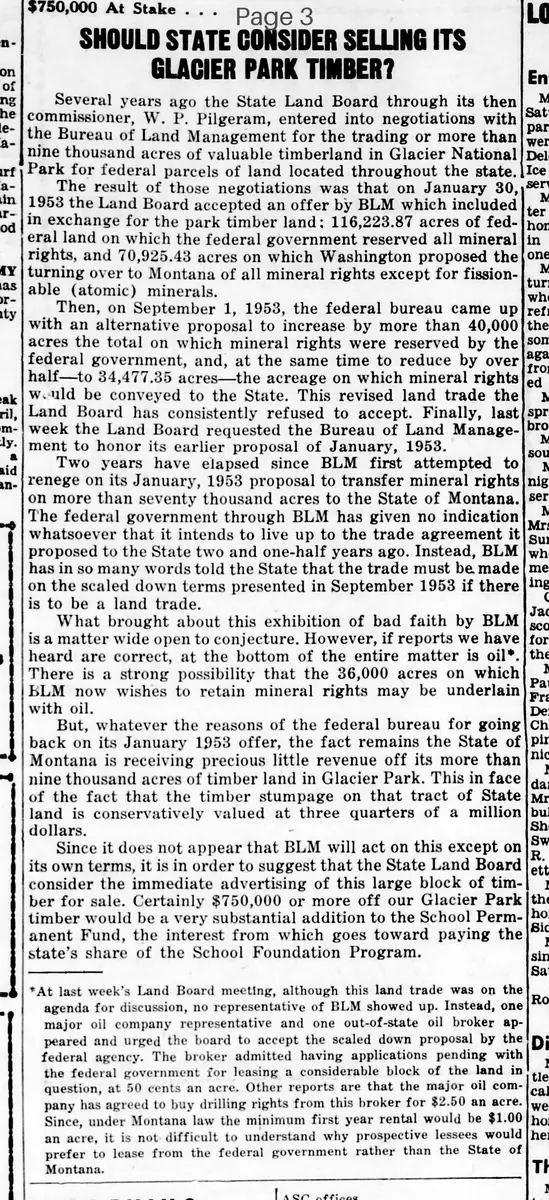
SHOULD STATE CONSIDER SELLING ITS GLACIER PARK TIMBER?
Several years ago the State Land Board through its then commissioner, W. P. Pilgeram, entered into negotiations with the Bureau of Land Management for the trading of more than nine thousand acres of valuable timberland in Glacier National Park for federal parcels of land located throughout the state.
The result of those negotiations was that on January 30, 1953 the Land Board accepted an offer by BLM which included in exchange for the park timber land: 116,223.87 acres of federal land on which the federal government reserved all mineral rights, and 70,925.43 acres on which Washington proposed the turning over to Montana of all mineral rights except for fissionable (atomic) minerals.
Then, on September 1, 1953, the federal bureau came up with an alternative proposal to increase by more than 40,000 acres the total on which mineral rights were reserved by the federal government, and, at the same time to reduce by over half—to 34,477.35 acres—the acreage on which mineral rights would be conveyed to the State. This revised land trade the Land Board has consistently refused to accept. Finally, last week the Land Board requested the Bureau of Land Management to honor its earlier proposal of January, 1953.
Two years have elapsed since BLM first attempted to renege on its January, 1953 proposal to transfer mineral rights on more than seventy thousand acres to the State of Montana.
The federal government through BLM has given no indication whatsoever that it intends to live up to the trade agreement it proposed to the State two and one-half years ago. Instead, BLM has in so many words told the State that the trade must be made on the scaled down terms presented in September 1953 if there is to be a land trade.
What brought about this exhibition of bad faith by BLM is a matter wide open to conjecture. However, if reports we have heard are correct, at the bottom of the entire matter is oil.
There is a strong possibility that the 36,000 acres on which BLM now wishes to retain mineral rights may be underlain with oil.
But, whatever the reasons of the federal bureau for going back on its January 1953 offer, the fact remains the State of Montana is receiving precious little revenue off its more than nine thousand acres of timber land in Glacier Park. This in face of the fact that the timber stumpage on that tract of State land is conservatively valued at three quarters of a million dollars.
Since it does not appear that BLM will act on this except on its own terms, it is in order to suggest that the State Land Board consider the immediate advertising of this large block of timber for sale. Certainly $750,000 or more off our Glacier Park timber would be a very substantial addition to the School Permanent Fund, the interest from which goes toward paying the state's share of the School Foundation Program.
*At last week's Land Board meeting, although this land trade was on the agenda for discussion, no representative of BLM showed up. Instead, one major oil company representative and one out-of-state oil broker appeared and urged the board to accept the scaled down proposal by the federal agency. The broker admitted having applications pending with the federal government for leasing a considerable block of the land in question, at 50 cents an acre. Other reports are that the major oil company has agreed to buy drilling rights from this broker for $2.50 an acre.
Since, under Montana law the minimum first year rental would be $1.00 an acre, it is not difficult to understand why prospective lessees would prefer to lease from the federal government rather than the State of Montana.
Several years ago the State Land Board through its then commissioner, W. P. Pilgeram, entered into negotiations with the Bureau of Land Management for the trading of more than nine thousand acres of valuable timberland in Glacier National Park for federal parcels of land located throughout the state.
The result of those negotiations was that on January 30, 1953 the Land Board accepted an offer by BLM which included in exchange for the park timber land: 116,223.87 acres of federal land on which the federal government reserved all mineral rights, and 70,925.43 acres on which Washington proposed the turning over to Montana of all mineral rights except for fissionable (atomic) minerals.
Then, on September 1, 1953, the federal bureau came up with an alternative proposal to increase by more than 40,000 acres the total on which mineral rights were reserved by the federal government, and, at the same time to reduce by over half—to 34,477.35 acres—the acreage on which mineral rights would be conveyed to the State. This revised land trade the Land Board has consistently refused to accept. Finally, last week the Land Board requested the Bureau of Land Management to honor its earlier proposal of January, 1953.
Two years have elapsed since BLM first attempted to renege on its January, 1953 proposal to transfer mineral rights on more than seventy thousand acres to the State of Montana.
The federal government through BLM has given no indication whatsoever that it intends to live up to the trade agreement it proposed to the State two and one-half years ago. Instead, BLM has in so many words told the State that the trade must be made on the scaled down terms presented in September 1953 if there is to be a land trade.
What brought about this exhibition of bad faith by BLM is a matter wide open to conjecture. However, if reports we have heard are correct, at the bottom of the entire matter is oil.
There is a strong possibility that the 36,000 acres on which BLM now wishes to retain mineral rights may be underlain with oil.
But, whatever the reasons of the federal bureau for going back on its January 1953 offer, the fact remains the State of Montana is receiving precious little revenue off its more than nine thousand acres of timber land in Glacier Park. This in face of the fact that the timber stumpage on that tract of State land is conservatively valued at three quarters of a million dollars.
Since it does not appear that BLM will act on this except on its own terms, it is in order to suggest that the State Land Board consider the immediate advertising of this large block of timber for sale. Certainly $750,000 or more off our Glacier Park timber would be a very substantial addition to the School Permanent Fund, the interest from which goes toward paying the state's share of the School Foundation Program.
*At last week's Land Board meeting, although this land trade was on the agenda for discussion, no representative of BLM showed up. Instead, one major oil company representative and one out-of-state oil broker appeared and urged the board to accept the scaled down proposal by the federal agency. The broker admitted having applications pending with the federal government for leasing a considerable block of the land in question, at 50 cents an acre. Other reports are that the major oil company has agreed to buy drilling rights from this broker for $2.50 an acre.
Since, under Montana law the minimum first year rental would be $1.00 an acre, it is not difficult to understand why prospective lessees would prefer to lease from the federal government rather than the State of Montana.
What sub-type of article is it?
Historical Event
What themes does it cover?
Deception
Justice
Misfortune
What keywords are associated?
Land Trade
Glacier Park Timber
Blm Negotiation
Mineral Rights
Oil Speculation
State Revenue
What entities or persons were involved?
W. P. Pilgeram
State Land Board
Bureau Of Land Management
Where did it happen?
Glacier National Park, Montana
Story Details
Key Persons
W. P. Pilgeram
State Land Board
Bureau Of Land Management
Location
Glacier National Park, Montana
Event Date
January 30, 1953; September 1, 1953
Story Details
State Land Board negotiated land trade with BLM in 1953 for Glacier Park timberland, but BLM reneged on mineral rights transfer amid oil speculation; board refuses revised terms and considers selling timber.