Thank you for visiting SNEWPapers!
Sign up free
The Times News
Hendersonville, Henderson County, North Carolina
What is this article about?
Gold worth $25.5 million rushed from France to US amid Roosevelt's gold buying; Washington observers see currency war signs as Bank of England weakens pound against rising dollar, with US secrecy on stabilization fund.
Clipping
OCR Quality
Full Text
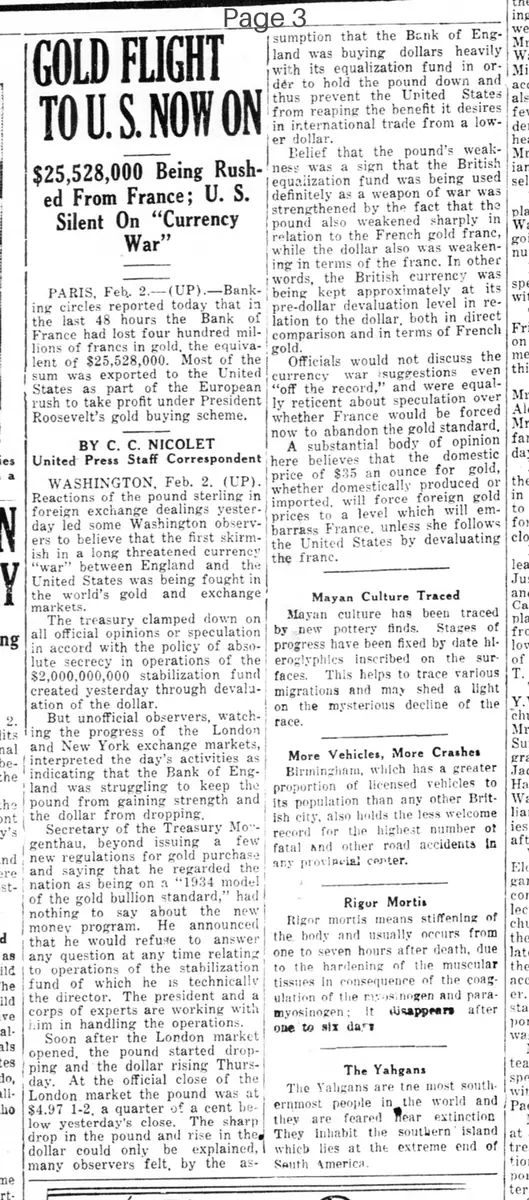
TO U. S. NOW ON
$25,528,000 Being Rushed From France; U. S.
Silent On "Currency War"
PARIS, Feb. 2.-(UP).-Banking circles reported today that in the last 48 hours the Bank of France had lost four hundred millions of francs in gold, the equivalent of $25,528,000. Most of the sum was exported to the United States as part of the European rush to take profit under President Roosevelt's gold buying scheme.
BY C.C. NICOLET
United Press Staff Correspondent
WASHINGTON, Feb. 2. (UP).
Reactions of the pound sterling in foreign exchange dealings yesterday led some Washington observers to believe that the first skirmish in a long threatened currency "war" between England and the United States was being fought in the world's gold and exchange markets.
The treasury clamped down on all official opinions or speculation in accord with the policy of absolute secrecy in operations of the $2,000,000,000 stabilization fund created yesterday through devaluation of the dollar.
But unofficial observers, watching the progress of the London and New York exchange markets, interpreted the day's activities as indicating that the Bank of England was struggling to keep the pound from gaining strength and the dollar from dropping.
Secretary of the Treasury Morgenthau, beyond issuing a few new regulations for gold purchases and saying that he regarded the nation as being on a "1934 model of the gold bullion standard," had nothing to say about the new money program. He announced that he would refuse to answer any question at any time relating to operations of the stabilization fund of which he is technically the director. The president and a corps of experts are working with him in handling the operations.
Soon after the London market opened, the pound started dropping and the dollar rising Thursday. At the official close of the London market the pound was at $4.97 1-2, a quarter of a cent below yesterday's close. The sharp drop in the pound and rise in the dollar could only be explained, many observers felt, by the assumption that the Bank of England was buying dollars heavily with its equalization fund in order to hold the pound down and thus prevent the United States from reaping the benefit it desires in international trade from a lower dollar.
Belief that the pound's weakness was a sign that the British equalization fund was being used definitely as a weapon of war was strengthened by the fact that the pound also weakened sharply in relation to the French gold franc, while the dollar also was weakening in terms of the franc. In other words, the British currency was being kept approximately at its pre-dollar devaluation level in relation to the dollar, both in direct comparison and in terms of French gold.
Officials would not discuss the currency war suggestions even "off the record," and were equally reticent about speculation over whether France would be forced now to abandon the gold standard.
A substantial body of opinion here believes that the domestic price of $35 an ounce for gold, whether domestically produced or imported, will force foreign gold prices to a level which will embarrass France, unless she follows the United States by devaluating the franc.
What sub-type of article is it?
What keywords are associated?
Where did it happen?
Foreign News Details
Primary Location
Paris, France
Event Date
Feb. 2
Outcome
bank of france lost four hundred millions of francs in gold, equivalent to $25,528,000, mostly exported to the united states; pound sterling dropped to $4.97 1-2, dollar rose
Event Details
Banking circles in Paris reported that in the last 48 hours the Bank of France had lost $25,528,000 in gold exported to the US under President Roosevelt's gold buying scheme. In Washington, observers interpreted reactions in foreign exchange markets as the first skirmish in a currency war between England and the US, with the Bank of England buying dollars to keep the pound from gaining strength. The US Treasury maintained secrecy on the stabilization fund operations. The pound weakened against the dollar and French franc, suggesting British efforts to prevent US trade benefits from dollar devaluation. Speculation arose that France might abandon the gold standard due to the US gold price of $35 an ounce.