Thank you for visiting SNEWPapers!
Sign up free
Story
April 14, 1903
The Providence News
Providence, Providence County, Rhode Island
What is this article about?
History of art embroidery using shadow-tone silks, invented in Japan, popularized in Europe, and brought to America by imported artists. Japanese expert Mr. K. K. Tsuboyama annually teaches the technique for free at O'Gorman Company in Providence, showcasing embroidered works including a portrait of President McKinley.
Clipping
OCR Quality
98%
Excellent
Full Text
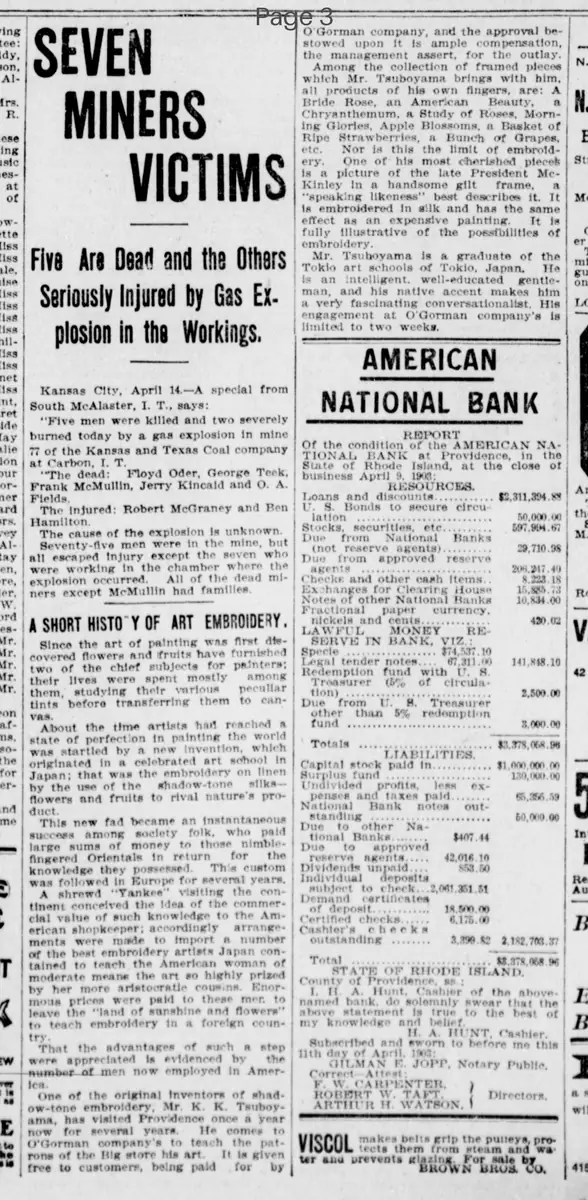
A SHORT HISTORY OF ART EMBROIDERY.
Since the art of painting was first discovered flowers and fruits have furnished two of the chief subjects for painters: their lives were spent mostly among them, studying their various peculiar tints before transferring them to canvas.
About the time artists had reached a state of perfection in painting the world was startled by a new invention, which originated in a celebrated art school in Japan: that was the embroidery on linen by the use of the shadow-tone silks—flowers and fruits to rival nature's product.
This new fad became an instantaneous success among society folk, who paid large sums of money to those nimble-fingered Orientals in return for the knowledge they possessed. This custom was followed in Europe for several years.
A shrewd "Yankee" visiting the continent conceived the idea of the commercial value of such knowledge to the American shopkeeper; accordingly arrangements were made to import a number of the best embroidery artists Japan contained to teach the American woman of moderate means the art so highly prized by her more aristocratic cousins. Enormous prices were paid to these men to leave the "land of sunshine and flowers" to teach embroidery in a foreign country.
That the advantages of such a step were appreciated is evidenced by the number of men now employed in America.
One of the original inventors of shadow-tone embroidery, Mr. K. K. Tsuboyama, has visited Providence once a year now for several years. He comes to O'Gorman company's to teach the patrons of the Big store his art. It is given free to customers, being paid for by O'Gorman company, and the approval bestowed upon it is ample compensation the management assert, for the outlay.
Among the collection of framed pieces which Mr. Tsuboyama brings with him, all products of his own fingers, are: A Bride Rose, an American Beauty, a Chrysanthemum, a Study of Roses, Morning Glories, Apple Blossoms, a Basket of Ripe Strawberries, a Bunch of Grapes, etc.
Nor is this the limit of embroidery. One of his most cherished pieces is a picture of the late President McKinley in a handsome gilt frame, a "speaking likeness" best describes it. It is embroidered in silk and has the same effect as an expensive painting. It is fully illustrative of the possibilities of embroidery.
Mr. Tsuboyama is a graduate of the Tokio art schools of Tokio, Japan. He is an intelligent, well-educated gentleman, and his native accent makes him a very fascinating conversationalist. His engagement at O'Gorman company's is limited to two weeks.
Since the art of painting was first discovered flowers and fruits have furnished two of the chief subjects for painters: their lives were spent mostly among them, studying their various peculiar tints before transferring them to canvas.
About the time artists had reached a state of perfection in painting the world was startled by a new invention, which originated in a celebrated art school in Japan: that was the embroidery on linen by the use of the shadow-tone silks—flowers and fruits to rival nature's product.
This new fad became an instantaneous success among society folk, who paid large sums of money to those nimble-fingered Orientals in return for the knowledge they possessed. This custom was followed in Europe for several years.
A shrewd "Yankee" visiting the continent conceived the idea of the commercial value of such knowledge to the American shopkeeper; accordingly arrangements were made to import a number of the best embroidery artists Japan contained to teach the American woman of moderate means the art so highly prized by her more aristocratic cousins. Enormous prices were paid to these men to leave the "land of sunshine and flowers" to teach embroidery in a foreign country.
That the advantages of such a step were appreciated is evidenced by the number of men now employed in America.
One of the original inventors of shadow-tone embroidery, Mr. K. K. Tsuboyama, has visited Providence once a year now for several years. He comes to O'Gorman company's to teach the patrons of the Big store his art. It is given free to customers, being paid for by O'Gorman company, and the approval bestowed upon it is ample compensation the management assert, for the outlay.
Among the collection of framed pieces which Mr. Tsuboyama brings with him, all products of his own fingers, are: A Bride Rose, an American Beauty, a Chrysanthemum, a Study of Roses, Morning Glories, Apple Blossoms, a Basket of Ripe Strawberries, a Bunch of Grapes, etc.
Nor is this the limit of embroidery. One of his most cherished pieces is a picture of the late President McKinley in a handsome gilt frame, a "speaking likeness" best describes it. It is embroidered in silk and has the same effect as an expensive painting. It is fully illustrative of the possibilities of embroidery.
Mr. Tsuboyama is a graduate of the Tokio art schools of Tokio, Japan. He is an intelligent, well-educated gentleman, and his native accent makes him a very fascinating conversationalist. His engagement at O'Gorman company's is limited to two weeks.
What sub-type of article is it?
Historical Event
Curiosity
What themes does it cover?
Triumph
Exploration
What keywords are associated?
Art Embroidery
Shadow Tone Silks
Japanese Artists
Providence Teaching
Tsuboyama
Mckinley Portrait
What entities or persons were involved?
Mr. K. K. Tsuboyama
Where did it happen?
Japan, Europe, America, Providence
Story Details
Key Persons
Mr. K. K. Tsuboyama
Location
Japan, Europe, America, Providence
Story Details
The invention of shadow-tone silk embroidery in Japan revolutionized art, spreading to Europe and America where artists like Mr. Tsuboyama taught it, demonstrating its potential through floral and presidential portraits.