Thank you for visiting SNEWPapers!
Sign up free
The New York Journal, And Daily Patriotic Register
New York, New York County, New York
What is this article about?
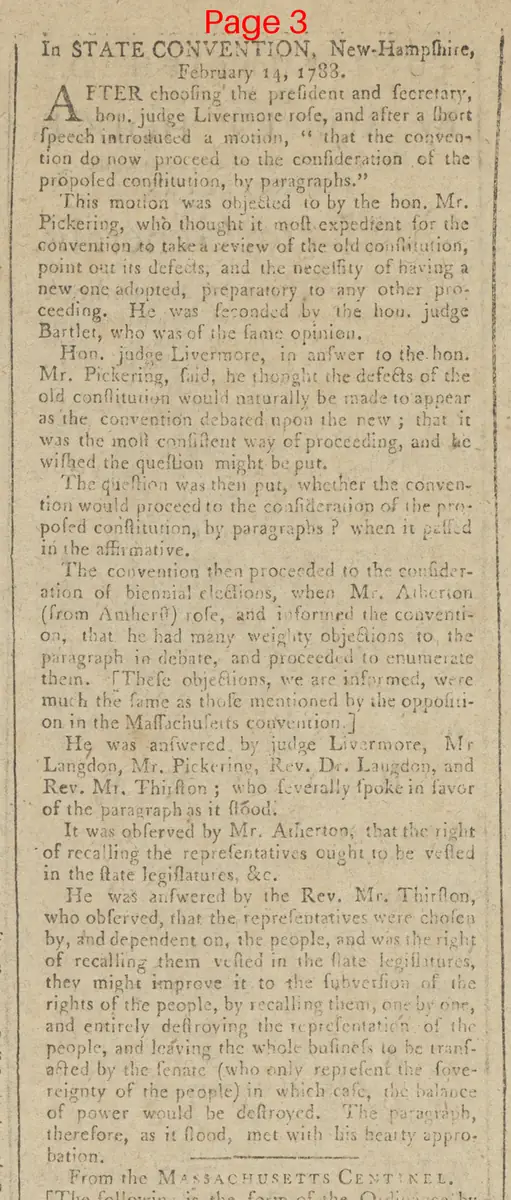
New Hampshire State Convention on February 14, 1788, voted to consider the proposed U.S. Constitution by paragraphs after debate. Discussion then turned to biennial elections, with Mr. Atherton raising objections similar to those in Massachusetts, countered by Judge Livermore, Mr. Langdon, Mr. Pickering, Rev. Dr. Langdon, and Rev. Mr. Thiston.
Clipping
OCR Quality
Full Text
February 14, 1788.
AFTER choosing the president and secretary,
hon. judge Livermore rose, and after a short
speech introduced a motion, "that the conven-
tion do now proceed to the consideration of the
proposed constitution, by paragraphs."
This motion was objected to by the hon. Mr.
Pickering, who thought it most expedient for the
convention to take a review of the old constitution,
point out its defects, and the necessity of having a
new one adopted, preparatory to any other pro-
ceeding. He was seconded by the hon. judge
Bartlet, who was of the same opinion.
Hon. judge Livermore, in answer to the hon.
Mr. Pickering, said, he thought the defects of the
old constitution would naturally be made to appear
as the convention debated upon the new; that it
was the most consistent way of proceeding, and he
wished the question might be put.
The question was then put, whether the conven-
tion would proceed to the consideration of the pro-
posed constitution, by paragraphs? when it passed
in the affirmative.
The convention then proceeded to the considera-
tion of biennial elections, when Mr. Atherton
(from Amherst) rose, and informed the conven-
vention, that he had many weighty objections to the
paragraph in debate, and proceeded to enumerate
them. These objections, we are informed, were
much the same as those mentioned by the opposi-
tion in the Massachusetts convention.
He was answered by judge Livermore, Mr.
Langdon, Mr. Pickering, Rev. Dr. Langdon, and
Rev. Mr. Thiston; who severally spoke in favor
of the paragraph as it stood.
It was observed by Mr. Atherton, that the right
of recalling the representatives ought to be vested
in the state legislatures, &c.
He was answered by the Rev. Mr. Thiston
who observed, that the representatives were chosen
by, and dependent on, the people, and was the right
of recalling them vested in the state legislatures,
they might improve it to the subversion of the
rights of the people, by recalling them, one by one,
and entirely destroying the representation of the
people, and leaving the whole business to be trans-
acted by the senate (who only represent the sov-
ereignty of the people) in which case, the balance
of power would be destroyed. The paragraph,
therefore, as it stood, met with his hearty appro-
bation.
What sub-type of article is it?
What keywords are associated?
What entities or persons were involved?
Where did it happen?
Domestic News Details
Primary Location
New Hampshire
Event Date
February 14, 1788
Key Persons
Outcome
motion to proceed to consideration of the proposed constitution by paragraphs passed in the affirmative. debate on biennial elections featured objections from mr. atherton and supporting arguments from others.
Event Details
After electing officers, Judge Livermore moved to consider the proposed constitution by paragraphs, opposed by Mr. Pickering and Judge Bartlet who favored reviewing the old constitution first. Livermore replied that defects would appear during debate. The motion passed. The convention then debated biennial elections; Mr. Atherton raised objections similar to those in Massachusetts, including the need for state legislatures to recall representatives. He was countered by Livermore, Langdon, Pickering, Rev. Dr. Langdon, and Rev. Mr. Thiston, who supported the paragraph as written, with Thiston arguing against legislative recall to preserve balance of power.