Thank you for visiting SNEWPapers!
Sign up free
Story
May 28, 1813
Daily National Intelligencer
Washington, District Of Columbia
What is this article about?
Biographical sketch of Cardinal de Retz, detailing his charismatic yet flawed character, youthful follies, political ambitions, memoirs, later retirement, and death, with anecdotes illustrating his wit, generosity, and management of the populace.
Clipping
OCR Quality
95%
Excellent
Full Text
CARDINAL DE RETZ.
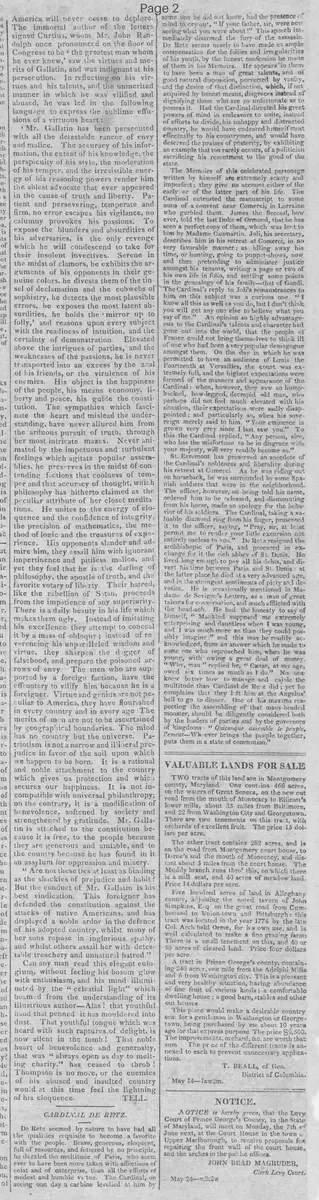
De Retz seemed by nature to have had all the qualities requisite to become a favorite with the people. Brave, generous, eloquent, full of resources, and fettered by no principle, he dazzled the multitude of Paris, who seem ever to have been more taken with affections of eclat and of enterprise, than all the efforts of modest and humble virtue. The Cardinal, on seeing one day a carbine levelled at him by some one he did not know, had the presence of mind to cry out, "If your father, sir, were now seeing what you were about!" This speech immediately disarmed the fury of the assassin.
De Retz seems nearly to have made an ample compensation for the follies and irregularities of his youth, by the honest confession he made of them in his Memoirs. He appears in them to have been a man of great talents, and of good natural disposition, perverted by vanity, and the desire of that distinction, which, if not acquired by honest means, disgraces instead of dignifying those who are so unfortunate as to possess it. Had the Cardinal directed his great powers of mind in endeavors to unite, instead of efforts to divide, his unhappy and distracted country, he would have endeared himself most effectually to his countrymen, and would have deserved the praises of posterity, by exhibiting an example that too rarely occurs, of a politician sacrificing his resentment to the good of the state.
The Memoirs of this celebrated personage written by himself are extremely scanty and imperfect: they give no account either of the early or of the latter part of his life. The Cardinal entrusted the manuscript to some nuns of a convent near Comerci, in Lorraine who garbled them. James the Second, however, told the last Duke of Ormond, that he has seen a perfect copy of them, which was lent to him by Madame Caumartin. Joli, his secretary, describes him in his retreat at Comerci, in no very favorable manner: as idling away his time, or hunting, going to puppet-shows, now and then pretending to administer justice amongst his tenants, writing a page or two of his own life in folio, and settling some points in the genealogy of his family—that of Gondi.
The Cardinal's reply to Joli's remonstrances to him on this subject was a curious one. "I know all this as well as you do, but I don't think you will get any one else to believe what you say of me." An opinion so highly advantageous to the Cardinal's talents and character had gone out into the world, that the people of France could not bring themselves to think ill of one who had been a very popular demagogue amongst them. On the day in which he was permitted to have an audience of Louis the Fourteenth at Versailles, the court was extremely full, and the highest expectations were formed of the manners and appearance of the Cardinal: when, however, they saw a hump-backed, bow-legged, decrepit old man, who perhaps did not feel much elevated with his situation, their expectations were sadly disappointed; and particularly so, when his sovereign merely said to him, "Your eminence is grown very grey since I last saw you." To this the Cardinal replied, "Any person, sire, who has the misfortune to be in disgrace with your majesty, will very readily become so."
St. Evremont has preserved an anecdote of the Cardinal's nobleness and liberality during his retreat at Comerci As he was riding out on horseback, he was surrounded by some Spanish soldiers that were in the neighborhood. The officer, however, on being told his name, ordered him to be released, and dismounting from his horse, made an apology for the behavior of his soldiers. The Cardinal, taking a valuable diamond ring from his finger, presented it to the officer, saying, "Pray, sir, at least permit me to render your little excursion not entirely useless to you." De Retz resigned the archbishopric of Paris, and procured in exchange for it the rich abbey of St. Denis. He lived long enough to pay all his debts, and divert his time between Paris and St. Denis: at the latter place he died at a very advanced age, and in the strongest sentiments of piety and devotion. He is occasionally mentioned in Madame de Sevigne's Letters, as a man of great talents for conversation, and much afflicted with the head-ach. He had the honesty to say of himself, "Mankind supposed me extremely enterprising and dauntless when I was young, and I was much more so than they could possibly imagine:" and this may be readily acknowledged, from an answer which he made to some one who reproached him, when he was young, with owing a great deal of money. "Why, man," replied he, "Caesar, at my age, owed six times as much as I do." No one knew better how to manage and cajole the multitude than Cardinal de Retz did: yet he complains that they left him at the Angelus bell to go to dinner. One of his maxims respecting the assembling of that many-headed monster, should be diligently considered both by the leaders of parties and by the governors of kingdoms: "Quicunque assemble le peuple, l'emeut—Whoever brings the people together, puts them in a state of commotion."
De Retz seemed by nature to have had all the qualities requisite to become a favorite with the people. Brave, generous, eloquent, full of resources, and fettered by no principle, he dazzled the multitude of Paris, who seem ever to have been more taken with affections of eclat and of enterprise, than all the efforts of modest and humble virtue. The Cardinal, on seeing one day a carbine levelled at him by some one he did not know, had the presence of mind to cry out, "If your father, sir, were now seeing what you were about!" This speech immediately disarmed the fury of the assassin.
De Retz seems nearly to have made an ample compensation for the follies and irregularities of his youth, by the honest confession he made of them in his Memoirs. He appears in them to have been a man of great talents, and of good natural disposition, perverted by vanity, and the desire of that distinction, which, if not acquired by honest means, disgraces instead of dignifying those who are so unfortunate as to possess it. Had the Cardinal directed his great powers of mind in endeavors to unite, instead of efforts to divide, his unhappy and distracted country, he would have endeared himself most effectually to his countrymen, and would have deserved the praises of posterity, by exhibiting an example that too rarely occurs, of a politician sacrificing his resentment to the good of the state.
The Memoirs of this celebrated personage written by himself are extremely scanty and imperfect: they give no account either of the early or of the latter part of his life. The Cardinal entrusted the manuscript to some nuns of a convent near Comerci, in Lorraine who garbled them. James the Second, however, told the last Duke of Ormond, that he has seen a perfect copy of them, which was lent to him by Madame Caumartin. Joli, his secretary, describes him in his retreat at Comerci, in no very favorable manner: as idling away his time, or hunting, going to puppet-shows, now and then pretending to administer justice amongst his tenants, writing a page or two of his own life in folio, and settling some points in the genealogy of his family—that of Gondi.
The Cardinal's reply to Joli's remonstrances to him on this subject was a curious one. "I know all this as well as you do, but I don't think you will get any one else to believe what you say of me." An opinion so highly advantageous to the Cardinal's talents and character had gone out into the world, that the people of France could not bring themselves to think ill of one who had been a very popular demagogue amongst them. On the day in which he was permitted to have an audience of Louis the Fourteenth at Versailles, the court was extremely full, and the highest expectations were formed of the manners and appearance of the Cardinal: when, however, they saw a hump-backed, bow-legged, decrepit old man, who perhaps did not feel much elevated with his situation, their expectations were sadly disappointed; and particularly so, when his sovereign merely said to him, "Your eminence is grown very grey since I last saw you." To this the Cardinal replied, "Any person, sire, who has the misfortune to be in disgrace with your majesty, will very readily become so."
St. Evremont has preserved an anecdote of the Cardinal's nobleness and liberality during his retreat at Comerci As he was riding out on horseback, he was surrounded by some Spanish soldiers that were in the neighborhood. The officer, however, on being told his name, ordered him to be released, and dismounting from his horse, made an apology for the behavior of his soldiers. The Cardinal, taking a valuable diamond ring from his finger, presented it to the officer, saying, "Pray, sir, at least permit me to render your little excursion not entirely useless to you." De Retz resigned the archbishopric of Paris, and procured in exchange for it the rich abbey of St. Denis. He lived long enough to pay all his debts, and divert his time between Paris and St. Denis: at the latter place he died at a very advanced age, and in the strongest sentiments of piety and devotion. He is occasionally mentioned in Madame de Sevigne's Letters, as a man of great talents for conversation, and much afflicted with the head-ach. He had the honesty to say of himself, "Mankind supposed me extremely enterprising and dauntless when I was young, and I was much more so than they could possibly imagine:" and this may be readily acknowledged, from an answer which he made to some one who reproached him, when he was young, with owing a great deal of money. "Why, man," replied he, "Caesar, at my age, owed six times as much as I do." No one knew better how to manage and cajole the multitude than Cardinal de Retz did: yet he complains that they left him at the Angelus bell to go to dinner. One of his maxims respecting the assembling of that many-headed monster, should be diligently considered both by the leaders of parties and by the governors of kingdoms: "Quicunque assemble le peuple, l'emeut—Whoever brings the people together, puts them in a state of commotion."
What sub-type of article is it?
Biography
What themes does it cover?
Moral Virtue
Fortune Reversal
Misfortune
What keywords are associated?
Cardinal De Retz
Memoirs
French Politics
Youthful Follies
Retirement Anecdotes
Public Favor
Political Maxim
What entities or persons were involved?
Cardinal De Retz
Louis The Fourteenth
James The Second
Duke Of Ormond
Madame Caumartin
Joli
St. Evremont
Madame De Sevigne
Where did it happen?
Paris, Comerci In Lorraine, Versailles, St. Denis
Story Details
Key Persons
Cardinal De Retz
Louis The Fourteenth
James The Second
Duke Of Ormond
Madame Caumartin
Joli
St. Evremont
Madame De Sevigne
Location
Paris, Comerci In Lorraine, Versailles, St. Denis
Story Details
Cardinal de Retz, a talented but vain politician, dazzled Paris with his bravery and eloquence but sowed division; his memoirs confess youthful follies; in retirement, he idled yet maintained popularity, showed wit and generosity, resigned his see for an abbey, and died piously after paying debts.