Thank you for visiting SNEWPapers!
Sign up free
Alexandria Daily Gazette, Commercial & Political
Alexandria, Virginia
What is this article about?
Arrival in Providence, RI, of ship Union with 60-70 American sailors released from French detention. Features journal of Mr. Smith detailing his 1809 capture, brutal imprisonment in France, starvation, and coerced enlistment in a privateer after refusing due to patriotism. (248 characters)
Merged-components note: Merged continuation of the journal story across pages, as the text flows directly from one to the next.
Clippings
1 of 2
OCR Quality
Full Text
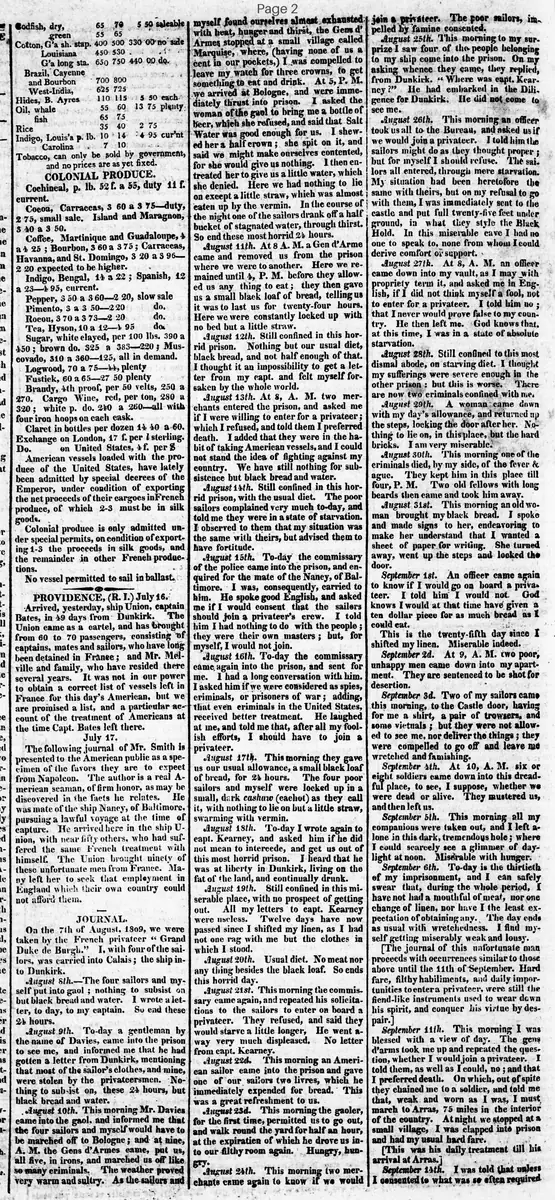
Arrived, yesterday, ship Union, captain Bates, in 19 days from Dunkirk. The Union came as a cartel, and has brought from 60 to 70 passengers, consisting of captains, mates and sailors, who have long been detained in France; and Mr. Melville and family, who have resided there several years. It was not in our power to obtain a correct list of vessels left in France for this day's American, but we are promised a list, and a particular account of the treatment of Americans at the time Capt. Bates left there.
July 17.
The following journal of Mr. Smith is presented to the American public as a specimen of the favors they are to expect from Napoleon. The author is a real American seaman, of firm honor, as may be discovered in the facts he relates. He was mate of the ship Nancy, of Baltimore, pursuing a lawful voyage at the time of capture. He arrived here in the ship Union, with near fifty others, who had suffered the same French treatment with himself. The Union brought ninety of these unfortunate men from France. Many left her to seek that employment in England which their own country could not afford them.
JOURNAL.
On the 7th of August, 1809, we were taken by the French privateer "Grand Duke de Burgh." I. with four of the sailors, was carried into Calais ; the ship into Dunkirk.
August 8th.--The four sailors and myself put into gaol ; nothing to subsist on but black bread and water. I wrote a letter, to day, to my captain. So end these 24 hours.
August 9th. To-day a gentleman by the name of Davies, came into the prison to see me, and informed me that he had gotten a letter from Dunkirk, mentioning that most of the sailor's clothes, and mine, were stolen by the privateersmen. Nothing to subsist on, these 24 hours, but black bread and water.
August 10th. This morning Mr. Davies came into the gaol. and informed me that the four sailors and myself would have to be marched off to Boulogne; and at nine A. M. the Gens d'Armes came, put us, all five, in irons, and marched us off like so many criminals. The weather proved very warm and sultry. As the sailors and myself found ourselves almost exhausted with heat, hunger and thirst, the Gens d' Armes stopped at a small village called Marquise, : where, (having none of us a cent in our pockets,) I was compelled to leave my watch for three crowns, to get something to eat and drink. At 5, P. M. we arrived at Boulogne, and were immediately thrust into prison. I asked the woman of the gaol to bring me a bottle of beer, which she refused, and said that Salt Water was good enough for us. I shewed her a half crown ; she spit on it, and said we might make ourselves contented. for she would give us nothing. I then entreated her to give us a little water, which she denied. Here we had nothing to lie on except a little straw, which was almost eaten up by the vermin. In the course of the night one of the sailors drank off a half bucket of stagnated water, through thirst. So end these most horrid 24 hours.
August 11th. At 8 A. M. a Gen d' Arme came and removed us from the prison where we were to another. Here we remained until 4, P. M. before they allowed us any thing to eat; they then gave us a small black loaf of bread, telling us it was to last us for twenty-four hours. Here we were constantly locked up with no bed but a little straw.
August 12th. Still confined in this horrid prison. Nothing but our usual diet, black bread, and not half enough of that. I thought it an impossibility to get a letter from my capt. and felt myself forsaken by the whole world.
August 13th. At 8, A. M. two merchants entered the prison, and asked me if I were willing to enter for a privateer ; which I refused, and told them I preferred death. I added that they were in the habit of taking American vessels, and I could not stand the idea of fighting against my country. We have still nothing for subsistence but black bread and water.
August 14th. Still confined in this horrid prison, with the usual diet. The poor sailors complained very much to-day, and told me they were in a state of starvation. I observed to them that my situation was the same with theirs, but advised them to have fortitude.
August 15th. To-day the commissary of the police came into the prison, and enquired for the mate of the Nancy, of Baltimore. : I was, consequently, carried to him. He spoke good English, and asked me if I would consent that the sailors should join a privateer's crew. I told him I had nothing to do with the people : they were their own masters; but, for myself, I would not join.
August 16th. To-day the commissary came again into the prison, and sent for me. I had a long conversation with him. I asked him if we were considered as spies, criminals, or prisoners of war; adding that even criminals in the United States, received better treatment. He laughed at me, and told me that, after all my foolish efforts, I should have to join a privateer.
August 17th. This morning they gave us our usual allowance, a small black loaf of bread, for 24 hours. The four poor sailors and myself were locked up in a small, dark cachot as they call it, with nothing to lie on but a little straw, swarming with vermin.
August 18th. To-day I wrote again to capt. Kearney, and asked him if he did not mean to intercede, and get us out of this most horrid prison. I heard that he was at liberty in Dunkirk, living on the fat of the land, and continually drunk.
August 19th. Still confined in this miserable place, with no prospect of getting out. All my letters to capt. Kearney were useless. Twelve days have now passed since I shifted my linen, as I had not one rag with me but the clothes in which I stood.
August 20th. Usual diet. No meat nor any thing besides the black loaf. So ends this horrid day.
August 21st. This morning the commissary came again, and repeated his solicitations to the sailors to enter on board a privateer. They refused, and said they would starve a little longer, He went away very much displeased. No letter from capt. Kearney.
August 22d. This morning an American sailor came into the prison and gave one of our sailors two livres, which he immediately expended for bread. : This was a great refreshment to us.
August 23d. This morning the gaoler, for the first time, permitted us to go out, and walk round the yard for half an hour, at the expiration of which he drove us into our filthy room again. Hungry, hungry.
August 24th. This morning two merchants came again to know if we would join a privateer. The poor sailors, impelled by famine consented.
August 25th. This morning to my surprise I saw four of the people belonging to my ship come into the prison. On my asking whence they came, they replied. from Dunkirk. " Where was capt. Kearney ?" He had embarked in the Diligence for Dunkirk: He did not come to see me.
August 26th. This morning an officer took us all to the Bureau, and asked us if we would join a privateer. I told him the sailors might do as they thought proper ; but for myself I should refuse.' The sailors all entered, through mere starvation. My situation had been heretofore the same with theirs, but on my refusal to go with them, I was immediately sent to the castle and put full twenty-five feet under ground, in what they style the Black Hold. In this miserable cave I had no one to speak to, none from whom I could derive comfort or support.
August 27th. At 8, A. M. an officer came down into my vault, as I may with propriety term it, and asked me in English, if I did not think myself a fool, not to enter for a privateer. I told him no ; that I never would prove false to my country. He then left me. God knows that at this time, I was in a state of absolute starvation.
August 28th. Still confined to this most dismal abode, on starving diet. I thought my sufferings were severe enough in the other prison : but this is worse. There are now two criminals confined with me.
August 29th. A woman came down with my day's allowance, and returned up the steps, locking the door after her. Nothing to lie on, in this place, but the hard bricks. I am very miserable.
August 30th. This morning one of the criminals died, by my side, of the fever & ague. They kept him in this place till four, P. M. Two old fellows with long beards then came and took him away.
August 31st. This morning an old woman brought my black bread. I spoke and made signs to her, endeavoring to make her understand that I wanted a sheet of paper for writing. She turned away, went up the steps and locked the door.
September 1st. An officer came again to know if I would go on board a privateer. I told him I would not. God knows I would at that time have given a ten dollar piece for as much bread as I could eat.
This is the twenty-fifth day since I shifted my linen. Miserable indeed.
September 2d. At 9, A. M. two poor unhappy men came down into my apartment. They are sentenced to be shot for desertion.
September 3d. Two of my sailors came this morning, to the Castle door, having for me a shirt, a pair of trowsers, and some victuals ; but they were not allowed to see me, nor deliver the things ; they were compelled to go off and leave me wretched and famishing.
September 4th. At 10, A. M. six or eight soldiers came down into this dreadful place, to see, I suppose, whether we were dead or alive. They mustered us, and then left us.
September 5th. This morning all my companions were taken out, and I left alone in this dark, tremendous hole ; where I could scarcely see a glimmer of daylight at noon. Miserable with hunger.
September 6th. To-day is the thirtieth of my imprisonment, and I can safely swear that, during the whole period, I have not had a mouthful of meat, nor one change of linen, nor have I the least expectation of obtaining any. The day ends as usual with wretchedness. I find myself getting miserably weak and lousy.
[The journal of this unfortunate man proceeds with occurrences similar to those above until the 11th of September. Hard fare, filthy habiliments, and daily importunities to enter a privateer, were still the fiend-like instruments used to wear down his spirit, and conquer his virtue by despair.]
September 11th. This morning I was blessed with a view of day. The gens d'arms took me up and repeated the question, whether I would join a privateer. I told them, as well as I could, no ; and that I preferred death. On which, out of spite they chained me to a soldier, and told me that, weak and worn as I was, I must march to Arras, 75 miles in the interior of the country. At night we stopped at a small village, I was clapped into prison and had my usual hard fare.
[This was his daily treatment till his arrival at Arras.]
September 18th. I was told that unless I consented to what was so often required
of me, I should be obliged to go to Besancon, another depot, to which prisoners in my situation are carried daily, three hundred at a time. I was examined by an English interpreter, who asked me what I was, though the gens d'armes had papers concerning me. I told him I was an unfortunate American, and repeated the circumstances of my capture and subsequent treatment. He told me Americans were used to such treatment in this country. This was all the consolation I got.
September 15th. I was taken out and asked if I would go on board a privateer. I refused. They told me I must then prepare to march to Besancon, 300 miles from Arras in the interior of the country. Through the whole term of my captivity I had never eaten to the satisfaction of my hunger, never tasted meat, never changed an article of my clothing. I told them I was totally unable to walk three miles; they said it was not their fault: I must make myself able to walk three hundred. So after every effort I was reduced, unwillingly enough, God knows, to enlist for a privateer lying at Calais.
What sub-type of article is it?
What themes does it cover?
What keywords are associated?
What entities or persons were involved?
Where did it happen?
Story Details
Key Persons
Location
France (Calais, Dunkirk, Boulogne, Arras, Besancon)
Event Date
August 7, 1809 September 15, 1809
Story Details
Mr. Smith, mate of the American ship Nancy captured by French privateer Grand Duke de Burgh in 1809, endures harsh imprisonment in French prisons. Starved on black bread and water, infested with vermin, and repeatedly coerced to join a privateer, he refuses out of loyalty to his country despite extreme suffering, until forced to enlist to avoid a grueling march to Besancon.