Thank you for visiting SNEWPapers!
Sign up free
Gazette Of The United States, & Philadelphia Daily Advertiser
Philadelphia, Philadelphia County, Pennsylvania
What is this article about?
On March 5, 1798, the U.S. House of Representatives processed petitions for compensation from veterans and officials, reported unfavorably on one claim, proposed a committee to encourage fine arts via copyright, received President Adams' urgent message relaying envoys' report on French Directory's hostile trade policies against neutrals, and debated amendments before advancing a bill funding diplomatic intercourse with foreign nations.
Clipping
OCR Quality
Full Text
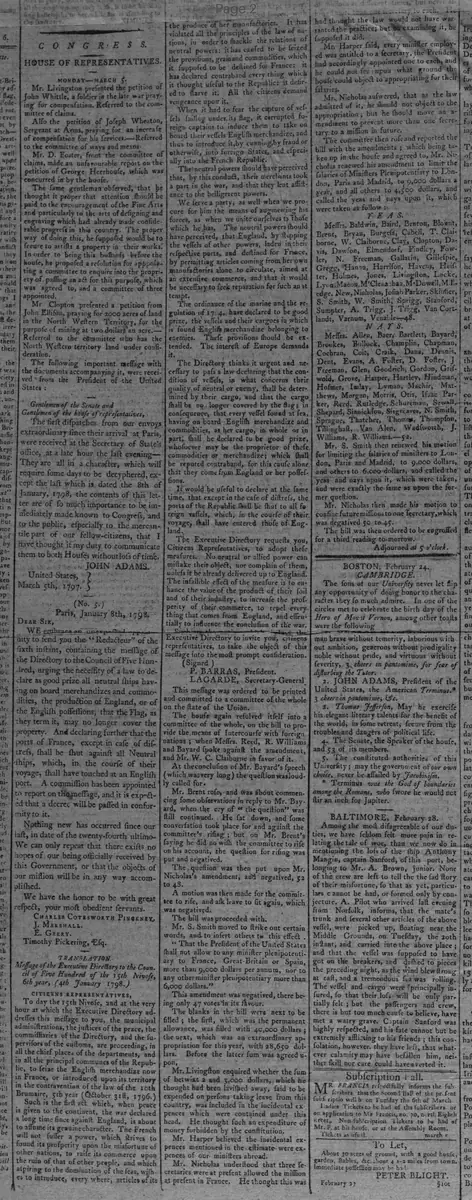
HOUSE OF REPRESENTATIVES.
MONDAY—MARCH 5.
Mr. Livingston presented the petition of John Whittle, a soldier in the late war, praying for compensation. Referred to the committee of claims.
Also the petition of Joseph Wheaton, Sergeant at Arms, praying for an increase of compensation for his services.—Referred to the committee of ways and means.
Mr. D. Foster, from the committee of claims, made an unfavourable report on the petition of George Heerhouse, which was concurred in by the House.
The same gentleman observed, that he thought it proper that attention should be paid to the encouragement of the Fine Arts, and particularly to the arts of designing and engraving which had already made considerable progress in this country. The proper way of doing this, he supposed would be to secure to artists a property in their works. In order to bring this business before the House, he proposed a resolution for appointing a committee to enquire into the propriety of passing an act for this purpose, which was agreed to, and a committee of three appointed.
Mr. Clopton presented a petition from John Elliston, praying for 2000 acres of land in the North Western Territory, for the purpose of mining at two dollars an acre.—Referred to the committee who has the North Western territory land under consideration.
The following important message, with the documents accompanying it, were received from the President of the United States:
Gentlemen of the Senate and Gentlemen of the House of Representatives,
The first dispatches from our envoys extraordinary since their arrival at Paris, were received at the Secretary of State's office, at a late hour last evening—They are all in a cipher, which will require some days to be decyphered, except the last which is dated the 8th of January, 1798, the contents of this letter are of so much importance to be immediately made known to Congress, and to the public, especially to the mercantile part of our fellow-citizens, that I have thought it my duty to communicate them to both Houses without loss of time.
JOHN ADAMS.
United States, March 4th, 1798.
(No. 5.)
Paris, January 8th, 1798.
Dear Sir,
WE embrace this opportunity to send you the 'Redacteur' of the sixth instant, containing the message of the Directory to the Council of Five Hundred, urging the necessity of a law to declare as good prize all neutral ships having on board merchandizes and commodities, the production of England, or of the English possessions, that the Flag, as they term it, may no longer cover the property. And declaring further that the ports of France, except in case of distress, shall be shut against all Neutral ships, which, in the course of their voyage, shall have touched at an English port. A commission has been appointed to report on the message, and it is expected that a decree will be passed in conformity to it.
Nothing new has occurred since our last, in date of the twenty-fourth ultimo—We can only repeat that there exists no hopes of our being officially received by this Government, or that the objects of our mission will be in any way accomplished.
We have the honor to be with great respect, your most obedient servants.
Charles Cotesworth Pinckney,
J. MARSHALL.
E. Gerry.
To Timothy Pickering, Esq.
TRANSLATION.
Message of the Executive Directory to the Council of Five Hundred of the 15th Nivose, 6th year, (4th January 1798.)
CITIZENS REPRESENTATIVES,
To day the 15th Nivose, and at the very hour at which the Executive Directory addresses this message to you, the municipal administrations, the justices of the peace, the commissaries of the Directory, and the supervisors of the customs, are proceeding, in all the chief places of the departments, and in all the principal communes of the Republic, to seize the English merchandize now in France, or introduced upon its territory in the contravention of the law of the 10th Brumaire, 5th year (October 31st, 1796.) Such is the first act which, when peace is given to the continent, the war declared a long time since against England, is about to assume its genuine character. The French will not suffer a power, which strives to found its prosperity upon the misfortune of other nations, to raise its commerce upon the ruin of that of other people, and which aspiring to the domination of the seas, wishes to introduce, every where, articles of the produce of her manufactories. It has, by its coalitions, in order to shackle the relations of neutral powers: it has violated all the principles of the law of nations: it has caused to be seized the provisions, grain and commodities, which it supposed to be destined for France: it has declared contraband every thing which it thought useful to the Republic: it desired to starve it. All the citizens demand vengeance upon it.
When it had to fear the capture of vessels sailing under its flag, it corrupted foreign captains to induce them to take on board their vessels English merchandize, and thus to introduce it, by cunning, by fraud or otherwise, into foreign States, and especially into the French Republic.
The neutral powers should have perceived that, by this conduct, their merchants took a part in the war, and that they lent assistance to the belligerent powers. We serve a party, as well when we procure for him the means of augmenting his forces, as when we unite ourselves to those which he has. The neutral powers should have perceived, that England, by stopping the vessels of other powers, laden in their respective ports, and destined for France, by permitting articles coming from her own manufactories alone to circulate, aimed at an extensive commerce, and that it would be necessary to seek reparation for such an attempt.
The ordinance of the marine and the regulation of 1744, have declared to be good prize, the vessels and their cargoes in which is found English merchandize belonging to enemies. These provisions should be extended. The interest of Europe demands it.
The Directory thinks it urgent and necessary to pass a law declaring that the condition of vessels, in what concerns their quality of neutral or enemy, shall be determined by their cargo, and that the cargo shall be no longer covered by the flag; in consequence, that every vessel found at sea, having on board English merchandize and commodities, as her cargo, in whole or in part; shall be declared to be good prize, whoever may be the proprietor of these commodities or merchandize; which shall be reputed contraband, for this cause alone that they come from England or her possessions.
It would be useful to declare at the same time, that except in the case of distress, the ports of the Republic shall be shut to all foreign vessels, which, in the course of their voyage, shall have entered those of England.
The Executive Directory requests you, Citizens Representatives, to adopt these measures. No neutral or allied power can mistake their object, nor complain of them, unless it be already delivered up to England. The infallible effect of the measure is to enhance the value of the product of their soil and of their industry, to increase the prosperity of their commerce, to repel every thing that comes from England, and essentially to influence the conclusion of the war.
The Executive Directory invites you, citizens representatives, to take the object of this message into the most prompt consideration.
(Signed)
P. BARRAS, President.
LAGARDE, Secretary-General
This message was ordered to be printed and committed to a committee of the whole on the state of the Union.
The House again resolved itself into a committee of the whole, on the bill to provide the means of Intercourse with foreign nations; when Messrs. Reed, R. Williams and Bayard spoke against the amendment, and Mr. W. C. Claiborne in favor of it.
At the conclusion of Mr. Bayard's speech (which was very long) the question was loudly called for.
Mr. Brent rose, and was about commencing some observations in reply to Mr. Bayard, when the cry of 'the question' was still continued. He sat down, and some conversation took place for and against the committee's rising; but on Mr. Brent's saying he did not wish the committee to rise on his account, the question for rising was put and negatived.
The question was then put upon Mr. Nicholas's amendment, and negatived, 52 to 48.
A motion was then made for the committee to rise, and ask leave to sit again, which was negatived.
The bill was proceeded with.
Mr. S. Smith moved to strike out certain words, and to insert others to this effect: 'That the President of the United States shall not allow to any minister plenipotentiary to France, Great-Britain or Spain, more than 9,000 dollars per annum, nor to any other minister plenipotentiary more than 6,000 dollars.'
This amendment was negatived, there being only 47 votes in its favour.
The blanks in the bill were next to be filled; the first, which was the permanent allowance, was filled with 40,000 dollars; the next, which was an extraordinary appropriation for this year, with 28,650 dollars. Before the latter sum was agreed upon,
Mr. Livingston enquired whether the sum of betwixt 2 and 3,000 dollars, which he thought had been lavished away, and to be expended on persons taking leave from this country, was included in the incidental expenses which were contained under this head. He thought such an expenditure of money forbidden by the constitution.
Mr. Harper believed the incidental expenses mentioned in the estimate were expenses of our ministers abroad.
Mr. Nicholas understood that three secretaries were at present allowed the mission at present in France. He thought this was
had thought the law would not have warranted the practice; but on examining it, he supposed it did.
Mr. Harper said, every minister employed was entitled to a secretary, the President had accordingly appointed one to each, and he could not see upon what ground the House could object to appropriating for their salaries.
Mr. Nicholas answered, that as the law admitted of it, he should not object to the appropriation; but he should move an amendment to prevent more than one secretary to a mission in future.—
The committee then rose and reported the bill with the amendments; which being taken up in the House and agreed to, Mr. Nicholas renewed his amendment to limit the salaries of Ministers Plenipotentiary to London, Paris and Madrid, to 9,000 dollars a year, and all others to 4,500 dollars, and called the yeas and nays upon it, which were taken as follow:
YEAS.
Messrs. Baldwin, Baird, Benton, Blount, Brent, Bryan, Burgess, Cabell, T. Claiborne, W. Claiborne, Clay, Clopton, Davis, Dawson, Elmendorf, Findley, Fowler, N. Freeman, Gallatin, Gillespie, Gregg, Hanna, Harrison, Havens, Heister, Holmes, Jones, Livingston, Locke, Lyon, Macon, M'Clenahan, M'Dowell, M'Nedg. New, Nicholas, Josiah Parker, Skinner, S. Smith, W. Smith, Sprigg, Stanford, Sumpter, A. Trigg, J. Trigg, Van Cortlandt, Varnum, Venable—48.
NAYS.
Messrs. Allen, Baer, Bartlett, Bayard, Brookes, Bullock, Champlin, Chapman, Cochran, Coit, Craik, Dana, Dennis, Dent, Evans, A. Foster, D. Foster, J. Freeman, Glen, Goodrich, Gordon, Griff wold, Grove, Harper, Hartley, Hindman, Homer, Imlay, Lyman, Machir, Matthews, Morgan, Morris, Otis, Isaac Parker, Reed, Rutledge, Schureman, Sewall, Shepard, Sinnickson, Sitgreaves, N. Smith, Sprague, Thatcher, Thomas, Thompson, Tillinghast, Van Alen, Wadsworth, J. Williams, R. Williams.—52.
Mr. S. Smith then renewed his motion for limiting the salaries of ministers to London, Paris and Madrid, to 9,000 dollars, and others to 6,000 dollars, and called the yeas and nays upon it, which were taken, and were exactly the same as upon the former question.
Mr. Nicholas then made his motion to confine future missions to one secretary, which was negatived 50 to 45.
The bill was then ordered to be engrossed for a third reading to-morrow.
Adjourned at 5 o'clock.
What sub-type of article is it?
What keywords are associated?
What entities or persons were involved?
Domestic News Details
Event Date
March 5, 1798
Key Persons
Outcome
petitions referred to committees; unfavorable report on heerhouse petition concurred; committee appointed for fine arts inquiry; president's message printed and committed; nicholas's amendment negatived 52-48; smith amendment negatived 47-? (implied); bill blanks filled with $40,000 permanent and $28,650 extraordinary; nicholas salary limit amendment negatived 48-52; smith salary limit renewed and negatived same vote; nicholas secretary limit negatived 45-50; bill ordered engrossed for third reading.
Event Details
The House processed petitions for compensation from John Whittle and Joseph Wheaton, referred them; unfavorable report on George Heerhouse's petition concurred; Mr. D. Foster proposed resolution for committee on securing property in artistic works, agreed; Mr. Clopton presented John Elliston's land petition, referred; received President's message with envoys' dispatch from Paris dated Jan 8, 1798, reporting French Directory's message to seize English goods, declare neutral ships with English cargo as prizes, close ports to ships touching England, and no hope for mission success; message committed; in committee on foreign intercourse bill, debated amendments, Nicholas's negatived 52-48, Smith's salary limit negatived, blanks filled, further amendments on salaries and secretaries negatived 48-52 and 45-50, bill reported and agreed with amendments, ordered engrossed.