Thank you for visiting SNEWPapers!
Sign up free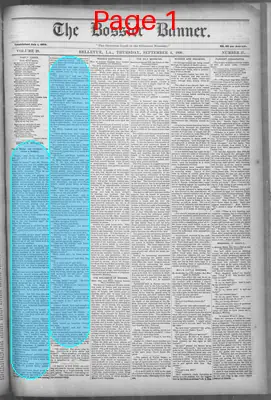
Story
September 4, 1890
The Bossier Banner
Benton, Bellevue, Bossier County, Louisiana
What is this article about?
Hetty Plumer, a farm girl seeking independence, writes and publishes stories encouraged by Hugh Allaire, unaware he is the editor of the Weekly Leader. Her success leads to their romance and marriage in October.
Clipping
OCR Quality
98%
Excellent
Full Text
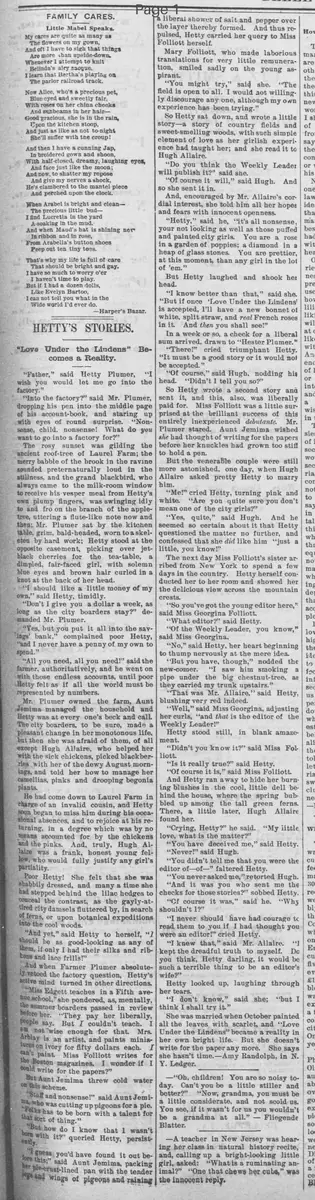
HETTY'S STORIES.
"Love Under the Lindens" Becomes a Reality.
"Father," said Hetty Plumer, "I wish you would let me go into the factory."
"Into the factory?" said Mr. Plumer, dropping his pen into the middle page of his account-book, and staring up with eyes of round surprise. "Nonsense, child, nonsense! What do you want to go into a factory for?"
The rosy sunset was gilding the ancient roof-tree of Laurel Farm; the merry babble of the brook in the ravine sounded preternaturally loud in the stillness, and the grand blackbird, who always came to the milk-room window to receive his vesper meal from Hetty's own plump fingers, was swinging idly to and fro on the branch of the apple-tree, uttering a flute-like note now and then; Mr. Plumer sat by the kitchen table, grim, bald-headed, worn to a skeleton by hard work: Hetty stood at the opposite casement, picking over jet-black cherries for the tea-table, a dimpled, fair-faced girl, with solemn blue eyes and brown hair curled in a knot at the back of her head.
"I should like a little money of my own," said Hetty, timidly.
"Don't I give you a dollar a week, as long as the city boarders stay?" demanded Mr. Plumer.
"Yes, but you put it all into the savings' bank," complained poor Hetty, "and I never have a penny of my own to spend."
"All you need, all you need!" said the farmer, authoritatively, and he went on with those endless accounts, until poor Hetty felt as if all the world must be represented by numbers.
Mr. Plumer owned the farm, Aunt Jemima managed the household and Hetty was at every one's beck and call. The city boarders, to be sure, made a pleasant change in her monotonous life, but then she was afraid of them, of all except Hugh Allaire, who helped her with the sick chickens, picked blackberries with her of the dewy August mornings, and told her how to manage her camellias, pinks and drooping begonia plants.
He had come down to Laurel Farm in charge of an invalid cousin, and Hetty soon began to miss him during his occasional absences, and to rejoice at his returning, in a degree which was by no means accounted for by the chickens and the pinks. And, truly, Hugh Allaire was a frank, honest young fellow, who would fully justify any girl's partiality.
Poor Hetty! She felt that she was shabbily dressed, and many a time she had stepped behind the lilac hedges to conceal the contrast, as the gayly-attired city damsels fluttered by, in search of ferns, or upon botanical expeditions into the cool woods.
"And yet," said Hetty to herself, "I should be as good-looking as any of them, if only I had their silks and ribbons and lace frills!"
And when Farmer Plumer absolutely vetoed the factory question, Hetty's active mind turned in other directions.
"Miss Edgett teaches in a Fifth avenue school," she pondered, as, mentally, the summer boarders passed in review before her.
"They pay her liberally, people say. But I couldn't teach. I am not wise enough for that. Mrs. Arblay is an artist, and paints miniatures on ivory for fifty dollars each. I can't paint. Miss Folliott writes for the Boston magazines. I wonder if I could write for the papers?"
But Aunt Jemima threw cold water on this scheme.
"Stuff and nonsense!" said Aunt Jemima, who was cutting up pigeons for a pie. "Folks has to be born with a talent for that sort of thing."
"But how do I know that I wasn't born with it?" queried Hetty, persistently.
"I guess you'd have found it out before this," said Aunt Jemima, packing her pie-crust-lined pan with the tender legs and wings of pigeons and raining a liberal shower of salt and pepper over the layer thereby formed. And thus repulsed, Hetty carried her query to Miss Folliott herself.
Mary Folliott, who made laborious translations for very little remuneration, smiled sadly on the young aspirant.
"You might try," said she. "The field is open to all. I would not willingly discourage any one, although my own experience has been trying."
So Hetty sat down, and wrote a little story—a story of country fields and sweet-smelling woods, with such simple element of love as her girlish experience had taught her; and she read it to Hugh Allaire.
"Do you think the Weekly Leader will publish it?" said she.
"Of course it will," said Hugh.
And so she sent it in.
And, encouraged by Mr. Allaire's cordial interest, she told him all her hopes and fears with innocent openness.
"Hetty," said he, "it's all nonsense, your not looking as well as those puffed and painted city girls. You are a rose in a garden of poppies; a diamond in a heap of glass stones. You are prettier at this moment, than any girl in the lot of 'em."
But Hetty laughed and shook her head.
"I know better than that," said she. "But if once 'Love Under the Lindens' is accepted, I'll have a new bonnet of white, split straw, and real French roses in it. And then you shall see!"
In a week or so, a check for a liberal sum arrived, drawn to "Hester Plumer."
"There!" cried triumphant Hetty. "It must be a good story or it would not be accepted."
"Of course," said Hugh, nodding his head. "Didn't I tell you so?"
So Hetty wrote a second story and sent it, and this, also, was liberally paid for. Miss Folliott was a little surprised at the brilliant success of this entirely inexperienced debutante. Mr. Plumer stared. Aunt Jemima wished she had thought of writing for the papers before her knuckles had grown too stiff to hold a pen.
But the venerable couple were still more astonished, one day, when Hugh Allaire asked pretty Hetty to marry him.
"Me!" cried Hetty, turning pink and white. "Are you quite sure you don't mean one of the city girls?"
"Yes, quite," said Hugh. And he seemed so certain about it that Hetty questioned the matter no further, and confessed that she did like him "just a little, you know!"
The next day Miss Folliott's sister arrived from New York to spend a few days in the country. Hetty herself conducted her to her room and showed her the delicious view across the mountain crests.
"So you've got the young editor here," said Miss Georgina Folliott.
"What editor?" said Hetty.
"Of the Weekly Leader, you know," said Miss Georgina.
"No," said Hetty, her heart beginning to thump nervously at the mere idea.
"But you have, though," nodded the new-comer. "I saw him smoking a pipe under the big chestnut-tree, as they carried my trunk upstairs."
"That was Mr. Allaire," said Hetty, blushing very red indeed.
"Well," said Miss Georgina, adjusting her curls, "and that is the editor of the Weekly Leader!"
Hetty stood still, in blank amazement.
"Didn't you know it?" said Miss Folliott.
"Is it really true?" said Hetty.
"Of course it is," said Miss Folliott.
And Hetty ran away to hide her burning blushes in the cool, little dell behind the house, where the spring bubbled up among the tall green ferns.
There, a little later, Hugh Allaire found her.
"Crying, Hetty?" he said. "My little love, what is the matter?"
"You have deceived me," said Hetty.
"Never!" said Hugh.
"You didn't tell me that you were the editor of—of—" faltered Hetty.
"You never asked me," retorted Hugh.
"And it was you who sent me the checks for those stories?" sobbed Hetty.
"Of course it was," said he. "Why shouldn't I?"
"I never should have had courage to read them to you if I had thought you were an editor!" cried Hetty.
"I knew that," said Mr. Allaire. "I kept the dreadful truth to myself. Do you think, Hetty darling, it would be such a terrible thing to be an editor's wife?"
Hetty looked up, laughing through her tears.
"I don't know," said she; "but I think I shall try it."
She was married when October painted all the leaves with scarlet, and "Love Under the Lindens" became a reality in her own bright life. But she doesn't write for the paper any more. She says she hasn't time.—Amy Randolph, in N. Y. Ledger.
"Love Under the Lindens" Becomes a Reality.
"Father," said Hetty Plumer, "I wish you would let me go into the factory."
"Into the factory?" said Mr. Plumer, dropping his pen into the middle page of his account-book, and staring up with eyes of round surprise. "Nonsense, child, nonsense! What do you want to go into a factory for?"
The rosy sunset was gilding the ancient roof-tree of Laurel Farm; the merry babble of the brook in the ravine sounded preternaturally loud in the stillness, and the grand blackbird, who always came to the milk-room window to receive his vesper meal from Hetty's own plump fingers, was swinging idly to and fro on the branch of the apple-tree, uttering a flute-like note now and then; Mr. Plumer sat by the kitchen table, grim, bald-headed, worn to a skeleton by hard work: Hetty stood at the opposite casement, picking over jet-black cherries for the tea-table, a dimpled, fair-faced girl, with solemn blue eyes and brown hair curled in a knot at the back of her head.
"I should like a little money of my own," said Hetty, timidly.
"Don't I give you a dollar a week, as long as the city boarders stay?" demanded Mr. Plumer.
"Yes, but you put it all into the savings' bank," complained poor Hetty, "and I never have a penny of my own to spend."
"All you need, all you need!" said the farmer, authoritatively, and he went on with those endless accounts, until poor Hetty felt as if all the world must be represented by numbers.
Mr. Plumer owned the farm, Aunt Jemima managed the household and Hetty was at every one's beck and call. The city boarders, to be sure, made a pleasant change in her monotonous life, but then she was afraid of them, of all except Hugh Allaire, who helped her with the sick chickens, picked blackberries with her of the dewy August mornings, and told her how to manage her camellias, pinks and drooping begonia plants.
He had come down to Laurel Farm in charge of an invalid cousin, and Hetty soon began to miss him during his occasional absences, and to rejoice at his returning, in a degree which was by no means accounted for by the chickens and the pinks. And, truly, Hugh Allaire was a frank, honest young fellow, who would fully justify any girl's partiality.
Poor Hetty! She felt that she was shabbily dressed, and many a time she had stepped behind the lilac hedges to conceal the contrast, as the gayly-attired city damsels fluttered by, in search of ferns, or upon botanical expeditions into the cool woods.
"And yet," said Hetty to herself, "I should be as good-looking as any of them, if only I had their silks and ribbons and lace frills!"
And when Farmer Plumer absolutely vetoed the factory question, Hetty's active mind turned in other directions.
"Miss Edgett teaches in a Fifth avenue school," she pondered, as, mentally, the summer boarders passed in review before her.
"They pay her liberally, people say. But I couldn't teach. I am not wise enough for that. Mrs. Arblay is an artist, and paints miniatures on ivory for fifty dollars each. I can't paint. Miss Folliott writes for the Boston magazines. I wonder if I could write for the papers?"
But Aunt Jemima threw cold water on this scheme.
"Stuff and nonsense!" said Aunt Jemima, who was cutting up pigeons for a pie. "Folks has to be born with a talent for that sort of thing."
"But how do I know that I wasn't born with it?" queried Hetty, persistently.
"I guess you'd have found it out before this," said Aunt Jemima, packing her pie-crust-lined pan with the tender legs and wings of pigeons and raining a liberal shower of salt and pepper over the layer thereby formed. And thus repulsed, Hetty carried her query to Miss Folliott herself.
Mary Folliott, who made laborious translations for very little remuneration, smiled sadly on the young aspirant.
"You might try," said she. "The field is open to all. I would not willingly discourage any one, although my own experience has been trying."
So Hetty sat down, and wrote a little story—a story of country fields and sweet-smelling woods, with such simple element of love as her girlish experience had taught her; and she read it to Hugh Allaire.
"Do you think the Weekly Leader will publish it?" said she.
"Of course it will," said Hugh.
And so she sent it in.
And, encouraged by Mr. Allaire's cordial interest, she told him all her hopes and fears with innocent openness.
"Hetty," said he, "it's all nonsense, your not looking as well as those puffed and painted city girls. You are a rose in a garden of poppies; a diamond in a heap of glass stones. You are prettier at this moment, than any girl in the lot of 'em."
But Hetty laughed and shook her head.
"I know better than that," said she. "But if once 'Love Under the Lindens' is accepted, I'll have a new bonnet of white, split straw, and real French roses in it. And then you shall see!"
In a week or so, a check for a liberal sum arrived, drawn to "Hester Plumer."
"There!" cried triumphant Hetty. "It must be a good story or it would not be accepted."
"Of course," said Hugh, nodding his head. "Didn't I tell you so?"
So Hetty wrote a second story and sent it, and this, also, was liberally paid for. Miss Folliott was a little surprised at the brilliant success of this entirely inexperienced debutante. Mr. Plumer stared. Aunt Jemima wished she had thought of writing for the papers before her knuckles had grown too stiff to hold a pen.
But the venerable couple were still more astonished, one day, when Hugh Allaire asked pretty Hetty to marry him.
"Me!" cried Hetty, turning pink and white. "Are you quite sure you don't mean one of the city girls?"
"Yes, quite," said Hugh. And he seemed so certain about it that Hetty questioned the matter no further, and confessed that she did like him "just a little, you know!"
The next day Miss Folliott's sister arrived from New York to spend a few days in the country. Hetty herself conducted her to her room and showed her the delicious view across the mountain crests.
"So you've got the young editor here," said Miss Georgina Folliott.
"What editor?" said Hetty.
"Of the Weekly Leader, you know," said Miss Georgina.
"No," said Hetty, her heart beginning to thump nervously at the mere idea.
"But you have, though," nodded the new-comer. "I saw him smoking a pipe under the big chestnut-tree, as they carried my trunk upstairs."
"That was Mr. Allaire," said Hetty, blushing very red indeed.
"Well," said Miss Georgina, adjusting her curls, "and that is the editor of the Weekly Leader!"
Hetty stood still, in blank amazement.
"Didn't you know it?" said Miss Folliott.
"Is it really true?" said Hetty.
"Of course it is," said Miss Folliott.
And Hetty ran away to hide her burning blushes in the cool, little dell behind the house, where the spring bubbled up among the tall green ferns.
There, a little later, Hugh Allaire found her.
"Crying, Hetty?" he said. "My little love, what is the matter?"
"You have deceived me," said Hetty.
"Never!" said Hugh.
"You didn't tell me that you were the editor of—of—" faltered Hetty.
"You never asked me," retorted Hugh.
"And it was you who sent me the checks for those stories?" sobbed Hetty.
"Of course it was," said he. "Why shouldn't I?"
"I never should have had courage to read them to you if I had thought you were an editor!" cried Hetty.
"I knew that," said Mr. Allaire. "I kept the dreadful truth to myself. Do you think, Hetty darling, it would be such a terrible thing to be an editor's wife?"
Hetty looked up, laughing through her tears.
"I don't know," said she; "but I think I shall try it."
She was married when October painted all the leaves with scarlet, and "Love Under the Lindens" became a reality in her own bright life. But she doesn't write for the paper any more. She says she hasn't time.—Amy Randolph, in N. Y. Ledger.
What sub-type of article is it?
Romance
Personal Triumph
What themes does it cover?
Love
Triumph
What keywords are associated?
Romance
Writing Success
Farm Life
Editor Deception
Marriage
What entities or persons were involved?
Hetty Plumer
Hugh Allaire
Mr. Plumer
Aunt Jemima
Miss Folliott
Where did it happen?
Laurel Farm
Story Details
Key Persons
Hetty Plumer
Hugh Allaire
Mr. Plumer
Aunt Jemima
Miss Folliott
Location
Laurel Farm
Event Date
Summer To October
Story Details
Hetty seeks financial independence, writes stories encouraged by Hugh, publishes successfully, discovers Hugh is the editor, and they marry.