Thank you for visiting SNEWPapers!
Sign up free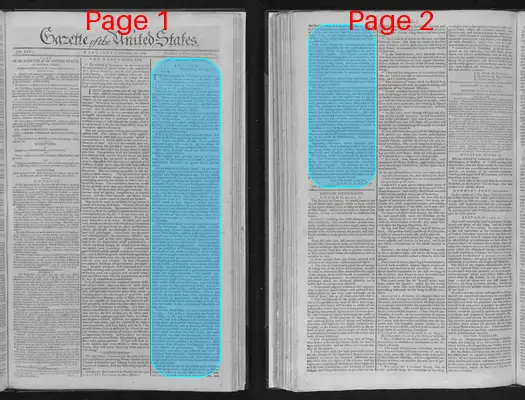
Gazette Of The United States
New York, New York County, New York
What is this article about?
In a letter dated October 9, 1780, from Amsterdam, John Adams argues against the possibility of any American state voluntarily revolting from the Confederation or submitting to British forces, citing failed British attempts to subdue small states like Rhode Island, Delaware, and Georgia, and the steadfast resistance of others.
Merged-components note: Continuation of John Adams's letter 'LETTER V.' across pages 1 and 2, discussing the likelihood of revolt in American states; relabeled from 'story' to 'domestic_news' as it fits local/national non-story news on American union and resistance.
Clippings
1 of 2
OCR Quality
Full Text
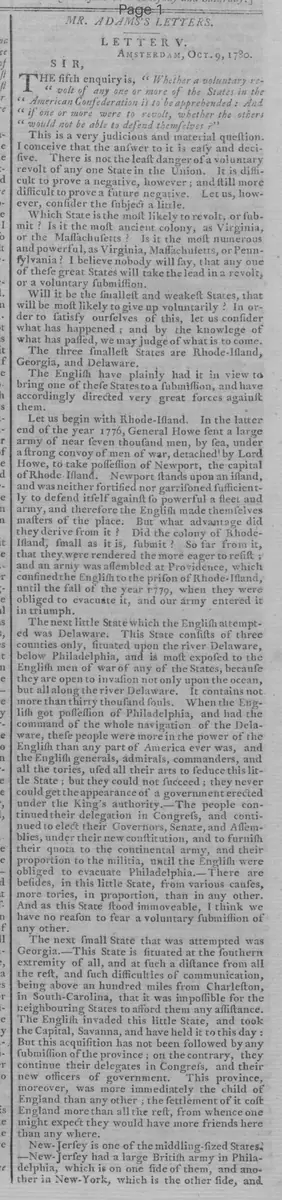
LETTER V.
AMSTERDAM, OCT. 9, 1780.
SIR,
The first, Whether a voluntary revolt from the
American Confederation is to be apprehended: And
if one or more were to revolt, whether the others
would not be able to defend themselves?
This is a very judicious and material question.
I conceive that the answer to it is easy and decisive.
There is not the least danger of a voluntary
revolt of any one State in the Union. It is difficult
to prove a negative, however; and still more
difficult to prove a future negative. Let us, however,
consider the subject a little.
Which State is the most likely to revolt, or submit?
Is it the most ancient colony, as Virginia,
or the Massachusetts? Is it the most numerous
and powerful, as Virginia, Massachusetts, or Pennsylvania?
I believe nobody will say, that any one
of these great States will take the lead in a revolt,
or a voluntary submission.
Will it be the smallest and weakest States, that
will be most likely to give up voluntarily: In order
to satisfy ourselves of this, let us consider
what has happened; and by the knowledge of
what has passed, we may judge of what is to come.
The three smallest States are Rhode-Island,
Georgia, and Delaware.
The English have plainly had it in view to
bring one of these States to a submission, and have
accordingly directed very great forces against them.
Let us begin with Rhode-Island. In the latter
end of the year 1776, General Howe sent a large
army of near seven thousand men, by sea, under
a strong convoy of men of war, detached by Lord
Howe, to take possession of Newport, the capital
of Rhode-Island. Newport stands upon an island,
and was neither fortified nor garrisoned sufficiently
to defend itself against so powerful a fleet and
army, and therefore the English made themselves
masters of the place. But what advantage did
they derive from it? Did the colony of Rhode-
Island, small as it is, submit? So far from it,
that they were rendered the more eager to resist;
and an army was assembled at Providence, which
confined the English to the prison of Rhode-Island,
until the fall of the year 1779, when they were
obliged to evacuate it, and our army entered it
in triumph.
The next little State which the English attempted
was Delaware. This State consists of three
counties only, situated upon the river Delaware,
below Philadelphia, and is most exposed to the
English men of war of any of the States, because
they are open to invasion not only upon the ocean,
but all along the river Delaware. It contains not
more than thirty thousand souls. When the English
got possession of Philadelphia, and had the
command of the whole navigation of the Delaware,
these people were more in the power of the
English than any part of America ever was, and
the English generals, admirals, commanders, and
all the tories, used all their arts to seduce this little
State; but they could not succeed; they never
could get the appearance of a government erected
under the King's authority. The people continued
their delegation in Congress, and continued to elect
their Governors, Senate, and Assemblies, under their
new constitution, and to furnish their quota to the
continental army, and their proportion to the militia,
until the English were obliged to evacuate Philadelphia.—There are
besides, in this little State, from various causes,
more tories, in proportion, than in any other.
And as this State stood immoveable, I think we
have no reason to fear a voluntary submission of
any other.
The next small State that was attempted was
Georgia. This State is situated at the southern
extremity of all, and at such a distance from all
the rest, and such difficulties of communication,
being above an hundred miles from Charleston,
in South-Carolina, that it was impossible for the
neighbouring States to afford them any assistance.
The English invaded this little State, and took
the Capital, Savannah, and have held it to this day:
But this acquisition has not been followed by any
submission of the province; on the contrary, they
continue their delegates in Congress, and their
new officers of government. This province,
moreover, was more immediately the child of
England than any other; the settlement of it cost
England more than all the rest, from whence one
might expect they would have more friends here
than any where.
New-Jersey is one of the middling-sized States.
—New-Jersey had a large British army in Philadelphia,
which is on one side of them, and another in New-York,
which is the other side, and the British army has marched
quite through it; and the English have used every policy of flattery,
of terror, and severity, but all in vain, and worse than in vain;
all has conspired to make the people of New-Jersey some of the most
brave and skillful to resist them.
New-York, before the commencement of hostilities, was supposed to be the most lukewarm of the middle States, in the opposition to the designs of the English. The English armies have invaded it from Canada and from the ocean, and have long been in possession of three islands, New-York Island, Long-Island, and Staten-Island; yet the rest of that Province has stood immovable, through all the varieties of the fortune of war, for four years, and increases in zeal and unanimity every year.
I think, therefore, there is not a possibility, that any one of the Thirteen States should ever voluntarily revolt or submit.
The efforts and exertions of General Howe, in New-York, Long-Island, Staten-Island, New-Jersey, Pennsylvania, Delaware, and Maryland, to obtain recruits; the vast expense that he put his pay-master to in appointing new corps of officers, even general officers: the pains they took to enlist men, among all the stragglers of those countries, and among many thousands of prisoners which they then had in their hands;—all these measures obtaining but three thousand six hundred men, and very few of these Americans, according to General Howe's own account, shows, I think, to a demonstration, that no voluntary revolt or submission is ever to be apprehended.
But even supposing Rhode-Island should submit, what could this small colony of fifty thousand souls do, in the midst of Massachusetts, Connecticut, and New-Hampshire?
Supposing Delaware, thirty thousand souls, should submit, what influence could it have upon the great States of New-Jersey, Pennsylvania, Maryland, and Virginia, among which it lies?
If Georgia, at the extremity of all, should submit, what influence could this little society of thirty thousand souls have upon the two Carolinas and Virginia? The colonies are at such vast distances from one another, and the country is so fortified every where, by rivers, mountains, and forests, that the conquest or submission of one part has no influence upon the rest.
I have the honor to be, &c.
JOHN ADAMS.
MR. GALKOEN.
What sub-type of article is it?
What keywords are associated?
What entities or persons were involved?
Where did it happen?
Domestic News Details
Primary Location
United States
Event Date
Oct. 9, 1780
Key Persons
Outcome
no voluntary revolts or submissions by any american states; british recruitment efforts yielded only 3,600 men, few americans.
Event Details
John Adams addresses concerns about potential voluntary revolt from the American Confederation, arguing it is unlikely based on historical British attempts to subdue small states like Rhode-Island (invaded 1776, evacuated 1779), Delaware (resisted despite occupation of Philadelphia), and Georgia (Savannah held but no submission), as well as resistance in New-Jersey and New-York.