Thank you for visiting SNEWPapers!
Sign up free
Letter to Editor
September 21, 1833
The Liberator
Boston, Suffolk County, Massachusetts
What is this article about?
A letter to the editor denounces the American Colonization Society for perpetuating prejudice against free Black Americans, compelling their emigration to Liberia through indirect insistence rather than remedying discrimination, illustrated by a school analogy.
Clipping
OCR Quality
98%
Excellent
Full Text
[For the Liberator.]
OPPRESSIVE INFLUENCE OF COLONIZATION.
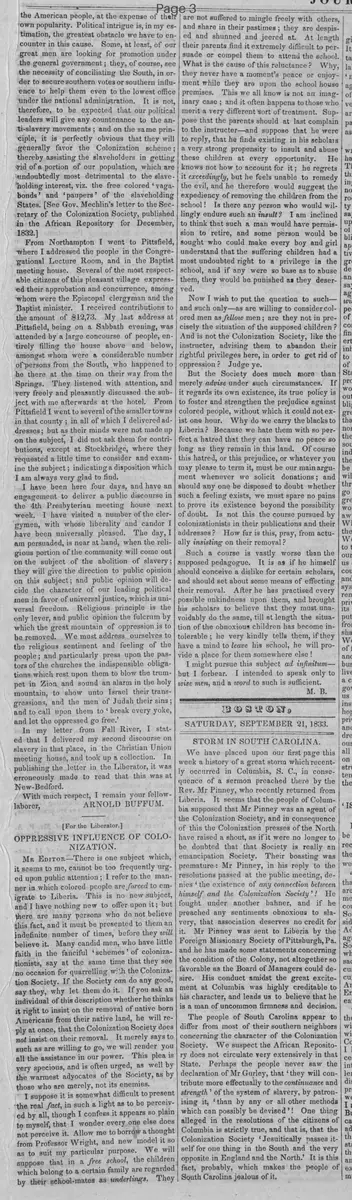
Mr. Editor—There is one subject which, it seems to me, cannot be too frequently urged upon public attention; I refer to the manner in which colored people are forced to emigrate to Liberia. This is no new subject, and I have nothing new to offer upon it; but there are many persons who do not believe this fact, and it must be presented to them an indefinite number of times, before they will believe it. Many candid men, who have little faith in the fanciful 'schemes' of colonizationists, say at the same time that they see no occasion for quarrelling with the Colonization Society. If the Society can do any good, say they, why let them do it. If you ask an individual of this description whether he thinks it right to insist on the removal of native born Americans from their native land, he will reply at once, that the Colonization Society does not insist on their removal. It merely says to such as are willing to go, we will render you all the assistance in our power. This plea is very specious, and is often urged, as well by the warmest advocates of the Society, as by those who are merely, not its enemies.
I suppose it is somewhat difficult to present the real fact, in such a light as to be perceived by all, though I confess it appears so plain to myself, that I wonder every one else does not perceive it. Allow me to borrow a thought from Professor Wright, and new model it so as to suit my particular purpose. We will suppose that in a free school, the children which belong to a certain family are regarded by their school-mates as underlings. They are not suffered to mingle freely with others, and share in their pastimes; they are despised and shunned and jeered at. At length their parents find it extremely difficult to persuade or compel them to attend the school. What is the cause of this reluctance? Why, they never have a moment's peace or enjoyment while they are upon the school house premises. This we all know is not an imaginary case; and it often happens to those who merit a very different sort of treatment. Suppose that the parents should at last complain to the instructor—and suppose that he were to reply, that he finds existing in his scholars a very strong propensity to insult and abuse these children at every opportunity. He knows not how to account for it; he regrets it exceedingly, but he feels unable to remedy the evil, and he therefore would suggest the expediency of removing the children from the school! Is there any person who would willingly endure such an insult? I am inclined to think that such a man would have permission to retire, and some person would be sought who could make every boy and girl understand that the suffering children had a most undoubted right to a privilege in the school, and if any were so base as to abuse them, they would be punished as they deserved.
Now I wish to put the question to such—and such only—as are willing to consider colored men as fellow men; are they not in precisely the situation of the supposed children? And is not the Colonization Society, like the instructor, advising them to abandon their rightful privileges here, in order to get rid of oppression? Judge ye.
But the Society does much more than merely advise under such circumstances. If it regards its own existence, its true policy is to foster and strengthen the prejudice against colored people, without which it could not exist one hour. Why do we carry the blacks to Liberia? Because we hate them with so perfect a hatred that they can have no peace so long as they remain in this land. Of course this hatred, or this prejudice, or whatever you may please to term it, must be our main argument whenever we solicit donations; and should any one be disposed to doubt whether such a feeling exists, we must spare no pains to prove its existence beyond the possibility of doubt. Is not this the course pursued by colonizationists in their publications and their addresses? How far is this, pray, from actually insisting on their removal?
Such a course is vastly worse than the supposed pedagogue. It is as if he himself should conceive a dislike for certain scholars, and should set about some means of effecting their removal. After he has practised every possible unkindness upon them, and brought his scholars to believe that they must unavoidably do the same, till at length the situation of the obnoxious children has become intolerable; he very kindly tells them, if they have a mind to leave his school, he will provide a place for them somewhere else!
I might pursue this subject ad infinitum—but I forbear. I intended to speak only to wise men, and a word to such is sufficient.
M. B.
OPPRESSIVE INFLUENCE OF COLONIZATION.
Mr. Editor—There is one subject which, it seems to me, cannot be too frequently urged upon public attention; I refer to the manner in which colored people are forced to emigrate to Liberia. This is no new subject, and I have nothing new to offer upon it; but there are many persons who do not believe this fact, and it must be presented to them an indefinite number of times, before they will believe it. Many candid men, who have little faith in the fanciful 'schemes' of colonizationists, say at the same time that they see no occasion for quarrelling with the Colonization Society. If the Society can do any good, say they, why let them do it. If you ask an individual of this description whether he thinks it right to insist on the removal of native born Americans from their native land, he will reply at once, that the Colonization Society does not insist on their removal. It merely says to such as are willing to go, we will render you all the assistance in our power. This plea is very specious, and is often urged, as well by the warmest advocates of the Society, as by those who are merely, not its enemies.
I suppose it is somewhat difficult to present the real fact, in such a light as to be perceived by all, though I confess it appears so plain to myself, that I wonder every one else does not perceive it. Allow me to borrow a thought from Professor Wright, and new model it so as to suit my particular purpose. We will suppose that in a free school, the children which belong to a certain family are regarded by their school-mates as underlings. They are not suffered to mingle freely with others, and share in their pastimes; they are despised and shunned and jeered at. At length their parents find it extremely difficult to persuade or compel them to attend the school. What is the cause of this reluctance? Why, they never have a moment's peace or enjoyment while they are upon the school house premises. This we all know is not an imaginary case; and it often happens to those who merit a very different sort of treatment. Suppose that the parents should at last complain to the instructor—and suppose that he were to reply, that he finds existing in his scholars a very strong propensity to insult and abuse these children at every opportunity. He knows not how to account for it; he regrets it exceedingly, but he feels unable to remedy the evil, and he therefore would suggest the expediency of removing the children from the school! Is there any person who would willingly endure such an insult? I am inclined to think that such a man would have permission to retire, and some person would be sought who could make every boy and girl understand that the suffering children had a most undoubted right to a privilege in the school, and if any were so base as to abuse them, they would be punished as they deserved.
Now I wish to put the question to such—and such only—as are willing to consider colored men as fellow men; are they not in precisely the situation of the supposed children? And is not the Colonization Society, like the instructor, advising them to abandon their rightful privileges here, in order to get rid of oppression? Judge ye.
But the Society does much more than merely advise under such circumstances. If it regards its own existence, its true policy is to foster and strengthen the prejudice against colored people, without which it could not exist one hour. Why do we carry the blacks to Liberia? Because we hate them with so perfect a hatred that they can have no peace so long as they remain in this land. Of course this hatred, or this prejudice, or whatever you may please to term it, must be our main argument whenever we solicit donations; and should any one be disposed to doubt whether such a feeling exists, we must spare no pains to prove its existence beyond the possibility of doubt. Is not this the course pursued by colonizationists in their publications and their addresses? How far is this, pray, from actually insisting on their removal?
Such a course is vastly worse than the supposed pedagogue. It is as if he himself should conceive a dislike for certain scholars, and should set about some means of effecting their removal. After he has practised every possible unkindness upon them, and brought his scholars to believe that they must unavoidably do the same, till at length the situation of the obnoxious children has become intolerable; he very kindly tells them, if they have a mind to leave his school, he will provide a place for them somewhere else!
I might pursue this subject ad infinitum—but I forbear. I intended to speak only to wise men, and a word to such is sufficient.
M. B.
What sub-type of article is it?
Persuasive
Social Critique
Ethical Moral
What themes does it cover?
Slavery Abolition
Social Issues
Morality
What keywords are associated?
Colonization Society
Liberia Emigration
Racial Prejudice
Forced Removal
American Oppression
What entities or persons were involved?
M. B.
Mr. Editor
Letter to Editor Details
Author
M. B.
Recipient
Mr. Editor
Main Argument
the colonization society fosters prejudice against colored people to justify and promote their forced emigration to liberia, effectively insisting on their removal from their native land rather than addressing the oppression.
Notable Details
Analogy To Mistreated School Children Shunned By Peers
Borrowed Thought From Professor Wright
Criticism Of Society's Publications And Addresses Proving Prejudice