Thank you for visiting SNEWPapers!
Sign up free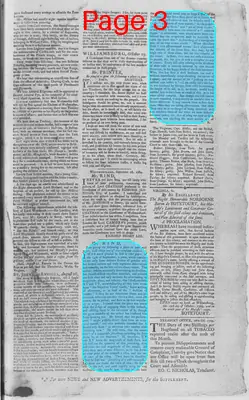
Letter to Editor
October 19, 1769
The Virginia Gazette
Williamsburg, Virginia
What is this article about?
A constant reader praises a witty September 14 article on a recent comet's observations, direction, magnitude, and velocity. Sarcastically challenges amateur astronomers X Y and T V to use its methods to analyze the comet, determine if it's new or old, and mockingly suggests shutting eyes for better fancy over observation.
Clipping
OCR Quality
98%
Excellent
Full Text
Mr. RIND,
Your giving the following a place in your next paper, will oblige one of your constant readers.
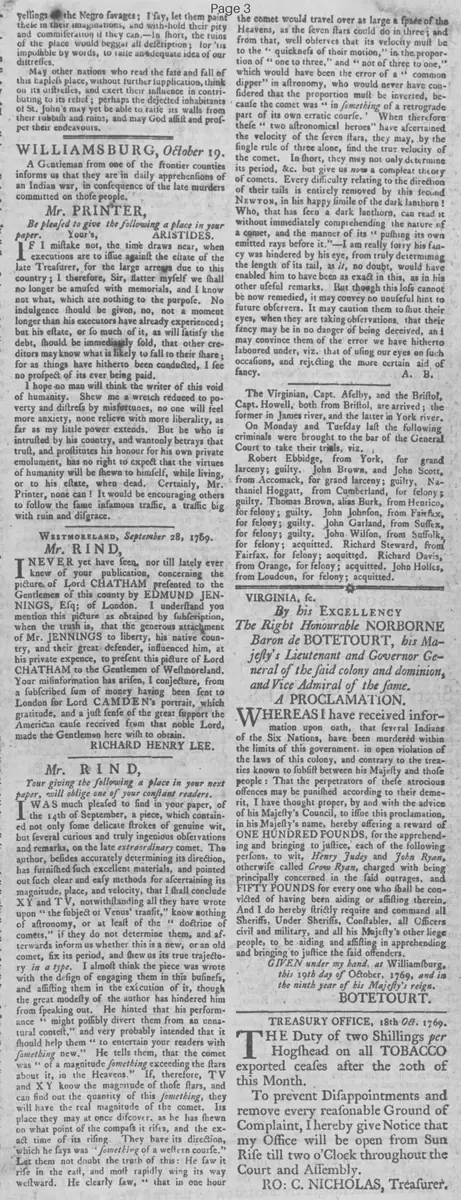
I WAS much pleased to find in your paper, of the 14th of September, a piece, which contained not only some delicate strokes of genuine wit, but several curious and truly ingenious observations and remarks, on the late extraordinary comet. The author, besides accurately determining its direction, has furnished such excellent materials, and pointed out such clear and easy methods for ascertaining its magnitude, place, and velocity, that I shall conclude X Y and T V, notwithstanding all they have wrote upon "the subject of Venus' transit," know nothing of astronomy, or at least of the "doctrine of comets," if they do not determine them, and afterwards inform us whether this is a new, or an old comet, fix its period, and shew us its true trajectory in a type. I almost think the piece was wrote with the design of engaging them in this business, and assisting them in the execution of it, though the great modesty of the author has hindered him from speaking out. He hinted that his performance "might possibly divert them from an unnatural contest," and very probably intended that it should help them "to entertain your readers with something new." He tells them, that the comet was "of a magnitude something exceeding the stars about it, in the Heavens." If, therefore, T V and X Y know the magnitude of those stars, and can find out the quantity of this something, they will have the real magnitude of the comet. Its place they may at once discover. as he has shewn on what point of the compass it rises, and the exact time of its rising. They have its direction, which he says was something of a western course. Let them not doubt the truth of this: He saw it rise in the east, and most rapidly wing its way westward. He clearly saw, that in one hour the comet would travel over as large a part of the Heavens, as the seven stars could do in three; and from that, well observes that its velocity must be to the "quickness of their motion," in the proportion of "one to three," and "not of three to one," which would have been the error of a "common dipper" in astronomy, who would never have considered that the proportion must be inverted, because the comet was "in something of a retrograde part of its own erratic course." When therefore these "two astronomical heroes" have ascertained the velocity of the seven stars, they may, by the single rule of three alone, find the true velocity of the comet. In short, they may not only determine its period, &c. but give us now a compleat history of comets. Every difficulty relating to the direction of their tails is entirely removed by this second Newton, in his happy simile of the dark lanthorn! Who, that has seen a dark lanthorn, can read it without immediately comprehending the nature of a comet, and the manner of its "pushing its own emitted rays before it."—I am really sorry his fancy was hindered by his eye, from truly determining the length of its tail, as it, no doubt, would have enabled him to have been as exact in this, as in his other useful remarks. But though this loss cannot be now remedied, it may convey no unuseful hint to future observers. It may caution them to shut their eyes, when they are taking observations, that their fancy may be in no danger of being deceived, and may convince them of the error we have hitherto laboured under, viz. that of using our eyes on such occasions, and rejecting the more certain aid of fancy.
A. B.
Your giving the following a place in your next paper, will oblige one of your constant readers.
I WAS much pleased to find in your paper, of the 14th of September, a piece, which contained not only some delicate strokes of genuine wit, but several curious and truly ingenious observations and remarks, on the late extraordinary comet. The author, besides accurately determining its direction, has furnished such excellent materials, and pointed out such clear and easy methods for ascertaining its magnitude, place, and velocity, that I shall conclude X Y and T V, notwithstanding all they have wrote upon "the subject of Venus' transit," know nothing of astronomy, or at least of the "doctrine of comets," if they do not determine them, and afterwards inform us whether this is a new, or an old comet, fix its period, and shew us its true trajectory in a type. I almost think the piece was wrote with the design of engaging them in this business, and assisting them in the execution of it, though the great modesty of the author has hindered him from speaking out. He hinted that his performance "might possibly divert them from an unnatural contest," and very probably intended that it should help them "to entertain your readers with something new." He tells them, that the comet was "of a magnitude something exceeding the stars about it, in the Heavens." If, therefore, T V and X Y know the magnitude of those stars, and can find out the quantity of this something, they will have the real magnitude of the comet. Its place they may at once discover. as he has shewn on what point of the compass it rises, and the exact time of its rising. They have its direction, which he says was something of a western course. Let them not doubt the truth of this: He saw it rise in the east, and most rapidly wing its way westward. He clearly saw, that in one hour the comet would travel over as large a part of the Heavens, as the seven stars could do in three; and from that, well observes that its velocity must be to the "quickness of their motion," in the proportion of "one to three," and "not of three to one," which would have been the error of a "common dipper" in astronomy, who would never have considered that the proportion must be inverted, because the comet was "in something of a retrograde part of its own erratic course." When therefore these "two astronomical heroes" have ascertained the velocity of the seven stars, they may, by the single rule of three alone, find the true velocity of the comet. In short, they may not only determine its period, &c. but give us now a compleat history of comets. Every difficulty relating to the direction of their tails is entirely removed by this second Newton, in his happy simile of the dark lanthorn! Who, that has seen a dark lanthorn, can read it without immediately comprehending the nature of a comet, and the manner of its "pushing its own emitted rays before it."—I am really sorry his fancy was hindered by his eye, from truly determining the length of its tail, as it, no doubt, would have enabled him to have been as exact in this, as in his other useful remarks. But though this loss cannot be now remedied, it may convey no unuseful hint to future observers. It may caution them to shut their eyes, when they are taking observations, that their fancy may be in no danger of being deceived, and may convince them of the error we have hitherto laboured under, viz. that of using our eyes on such occasions, and rejecting the more certain aid of fancy.
A. B.
What sub-type of article is it?
Satirical
Comedic
Informative
What themes does it cover?
Science Nature
What keywords are associated?
Comet Observation
Astronomy Satire
Venus Transit
X Y T V
Dark Lanthorn Simile
Seven Stars Velocity
What entities or persons were involved?
A. B.
Mr. Rind
Letter to Editor Details
Author
A. B.
Recipient
Mr. Rind
Main Argument
praises the witty and ingenious september 14 article on the recent comet's observations and sarcastically urges x y and t v, critics of venus' transit, to apply its methods to determine the comet's magnitude, place, velocity, period, and trajectory, mocking their astronomical ignorance.
Notable Details
References September 14 Article
Comet Rising In East, Western Course
Velocity Proportion To Seven Stars (Pleiades)
Simile Of Dark Lanthorn For Comet Tail
Mockery Of Using Fancy Over Eyes In Observation