Thank you for visiting SNEWPapers!
Sign up free
Worcester Daily Spy
Worcester, Worcester County, Massachusetts
What is this article about?
On a Monday in 1858, Worcester citizens gathered at City Hall for the inauguration of the new city government. Outgoing Mayor Richardson swore in Isaac Davis as mayor, who then addressed the council on economic woes from currency issues, urging fiscal prudence, and covered schools, infrastructure, poor relief, water, cemetery, fire, and police departments. (278 characters)
Merged-components note: The two story components and three tables are part of the same inaugural address narrative; tables provide supporting data (appropriations, school expenses, aqueduct costs) embedded within the text flow and sequential reading order.
Clipping
OCR Quality
Full Text
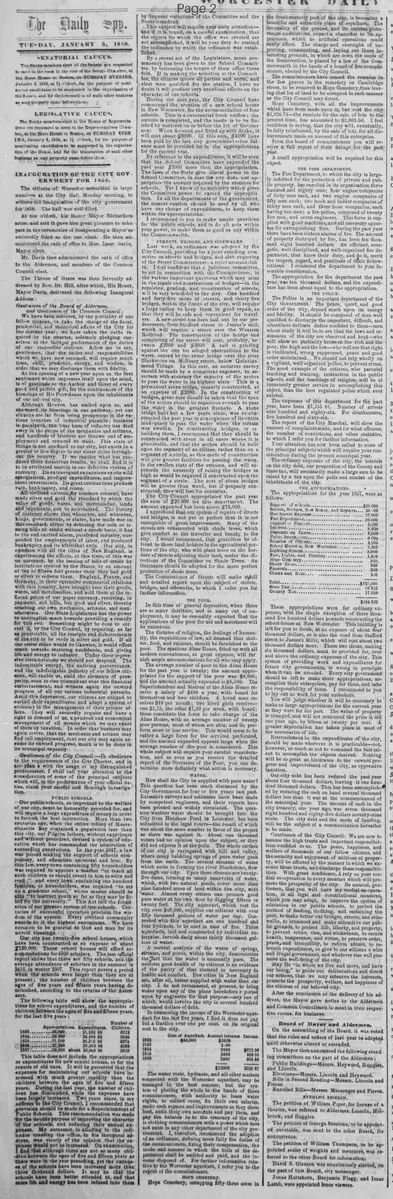
The citizens of Worcester assembled in large numbers at the City Hall, Monday morning, to witness the inauguration of the city government for 1858. The hall was well filled.
At ten o'clock, his Honor Mayor Richardson arose, and said it gave him great pleasure to take part in the ceremonies of inaugurating a Mayor so eminently fitted as the one elect. He then administered the oath of office to Hon. Isaac Davis, Mayor elect.
Mr. Davis then administered the oath of office to the Aldermen, and members of the Common Council elect.
The Throne of Grace was then fervently addressed by Rev. Dr. Hill, after which, His Honor, Mayor Davis, delivered the following Inaugural Address:
Gentlemen of the Board of Aldermen, and Gentlemen of the Common Council:
We have been selected, by the partiality of our fellow citizens, to take the charge of the fiscal, prudential, and municipal affairs of the City for the current year; we have taken the oaths required by the charter, solemnly pledging ourselves to the faithful performance of the duties of our respective stations. Allow me to say, gentlemen, that the duties and responsibilities which we have now assumed, will require much time, skill, prudence, energy, and wisdom, in order that we may discharge them with fidelity.
At the opening of a new year upon us, the first sentiment which impresses itself upon the mind, is of gratitude to the Author and Giver of every good and perfect gift, for the continuance of the blessings of His Providence upon the inhabitants of our beloved city.
Although Heaven has smiled upon us, and showered its blessings in our pathway, yet our citizens are far from being prosperous in the various branches of industrial pursuits; business is paralyzed, the busy hum of industry has died away in the shops of the mechanics and artizans, and hundreds of laborers are thrown out of employment and reduced to want. This state of things is not confined to our city, but exists in a greater or less degree in our sister cities throughout the country. If we inquire what has produced these disastrous results, we shall find it is to be attributed mainly to our defective system of currency. Its extravagant expansions excite wild speculations, prodigal expenditures, and improvident investments. Its great contractions produce ruin, bankruptcy, and crime.
All civilized nations, by common consent, have made silver and gold the standard by which the value of goods, wares, and merchandise, lands and tenements, can be ascertained. The history of currency shows that whenever, and wherever, kings, governments, or states, have made war on this standard, either by debasing the coin or issuing bills of credit without a specific basis, it has in the end excited alarm, paralyzed industry, suspended the employments of labor, and produced bankruptcy and its attendant evils. Our city, in common with all the cities of New England, is experiencing the effects, at this time, of this war on currency, by the issuing of bills of credit by institutions created by the States, to an amount of ten or fifteen fold greater than they had gold or silver to redeem them. England, France, and Germany, in their extensive commercial relations with this country, have brought here their goods, wares, and merchandise, and sold them at the inflated prices of our paper currency, receiving, in payment, not bills, but gold and silver, thereby crushing our own mechanics, artizans, and manufacturers. Our State Legislature has the power to accomplish much towards providing a remedy for this evil: Something might be done to correct it, by the City Council, by requiring, as far as practicable, all the receipts and disbursements of the city to be made in silver and gold. If all our sister cities would do likewise, it would effect much towards restoring confidence, and giving life and energy to industry. Under these repressive circumstances we should not despond. The indomitable energy, the untiring perseverance, and the indefatigable industry of our fellow citizens, will enable us, amid the elements of prosperity, soon to rise triumphant over this financial embarrassment, and witness again the onward progress of all our various industrial pursuits.
Amid this depression, our citizens are obliged to curtail their expenditures, and adopt a system of economy in the management of their private affairs. They will assuredly require and have a right to demand of us, a prudent and economical management of all monies which we may exact of them by taxation. In order that business may again revive, that the mechanic and artizan may find full employment, that our city may again assume its onward progress, much is to be done in its municipal capacity.
Gentlemen of the City Council: In obedience to the requirements of the City Charter, and in accordance with the usage of my distinguished predecessors, I shall call your attention to the consideration of some of the principal subjects which will, in the performance of your official duties, claim your careful and thorough investigation.
PUBLIC SCHOOLS.
Our public schools, so important to the welfare of our city, must be honorably provided for, and will require a large expenditure of money in order to furnish the best instruction. More than two centuries ago, when the entire colony of Massachusetts Bay contained a population less than this city, our Pilgrim fathers, without experience and without precedent, devised a system of education which has commanded the admiration of succeeding generations. In the year 1647, a law was passed making the support of schools compulsory, and education universal and free. By this law, every town containing fifty householders was required to appoint a teacher "to teach all such children as should resort to him to write and read;" and every town containing one hundred families, or householders, was required "to set up a grammar school," whose master should be able "to instruct youth so far as they may be fitted for the university." This Act laid the foundation of our present system of free schools. Centuries of successful operation proclaim the wisdom of the system. Every civilized community awards to it the highest encomiums. We have occasion to be grateful to God and man for its untold blessings.
Our city has twenty-five school houses, which have been constructed at an expense of about $130,000. These school houses will afford accommodations for 4500 scholars. The last official report shows that there are fifty schools, and the average attendance of scholars in the summer is 2415, in winter 2507. This report covers a period when the schools were larger than they are at present; the number of children between the ages of five years and fifteen years having diminished, according to the returns of the Assessors.
The following table will show the appropriations for school expenditures, and the number of children between the ages of five and fifteen years, for the last five years:
[Table data as per OCR, corrected: Expenses for maintaining our schools have increased with much greater rapidity than the children between the ages of five and fifteen years. During the last year, the number of children has diminished while the expenses have been largely increased.]
Two years since, in an address to the City Council, I recommended that provision should be made for a Superintendent of Public Schools. This recommendation was made for the double purpose of improving the character of the schools, and reducing their annual expenses. My successor, in alluding to the ordinance creating the office, in his inaugural address, was clearly of the opinion that the expenses would not be increased. On examination, I find that although there are not so many children between the ages of five and fifteen years as there were in the year preceding, yet the expenses of the schools have been increased more than three thousand dollars. It may be that the schools have been better attended to, and that more life and energy have been infused into them by frequent visitations of the Committee and the Superintendent. This subject will require your early attention—and if it is found, on a careful examination, that the objects for which the office was created are not accomplished, it will be your duty to rescind the ordinance by which the office was established.
By a recent act of the Legislature, more permanency has been given to the School Committee, by increasing the tenure of their office three fold. If in making the selection of the Committee, the citizens ignore all parties and sects, and elect men qualified for the station, I have no doubt it will produce very beneficial effects on the character of our schools.
During the past year, the City Council have commenced the erection of a new school house in New Worcester, for the accommodation of four schools. This is a substantial brick edifice; the outside is completed, and the inside is to be finished by contract on or before the 1st of October next. When finished and fitted up with desks, it will cost about $8000. Of this sum, $4100 have been paid by the last city government—the balance must be provided for in the appropriations for the current year.
By reference to the expenditures, it will be seen that the School Committee have expended the past year $3000 more than the appropriation. The laws of the State give liberal power to the School Committee, in case the city does not appropriate the amount required by the statutes for schools. Yet I know of no authority which gives the Committee power to exceed the appropriation. In all the departments of the government, the utmost caution should be used by all who have any charge of expenditures, to keep them within the appropriations.
I recommend to you to make ample provision for the public schools, and to do all acts within your power, to make them as good as any within the Commonwealth.
STREETS, BRIDGES, AND SIDEWALKS.
Last week, an ordinance was adopted by the City Council, providing for a joint standing committee on streets and bridges, and also requiring of the Street Commissioner, a strict accountability. I feel confident that a judicious committee, to act in connection with the Commissioner, in the various important questions which may arise in the repair and construction of bridges—in the repairing, grading, and construction of streets, will be very beneficial to the city. One hundred and forty-five miles of streets, and thirty five bridges, within the limits of the city, will require a large outlay to keep them in good repair, so that they will be safe and convenient for travelers. A new street has been laid out by our predecessors, from Stafford street to James's mill, which will require a street over the Western Railroad. The construction of the bridge and completing of the street will cost, probably, between $2000 and $3000. A suit is pending against the city for alleged obstructions to the water, caused by the stone bridge over the river Blackstone on Millbury street, below Quinsigamond Village. In this case, an accurate survey should be made by a competent engineer, to ascertain with accuracy the capacity of the arches to pass the water in its highest state. This is a permanent stone bridge, recently constructed, at an expense of $2000. In the construction of bridges, great care should be taken that the span of the arches should be capacious enough to pass the water in the greatest freshets. A stone bridge built but a few years since, was re-constructed the past year in consequence of its entire inadequacy to pass the water when the stream was swollen. In constructing bridges, or re-building them, I recommend that they should be constructed with stone in all cases where it is practicable, and that the arches should be built upon the segment of an ellipse, rather than on a segment of a circle, as this mode of construction will give greater facilities for passing the water, in the swollen state of the streams, and will supersede the necessity of raising the bridges as high as would be required if constructed upon the segment of a circle. The cost of stone bridges will be greater than wood, but if properly constructed, they will last for centuries.
The City Council appropriated the past year the sum of $20,000 for this department. The amount expended has been about $15,000. I apprehend that our system of repairs of streets and bridges, is not yet so perfect that it is not susceptible of great improvement. Many of the streets are ornamented with shade trees, which give comfort to the traveller and beauty to the city. I would recommend, that gratuities be offered to those land holders in the agricultural portions of the city, who will plant trees on the borders of streets adjoining their land, under the directions of the Committee on Shade Trees. An Ordinance should be adopted for the more perfect protection of shade trees.
The Commissioner of Streets will make a full and detailed report upon the subject of streets, bridges, and sidewalks, to which I refer you for further information.
THE POOR.
In this time of general depression, when there are so many destitute, and so many out of employment, it may be reasonably expected that the applications of the poor for aid and assistance will be numerous. The dictates of religion, the feelings of humanity, the requisitions of law, all demand that shelter, food, and raiment, should be furnished to the poor. The spacious Alms House, fitted up with all modern conveniences, at great expense, will furnish ample accommodations for all who may apply. The average number of poor in the Alms House for the past year is twenty; the amount appropriated for the support of the poor was $8,000; and the amount actually expended is $8,500. The Superintendent and Matron of the Alms House receive a salary of $490 a year, with board for themselves and two children. A hired man receives $19 per month; two hired girls receive—one $1.75, the other $1.50 per week, with board; these constitute the force to take charge of the Alms House, with an average number of twenty poor persons, most of whom are able, and do perform more or less service. This would seem to be rather a large force for the services performed, and the amount expended appears large when the average number of the poor is considered. This whole subject will require your careful consideration, and as soon as you receive the detailed report of the Overseers of the Poor, you can determine more definitely what action is necessary.
WATER.
How shall the City be supplied with pure water? This question has been much discussed by the City Government for four or five years last past. Extensive surveys and estimates have been made by competent engineers, and their reports have been printed and widely circulated. The question whether water should be brought into the City from Henshaw Pond in Leicester, has been submitted to the legal voters—the result of which was about the same number in favor of the project as there was against it. About one thousand voters had no opinion upon the subject, or they did not express it at the polls. The whole surface of our city is variegated with hill and valley, where many bubbling springs of pure water gush from the earth. The several streams of water which unite in forming the river Blackstone, flow through our city. Upon these streams are twenty-five dams, forming as many reservoirs of water, which, with two natural ponds, cover more than nine hundred acres of land within the city, with water. Almost every citizen can procure good pure water at his own door by digging fifteen or twenty feet. The city aqueduct, which cost the city over $40,000, supplies our citizens with over fifty thousand gallons of water per day. Connected with this aqueduct are one hundred and four hydrants, to be used in case of fire. Three aqueducts, laid and constructed by individual enterprise, furnish daily about thirty thousand gallons of water.
A careful analysis of the water of springs, streams, and ponds, within the city, demonstrates the fact that the water is unusually pure. The uniform good health of its citizens is an evidence of the purity of that element so necessary to health and comfort. Few cities in New England are, after all, better supplied with water than our city. I do not recommend, at present, to bring water upon any of the plans heretofore reported upon by engineers for that purpose—any one of which, would involve the city in several hundred thousand dollars of debt.
In examining the income of the Worcester aqueduct for the last five years, I find it does not pay but a fraction over one per cent. on its original cost to the city. The water rents, hydrants, and all other matters connected with the Worcester aqueduct, may be managed in the best manner, but the system of placing the whole in the hands of three commissioners, with authority to lease water rights, to collect rents, fix their own salaries, make such repairs and improvements as they deem best, audit their own accounts and pay them, and pay the balance into the treasury of the city, is clothing commissioners with a power which does not exist in any other department of the city government. I, therefore, recommend the adoption of an ordinance, defining more fully the duties of the commissioners, fixing their compensation, the mode and manner in which the bills of the department shall be audited and paid, and the income disposed of. For further information relative to the Worcester aqueduct, I refer you to the report of the commissioners.
HOPE CEMETERY.
Hope Cemetery, occupying fifty-three acres in the Southwesterly part of the city, is becoming a beautiful and attractive place of sepulture. The inequality of the ground, and its various picturesque undulations, impart a character to its appearance, which no artificial operations could easily effect. The charge and oversight of improving, ornamenting, and laying out these interesting grounds, in which are sown the seeds of the Resurrection, is placed by a law of the Commonwealth in the hands of a board of five commissioners, elected by the City Council.
The commissioners have caused the remains in the few graves in the cemetery on Cambridge street, to be removed to Hope Cemetery, thus leaving that lot of land to be occupied in such manner as the City Council may direct.
Hope Cemetery, with all the improvements which have been made upon it, has cost the city $5,920.74—the receipts for the sale of lots to the present time, has amounted to $3,003.50. I feel confident in saying, that the city will, eventually, be fully reimbursed, by the sale of lots, for all disbursements made on account of this enterprise.
From the board of commissioners you will receive a full report of their doings for the past year. A small appropriation will be required for this object.
THE FIRE DEPARTMENT.
The Fire Department, to which the city is largely indebted for the protection of private and public property, has enrolled in its organization three hundred and eighty men; four engine companies of forty men each, and two engine companies of fifty men each; two hook and ladder companies of thirty men each, and three hose companies, each having ten men; a fire police, composed of twenty five men, and seven engineers. This force is supplied with good machines, and all necessary apparatus for extinguishing fires. During the past year there have been sixteen alarms of fire. The amount of property destroyed by fire, has been ten thousand eight hundred dollars. An efficient, energetic, well disciplined, and well-organized fire department, that know their duty, and do it, merit the respect, regard, and gratitude of their fellow citizens. I commend the department to your favorable consideration.
The appropriation for the department the past year, was ten thousand dollars, and the expenditure has been about equal to the appropriation.
THE POLICE.
The Police is an important department of the City Government. The peace, quiet, and good order of the city, depend much upon its energy and fidelity. It should be composed of men well qualified to discharge the important, difficult, and oftentimes delicate duties confided to them—men whose study it will be, to see that the laws and ordinances of the city are observed and kept—who will show no partiality between the rich and the poor, the high and the low—who will see that right is vindicated, wrong suppressed, peace and good order maintained. We should not rely wholly on a vigilant, well organized police, to prevent crime. The good example of the citizens, wise parental teaching and training, instruction in the public schools, and the teachings of religion, will be of immensely greater service in accomplishing this object, than the best regulated police which ever existed.
The expenses of this department for the past year, have been $7,155.01. Number of arrests nine hundred and eighty-six. For drunkenness, five hundred and sixty-six.
The report of the City Marshal, will show the number of complaints made, and for what offences, the number of convictions, and other statistics, to which I refer you for further information.
Your attention has now been called to some of the principal subjects which will require your consideration during the present municipal year. The ordinary expenses of the city, the interest on the city debt, our proportion of the County and State tax, will necessarily make a large sum to be raised by a tax upon the polls and estates of the inhabitants of the city.
THE APPROPRIATIONS.
The appropriations for the year 1857, were as follows:
[Table: $154,822 for ordinary expenses, etc.]
These appropriations were for ordinary expenses, with the single exception of three thousand five hundred dollars towards constructing the school-house at New Worcester. This building is left for you to finish, at an expense of about four thousand dollars, as is also the road from Stafford street to James's Mills, which will cost about two thousand dollars more. These two items, making six thousand dollars, must be provided for, over and above the ordinary expenses of the city. This system of providing work and expenditures for future city governments, is wrong in principle when it can be avoided. Every city government should be left to make their appropriations, accomplish their enterprises, pay for them, and take the responsibility of them. I recommend to you to lay out no work for your successors.
You will judge whether it will be necessary to make as large appropriations for the current year as they were for the past. The value of property is changed, and will not command the price it did one year ago, by fifteen or twenty per cent. A greater depreciation has taken place in most of the necessaries of life.
Retrenchment in the expenditures of the city, should be made wherever it is practicable—not, however, so much as not to command the best talent to accomplish the objects desired. Nothing will be so great an hindrance to the onward progress and improvement of the city, as oppressive taxation.
Our city debt has been reduced the past year about four thousand dollars, leaving it one hundred thousand dollars. This has been accomplished by reducing the cash on hand several thousand dollars less than it was at the commencement of the municipal year. The amount of cash in the city treasury, one year ago, was seven thousand eight hundred and eighty-five dollars seventy-nine cents. The city debt and the mode of funding, will be the subject of a communication hereafter to be made.
Gentlemen of the City Council: We are now to assume the high trusts and important responsibilities confided to us. The peace, happiness, and welfare of thousands of our fellow citizens, and the security and enjoyment of millions of property, will be affected by the manner in which we execute these trusts, and discharge these responsibilities. With great confidence, I rely on your cordial co-operation in every measure which will promote the prosperity of the city. Be assured, gentlemen, that you will have my cordial co-operation, in all legal and constitutional measures, which you may adopt, to improve the system of education in our public schools, to perfect the method of feeding, clothing, and sustaining the poor, to make better our bridges, streets, and sidewalks, to ornament and make attractive our public grounds, to protect life, liberty, and property, to prevent crime, vice, and wickedness, to secure health, temperance, and virtue, to preserve order, peace, and tranquility, to reform abuses, to retrench expenditures, to give to our citizens a wise and frugal government, and whatever else will promote the well-being of the city.
May He "in whom we live and move, and have our being," so guide our deliberations and direct our actions, that we may subserve the interests, promote the prosperity, welfare, and happiness of the citizens of our beloved city.
After the conclusion of the delivery of his address, the Mayor gave notice to the Aldermen and Common Councilmen to meet in their respective rooms, for business.
| Appropriations. Expenditures. | Children. |
| 1855 | 20,000 |
| 1854 | 22,900 |
| 1855 | 25,500 |
| 1856 | 27,200 |
| 1857 | 30,000 |
| Cost of Aqueduct. Annual interest Income. | ||
| 1852 | $40,000 | $2400 |
| 1853 | 2-00 | |
| 1854 | 2400 | $872.56 |
| 1855 | 2400 | $948.53 |
| 1856 | 2400 | $504.58 |
| Support of schools | $30,000 |
| Streets, Bridges, New Roas, and Repairs | 20,000 |
| Coningent Expense | 17,000 |
| Fire Department | 10,000 |
| Support of Paucers | 5,000 |
| Interest | 8,000 |
| Discount on Taxes | 8,000 |
| Police Department | 6,000 |
| Salaries of Officers | 4,200 |
| School House's, New Worcester | 3,500 |
| Lighting Streets | 3,000 |
| Fuel, Lights, and Printing | 1,800 |
| Hope Cem.tery | 500 |
| Shade Trees | 500 |
| Funerals | 300 |
| Clocks and Bells | 200 |
| Total | $121,000 |
| State Tax | 16,812 |
| County Tax | 17,019 |
What sub-type of article is it?
What themes does it cover?
What keywords are associated?
What entities or persons were involved?
Where did it happen?
Story Details
Key Persons
Location
Worcester City Hall
Event Date
1858
Story Details
Inauguration ceremony for Worcester's 1858 city government where outgoing Mayor Richardson administers oath to new Mayor Isaac Davis, who then oaths officials and delivers address on economic depression due to currency issues, need for prudent management, public schools history and funding, streets and bridges maintenance, care for the poor, water supply, Hope Cemetery, fire department, police, and appropriations emphasizing economy.