Thank you for visiting SNEWPapers!
Sign up free
The Brooksville Journal
Brooksville, Hernando County, Florida
What is this article about?
County Agent Harry J. Brinkley and Extension Agronomist Russell Henderson provide advice on managing Florida winter pastures for optimal cattle grazing, emphasizing fertilization, rotational grazing, and avoiding over- or under-grazing to maximize forage production.
Clipping
OCR Quality
Full Text
SAYS COUNTY AGENT
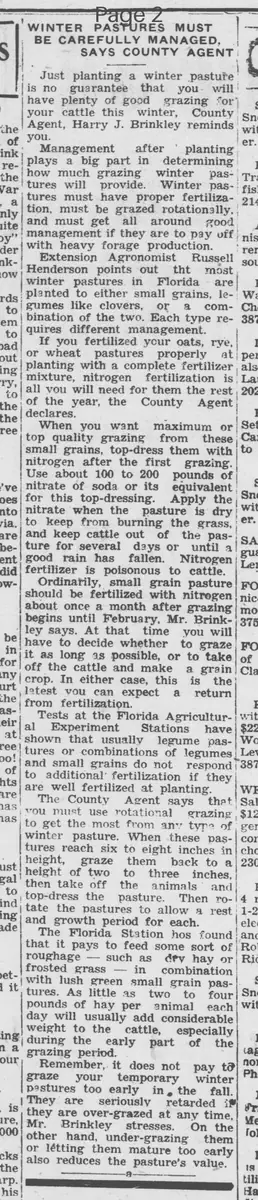
Just planting a winter pasture is no guarantee that you will have plenty of good grazing for your cattle this winter, County Agent, Harry J. Brinkley reminds you.
Management after planting plays a big part in determining how much grazing winter pastures will provide. Winter pastures must have proper fertilization, must be grazed rotationally, and must get all around good management if they are to pay off with heavy forage production.
Extension Agronomist Russell Henderson points out that most winter pastures in Florida are planted to either small grains, legumes like clovers, or a combination of the two. Each type requires different management.
If you fertilized your oats, rye, or wheat pastures properly at planting with a complete fertilizer mixture, nitrogen fertilization is all you will need for them the rest of the year, the County Agent declares.
When you want maximum or top quality grazing from these small grains, top-dress them with nitrogen after the first grazing. Use about 100 to 200 pounds of nitrate of soda or its equivalent for this top-dressing. Apply the nitrate when the pasture is dry to keep from burning the grass, and keep cattle out of the pasture for several days or until a good rain has fallen. Nitrogen fertilizer is poisonous to cattle.
Ordinarily, small grain pasture should be fertilized with nitrogen about once a month after grazing begins until February. Mr. Brinkley says. At that time you will have to decide whether to graze it as long as possible, or to take off the cattle and make a grain crop. In either case, this is the latest you can expect a return from fertilization.
Tests at the Florida Agricultural Experiment Stations have shown that usually legume pastures or combinations of legumes and small grains do not respond to additional fertilization if they are well fertilized at planting.
The County Agent says that you must use rotational grazing to get the most from any type of winter pasture. When these pastures reach six to eight inches in height, graze them back to a height of two to three inches, then take off the animals and top-dress the pasture. Then rotate the pastures to allow a rest and growth period for each.
The Florida Station has found that it pays to feed some sort of roughage—such as dry hay or frosted grass—in combination with lush green small grain pastures. As little as two to four pounds of hay per animal each day will usually add considerable weight to the cattle, especially during the early part of the grazing period.
Remember, it does not pay to graze your temporary winter pastures too early in the fall. They are seriously retarded if they are over-grazed at any time, Mr. Brinkley stresses. On the other hand, under-grazing them or letting them mature too early also reduces the pasture's value.
What sub-type of article is it?
What keywords are associated?
What entities or persons were involved?
Where did it happen?
Domestic News Details
Primary Location
Florida
Key Persons
Event Details
County Agent Harry J. Brinkley advises that proper management after planting is essential for winter pastures to provide good grazing for cattle, including fertilization, rotational grazing, and overall care. Extension Agronomist Russell Henderson notes that Florida winter pastures are typically small grains, legumes like clovers, or combinations, each requiring specific management. Small grain pastures need nitrogen top-dressing after first grazing and monthly until February. Legume pastures usually do not need additional fertilization if well-fertilized at planting. Rotational grazing is recommended: graze to 2-3 inches when 6-8 inches high, then rest and top-dress. Feeding roughage like hay with lush pastures aids weight gain. Avoid over-grazing early or under-grazing to prevent retardation or reduced value.