Thank you for visiting SNEWPapers!
Sign up free
Editorial
January 27, 1848
Lynchburg Virginian
Lynchburg, Virginia
What is this article about?
Reverdy Johnson's speech criticizes President Polk's handling of Texas annexation and the order to march troops to the Rio Grande as the remote and immediate causes of the Mexican-American War, arguing it violated constitutional war powers and prudent policy, while defending U.S. troops' actions after Mexico's attack.
Clipping
OCR Quality
95%
Excellent
Full Text
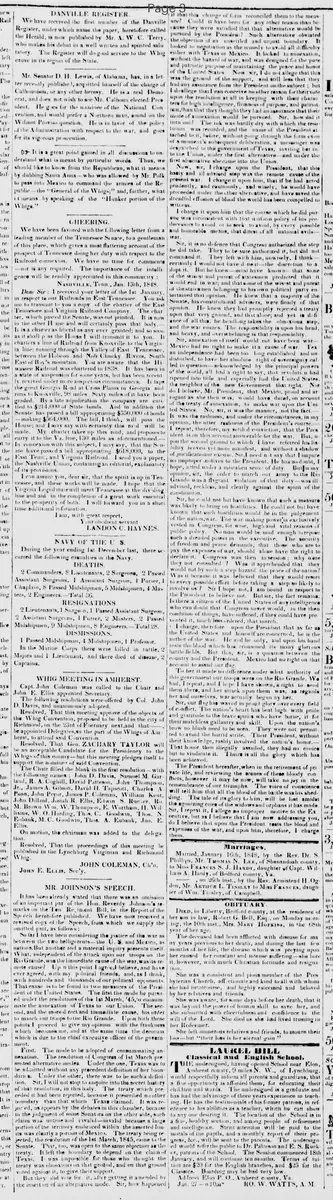
MR. JOHNSON'S SPEECH.
It has been already stated that there was an omission of an important part of the Hon. Reverdy Johnson's remarks on the 'Ten Regiment Bill, in the Report of the Speech heretofore published. We have now received a revised copy of the Speech, from which we supply the omitted part, as follows:
So far I have been considering the justice of the war as between the two belligerents—the U. S. and Mexico, as nations. But another and a material inquiry presents itself. What, independent of the attack upon our troops on the Rio Grande, was the immediate cause of the war, was its remote cause? Upon this point I agree, I believe, and have ever agreed, with my political friends, and, as I think, with hundreds and thousands of our political opponents. That cause is to be found in two measures of the President of the United States. The first the mode he pursued under the resolutions of the 1st March, '45, to consummate the annexation of Texas to our Union. The second, and the more direct and immediate cause, his order to march our troops to the Rio Grande. Upon both these points I proceed to give my opinion with the frankness which becomes me, and at the same time the decorum which is due to the chief executive officer of the government.
First. The mode to be adopted of consummating annexation. The resolution of Congress of 1st March presented alternative modes. Under the one, Texas was to be admitted without any precedent definition of her boundaries. Under the other, there was to be such a definition. Sir, I will not stop to enquire into the secret history of that resolution, in this body. The treaty which preceded it had been rejected, because it prescribed another boundary than that which Texas claimed. It was rejected, as appears by the debates in this chamber, because in the judgment of some Senators on the other side, such claim was untrue and invalid—invalid because a large portion of the territory embraced within the asserted limits was clearly a portion of Mexico. The treaty being rejected, the resolution of the 1st March, 1845, came to the Senate. That, too, was open to the same objection as the treaty. It left the boundary to depend on the claim of Texas. It was impossible for those who thought the treaty was obnoxious on that ground, and on that ground voted against it, to give their support.
But they did vote for it, after getting it amended by the insertion of an alternative mode. Sir, how happened it that this change of form reconciled them to the measure? Could it have been for any other reason than because they were satisfied that that alternative would be pursued by the President? Such alternative obviated the objection of an unsettled and unjust boundary. It looked to negotiation as the remedy to avoid all difficulty either with Texas or Mexico. It looked to annexation, without the hazard of war, and was designed for the pure and patriotic purpose of maintaining the peace and honor of the United States. Now sir, I do not allege that this was the ground of the support, and still less that they had any assurance from the President on the subject; but I do allege that I can conceive no other reason for their vote upon the resolution at all in keeping with their characters for high intelligence, firmness of purpose, and patriotism, than that they thought they had an assurance that their mode of annexation would be pursued. Sir, how did it turn out? The ink was hardly dry with which the resolution was recorded, and the name of the President attached to it, before, without going through the form even of a moment's subsequent deliberation, a messenger was despatched to the government of Texas, inviting her into the Union, under the first alternative—and under the first alternative she came into the Union.
Now, sir, I charge upon the President, that this hasty and ill advised step was the remote cause of the present war. I charge it upon him, that if he had acted prudently, and cautiously, and wisely, he would have proceeded under the other alternative, and have saved the dreadful effusion of blood the world has been compelled to witness.
I charge it upon him that the course which he did pursue was inconsistent with that uniform policy of his predecessors to avoid or to seek to avoid, by every possible and honorable means, that direst of all national evils—war.
Sir, it is no defence that Congress authorized the step he did take. They to be sure authorized it, but did not command it. They left with him, unwisely, I think—certainly I would not have done it—the discretion to adopt it. But he knew—must have known—that some of the wisest and purest of statesmen predicted that it would end in war; and that some of the wisest and purest of those statesmen belonging to his own political party entertained that opinion. He knew that a majority of the Senate, his constitutional advisers, were firmly of that opinion. He knew they had promptly rejected a treaty upon that very ground, and that alone; and yet in defiance of all this, he headlong takes the obnoxious step, and the war ensues. The responsibility is upon his head, and heavy, and overwhelming is that responsibility.
Sir, annexation of itself would not have been war—Mexico had no right to make it a cause of war. Texas' independence had been too long established and undisturbed, to have her absolute right of sovereignty called in question—acknowledged by the principal powers of the world, all had a right to say, that revolution had ripened into fact and especially had the United States, the neighbor of the new Government that right. Not do I believe, Mr. President, that Mexico, proud and arrogant as she then was, would have dared, on account of the treaty of annexation, to make war upon the United States. No, sir, it was the manner, not the fact.—It was the rashness, and under the circumstances, in my opinion, the utter rashness of the President's course.—I repeat, therefore, my settled conviction, that the President is on this account answerable for the war. But, upon the second ground to which I have referred his liability is even yet more manifest, and without a shadow of justification or excuse. Sir, I need not say that I impute no improper motives to the President. He has no doubt, I hope, acted under a mistaken sense of duty. But in my opinion, sir, the order to march our army to the Rio Grande was a flagrant violation of that duty—was ill advised, reckless, and clearly against the spirit of the constitution.
Sir, he could not but have known that such a measure was likely to bring on hostilities. He could not but have known that such hostilities would be in the judgement of the nation, war. The war making power is exclusively vested in Congress, for wise, high and vital reasons of public policy. "No man would be mad enough to repose such a dreaded power in the executive. The security of freedom and peace demands, that those who are to pay the expenses of war, should alone have the right to declare it. Congress was then in session; why were they not consulted? Was it apprehended that they would not by such a step hazard the peace of the nation? Was it because it was believed that they would resort to every possible effort before taking a step so likely to involve us? Sir I hope not, I am bound in respect to the President to believe not. But sir, the fact remains. Is there a citizen of the United States of any intelligence who can doubt that Congress never would, in the then condition of things, have suffered, if they could have prevented it, much less ordered, that march.
I charge, therefore upon the President that as far as the United States and himself are concerned, he is the author of the war. He and he only, and upon his hand rests the blood which has crimsoned its many glorious battle fields. But this, sir, is a question between the country and the President. Mexico had no right on that account to assail our flag.
To her it made no difference under what authority of this government our troops were on the Rio Grande. We had, I repeat, and I hope I have shown, a right to send them there, and her attack upon them was, as regards her and ourselves, war actually begun by her.
Sir, our flag has waved in proud glory over every field of conflict. The nation's heart has beat high with pride and gratitude to the brave spirits who have borne it for their matchless gallantry and skill. Upon the nation's brow no blush need to be seen. They were not permitted to avoid the horrid strife. Their President, without their knowledge, rashly involved the nation's honor.—That honor then illegally assailed, they had no choice but to vindicate it. Theirs is all the glory which has been achieved.
The President hereafter, when in the retirement of private life, and reviewing the scenes of these bloody conflicts, however it may be now, will take no joy in the remembrance of our triumphs. The voice of conscience will tell him that all the blood of the battle was his shedding. The tale of its glory to him, will be lost amidst the agonizing cries of the widows and orphans it has made.
Sir, I repeat it, I allege no improper motive to the Executive, but as I believe that I am now addressing you, do I believe that upon the President rests the blood and expenses of the war, and upon him, therefore, I charge them.
It has been already stated that there was an omission of an important part of the Hon. Reverdy Johnson's remarks on the 'Ten Regiment Bill, in the Report of the Speech heretofore published. We have now received a revised copy of the Speech, from which we supply the omitted part, as follows:
So far I have been considering the justice of the war as between the two belligerents—the U. S. and Mexico, as nations. But another and a material inquiry presents itself. What, independent of the attack upon our troops on the Rio Grande, was the immediate cause of the war, was its remote cause? Upon this point I agree, I believe, and have ever agreed, with my political friends, and, as I think, with hundreds and thousands of our political opponents. That cause is to be found in two measures of the President of the United States. The first the mode he pursued under the resolutions of the 1st March, '45, to consummate the annexation of Texas to our Union. The second, and the more direct and immediate cause, his order to march our troops to the Rio Grande. Upon both these points I proceed to give my opinion with the frankness which becomes me, and at the same time the decorum which is due to the chief executive officer of the government.
First. The mode to be adopted of consummating annexation. The resolution of Congress of 1st March presented alternative modes. Under the one, Texas was to be admitted without any precedent definition of her boundaries. Under the other, there was to be such a definition. Sir, I will not stop to enquire into the secret history of that resolution, in this body. The treaty which preceded it had been rejected, because it prescribed another boundary than that which Texas claimed. It was rejected, as appears by the debates in this chamber, because in the judgment of some Senators on the other side, such claim was untrue and invalid—invalid because a large portion of the territory embraced within the asserted limits was clearly a portion of Mexico. The treaty being rejected, the resolution of the 1st March, 1845, came to the Senate. That, too, was open to the same objection as the treaty. It left the boundary to depend on the claim of Texas. It was impossible for those who thought the treaty was obnoxious on that ground, and on that ground voted against it, to give their support.
But they did vote for it, after getting it amended by the insertion of an alternative mode. Sir, how happened it that this change of form reconciled them to the measure? Could it have been for any other reason than because they were satisfied that that alternative would be pursued by the President? Such alternative obviated the objection of an unsettled and unjust boundary. It looked to negotiation as the remedy to avoid all difficulty either with Texas or Mexico. It looked to annexation, without the hazard of war, and was designed for the pure and patriotic purpose of maintaining the peace and honor of the United States. Now sir, I do not allege that this was the ground of the support, and still less that they had any assurance from the President on the subject; but I do allege that I can conceive no other reason for their vote upon the resolution at all in keeping with their characters for high intelligence, firmness of purpose, and patriotism, than that they thought they had an assurance that their mode of annexation would be pursued. Sir, how did it turn out? The ink was hardly dry with which the resolution was recorded, and the name of the President attached to it, before, without going through the form even of a moment's subsequent deliberation, a messenger was despatched to the government of Texas, inviting her into the Union, under the first alternative—and under the first alternative she came into the Union.
Now, sir, I charge upon the President, that this hasty and ill advised step was the remote cause of the present war. I charge it upon him, that if he had acted prudently, and cautiously, and wisely, he would have proceeded under the other alternative, and have saved the dreadful effusion of blood the world has been compelled to witness.
I charge it upon him that the course which he did pursue was inconsistent with that uniform policy of his predecessors to avoid or to seek to avoid, by every possible and honorable means, that direst of all national evils—war.
Sir, it is no defence that Congress authorized the step he did take. They to be sure authorized it, but did not command it. They left with him, unwisely, I think—certainly I would not have done it—the discretion to adopt it. But he knew—must have known—that some of the wisest and purest of statesmen predicted that it would end in war; and that some of the wisest and purest of those statesmen belonging to his own political party entertained that opinion. He knew that a majority of the Senate, his constitutional advisers, were firmly of that opinion. He knew they had promptly rejected a treaty upon that very ground, and that alone; and yet in defiance of all this, he headlong takes the obnoxious step, and the war ensues. The responsibility is upon his head, and heavy, and overwhelming is that responsibility.
Sir, annexation of itself would not have been war—Mexico had no right to make it a cause of war. Texas' independence had been too long established and undisturbed, to have her absolute right of sovereignty called in question—acknowledged by the principal powers of the world, all had a right to say, that revolution had ripened into fact and especially had the United States, the neighbor of the new Government that right. Not do I believe, Mr. President, that Mexico, proud and arrogant as she then was, would have dared, on account of the treaty of annexation, to make war upon the United States. No, sir, it was the manner, not the fact.—It was the rashness, and under the circumstances, in my opinion, the utter rashness of the President's course.—I repeat, therefore, my settled conviction, that the President is on this account answerable for the war. But, upon the second ground to which I have referred his liability is even yet more manifest, and without a shadow of justification or excuse. Sir, I need not say that I impute no improper motives to the President. He has no doubt, I hope, acted under a mistaken sense of duty. But in my opinion, sir, the order to march our army to the Rio Grande was a flagrant violation of that duty—was ill advised, reckless, and clearly against the spirit of the constitution.
Sir, he could not but have known that such a measure was likely to bring on hostilities. He could not but have known that such hostilities would be in the judgement of the nation, war. The war making power is exclusively vested in Congress, for wise, high and vital reasons of public policy. "No man would be mad enough to repose such a dreaded power in the executive. The security of freedom and peace demands, that those who are to pay the expenses of war, should alone have the right to declare it. Congress was then in session; why were they not consulted? Was it apprehended that they would not by such a step hazard the peace of the nation? Was it because it was believed that they would resort to every possible effort before taking a step so likely to involve us? Sir I hope not, I am bound in respect to the President to believe not. But sir, the fact remains. Is there a citizen of the United States of any intelligence who can doubt that Congress never would, in the then condition of things, have suffered, if they could have prevented it, much less ordered, that march.
I charge, therefore upon the President that as far as the United States and himself are concerned, he is the author of the war. He and he only, and upon his hand rests the blood which has crimsoned its many glorious battle fields. But this, sir, is a question between the country and the President. Mexico had no right on that account to assail our flag.
To her it made no difference under what authority of this government our troops were on the Rio Grande. We had, I repeat, and I hope I have shown, a right to send them there, and her attack upon them was, as regards her and ourselves, war actually begun by her.
Sir, our flag has waved in proud glory over every field of conflict. The nation's heart has beat high with pride and gratitude to the brave spirits who have borne it for their matchless gallantry and skill. Upon the nation's brow no blush need to be seen. They were not permitted to avoid the horrid strife. Their President, without their knowledge, rashly involved the nation's honor.—That honor then illegally assailed, they had no choice but to vindicate it. Theirs is all the glory which has been achieved.
The President hereafter, when in the retirement of private life, and reviewing the scenes of these bloody conflicts, however it may be now, will take no joy in the remembrance of our triumphs. The voice of conscience will tell him that all the blood of the battle was his shedding. The tale of its glory to him, will be lost amidst the agonizing cries of the widows and orphans it has made.
Sir, I repeat it, I allege no improper motive to the Executive, but as I believe that I am now addressing you, do I believe that upon the President rests the blood and expenses of the war, and upon him, therefore, I charge them.
What sub-type of article is it?
War Or Peace
Constitutional
Foreign Affairs
What keywords are associated?
Mexican War
Texas Annexation
Rio Grande March
President Polk
War Powers
Constitutional Violation
Congressional Authority
What entities or persons were involved?
Reverdy Johnson
President Polk
Texas
Mexico
Congress
U.S. Senate
Editorial Details
Primary Topic
Criticism Of President Polk's Actions Causing The Mexican War
Stance / Tone
Strongly Critical Of Presidential Overreach In Initiating War
Key Figures
Reverdy Johnson
President Polk
Texas
Mexico
Congress
U.S. Senate
Key Arguments
President's Choice Of Annexation Mode Without Boundary Negotiation Caused War
March To Rio Grande Was Reckless And Violated Constitutional War Powers
Congress Should Have Been Consulted Before Provocative Military Action
Annexation Itself Was Not Cause For War, But Hasty Manner Was
President Bears Responsibility For War's Blood And Costs
U.S. Troops Acted Honorably In Defense After Mexican Attack