Thank you for visiting SNEWPapers!
Sign up free
Letter to Editor
May 31, 1864
Cleveland Morning Leader
Cleveland, Cuyahoga County, Ohio
What is this article about?
A soldier from Co. C, 150th Regiment, Ohio National Guard, writes from Fort Bunker Hill near Washington, D.C., on May 27, describing the company's duties, daily routine including drills and roll calls, mail distribution, amusements like music, and overall life while serving for Uncle Sam at $16 per month.
Clipping
OCR Quality
88%
Good
Full Text
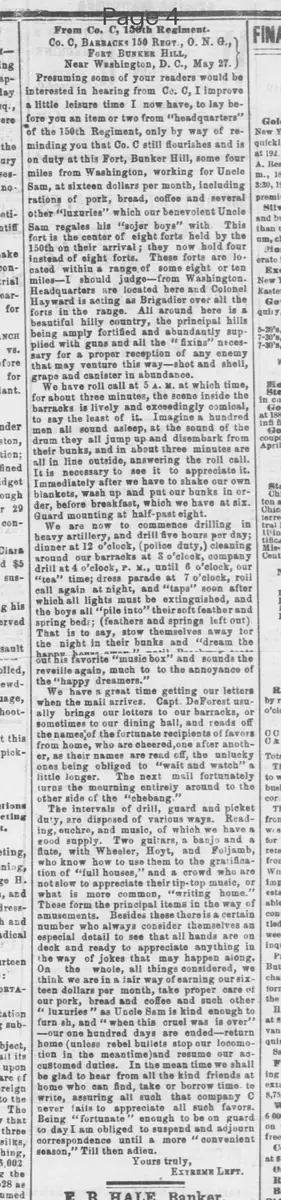
From Co. C, 150th Regiment.
Co. C, Barracks 150 Regt., O. N. G.,
FORT BUNKER HILL,
Near Washington, D. C.,
May 27.
Presuming some of your readers would be interested in hearing from Co. C, I improve a little leisure time I now have, to lay before you an item or two from "headquarters" of the 150th Regiment, only by way of reminding you that Co. C still flourishes and is on duty at this Fort, Bunker Hill, some four miles from Washington, working for Uncle Sam, at sixteen dollars per month, including rations of pork, bread, coffee and several other "luxuries" which our benevolent Uncle Sam regales his "sojer boys" with. This fort is the center of eight forts held by the 150th on their arrival; they now hold four instead of eight forts. These forts are located within a range of some eight or ten miles-I should judge-from Washington. Headquarters are located here and Colonel Hayward is acting as Brigadier over all the forts in the range. All around here is a beautiful hilly country, the principal hills being amply fortified and abundantly supplied with guns and all the "fixins" necessary for a proper reception of any enemy that may venture this way-shot and shell, grape and canister in abundance.
We have roll call at 5 A. M. at which time, for about three minutes, the scene inside the barracks is lively and exceedingly comical, to say the least of it. Imagine a hundred men all sound asleep, at the sound of the drum they all jump up and disembark from their bunks, and in about three minutes are all in line outside, answering the roll call. It is necessary to see it to appreciate it. Immediately after we have to shake our own blankets, wash up and put our bunks in order, before breakfast, which we have at six. Guard mounting at half-past eight.
We are now to commence drilling in heavy artillery, and drill five hours per day; dinner at 12 o'clock, (police duty,) cleaning around our barracks at 3 o'clock, company drill at 4 o'clock, P. M., until 6 o'clock, our "tea" time; dress parade at 7 o'clock, roll call again at night, and "taps" soon after which all lights must be extinguished, and the boys all "pile into" their soft feather and spring beds; (feathers and springs left out). That is to say, stow themselves away for the night in their bunks and "dream the out his favorite "music box" and sounds the reveille again, much to the annoyance of the "happy dreamers."
We have a great time getting our letters when the mail arrives. Capt. DeForest usually brings our letters to our barracks, or sometimes to our dining hall, and reads off the names of the fortunate recipients of favors from home, who are cheered, one after another, as their names are read off, the unlucky ones being obliged to "wait and watch" a little longer. The next mail fortunately turns the mourning entirely around to the other side of the "shebang."
The intervals of drill, guard and picket duty, are disposed of various ways. Reading, euchre, and music, of which we have a good supply. Two guitars, a banjo and a flute, with Wheeler, Hoyt, and Foljamb, who know how to use them to the gratification of "full houses," and a crowd who are not slow to appreciate their tip-top music, or what is more common, "writing home." These form the principal items in the way of amusements. Besides these there is a certain number who always consider themselves an especial detail to see that all hands are on deck and ready to appreciate anything in the way of jokes that may happen along.
On the whole, all things considered, we think we are in a fair way of earning our sixteen dollars per month, take proper care of our pork, bread and coffee and such other "luxuries" as Uncle Sam is kind enough to furnish us, and "when this cruel war is over"-our one hundred days are ended-return home (unless rebel bullets stop our locomotion in the meantime) and resume our accustomed duties. In the mean time we shall be glad to hear from all the kind friends at home who can find, take or borrow time to write, assuring all such that company C never fails to appreciate all such favors.
Being "fortunate" enough to be on guard to day I am obliged to suspend and adjourn correspondence until a more "convenient season," Till then adieu.
Yours truly,
EXIREME LEFT.
Co. C, Barracks 150 Regt., O. N. G.,
FORT BUNKER HILL,
Near Washington, D. C.,
May 27.
Presuming some of your readers would be interested in hearing from Co. C, I improve a little leisure time I now have, to lay before you an item or two from "headquarters" of the 150th Regiment, only by way of reminding you that Co. C still flourishes and is on duty at this Fort, Bunker Hill, some four miles from Washington, working for Uncle Sam, at sixteen dollars per month, including rations of pork, bread, coffee and several other "luxuries" which our benevolent Uncle Sam regales his "sojer boys" with. This fort is the center of eight forts held by the 150th on their arrival; they now hold four instead of eight forts. These forts are located within a range of some eight or ten miles-I should judge-from Washington. Headquarters are located here and Colonel Hayward is acting as Brigadier over all the forts in the range. All around here is a beautiful hilly country, the principal hills being amply fortified and abundantly supplied with guns and all the "fixins" necessary for a proper reception of any enemy that may venture this way-shot and shell, grape and canister in abundance.
We have roll call at 5 A. M. at which time, for about three minutes, the scene inside the barracks is lively and exceedingly comical, to say the least of it. Imagine a hundred men all sound asleep, at the sound of the drum they all jump up and disembark from their bunks, and in about three minutes are all in line outside, answering the roll call. It is necessary to see it to appreciate it. Immediately after we have to shake our own blankets, wash up and put our bunks in order, before breakfast, which we have at six. Guard mounting at half-past eight.
We are now to commence drilling in heavy artillery, and drill five hours per day; dinner at 12 o'clock, (police duty,) cleaning around our barracks at 3 o'clock, company drill at 4 o'clock, P. M., until 6 o'clock, our "tea" time; dress parade at 7 o'clock, roll call again at night, and "taps" soon after which all lights must be extinguished, and the boys all "pile into" their soft feather and spring beds; (feathers and springs left out). That is to say, stow themselves away for the night in their bunks and "dream the out his favorite "music box" and sounds the reveille again, much to the annoyance of the "happy dreamers."
We have a great time getting our letters when the mail arrives. Capt. DeForest usually brings our letters to our barracks, or sometimes to our dining hall, and reads off the names of the fortunate recipients of favors from home, who are cheered, one after another, as their names are read off, the unlucky ones being obliged to "wait and watch" a little longer. The next mail fortunately turns the mourning entirely around to the other side of the "shebang."
The intervals of drill, guard and picket duty, are disposed of various ways. Reading, euchre, and music, of which we have a good supply. Two guitars, a banjo and a flute, with Wheeler, Hoyt, and Foljamb, who know how to use them to the gratification of "full houses," and a crowd who are not slow to appreciate their tip-top music, or what is more common, "writing home." These form the principal items in the way of amusements. Besides these there is a certain number who always consider themselves an especial detail to see that all hands are on deck and ready to appreciate anything in the way of jokes that may happen along.
On the whole, all things considered, we think we are in a fair way of earning our sixteen dollars per month, take proper care of our pork, bread and coffee and such other "luxuries" as Uncle Sam is kind enough to furnish us, and "when this cruel war is over"-our one hundred days are ended-return home (unless rebel bullets stop our locomotion in the meantime) and resume our accustomed duties. In the mean time we shall be glad to hear from all the kind friends at home who can find, take or borrow time to write, assuring all such that company C never fails to appreciate all such favors.
Being "fortunate" enough to be on guard to day I am obliged to suspend and adjourn correspondence until a more "convenient season," Till then adieu.
Yours truly,
EXIREME LEFT.
What sub-type of article is it?
Informative
Reflective
Comedic
What themes does it cover?
Military War
What keywords are associated?
150th Regiment
Fort Bunker Hill
Soldier Routine
Civil War
Ohio National Guard
Daily Drills
Mail Call
Company C
What entities or persons were involved?
Exireme Left
Letter to Editor Details
Author
Exireme Left
Main Argument
describes the daily life, routines, and amusements of co. c, 150th regiment at fort bunker hill, emphasizing their service and eagerness for correspondence from home.
Notable Details
Daily Routine Including 5 A.M. Roll Call Described As Comical
Drilling In Heavy Artillery Five Hours Per Day
Mail Distribution By Capt. Deforest
Music By Wheeler, Hoyt, And Foljamb
One Hundred Days Service For $16 Per Month