Thank you for visiting SNEWPapers!
Sign up free
The Virginia Gazette
Richmond, Williamsburg, Richmond County, Virginia
What is this article about?
The Gentleman's Magazine reports the recent Paris publication (reprinted in Hague) of 'Causes célèbres et intéressantes,' a collection of notable French trials by M. Gayot de Pitaval. It excerpts the famous 16th-century case of Martin Guerre, who returned after 8 years away, lived with his wife Bertrande de Rols, but was accused of being impostor Arnold du Tilh by relatives; the trial before Rieux and Toulouse parliaments ended in conviction and death sentence, though appealed.
Merged-components note: Continuation of the serialized narrative on the Martin Guerre case across pages 2 and 3; relabeled to foreign_news as it concerns an international (French) historical trial.
Clippings
1 of 2
OCR Quality
Full Text
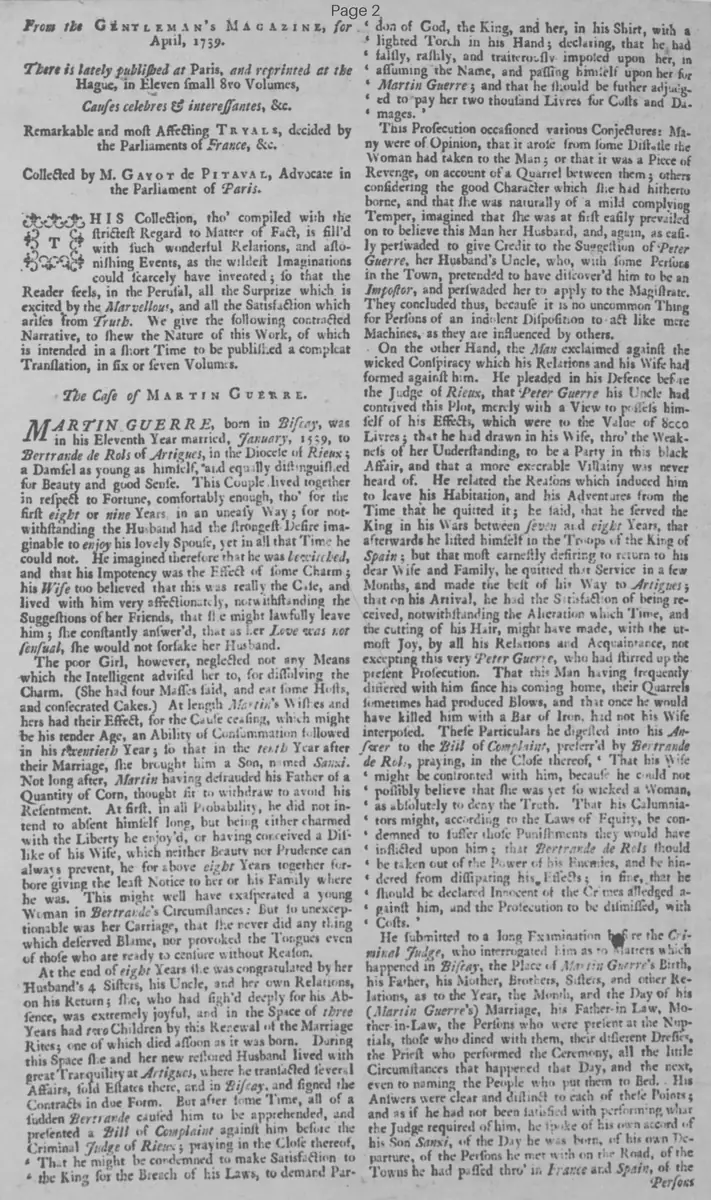
There is lately published at Paris, and reprinted at the Hague, in Eleven small 8vo Volumes, Causes célèbres et intéressantes, &c. Remarkable and most Affecting Trials, decided by the Parliaments of France, &c. Collected by M. Gayot de Pitaval, Advocate in the Parliament of Paris.
His Collection, though compiled with the strictest Regard to Matter of Fact, is filled with such wonderful Relations, and astonishing Events, as the wildest Imaginations could scarcely have invented; so that the Reader feels, in the Perusal, all the Surprize which is excited by the Marvellous, and all the Satisfaction which arises from Truth. We give the following contracted Narrative, to Shew the Nature of this Work, of which it is intended in a short Time to be publicised a complete Translation, in six or seven Volumes.
The Case of Martin Guerre.
Martin Guerre, born in Biscay, was married January 1529 to Bertrande de Rols of Artigues, in the Diocese of Rieux; a damsel as young as himself, and equally distinguished for Beauty and good Sense. This Couple lived together in respect to Fortune, comfortably enough, though for the first eight or nine Years in an uneasy Way; notwithstanding the Husband had the strongest Desire imaginable to enjoy his lovely Spouse, yet in all that Time he could not. He imagined therefore that he was bewitched, and that his Impotency was the Effect of some Charm; his Wife too believed that this was really the Case, and lived with him very affectionately, notwithstanding the Suggestions of her Friends, that he might lawfully leave him; she constantly answered, that as her Love was not Sensual, She would not forsake her Husband.
The poor Girl, however, neglected not any Means which the Intelligents advised her to, for dissolving the Charm. (She had four Masses said, and ate some Hosts, and consecrated Cakes.) At length Martin's Wishes and hers had their Effect, for the Cause ceasing, which might be his tender Age, an Ability of Consummation followed in his twentieth Year; so that in the eighth Year after their Marriage, she brought him a Son, named Sanxi.
Not long after, Martin having defrauded his Father of a Quantity of Corn, thought fit to withdraw to avoid his Resentment. At first, in all probability, he did not intend to absent himself long, but being either charmed with the Liberty he enjoyed, or having conceived a Dislike of his Wife, which neither Beauty nor Prudence can always prevent, he for above eight Years together forbore giving the least Notice to her or his Family where he was. This might well have exasperated a young Woman in Bertrande's Circumstances: But so unexceptionable was her Carriage, that she never did anything which deserved Blame, nor provoked the Tongues even of those who are ready to censure without Reason.
At the end of eight Years she was congratulated by her Husband's Sisters, his Uncle, and her own Relations, on his Return; She, who had sighed deeply for his Absence, was extremely joyful, and in the Space of three Years had two Children by this Renewal of the Marriage Rites; one of which died soon as it was born. During this Space she and her new restored Husband lived with great Tranquility at Artigues, where he transacted several Affairs, on Estates there, and in Biscay, and signed the Contracts in due Form. But after some Time, all of a sudden Bertrande caused him to be apprehended, and presented a Bill of Complaint against him before the Criminal Judge of Rieux: praying in the Close thereof, That he might be condemned to make Satisfaction to the King for the Breach of his Laws, to demand Pardon of God, the King, and her, in his Shirt, with a lighted Torch in his Hand; declaring, that he had falsely, rashly, and traitorously imposed upon her, in assuming the Name, and passing himself upon her for Martin Guerre; and that he should be further adjudged to pay her two thousand Livres for Costs and Damages.
This Prosecution occasioned various Conjectures: Many were of Opinion, that it arose from some Distaste the Woman had taken to the Man; or that it was a Piece of Revenge, on account of a Quarrel between them; others considering the good Character which she had hitherto borne, and that she was naturally of a mild complying Temper, imagined that she was at first easily prevailed on to believe this Man her Husband, and, again, as easily persuaded to give Credit to the Suggestion of Peter Guerre, her Husband's Uncle, who, with some Persons in the Town, pretended to have discovered him to be an Impostor, and persuaded her to apply to the Magistrate. They concluded thus, because it is no uncommon Thing for Persons of an indolent Disposition to act like mere Machines, as they are influenced by others.
On the other Hand, the Man exclaimed against the wicked Conspiracy which his Relations and his Wife had formed against him. He pleaded in his Defence before the Judge of Rieux, that Peter Guerre his Uncle had contrived this Plot, merely with a View to possess himself of his Effects, which were to the Value of 8000 Livres; that he had drawn in his Wife, through the Weakness of her Understanding, to be a Party in this black Affair, and that a more execrable Villainy was never heard of. He related the Reasons which induced him to leave his Habitation, and his Adventures from the Time that he quitted it; he said, that he served the King in his Wars between seven and eight Years, that afterwards he listed himself in the Troops of the King of Spain: but that most earnestly desiring to return to his dear Wife and Family, he quitted that Service in a few Months, and made the best of his Way to Artigues; that on his Arrival, he had the Satisfaction of being received, notwithstanding the Alteration which Time, and the cutting of his Hair, might have made, with the utmost Joy, by all his Relations and Acquaintance, not excepting this very Peter Guerre, who had stirred up the present Prosecution. That this Man having frequently differed with him since his coming home, their Quarrels sometimes had produced Blows, and that once he would have killed him with a Bar of Iron, had not his Wife interposed. These Particulars he digested into his Answer to the Bill of Complaint, preferred by Bertrande de Rols, praying, in the Close thereof, That his Wife might be confronted with him, because he could not possibly believe that she was yet so wicked a Woman, as absolutely to deny the Truth. That his Calumniators might, according to the Laws of Equity, be condemned to suffer those Punishments they would have inflicted upon him: that Bertrande de Rols should be taken out of the Power of his Enemies, and he hindered from dissipating his Effects: in fine, that he should be declared Innocent of the Crimes alleged against him, and the Prosecution to be dismissed, with Costs.
He submitted to a long Examination before the Criminal Judge, who interrogated him as to Matters which happened in Biscar, the Place of Martin Guerre's Birth, his Father, his Mother, Brothers, Sisters, and other Relations, as to the Year, the Month, and the Day of his (Martin Guerre's) Marriage, his Father-in-Law, Mother-in-Law, the Persons who were present at the Nuptials, those who dined with them, their different Dresses, the Priest who performed the Ceremony, all the little Circumstances that happened that Day, and the next, even to naming the People who put them to Bed. His Answers were clear and distinct to each of these Points: and as if he had not been satisfied with performing what the Judge required of him, he spoke of his own accord of his Son Sanxi, of the Day he was born, of his own Departure, of the Persons he met with on the Road, of the Towns he had passed through in France and Spain, of the Persons
Persons he had seen in both Kingdoms; and that nothing might be wanting to confirm his innocence, he named many Persons who were able to testify the Truth of what he had declared.
The Court ordered Bertrande de Rols, and several other Persons, whom the Accused had cited, to answer upon Interrogatories; which they did. Bertrande answered in a Manner that agreed exactly with all that the Accused had advanced, except that she related the Story of his being bewitched for eight or nine Years, which he had omitted; and he was very particular as to the Circumstances thereof, and to that heroick Instance of her Virtue, in not getting a Divorce from him, as advised by her Relations. He was then questioned as to that Point, and his Replies were such as tallied exactly, with what Bertrande had said; he repeated all that had been done to free them from that Enchantment, and never once faltered in the slightest Circumstance. He was next confronted with the Woman he called his Wife, and with all the Witnesses; upon which he renewed his Demand, that he might be kept safely and apart from his Enemies, which was granted. He offered certain Objections to the Credit of the Witnesses produced against him, and required that a Monitory should be published, exhorting all Persons to come in and give what Light they could as to the Subornation of Bertrande de Rols, and the Characters of the Witnesses he had impeached. This was allowed him. But at the same Time it was directed, that an Inquiry should be taken at the several Places following, viz. at Pin, at Sagias, and at Artigues, of all the Facts which might concern Martin Guerre, the Accused, and Bertrande de Rols, and the Reputation of the Witnesses. All the Discoveries upon these Proceedings were perfectly favourable to Bertrande, confirmed her virtuous Character, and proved that she had not lost her Senses during the Absence of her Husband, as the Pleading suggested.
In respect to the Accused, of near 150 Witnesses that were examined, between 20 and 30 deposed that he was really Martin Guerre; that they had known him, and conversed with him from his Infancy; that they were perfectly acquainted with his Person, Air, and Tone of Voice; and that they moreover were convinced of the Truth of what they asserted, by certain Scars and secret Marks, which it was impossible for Time to efface.
On the other hand, a greater Number of Witnesses deposed positively, that he was one Arnold du Tilb, of Sagias, and was commonly called Panseurre, and that they were perfectly acquainted with his Person, Air and Voice. The rest of the Witnesses, to the Number of Sixty and upwards, declared that there was so strong a Resemblance between these two Persons, that it was impossible for them to declare positively, whether the Accused was Martin Guerre, or Arnold du Tilb.
The Criminal Judge of Rieux ordered two Enquiries, and Reports to be made to him; one with Regard to the Likeness or Unlikeness of Sanxi Guerre to the Accused; the other as to the Likeness of the same Child to the Sisters of Martin Guerre. On the first, it was found that Sanxi did not resemble the Accused at all, and on the second, that he was very like his Father's Sisters. In short, upon these Circumstances, this Judge thought proper to pronounce definitive Sentence, as follows:
That (the Accused) Arnold du Tilh is guilty, and convicted of being an Impostor; and for that Crime is condemned to lose his Head, and further, that his Body be afterwards divided into four quarters.
This Judgment was by many accounted too quick, and too severe; or, without arrogating to himself divine Inspiration, People were at a Loss to know on what Grounds the Judge of Rieux founded his Decision, Matters appearing to other Eyes so perplexed, that those who were well acquainted with the Proofs on both Sides, knew not what to make of the Matter. The Publick, therefore, was far from being displeased, that the Convict appealed to the Parliament of Toulouse; and this extraordinary Cause now making a great Noise, every one began to regard it with the utmost Attention.
That August Assembly, having proper Information of what had been done below, began to take all necessary Measures for a further Enquiry, with the utmost Caution. In the first Place they ordered Peter Guerre and Bertrande de Rols to be confronted, in open Court, with the Person whom they accused; but singly one after the other. In these Confrontations, the Accused maintained so steady a Countenance; spoke with such an Air of Assurance and Truth, and answered every Question with such Quickness and Perspicuity, that the Members of that Venerable Tribunal readily concluded that he was the true Martin Guerre: While, on the other Hand, the Terror and Confusion of Peter Guerre and Bertrande de Rols was so great, that they created strong Suspicions of their being perjured and false Accusers. But as these Circumstances could not be considered as full Evidence, an Inquisition was ordered as to the principal Facts in Dispute, with this Limitation, that none but new Witnesses should be examined.
This wise and prudent Ordinance of the Parliament of Toulouse, was so far from procuring any new Lights, that it served only to render this intricate Affair still more obscure than it was before. Thirty new Witnesses were examined; nine or ten of these were positive that the Accused was Martin Guerre; even or eight were as positive that he was Arnold du Tilb. The rest having weighed all Circumstances, and being afraid of injuring their Consciences, declared plainly, that they could not swear which he was. The Parliament were now more in Doubt than ever, they could not concur with the Criminal Judge of Rieux, and yet they were afraid of discharging the Accused; but in order to put an End to so odd a Cause, they summed up the Proofs on both Sides.
On one Hand it appeared that 45 Witnesses had affirmed, in Terms the most express, that he was not Martin Guerre, but Arnold du Tilb, which they said they were the better enabled to do, because they had known both Persons intimately, eat and drank with them, and conversed constantly with them from their very Childhood; nay, some of them went still farther: For Carbon Barreau, Uncle by the Mother's Side of Arnold du Tilb, acknowledged that he was his Nephew, and observing the Irons that were upon his Legs, bitterly lamented his Misfortune in having a Relation in such Circumstances; he farther said, that he had at Times been concerned in several Contracts with his Nephew, and he actually produced those Writings signed by Arnold du Tilb.
Most of these Witnesses agreed that Martin Guerre, was taller, and of a darker Complexion, these he was slender in his Body, and Legs, stooping in the Shoulders, his Chin forked and turning up, his lower Lip hanging, his Nose large and flat, the Mark of an Ulcer in his Face, and a Scar in his right Eye-brow; whereas Arnold du Tilb was a squat well-set Man, having thick Legs, did not stoop, neither had he a flat Nose, but in his Face indeed he had the same Marks with Martin Guerre.
[To be continued.]
What sub-type of article is it?
What keywords are associated?
What entities or persons were involved?
Where did it happen?
Foreign News Details
Primary Location
Paris
Event Date
April 1739
Key Persons
Outcome
arnold du tilh convicted as impostor and sentenced to death by beheading and quartering by rieux judge; appealed to parliament of toulouse, where further inquiry left doubts but case continued.
Event Details
Publication of 'Causes célèbres et intéressantes,' collection of French parliamentary trials by Pitaval. Excerpt recounts 16th-century case: Martin Guerre marries Bertrande de Rols in 1529; impotence resolved, son Sanxi born; Martin absents 8 years; returns, lives with wife 3 years, has children; accused by uncle Peter and wife of being Arnold du Tilh impostor; extensive trial with witnesses, examinations, confrontations at Rieux and Toulouse; initial conviction appealed.