Thank you for visiting SNEWPapers!
Sign up free
Kentucky Gazette
Lexington, Fayette County, Kentucky
What is this article about?
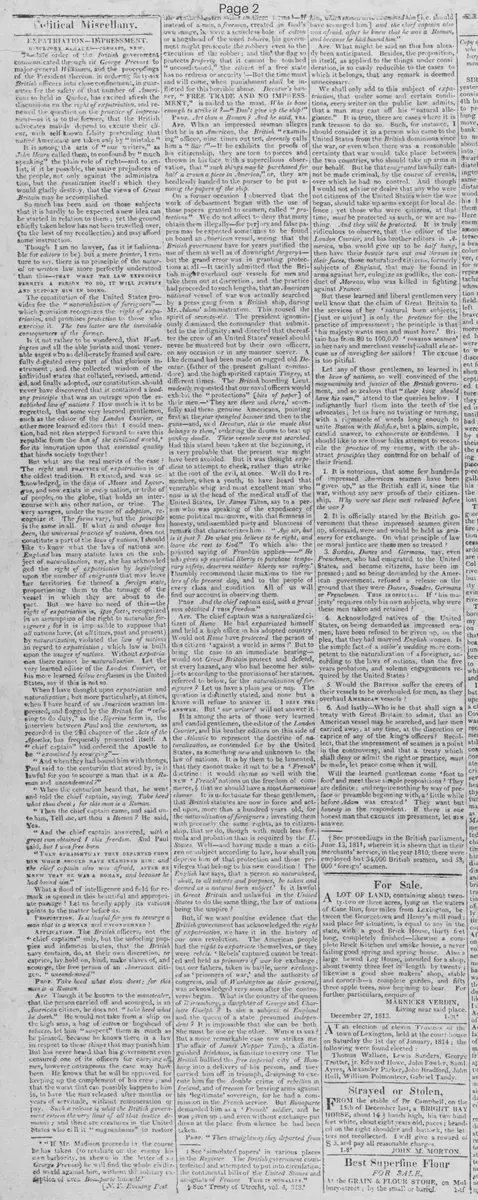
This editorial defends the US right of expatriation and naturalization against British impressment practices, using constitutional arguments, historical precedents, and a biblical analogy from Acts. It criticizes British seizure of American seamen and calls for firm resistance, referencing events like the order by Sir George Prevost and US retaliation under President Madison.
Merged-components note: These two components form a single continuous editorial article on expatriation, impressment, and related topics, spanning sequential reading orders on the same page.
Clipping
OCR Quality
Full Text
DISCUSSIONS RADICAL—PERHAPS, NEW.
The late order of the British government, communicated through sir George Prevost to major-general Wilkinson, and the proceedings of the President thereon, in ordering forty-six British officers into close confinement, in guarantee for the safety of that number of Americans so held in Quebec, has excited afresh the discussions on the right of expatriation, and renewed the question on the practice of impressment—as it is to the former that the British advocates mainly depend to excuse their client, with self known falsity pretending that native Americans are taken only by "mistake."
It is among the arts of our writers, as John Henry called them, to confound by "much speaking" the plain rule of right—and to enlist, if it be possible, the native prejudices of the people, not only against the administration, but the constitution itself; which they would gladly destroy, that the views of Great Britain may be accomplished.
So much has been said on those subjects that it is hardly to be expected a new idea can be started in relation to them; yet the ground chiefly taken below has not been travelled over (to the best of my recollection) and may afford some instruction.
Though I am no lawyer (as it is fashionable for editors to be) but a mere printer, I venture to say, there is no principle of the natural or written law more perfectly understood than this—THAT WHAT THE LAW EXPRESSLY PERMITS A PERSON TO DO, IT WILL JUSTIFY AND SUPPORT HIM IN DOING.
The constitution of the United States provides for the "naturalization of foreigners"—by which provision recognizes the right of expatriation, and promises protection to those who exercise it. The two latter are the inevitable consequences of the former.
Is it not rather to be wondered, that Washington and all the able jurists and most venerable sages who so deliberately framed and carefully digested every part of that glorious instrument, and the collected wisdom of the individual states that collated, revised, amended, and finally adopted, our constitution, should never have discovered that it contained a leading principle that was an outrage upon the established law of nations? How much is it to be regretted, that some very learned gentlemen, such as the editor of the London Courier, or other more learned editors that I could mention, had not then stepped forward to save this republic from the ban of the civilized world, for its innovation upon that essential quality that binds society together!
But what are the real merits of the case? The right and practice of expatriation is of the oldest tradition. It existed, and was acknowledged, in the days of Moses and Lycurgus, and now exists in every nation, or tribe of people, on the globe, that holds an intercourse with any other nation, or tribe. The very savages, under the name of adoption, recognize it. The forms vary, but the principle is the same in all. If what is and always has been, the universal practice of nations, does not constitute a part of the laws of nations, I should like to know what the laws of nations are.
England has many statute laws on the subject of naturalization, nay, she has acknowledged the right of expatriation by legislating upon the number of emigrants that may leave her territories for those of a foreign state, proportioning them to the tonnage of the vessel in which they are about to depart. But we have no need of this—the right of expatriation is, ipso facto, recognized in an assumption of the right to naturalize foreigners; for it is impossible to suppose that all nations have, (at all times, past and present) by naturalization, violated the law of nations in regard to expatriation; which law is built upon the usages of nations. Without expatriation there cannot be naturalization. Let the very learned editor of the London Courier, or his more learned fellow craftsmen in the United States, say if this is not so.
When I have thought upon expatriation and naturalization; but more particularly, at times, when I have heard of an American seaman impressed, and flogged by the British for "refusing to do duty," as the illiterate term is, the interview between Paul and the centurion, as recorded in the 22d chapter of the Acts of the Apostles, has frequently presented itself. A "chief captain" had ordered the Apostle to be "examined by scourging"—
"And when they had bound him with thongs, Paul said to the centurion that stood by, Is it lawful for you to scourge a man that is a Roman and uncondemned?"
"When the centurion heard that, he went and told the chief captain, saying, Take heed what thou doest, for this man is a Roman."
"Then the chief captain came, and said unto him, Tell me, art thou a Roman? He said, Yea."
"And the chief captain answered, with a great sum obtained I this freedom. And Paul said, but I was free born."
"THEN STRAIGHTWAY THEY DEPARTED FROM HIM WHICH SHOULD HAVE EXAMINED HIM: and the chief captain also was afraid, after he knew that he was a Roman, and because he had bound him."
What a flood of intelligence and field for remark is opened in this beautiful and appropriate passage! Let us briefly apply its various points to the matter before us.
Proposition. Is it lawful for you to scourge a man that is a ROMAN and UNCONDEMNED?
Application. The British officers, not the "chief captains" only, but the unfeeling puppies and infamous brutes, that the British navy contains, do, at their own discretion, or caprice, lay hold on, bind, make slaves of, and scourge, the free person of an American citizen, "uncondemned."
Prop. Take heed what thou doest: for this man is a Roman.
App. Though it be known to the manstealer that the person carried off and scourged, is an American citizen, he does not "take heed what he doeth." He would not take from a slip on the high seas, a bag of cotton or hogshead of tobacco, let him "suspect" them as much as he pleased, because he knows there is a law in respect to those things that may punish him. But he has never heard that his government even censured one of its officers for carrying off men, however outrageous the case may have been. He knows that he will be approved for keeping up the complement of his crew; and that the worst that can possibly happen to him is, to have the man released after months or years of servitude, without remuneration or pay. Such a release is what the British government esteem the very limit of all that justice demands: and there are creatures in the United States who call it "magnanimous" to restore
If Mr. Madison proceeds in the course he has taken (to retaliate on the enemy his own barbarity, as shewn in the letter of sir George Prevost) he will find the whole civilized world against him, without the solitary exception of even Bonaparte himself.
The unfortunate sailor, instead of a man, a freeman, created in God's own image, if he were a senseless bale of cotton or a hogshead of the weed tobacco, his government might prosecute the robbery even to the execution of the robber; and tho' the flag so protects property that it cannot be touched uncondemned, the citizen of a free state has no redress or security!—But the time must and will come, when punishment shall be inflicted for this horrible abuse. Decatur's banner, "FREE TRADE AND NO IMPRESSMENT," is nailed to the mast. Who is base enough to strike it?—"Don't give up the ship!"
Prop. Art thou a Roman? And he said, YEA.
App. When an impressed seaman alleges that he is an American, the British "examining" officer, nine times out of ten, decently calls him a "liar!"—If he exhibits the proofs of his citizenship, they are torn to pieces and thrown in his face with a supercilious observation, that "such things may be purchased for half a crown a piece in America," or, they are heedlessly handed to the purser to be put among the papers of the ship.
On a former occasion I observed that the work of debasement began with the use of those papers granted to seamen, called "protections." We do not affect to deny that many obtain them illegally—for perjury and false papers may be expected sometimes to be found on board an American vessel, seeing that the British government have for years justified the use of them as well as of downright forgery—but the grand error was in granting protections at all—It tacitly admitted that the British might overhaul our vessels for men and take them out at discretion, and the practice had proceeded to such lengths, that an American national vessel of war was actually searched by a press gang from a British ship, during Mr. Adams' administration. This roused the spirit of seventy-six. The president ignominiously dismissed the commander that submitted to the indignity; and directed that thereafter the crew of an United States' vessel should never be mustered but by their own officers, on any occasion or in any manner soever. A like demand had been made on rugged old Decatur (father of the present gallant commodore) and the high spirited captain Tingey, at different times. The British boarding Lieut. modestly requested that our naval officers would exhibit the "protections" [bits of paper] of their men.—"They are there and there," scornfully said these genuine Americans, pointing first at the star spangled banner and then to the guns—and, said Decatur, this is the music that belongs to them, ordering the drums to beat up yankee doodle. These vessels were not searched.
Had this stand been taken at the beginning, it is very probable that the present war might have been avoided. But it was thought expedient to attempt to check, rather than strike at the root of the evil, at once. Well do I remember, when a youth, to have heard that venerable whig and most excellent man who now is at the head of the medical staff of the United States, Dr. James Tilton, say to a person who was speaking of the expediency of some political manoeuvre, with that firmness in honesty, undissembled piety and bluntness of remark that characterizes him:
"Aye sir, but is it just? Do what you believe to be right, and leave the rest to God." To which also the pointed saying of Franklin applies—"He who gives up essential liberty to purchase temporary safety, deserves neither liberty nor safety."
I humbly recommend these maxims to the rulers of the present day, and to the people of every class and condition. All of us will find our account in observing them.
Prop. And the chief captain said, with a great sum obtained I this freedom.
App. The chief captain was a naturalized citizen of Rome. He had expatriated himself and held a high office in his adopted country. Would not Rome have protected the person of this citizen against a world in arms? But to bring the case to an immediate bearing—would not Great Britain protect and defend, at every hazard, any who had become her subjects according to the provisions of her statutes, referred to below, for the naturalization of foreigners? Let us have a plain yea or nay. The question is distinctly stated, and none but a knave will refuse to answer it. I pray the Answer. But our writers will not answer it. It is among the arts of those very learned and candid gentlemen, the editor of the London Courier, and his brother editors on this side of the Atlantic to represent the doctrine of naturalization, as contended for by the United States, as something new and unknown to the law of nations. It is by them to be lamented, that they cannot make it out to be a French doctrine: it would rhyme so well with the New French notions on the freedom of commerce, that we should have a most harmonious clamor. It is unfortunate for these gentlemen, that British statutes are now in force and acted upon, more than a hundred years old, for the naturalization of foreigners; investing them with precisely the same rights, as to citizenship, that we do, though with much less formula and probation than is required by the U. States. Well—and having made a man a citizen or subject according to law, how shall you deprive him of that protection and those privileges that belong to his new condition? The English law says, that a person so naturalized, shall, to all intents and purposes, be taken and deemed as a natural born subject. Is it lawful in Great Britain and unlawful in the United States to do the same thing, the law of nations being the umpire?
But, if we want positive evidence that the British government has acknowledged the right of expatriation, we have it in the history of our own revolution. The American people had the right to expatriate themselves, or they were rebels. Rebels captured cannot be treated and held as prisoners of war for exchange: but our fathers, taken in battle, were exchanged as "prisoners of war," and the authority of congress, and of Washington as their general, was acknowledged very soon after the controversy began. What is the country of the queen of Wurtemberg, a daughter of George and Charlotte Guelph? Is she a subject of England and the queen of a state presumed independent? It is impossible that she can be both. She must be one or the other. Which is she?
But a more remarkable case now strikes me. The affair of James Napper Tandy, a distinguished Irishman, is familiar to every one. The British bullied the free imperial city of Hamburg into a delivery of his person, and they carried him off in triumph, designing to execute him for the double crime of rebellion in Ireland, and of treason for bearing arms against his "legitimate" sovereign, for he had a commission in the French service. But Bonaparte demanded him as a "French" soldier, and he was given up; and even without exchange put down at the place from whence he had been taken.
Prop. Then straightway they departed from him which should have examined him: i.e. should have scourged him? and the chief captain also was afraid, after he knew that he was a Roman, and because he had bound him.
App. What might be said on this has already been anticipated. Besides, the proposition, in itself, as applied to the things under consideration, is so easily reducible to the cases to which it belongs, that any remark is deemed unnecessary.
We shall only add to this subject of expatriation, that under some and certain conditions, every writer on the public law admits, that a man may cast off his "natural allegiance." It is true, there are cases where it is rank treason to do so. Such, for instance, I should consider it in a person who came to the United States from the British dominions since the war, or even when there was a reasonable certainty that war would take place between the two countries, who should take up arms in our behalf. But he that emigrated lawfully cannot be made criminal, by the course of events, over which he had no control. And though I would not advise or desire that any who were not citizens of the United States when the war began, should take up arms except for local defence; yet those who were citizens, at that time, must be protected as such, or we are nothing. And they will be protected. It is truly ridiculous to observe, that the editor of the London Courier, and his brother editors in America, who would give up to be half hung, then have their bowels torn out and thrown in their faces, those naturalized citizens, formerly subjects of England, that may be found in arms against her, eulogize as godlike, the conduct of Moreau, who was killed in fighting against France.
But these learned and liberal gentlemen very well know that the claim of Great Britain to the services of her natural born subjects, just or unjust, is only the pretence for the practice of impressment; the principle is that his majesty wants men and must have. Britain has from 80 to 100,000 foreign seamen in her navy and merchant vessels—shall she accuse us of inveigling her sailors? The excuse is too pitiful.
Let any of those gentlemen, so learned in the laws of nations, so well convinced of the magnanimity and justice of the British government, and so zealous that "their king should have his own," attend to the queries below. I indignantly hurl them into the teeth of the advocates; let us have no twisting or turning, with a rigmarole of words long enough to unite Boston with Halifax, but a plain, simple, candid answer, to exonerate or condemn. I should like to see those folks attempt to reconcile the practice of my enemy, with the abstract principles they contend for on behalf of their friend.
1. It is notorious, that some few hundreds of impressed American seamen have been "given up," as the British call it, since the war, without any new proofs of their citizenship. Why were not these men released before the war?
2. It is officially stated by the British government that these impressed seamen given up, aforesaid, were and would be held as prisoners for exchange. On what principle of law or moral justice are these men so treated?
3. Swedes, Danes and Germans, nay, even Frenchmen, who had emigrated to the United States, and become citizens, have been impressed; and so being demanded by the American government, refused a release on the ground that they were Danes, Swedes, Germans or Frenchmen. THIS IS OFFICIAL. If "his majesty" requires only his own subjects, why were these men taken and retained?
4. Acknowledged natives of the United States, on being demanded as impressed seamen, have been refused to be given up, on the plea, that they had married English women. Is the simple fact of a sailor's wedding more competent to the naturalization of a foreigner, according to the laws of nations, than the five years probation, and solemn engagements required by the United States?
5. Would the British suffer the crews of their vessels to be overhauled for men, as they overhaul American vessels?
6. And lastly—Who is he that shall sign a treaty with Great Britain to admit, that an American vessel may be searched, and her men carried away, at any time, at the discretion or caprice of any of the king's officers? Recollect, that the impressment of seamen is a point in the controversy, and that a treaty which shall deny or admit the right or practice, must be made, let peace come when it will.
Will the learned gentleman come foot to foot and meet these simple propositions? They are definite; and require nothing by way of preface or preamble beginning with, a "little while before Adam was created." They want but honesty in the respondent. If there is one honest man that excuses impressment, let him answer.
See proceedings in the British parliament, June 13, 1811, wherein it is shewn that in their merchants' service, in the year 1810, there were employed but 34,000 British seamen, and 53,000 "foreign" seamen.
What sub-type of article is it?
What keywords are associated?
What entities or persons were involved?
Editorial Details
Primary Topic
Defense Of Expatriation And Opposition To British Impressment
Stance / Tone
Strongly Pro American, Anti British, Argumentative
Key Figures
Key Arguments