Thank you for visiting SNEWPapers!
Sign up free
Literary
January 5, 1863
New Hampshire Journal Of Agriculture
Manchester, Hillsborough County, New Hampshire
What is this article about?
Humorous rural anecdote about feuding neighbors Job Tullock and Deacon Wyman in Piscataquog, whose children's romance persists despite tensions. A chaotic sawmill incident involving a steer disguised as a bear in a buffalo robe resolves the quarrel, leading to reconciliation.
Clipping
OCR Quality
98%
Excellent
Full Text
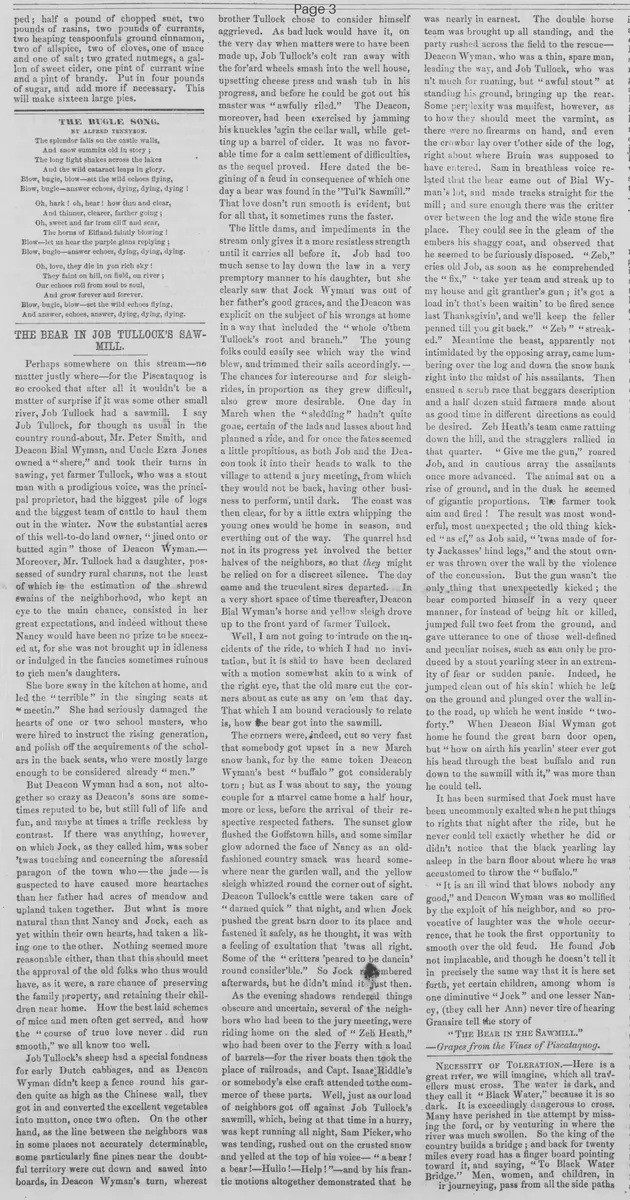
THE BEAR IN JOB TULLOCK'S SAW-MILL.
Perhaps somewhere on this stream—no matter justly where—for the Piscataquog is so crooked that after all it wouldn't be a matter of surprise if it was some other small river, Job Tullock had a sawmill. I say Job Tullock, for though as usual in the country round-about, Mr. Peter Smith, and Deacon Bial Wyman, and Uncle Ezra Jones owned a "share," and took their turns in sawing, yet farmer Tullock, who was a stout man with a prodigious voice, was the principal proprietor, had the biggest pile of logs and the biggest team of cattle to haul them out in the winter. Now the substantial acres of this well-to-do land owner, "jined onto or butted agin" those of Deacon Wyman. Moreover, Mr. Tullock had a daughter, possessed of sundry rural charms, not the least of which in the estimation of the shrewd swains of the neighborhood, who kept an eye to the main chance, consisted in her great expectations, and indeed without these Nancy would have been no prize to be sneezed at, for she was not brought up in idleness or indulged in the fancies sometimes ruinous to rich men's daughters.
She bore sway in the kitchen at home, and led the "terrible" in the singing seats at meetin'. She had seriously damaged the hearts of one or two school masters, who were hired to instruct the rising generation, and polish off the acquirements of the scholars in the back seats, who were mostly large enough to be considered already "men."
But Deacon Wyman had a son, not altogether so crazy as Deacon's sons are sometimes reputed to be, but still full of life and fun, and maybe at times a trifle reckless by contrast. If there was anything, however on which Jock, as they called him, was sober 'twas touching and concerning the aforesaid paragon of the town who—the jade—is suspected to have caused more heartaches than her father had acres of meadow and upland taken together. But what is more natural than that Nancy and Jock, each as yet within their own hearts, had taken a liking one to the other. Nothing seemed more reasonable either, than that this should meet the approval of the old folks who thus would have, as it were, a rare chance of preserving the family property, and retaining their children near home. How the best laid schemes of mice and men often get served, and how the "course of true love never did run smooth," we all know too well.
Job Tullock's sheep had a special fondness for early Dutch cabbages, and as Deacon Wyman didn't keep a fence round his garden quite as high as the Chinese wall, they got in and converted the excellent vegetables into mutton, once too often. On the other hand, as the line between the neighbors was in some places not accurately determinable, some particularly fine pines near the doubtful territory were cut down and sawed into boards, in Deacon Wyman's turn, whereat brother Tullock chose to consider himself aggrieved. As bad luck would have it, on the very day when matters were to have been made up, Job Tullock's colt ran away with the for'ard wheels smash into the well house, upsetting cheese press and wash tub in his progress, and before he could be got out his master was "awfully riled." The Deacon, moreover, had been exercised by jamming his knuckles 'agin the cellar wall, while getting up a barrel of cider. It was no favorable time for a calm settlement of difficulties. as the sequel proved. Here dated the beginning of a feud in consequence of which one day a bear was found in the "Tullock Sawmill."
That love doesn't run smooth is evident; but for all that, it sometimes runs the faster. The little dams, and impediments in the stream only gives it a more resistless strength until it carries all before it. Job had too much sense to lay down the law in a very preemptory manner to his daughter, but she clearly saw that Jock Wyman was out of her father's good graces, and the Deacon was explicit on the subject of his wrongs at home in a way that included the "whole o'them Tullock's root and branch." The young folks could easily see which way the wind blew, and trimmed their sails accordingly. The chances for intercourse and for sleigh-rides, in proportion as they grew difficult, also grew more desirable. One day in March when the "sledding" hadn't quite gone, certain of the lads and lasses about had planned a ride, and for once the fates seemed a little propitious, as both Job and the Deacon took it into their heads to walk to the village to attend a jury meeting, from which they would not be back, having other business to perform, until dark. The coast was then clear, for by a little extra whipping the young ones would be home in season, and everything out of the way. The quarrel had not in its progress yet involved the better halves of the neighbors, so that they might be relied on for a discreet silence. The day came and the truculent sires departed. In a very short space of time thereafter, Deacon Bial Wyman's horse and yellow sleigh drove up to the front yard of farmer Tullock.
Well, I am not going to intrude on the incidents of the ride, to which I had no invitation, but it is said to have been declared with a motion somewhat akin to a wink of the right eye, that the old mare cut the corners about as cute as any on 'em that day. That which I am bound veraciously to relate is, how the bear got into the sawmill.
The corners were, indeed, cut so very fast that somebody got upset in a new March snow bank, for by the same token Deacon Wyman's best "buffalo" got considerably torn; but as I was about to say, the young couple for a marvel came home a half hour, more or less, before the arrival of their respective respected fathers. The sunset glow flushed the Goffstown hills, and some similar glow adorned the face of Nancy as an old-fashioned country smack was heard somewhere near the garden wall, and the yellow sleigh whizzed round the corner out of sight.
Deacon Tullock's cattle were taken care of "darned quick" that night, and when Jock pushed the great barn door to its place and fastened it safely, as he thought, it was with a feeling of exultation that 'twas all right. Some of the "critters" 'peared to be dancin' round consider'ble. So Jock remembered afterwards, but he didn't mind it just then.
As the evening shadows rendered things obscure and uncertain, several of the neighbors who had been to the jury meeting, were riding home on the sled of "Zeb Heath," who had been over to the Ferry with a load of barrels—for the river boats then took the place of railroads, and Capt. Isaac Riddle's or somebody's else craft attended to the commerce of these parts. Well, just as our load of neighbors got off against Job Tullock's sawmill, which, being at that time in a hurry, was kept running all night, Sam Picker, who was tending, rushed out on the crusted snow and yelled at the top of his voice— "a bear! a bear!—Hullo!—Help!"—and by his frantic motions altogether demonstrated that he was nearly in earnest. The double horse team was brought up all standing, and the party rushed across the field to the rescue—Deacon Wyman, who was a thin, spare man, leading the way, and Job Tullock, who wasn't much for running but "awful stout" at standing his ground, bringing up the rear.
Some perplexity was manifest, however, as to how they should meet the varmint, as there were no firearms on hand, and even the crowbar lay over t'other side of the log, right about where Bruin was supposed to have entered. Sam in breathless voice related that the bear came out of Bial Wyman's lot, and made tracks straight for the mill; and sure enough there was the critter over between the log and the wide stone fire place. They could see in the gleam of the embers his shaggy coat, and observed that he seemed to be furiously disposed. "Zeb," cries old Job, as soon as he comprehended the "fix," "take yer team and streak up to my house and git granther's gun; it's got a load in't that's been waitin' to be fired sence last Thanksgivin', and we'll keep the feller penned till you git back." "Zeb" "streaked." Meantime the beast, apparently not intimidated by the opposing array, came lumbering over the log and down the snow bank right into the midst of his assailants. Then ensued a scrub race that beggars description and a half dozen staid farmers made about as good time in different directions as could be desired. Zeb Heath's team came rattling down the hill, and the stragglers rallied in that quarter. "Give me the gun," roared Job, and in cautious array the assailants once more advanced. The animal sat on a rise of ground, and in the dusk he seemed of gigantic proportions. The farmer took aim and fired! The result was most wonderful, most unexpected; the old thing kicked "as ef," as Job said, "'twas made of forty Jackasses' hind legs," and the stout owner was thrown over the wall by the violence of the concussion. But the gun wasn't the only thing that unexpectedly kicked; the bear comported himself in a very queer manner, for instead of being hit or killed, jumped full two feet from the ground, and gave utterance to one of those well-defined and peculiar noises, such as can only be produced by a stout yearling steer in an extremity of fear or sudden panic. Indeed, he jumped clean out of his skin! which he left on the ground and plunged over the wall into the road, up which he went inside "two-forty."
When Deacon Bial Wyman got home he found the great barn door open, but "how on airth his yearlin' steer ever got his head through the best buffalo and run down to the sawmill with it," was more than he could tell.
It has been surmised that Jock must have been uncommonly exalted when he put things to rights that night after the ride, but he never could tell exactly whether he did or didn't notice that the black yearling lay asleep in the barn floor about where he was accustomed to throw the "buffalo."
"It is an ill wind that blows nobody any good," and Deacon Wyman was so mollified by the exploit of his neighbor, and so provocative of laughter was the whole occurrence, that he took the first opportunity to smooth over the old feud. He found Job not implacable, and though he doesn't tell it in precisely the same way that it is here set forth, yet certain children, among whom is one diminutive "Jock" and one lesser Nancy, (they call her Ann) never tire of hearing Gransire tell the story of
THE BEAR IN THE SAWMILL.
—Grapes from the Vines of Piscataquog.
Perhaps somewhere on this stream—no matter justly where—for the Piscataquog is so crooked that after all it wouldn't be a matter of surprise if it was some other small river, Job Tullock had a sawmill. I say Job Tullock, for though as usual in the country round-about, Mr. Peter Smith, and Deacon Bial Wyman, and Uncle Ezra Jones owned a "share," and took their turns in sawing, yet farmer Tullock, who was a stout man with a prodigious voice, was the principal proprietor, had the biggest pile of logs and the biggest team of cattle to haul them out in the winter. Now the substantial acres of this well-to-do land owner, "jined onto or butted agin" those of Deacon Wyman. Moreover, Mr. Tullock had a daughter, possessed of sundry rural charms, not the least of which in the estimation of the shrewd swains of the neighborhood, who kept an eye to the main chance, consisted in her great expectations, and indeed without these Nancy would have been no prize to be sneezed at, for she was not brought up in idleness or indulged in the fancies sometimes ruinous to rich men's daughters.
She bore sway in the kitchen at home, and led the "terrible" in the singing seats at meetin'. She had seriously damaged the hearts of one or two school masters, who were hired to instruct the rising generation, and polish off the acquirements of the scholars in the back seats, who were mostly large enough to be considered already "men."
But Deacon Wyman had a son, not altogether so crazy as Deacon's sons are sometimes reputed to be, but still full of life and fun, and maybe at times a trifle reckless by contrast. If there was anything, however on which Jock, as they called him, was sober 'twas touching and concerning the aforesaid paragon of the town who—the jade—is suspected to have caused more heartaches than her father had acres of meadow and upland taken together. But what is more natural than that Nancy and Jock, each as yet within their own hearts, had taken a liking one to the other. Nothing seemed more reasonable either, than that this should meet the approval of the old folks who thus would have, as it were, a rare chance of preserving the family property, and retaining their children near home. How the best laid schemes of mice and men often get served, and how the "course of true love never did run smooth," we all know too well.
Job Tullock's sheep had a special fondness for early Dutch cabbages, and as Deacon Wyman didn't keep a fence round his garden quite as high as the Chinese wall, they got in and converted the excellent vegetables into mutton, once too often. On the other hand, as the line between the neighbors was in some places not accurately determinable, some particularly fine pines near the doubtful territory were cut down and sawed into boards, in Deacon Wyman's turn, whereat brother Tullock chose to consider himself aggrieved. As bad luck would have it, on the very day when matters were to have been made up, Job Tullock's colt ran away with the for'ard wheels smash into the well house, upsetting cheese press and wash tub in his progress, and before he could be got out his master was "awfully riled." The Deacon, moreover, had been exercised by jamming his knuckles 'agin the cellar wall, while getting up a barrel of cider. It was no favorable time for a calm settlement of difficulties. as the sequel proved. Here dated the beginning of a feud in consequence of which one day a bear was found in the "Tullock Sawmill."
That love doesn't run smooth is evident; but for all that, it sometimes runs the faster. The little dams, and impediments in the stream only gives it a more resistless strength until it carries all before it. Job had too much sense to lay down the law in a very preemptory manner to his daughter, but she clearly saw that Jock Wyman was out of her father's good graces, and the Deacon was explicit on the subject of his wrongs at home in a way that included the "whole o'them Tullock's root and branch." The young folks could easily see which way the wind blew, and trimmed their sails accordingly. The chances for intercourse and for sleigh-rides, in proportion as they grew difficult, also grew more desirable. One day in March when the "sledding" hadn't quite gone, certain of the lads and lasses about had planned a ride, and for once the fates seemed a little propitious, as both Job and the Deacon took it into their heads to walk to the village to attend a jury meeting, from which they would not be back, having other business to perform, until dark. The coast was then clear, for by a little extra whipping the young ones would be home in season, and everything out of the way. The quarrel had not in its progress yet involved the better halves of the neighbors, so that they might be relied on for a discreet silence. The day came and the truculent sires departed. In a very short space of time thereafter, Deacon Bial Wyman's horse and yellow sleigh drove up to the front yard of farmer Tullock.
Well, I am not going to intrude on the incidents of the ride, to which I had no invitation, but it is said to have been declared with a motion somewhat akin to a wink of the right eye, that the old mare cut the corners about as cute as any on 'em that day. That which I am bound veraciously to relate is, how the bear got into the sawmill.
The corners were, indeed, cut so very fast that somebody got upset in a new March snow bank, for by the same token Deacon Wyman's best "buffalo" got considerably torn; but as I was about to say, the young couple for a marvel came home a half hour, more or less, before the arrival of their respective respected fathers. The sunset glow flushed the Goffstown hills, and some similar glow adorned the face of Nancy as an old-fashioned country smack was heard somewhere near the garden wall, and the yellow sleigh whizzed round the corner out of sight.
Deacon Tullock's cattle were taken care of "darned quick" that night, and when Jock pushed the great barn door to its place and fastened it safely, as he thought, it was with a feeling of exultation that 'twas all right. Some of the "critters" 'peared to be dancin' round consider'ble. So Jock remembered afterwards, but he didn't mind it just then.
As the evening shadows rendered things obscure and uncertain, several of the neighbors who had been to the jury meeting, were riding home on the sled of "Zeb Heath," who had been over to the Ferry with a load of barrels—for the river boats then took the place of railroads, and Capt. Isaac Riddle's or somebody's else craft attended to the commerce of these parts. Well, just as our load of neighbors got off against Job Tullock's sawmill, which, being at that time in a hurry, was kept running all night, Sam Picker, who was tending, rushed out on the crusted snow and yelled at the top of his voice— "a bear! a bear!—Hullo!—Help!"—and by his frantic motions altogether demonstrated that he was nearly in earnest. The double horse team was brought up all standing, and the party rushed across the field to the rescue—Deacon Wyman, who was a thin, spare man, leading the way, and Job Tullock, who wasn't much for running but "awful stout" at standing his ground, bringing up the rear.
Some perplexity was manifest, however, as to how they should meet the varmint, as there were no firearms on hand, and even the crowbar lay over t'other side of the log, right about where Bruin was supposed to have entered. Sam in breathless voice related that the bear came out of Bial Wyman's lot, and made tracks straight for the mill; and sure enough there was the critter over between the log and the wide stone fire place. They could see in the gleam of the embers his shaggy coat, and observed that he seemed to be furiously disposed. "Zeb," cries old Job, as soon as he comprehended the "fix," "take yer team and streak up to my house and git granther's gun; it's got a load in't that's been waitin' to be fired sence last Thanksgivin', and we'll keep the feller penned till you git back." "Zeb" "streaked." Meantime the beast, apparently not intimidated by the opposing array, came lumbering over the log and down the snow bank right into the midst of his assailants. Then ensued a scrub race that beggars description and a half dozen staid farmers made about as good time in different directions as could be desired. Zeb Heath's team came rattling down the hill, and the stragglers rallied in that quarter. "Give me the gun," roared Job, and in cautious array the assailants once more advanced. The animal sat on a rise of ground, and in the dusk he seemed of gigantic proportions. The farmer took aim and fired! The result was most wonderful, most unexpected; the old thing kicked "as ef," as Job said, "'twas made of forty Jackasses' hind legs," and the stout owner was thrown over the wall by the violence of the concussion. But the gun wasn't the only thing that unexpectedly kicked; the bear comported himself in a very queer manner, for instead of being hit or killed, jumped full two feet from the ground, and gave utterance to one of those well-defined and peculiar noises, such as can only be produced by a stout yearling steer in an extremity of fear or sudden panic. Indeed, he jumped clean out of his skin! which he left on the ground and plunged over the wall into the road, up which he went inside "two-forty."
When Deacon Bial Wyman got home he found the great barn door open, but "how on airth his yearlin' steer ever got his head through the best buffalo and run down to the sawmill with it," was more than he could tell.
It has been surmised that Jock must have been uncommonly exalted when he put things to rights that night after the ride, but he never could tell exactly whether he did or didn't notice that the black yearling lay asleep in the barn floor about where he was accustomed to throw the "buffalo."
"It is an ill wind that blows nobody any good," and Deacon Wyman was so mollified by the exploit of his neighbor, and so provocative of laughter was the whole occurrence, that he took the first opportunity to smooth over the old feud. He found Job not implacable, and though he doesn't tell it in precisely the same way that it is here set forth, yet certain children, among whom is one diminutive "Jock" and one lesser Nancy, (they call her Ann) never tire of hearing Gransire tell the story of
THE BEAR IN THE SAWMILL.
—Grapes from the Vines of Piscataquog.
What sub-type of article is it?
Prose Fiction
Satire
What themes does it cover?
Agriculture Rural
Love Romance
Social Manners
What keywords are associated?
Rural Anecdote
Neighbor Feud
Young Love
Sawmill Incident
Bear Hoax
Piscataquog
Sleigh Ride
What entities or persons were involved?
—Grapes From The Vines Of Piscataquog.
Literary Details
Title
The Bear In Job Tullock's Saw Mill.
Author
—Grapes From The Vines Of Piscataquog.
Form / Style
Humorous Rural Anecdote
Key Lines
"A Bear! A Bear!—Hullo!—Help!"
"It Is An Ill Wind That Blows Nobody Any Good,"
Indeed, He Jumped Clean Out Of His Skin! Which He Left On The Ground