Thank you for visiting SNEWPapers!
Sign up free
Editorial
September 30, 1920
Batesville Daily Guard
Batesville, Independence County, Arkansas
What is this article about?
This editorial defends President Woodrow Wilson against partisan enemies attempting to impeach him for upholding international treaties, comparing him to Washington, Jackson, and Lincoln whose legacies endured despite opposition. It praises Wilson's vision for world peace via reason over force.
Clipping
OCR Quality
95%
Excellent
Full Text
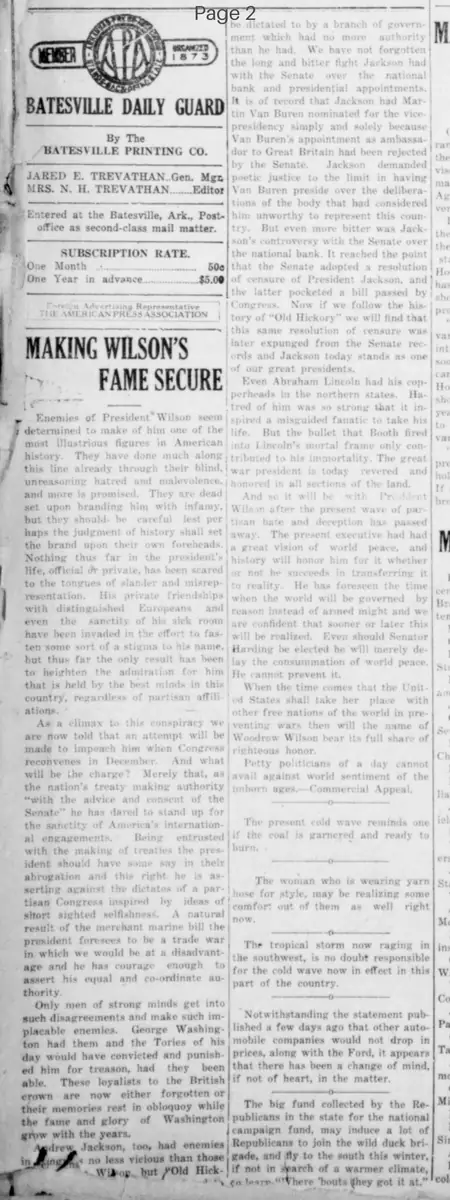
MAKING WILSON'S FAME SECURE
Enemies of President Wilson seem determined to make of him one of the most illustrious figures in American history. They have done much along this line already through their blind, unreasoning hatred and malevolence, and more is promised. They are dead set upon branding him with infamy, but they should be careful lest perhaps the judgment of history shall set the brand upon their own foreheads.
Nothing thus far in the president's life, official or private, has been sacred to the tongues of slander and misrepresentation. His private friendships with distinguished Europeans and even the sanctity of his sick room have been invaded in the effort to fasten some sort of a stigma to his name. But thus far the only result has been to heighten the admiration for him that is held by the best minds in this country, regardless of partisan affiliations.
As a climax to this conspiracy we are now told that an attempt will be made to impeach him when Congress reconvenes in December. And what will be the charge? Merely that, as the nation's treaty-making authority 'with the advice and consent of the Senate' he has dared to stand up for the sanctity of America's international engagements.
Being entrusted with the making of treaties the president should have some say in their abrogation and this right he is asserting against the dictates of a partisan Congress inspired by ideas of short-sighted selfishness. A natural result of the merchant marine bill the president foresees to be a trade war in which we would be at a disadvantage and he has courage enough to assert his equal and co-ordinate authority.
Only men of strong minds get into such disagreements and make such implacable enemies. George Washington had them and the Tories of his day would have convicted and punished him for treason, had they been able. These loyalists to the British crown are now either forgotten or their memories rest in obloquy while the fame and glory of Washington grow with the years.
Andrew Jackson, too, had enemies no less vicious than those of Wilson, but Old Hickory would be dictated to by a branch of government which had no more authority than he had. We have not forgotten the long and bitter fight Jackson had with the Senate over the national bank and presidential appointments. It is of record that Jackson had Martin Van Buren nominated for the vice presidency simply and solely because Van Buren's appointment as ambassador to Great Britain had been rejected by the Senate. Jackson demanded poetic justice to the limit in having Van Buren preside over the deliberations of the body that had considered him unworthy to represent this country. But even more bitter was Jackson's controversy with the Senate over the national bank. It reached the point that the Senate adopted a resolution of censure of President Jackson, and the latter pocketed a bill passed by Congress. Now if we follow the history of 'Old Hickory' we will find that this same resolution of censure was later expunged from the Senate records and Jackson today stands as one of our great presidents.
Even Abraham Lincoln had his copperheads in the northern states. Hatred of him was so strong that it inspired a misguided fanatic to take his life. But the bullet that Booth fired into Lincoln's mortal frame only contributed to his immortality. The great war president is today revered and honored in all sections of the land.
And so it will be with President Wilson after the present wave of partisan hate and deception has passed away. The present executive has had a great vision of world peace, and history will honor him for it whether or not he succeeds in transferring it to reality. He has foreseen the time when the world will be governed by reason instead of armed might and we are confident that sooner or later this will be realized. Even should Senator Harding be elected he will merely delay the consummation of world peace. He cannot prevent it.
When the time comes that the United States shall take her place with other free nations of the world in preventing wars then will the name of Woodrow Wilson bear its full share of righteous honor. Petty politicians of a day cannot avail against world sentiment of the unborn ages.—Commercial Appeal.
Enemies of President Wilson seem determined to make of him one of the most illustrious figures in American history. They have done much along this line already through their blind, unreasoning hatred and malevolence, and more is promised. They are dead set upon branding him with infamy, but they should be careful lest perhaps the judgment of history shall set the brand upon their own foreheads.
Nothing thus far in the president's life, official or private, has been sacred to the tongues of slander and misrepresentation. His private friendships with distinguished Europeans and even the sanctity of his sick room have been invaded in the effort to fasten some sort of a stigma to his name. But thus far the only result has been to heighten the admiration for him that is held by the best minds in this country, regardless of partisan affiliations.
As a climax to this conspiracy we are now told that an attempt will be made to impeach him when Congress reconvenes in December. And what will be the charge? Merely that, as the nation's treaty-making authority 'with the advice and consent of the Senate' he has dared to stand up for the sanctity of America's international engagements.
Being entrusted with the making of treaties the president should have some say in their abrogation and this right he is asserting against the dictates of a partisan Congress inspired by ideas of short-sighted selfishness. A natural result of the merchant marine bill the president foresees to be a trade war in which we would be at a disadvantage and he has courage enough to assert his equal and co-ordinate authority.
Only men of strong minds get into such disagreements and make such implacable enemies. George Washington had them and the Tories of his day would have convicted and punished him for treason, had they been able. These loyalists to the British crown are now either forgotten or their memories rest in obloquy while the fame and glory of Washington grow with the years.
Andrew Jackson, too, had enemies no less vicious than those of Wilson, but Old Hickory would be dictated to by a branch of government which had no more authority than he had. We have not forgotten the long and bitter fight Jackson had with the Senate over the national bank and presidential appointments. It is of record that Jackson had Martin Van Buren nominated for the vice presidency simply and solely because Van Buren's appointment as ambassador to Great Britain had been rejected by the Senate. Jackson demanded poetic justice to the limit in having Van Buren preside over the deliberations of the body that had considered him unworthy to represent this country. But even more bitter was Jackson's controversy with the Senate over the national bank. It reached the point that the Senate adopted a resolution of censure of President Jackson, and the latter pocketed a bill passed by Congress. Now if we follow the history of 'Old Hickory' we will find that this same resolution of censure was later expunged from the Senate records and Jackson today stands as one of our great presidents.
Even Abraham Lincoln had his copperheads in the northern states. Hatred of him was so strong that it inspired a misguided fanatic to take his life. But the bullet that Booth fired into Lincoln's mortal frame only contributed to his immortality. The great war president is today revered and honored in all sections of the land.
And so it will be with President Wilson after the present wave of partisan hate and deception has passed away. The present executive has had a great vision of world peace, and history will honor him for it whether or not he succeeds in transferring it to reality. He has foreseen the time when the world will be governed by reason instead of armed might and we are confident that sooner or later this will be realized. Even should Senator Harding be elected he will merely delay the consummation of world peace. He cannot prevent it.
When the time comes that the United States shall take her place with other free nations of the world in preventing wars then will the name of Woodrow Wilson bear its full share of righteous honor. Petty politicians of a day cannot avail against world sentiment of the unborn ages.—Commercial Appeal.
What sub-type of article is it?
Partisan Politics
Foreign Affairs
War Or Peace
What keywords are associated?
Wilson Defense
Partisan Enemies
Presidential Authority
World Peace
Historical Legacy
Impeachment Threat
Treaty Sanctity
What entities or persons were involved?
President Wilson
Congress
George Washington
Andrew Jackson
Abraham Lincoln
Senator Harding
Martin Van Buren
Editorial Details
Primary Topic
Defense Of President Wilson Against Impeachment And Partisan Attacks
Stance / Tone
Strongly Supportive Of Wilson, Critical Of His Enemies
Key Figures
President Wilson
Congress
George Washington
Andrew Jackson
Abraham Lincoln
Senator Harding
Martin Van Buren
Key Arguments
Enemies' Attacks Will Enhance Wilson's Historical Fame Like Past Presidents
Impeachment Attempt Over Upholding Treaties Is Unjust
Wilson Asserts Presidential Authority Against Partisan Congress
Comparisons To Washington, Jackson, And Lincoln Show Endurance Of Great Leaders
Wilson's Vision For World Peace Via Reason Will Prevail Despite Opposition