Thank you for visiting SNEWPapers!
Sign up free
Gazette Of The United States
New York, New York County, New York
What is this article about?
In the U.S. House on May 17, members debated and voted to maintain alternating District Court sessions in Portsmouth and Exeter, New Hampshire, against the Senate's proposal to hold them only in Portsmouth, amid arguments over local trade and navigation.
Clipping
OCR Quality
Full Text
HOUSE OF REPRESENTATIVES.
MONDAY, MAY 17.
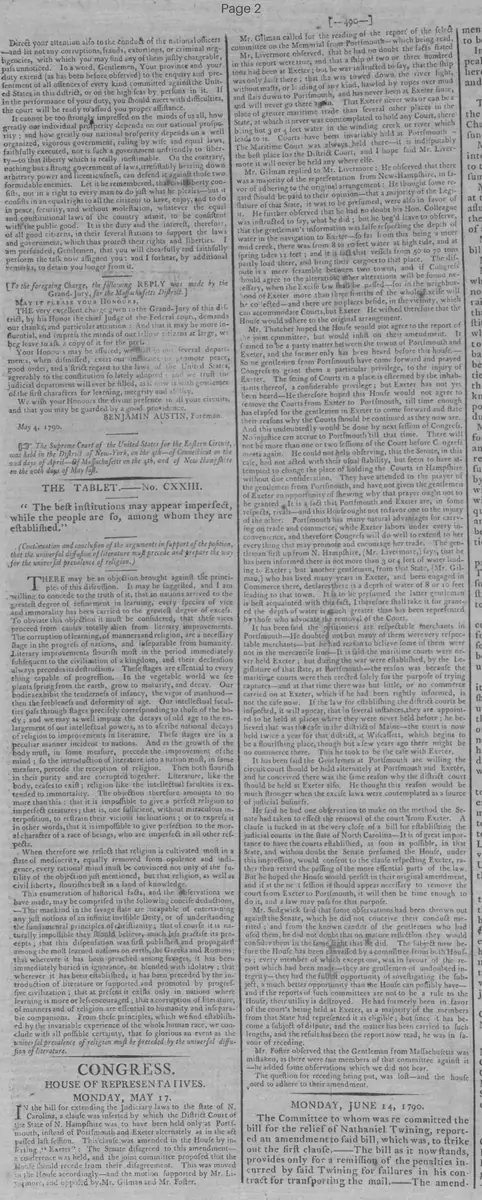
On the bill for extending the Judiciary laws to the state of N. Carolina, a clause was inserted by which the District Court of the State of N. Hampshire was to have been held only at Portsmouth, instead of Portsmouth and Exeter alternately as in the act passed last session. This clause was amended in the House by inserting "Exeter": The Senate disagreed to this amendment—A conference was held, and the joint committee proposed that the House should recede from their disagreement. This was moved in the House accordingly—and the motion supported by Mr. Livermore, and opposed by Mr. Gilman and Mr. Foster.
Mr. Gilman called for the reading of the report of the select committee on the Memorial from Portsmouth—which being read, Mr. Livermore observed, he was instructed to say, that a ship of two or three hundred tons had been at Exeter; but he had no doubt the facts stated in this report were true, and that a ship of two or three hundred tons had been at Exeter; but that the ship was only built there; that the ship was towed down the river light, without masts, or loading of any kind, hauled by ropes over mud and flats down to Portsmouth, and has never been at Exeter since, and will never go there again. That Exeter never was or can be a place of greater maritime trade than several other places in the State, at which it never was contemplated to hold any Court, there being but 3 or 4 feet water in the winding creek or river which leads to it. Courts have been invariably held at Portsmouth. The Maritime Court was always held there—it is indisputably the best place for the District Court, and I hope said Mr. Livermore it will never be held any where else.
Mr. Gilman replied to Mr. Livermore: He observed that there was a majority of the representation from New-Hampshire, in favor of adhering to the original arrangement: He thought some regard should be paid to their opinion—that a majority of the Legislature of that State, it was to be presumed, were also in favor of it. He further observed that he had no doubt his Hon. Colleague was instructed to say, what he did; but he beg'd leave to observe, that the gentleman's information was false respecting the depth of water in the navigation to Exeter—so far from this being a mere mud creek, there was from 8 to 10 feet water at high tide, and at spring tides 11 feet; and it is false that vessels from 50 to 70 tons partly load there, and bring their cargoes to that place. The dispute is a mere scramble between two towns, and if Congress should agree to the alteration, her alterations will be found necessary, when the Excise law shall be passed—for in the neighborhood good of Exeter more than three fourths of the whole Excise will be collected—and there are no places beside, in the vicinity, which can accommodate Courts, but Exeter. He wished therefore that the House would adhere to the original arrangement.
Mr. Thatcher hoped the House would not agree to the report of the joint committee, but would insist on their amendment. It seemed to be a party matter between the towns of Portsmouth and Exeter, and the former only has been heard before this house.—Some gentlemen from Portsmouth have come forward and prayed Congress to grant them a particular privilege, to the injury of Exeter. The sitting of Courts in a place is esteemed by the inhabitants thereof, a considerable privilege; but Exeter has not yet been heard—He therefore hoped this House would not agree to remove the Courts from Exeter to Portsmouth, till time enough has elapsed for the gentlemen in Exeter to come forward and state their reasons why the Courts should be continued as they now are. And this undoubtedly would be done by next session of Congress. No injustice can accrue to Portsmouth till that time. There will not be more than one or two sessions of the Court before Congress meets again. He could not help observing, that the Senate, in this case, had not acted with their usual stability, but seem to have attempted to change the place of holding the Courts in Hampshire without due consideration. They have attended to the prayer of the gentlemen from Portsmouth, and have not given the gentlemen of Exeter an opportunity of shewing why that prayer ought not to be granted. It is a fact that Portsmouth and Exeter are, in some respects, rivals—and this House ought not to favor one to the injury of the other. Portsmouth has many natural advantages for carrying on trade and commerce, while Exeter labors under every inconvenience, and therefore Congress will do well to extend to her every thing that may promote and encourage her trade. The gentleman first up from N. Hampshire, (Mr. Livermore,) says, that he has been informed there is not more than 3 or 4 feet of water leading to Exeter; but another gentleman, from that State, (Mr. Gilman,) who has lived many years in Exeter, and been engaged in Commerce there, declares there is a depth of water of 8 or 10 feet leading to that town. It is to be presumed the latter gentleman is best acquainted with this fact, I therefore shall take it for granted the depth of water is much greater than has been represented by those who advocate the removal of the Court.
It has been said the petitioners are respectable merchants in Portsmouth—He doubted not but many of them were very respectable merchants—but he had reason to believe some of them were not in the mercantile line. It is said the maritime courts were never held Exeter; but during the war were established, by the Legislature of that state, at Portsmouth—the reason was because the maritime courts were then erected solely for the purpose of trying captures—and at that time there was but little, or no commerce carried on at Exeter, which if he had been rightly informed, is not the case now. If the law for establishing the district courts be inspected, it will appear, that in several instances, they are appointed to be held at places where they were never held before; he believed that was the case in the district of Maine—the court is now held twice a year for that district, at Wiscasset, which begins to be a flourishing place, though but a few years ago there might be no commerce there. This he took to be the case with Exeter.
It has been said the Gentlemen at Portsmouth are willing the circuit court should be held alternately at Portsmouth and Exeter, and he conceived there was the same reason why the district court should be held at Exeter also. He thought this reason would be much stronger when the excise laws were contemplated as a source of judicial business.
He said he had one observation to make on the method the Senate had taken to effect the removal of the court from Exeter. A clause is tucked in at the very close of a bill for establishing the judicial courts in the state of North Carolina—It is of great importance to have the courts established, as soon as possible, in that State, and without doubt the Senate presumed the House, under this impression, would consent to the clause respecting Exeter, rather than retard the passing of the more essential parts of the law. But he hoped the House would persist in their original amendment, and if at the next session it should appear necessary to remove the court from Exeter to Portsmouth, it will then be time enough to do it, and a law may pass for that purpose.
Mr. Sedgwick said that some observations had been thrown out against the Senate, which he did not conceive their conduct merited; and from the known candor of the gentlemen who had used them, he did not doubt that on mature reflection they would consider them in the same light that he did. The subject now before the House has been canvassed by a committee from both Houses; every member of which except one, was in favour of the report which had been made—they are gentlemen of undoubted integrity—they had the fullest opportunity of investigating the subject, a much better opportunity than the House can possibly have—and if the reports of such committees are not to be a rule to the House, their utility is destroyed. He had formerly been in favor of the court's being held at Exeter, as a majority of the members from that State had represented it as eligible; but since it has become a subject of dispute, and the matter has been carried to such lengths, and the result has been the report now read, he was in favour of receding.
Mr. Foster observed that the Gentleman from Massachusetts was mistaken, as there were two members of that committee against—he added some observations which we did not hear.
The question for receding being put, was lost—and the house voted to adhere to their amendment.
What sub-type of article is it?
What keywords are associated?
What entities or persons were involved?
Where did it happen?
Domestic News Details
Primary Location
New Hampshire
Event Date
Monday, May 17
Key Persons
Outcome
the house voted to adhere to their amendment inserting 'exeter' for the district court location, rejecting the senate's disagreement.
Event Details
Debate in the House of Representatives on a clause in the bill extending judiciary laws to North Carolina, concerning whether the District Court in New Hampshire should be held only at Portsmouth or alternately at Portsmouth and Exeter. Arguments focused on navigation, trade, local representation, and fairness between the towns.