Thank you for visiting SNEWPapers!
Sign up free
Editorial
March 25, 1866
Shreveport Weekly News
Shreveport, Caddo County, Louisiana
What is this article about?
Editorial praises General Grant's military reputation but criticizes his order censoring disloyal press, questioning its ambiguity and threat to his fame amid Executive-Legislative tensions.
Clipping
OCR Quality
75%
Good
Full Text
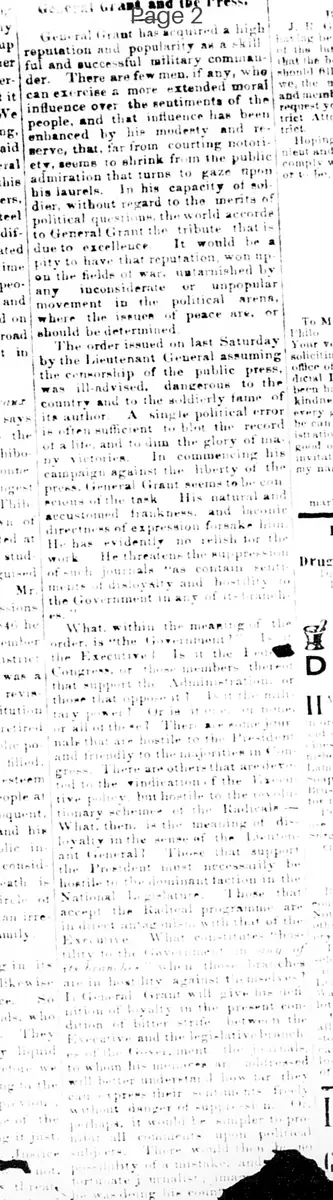
Gen. Grant has acquired a high reputation and popularity as a skillful and successful military commander. There are few men, if any, who can exercise a more extended moral influence over the sentiments of the people, and that influence has been enhanced by his modesty and reserve, that, far from courting notoriety, seems to shrink from the public admiration that turns to gaze upon his laurels. In his capacity of soldier, without regard to the merits of political questions, the world accords to General Grant the tribute that is due to excellence. It would be a pity to have that reputation, won upon the fields of war, untarnished by any inconsiderate or unpopular movement in the political arena, where the issues of peace are, or should be determined.
The order issued on last Saturday by the Lieutenant General assuming the censorship of the public press, was ill-advised, dangerous to the country and to the soldierly fame of its author. A single political error is often sufficient to blot the record of a life, and to dim the glory of many victories. In commencing his campaign against the liberty of the press, General Grant seems to be conscious of the task. His natural and accustomed frankness, and laconic directness of expression forsake him. He has evidently no relish for the work. He threatens the suppression of such journals 'as contain sentiments of disloyalty and hostility against the Government on any of its channels.'
What, within the meaning of the order, is 'the government'? Is it the Executive? Is it the true Congress, or those members thereof that support the Administration, or those that oppose it? Is it nihil ad nauseam? Or is it all of them? There are organs which are hostile to the secession and inimical to the administration. There are others that are loyal to the indications of the Executive to them, but hostile to the loyal military scheme of the Radical—what, then, is the meaning of disloyalty within the sense of the Lieutenant General? Those that support the President must necessarily be hostile to the dominant faction in the National Legislature. Those that accept the loyal programme are identical with that of the Executive. What constitutes disloyalty to the Executive? Who is to be the judge? Or in what has he authority against the press? Is Gen. Grant willing to vault in the present condition of affairs between the Executive and the legislative branch of government to sustain the mall to which he never arrived with state union yet low in this capacity to expunge their sentiments follows what dangerous Georgia. It would be happier to pro rata. The word in be st. poetry of a mistake, and
The order issued on last Saturday by the Lieutenant General assuming the censorship of the public press, was ill-advised, dangerous to the country and to the soldierly fame of its author. A single political error is often sufficient to blot the record of a life, and to dim the glory of many victories. In commencing his campaign against the liberty of the press, General Grant seems to be conscious of the task. His natural and accustomed frankness, and laconic directness of expression forsake him. He has evidently no relish for the work. He threatens the suppression of such journals 'as contain sentiments of disloyalty and hostility against the Government on any of its channels.'
What, within the meaning of the order, is 'the government'? Is it the Executive? Is it the true Congress, or those members thereof that support the Administration, or those that oppose it? Is it nihil ad nauseam? Or is it all of them? There are organs which are hostile to the secession and inimical to the administration. There are others that are loyal to the indications of the Executive to them, but hostile to the loyal military scheme of the Radical—what, then, is the meaning of disloyalty within the sense of the Lieutenant General? Those that support the President must necessarily be hostile to the dominant faction in the National Legislature. Those that accept the loyal programme are identical with that of the Executive. What constitutes disloyalty to the Executive? Who is to be the judge? Or in what has he authority against the press? Is Gen. Grant willing to vault in the present condition of affairs between the Executive and the legislative branch of government to sustain the mall to which he never arrived with state union yet low in this capacity to expunge their sentiments follows what dangerous Georgia. It would be happier to pro rata. The word in be st. poetry of a mistake, and
What sub-type of article is it?
Press Freedom
Military Affairs
Partisan Politics
What keywords are associated?
Grant Censorship
Press Freedom
Military Reputation
Civil War Politics
Disloyalty Ambiguity
What entities or persons were involved?
General Grant
Lieutenant General
Executive
Congress
Radicals
Editorial Details
Primary Topic
Criticism Of General Grant's Press Censorship Order
Stance / Tone
Critical Of Censorship, Protective Of Press Liberty
Key Figures
General Grant
Lieutenant General
Executive
Congress
Radicals
Key Arguments
Grant's Military Reputation Risks Tarnishing By Political Actions
Censorship Order Is Ill Advised And Dangerous
Ambiguity In Defining 'Disloyalty' And 'The Government'
Threatens Liberty Of The Press Amid Executive Legislative Conflicts