Thank you for visiting SNEWPapers!
Sign up free
Editorial
April 21, 1827
Phenix Gazette
Alexandria, Virginia
What is this article about?
Editorial from the National Intelligencer criticizes an organized opposition to President Adams' administration, alleging a secret congressional caucus led by Martin Van Buren aims to oust it regardless of merits, subjugate the press, and control elections via party machinery rather than popular will.
Clipping
OCR Quality
95%
Excellent
Full Text
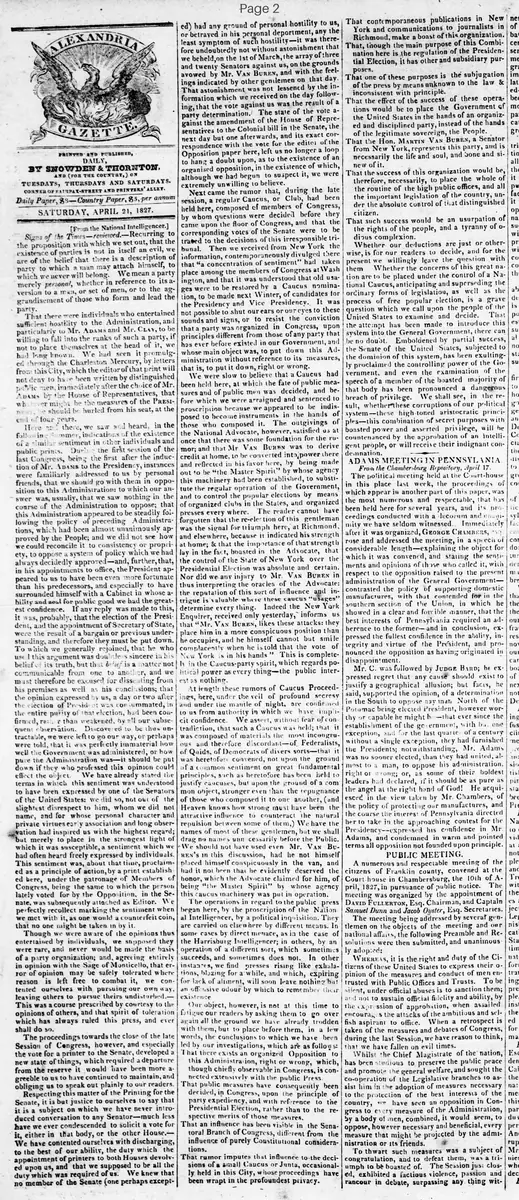
[From the National Intelligencer.]
Signs of the Times-reviewed.--Recurring to the proposition with which we set out, that the existence of parties is not in itself an evil, we are of the belief that there is a description of party to which a man may attach himself, to which we never will belong. We mean a party merely personal, whether in reference to its aversion to a man, or set of men, or to the aggrandisement of those who form and lead the party.
That there were individuals who entertained particular hostility to Mr. Adams and Mr. Clay, to be sufficient to the Administration, and willing to fall into the ranks of such a party, if not to place themselves at the head of it, we had long known. We had seen it promulgated through the Charleston Mercury, by letters from this City, which the editor of that print will not deny to have been written by distinguished public men, immediately after the choice of Mr. Adams by the House of Representatives, that whatever might be the measures of the President, he should be hurled from his seat, at the end of four years.
Here and there, we saw and heard, in the following Summer, indications of the existence of a similar sentiment in other individuals and public prints. During the first session of the last Congress, being the first after the induction of Mr. Adams to the Presidency, instances were familiarly addressed to us by personal friends, that we should go with them in opposition to this Administration: to which our answer was, usually, that we saw nothing in the course of the Administration to oppose; that this Administration appeared to be steadily following the policy of preceding Administrations, which had been almost unanimously approved by the People; and we did not see how we could reconcile it to consistency or propriety, to oppose a system of policy which we had always decidedly approved--and, further, that, in his appointments to office, the President appeared to us to have been even more fortunate than his predecessors, and especially to have surrounded himself with a Cabinet in whose ability and zeal for public good we had the greatest confidence. If any reply was made to this, it was, probably, that the election of the President, and the appointment of Secretary of State, were the result of a bargain or previous understanding, and therefore they must be put down.
To which we generally rejoined, that he who used this argument was doubtless sincere in his belief of its truth, but that belief is a matter not communicable from one to another, and we must therefore be excused for dissenting from his premises as well as his conclusions; that the opinion expressed by us, a day or two after the election of President was consummated, in the entire purity of that election, had been confirmed, rather than weakened, by all our subsequent observation. Discovered to be thus intractable, we were left to go our way, or perhaps were told, that it was perfectly immaterial how well the Government was administered, or how pure the Administration was--it should be put down if they who professed this opinion could effect the object. We have already stated the terms in which this sentiment was understood to have been expressed by one of the Senators of the United States: we did so, not out of the slightest disrespect to him, whom we did not name, and for whose personal character and private virtues early association and long observation had inspired us with the highest regard; but merely to place in the strongest light of which it was susceptible, a sentiment which we had often heard freely expressed by individuals.
This sentiment was, about that time, proclaimed as a principle of action, by a print established here, under the patronage of Members of Congress, being the same to which the person lately voted for by the Opposition, in the Senate, was subsequently attached as Editor. We perfectly recollect marking the sentiment when we met with it, as one would a counterfeit coin, that no one might be taken in by it.
Though we were aware of the opinions thus entertained by individuals, we supposed they were rare, and never would be made the basis of a party organization; and, agreeing entirely in opinion with the Sage of Monticello, that error of opinion may be safely tolerated where reason is left free to combat it, we contented ourselves with pursuing our own way, leaving others to pursue theirs undisturbed.
This was a course prescribed by courtesy to the opinions of others, and that spirit of toleration which has always ruled this press, and ever shall do so.
The proceedings towards the close of the late Session of Congress, however, and especially the vote for a printer to the Senate, developed a new state of things, which required a departure from the reserve it would have been more agreeable to us to have continued to maintain, and obliging us to speak out plainly to our readers.
Respecting this matter of the Printing for the Senate, it is but justice to ourselves to say that it is a subject on which we have never introduced conversation to any Senator much less have we ever condescended to solicit a vote for it, either in that body, or the other House.
We have contented ourselves with discharging, to the best of our ability, the duty which the appointment of printers to both Houses devolved upon us, and that we supposed to be all the duty which was required of us. We knew that no member of the Senate (one perhaps excepted) had any ground of personal hostility to us, or betrayed in his personal deportment, any the least symptom of such hostility--it was therefore undoubtedly not without astonishment that we beheld, on the 1st of March, the array of three and twenty Senators against us, on the grounds avowed by Mr. Van Buren, and with the feelings indicated by other gentlemen on that day.
That astonishment was not lessened by the information which we received on the day following, that the vote against us was the result of a party determination. The state of the vote against the amendment of the House of Representatives to the Colonial bill in the Senate, the next day but one afterwards, and its exact correspondence with the vote for the editor of the Opposition paper here, left us no longer a loop to hang a doubt upon, as to the existence of an organised opposition, in the existence of which, although we had begun to suspect it, we were extremely unwilling to believe.
Next came the rumor that, during the late session, a regular Caucus, or Club, had been held here, composed of members of Congress, by whom questions were decided before they came upon the floor of Congress, and that the corresponding votes of the Senate were to be traced to the decisions of this irresponsible tribunal. Then we received from New York the information, contemporaneously divulged there that "a concentration of sentiment" had taken place among the members of Congress at Washington, and that it was understood that old usages were to be restored by a Caucus nomination, to be made next Winter, of candidates for the Presidency and Vice Presidency. It was not possible to shut our ears or our eyes to these sounds and signs, or to resist the conviction that a party was organized in Congress, upon principles different from those of any party that has ever before existed in our Government, and whose main object was, to put down this Administration without reference to its measures, that is, to put it down, right or wrong.
We were slow to believe that a Caucus had been held here, at which the fate of public measures and of public men was decided, and before which we were arraigned and sentenced to proscription because we appeared to be indisposed to become instruments in the hands of those who composed it. The outgivings of the National Advocate, however, satisfied us at once that there was some foundation for the rumor; and that Mr. Van Buren was to derive credit at home, to be converted into power there and reflected in his favor here, by being made out to be "the Master Spirit" by whose agency this machinery had been established, to substi-tute the regular operation of the Government, and to control the popular elections by means of organized clubs in the States, and organized presses every where. The reader cannot have forgotten that the re-election of this gentleman was the signal for triumph here, at Richmond, and elsewhere, because it indicated his strength at home; & that the importance of that strength lay in the fact, boasted in the Advocate, that the control of the State of New York over the Presidential Election was absolute and certain.
Nor did we any injury to Mr. Van Buren in thus interpreting the oracles of the Advocate: the reputation of this sort of influence and intrigue is valuable where these caucus "usages" determine every thing. Indeed the New York Enquirer, received only yesterday, informs us that "Mr. Van Buren, likes these attacks: they place him in a more conspicuous position than he occupies, and he himself cannot but smile complacently when he is told that the vote of New York is in his hands" This is completely in the Caucus-party spirit, which regards political power as every thing--the public interests nothing.
At length these rumors of Caucus Proceedings, here, under the veil of profound secrecy and under the mantle of night, are confirmed to us from authority in which we have implicit confidence. We assert, without fear of contradiction, that such a Caucus was held; that it was composed of materials the most incongruous and therefore discordant--of Federalists, of Quids, of Democrats of divers sorts--that it was heretofore convened, not upon the ground of a common sentiment on great fundamental principles, such as heretofore has been held to justify caucuses, but upon the ground of a common object, stronger even than the repugnance of those who composed it to one another, (and Heaven knows how strong must have been the attractive influence to counteract the natural repulsion between some of them.) We have the names of most of these gentlemen, but we shall drag no names unnecessarily before the Public.
We should not have used even Mr. Van Buren's in this discussion, had he not himself placed himself conspicuously in the van, and had it not been that he evidently deserved the honor, which the Advocate claimed for him, of being "the Master Spirit" by whose agency this caucus machinery was put in operation.
The operations in regard to the public press began here, by the proscription of the National Intelligencer, by a political inquisition. They are carried on elsewhere by different means. In some cases by direct menace, as in the case of the Harrisburg Intelligencer; in others, by an operation of a different sort, which sometimes succeeds, and sometimes does not. In other instances, we find presses rising like exhalations, blazing for a while, and which, expiring for lack of aliment, will soon leave nothing but an offensive odour by which to remember their existence.
Our object, however, is not at this time to fatigue our readers by asking them to go over again all the ground we have already trodden with them, but to place before them, in a few words, the conclusions to which we have been led by our investigations, which are as follows:
That there exists an organized Opposition to this Administration, right or wrong, which, though chiefly observable in Congress, is connected extensively with the public Press.
That public measures have consequently been decided, in Congress, upon the principle of party expediency, and with reference to the Presidential Election, rather than to the respective merits of those measures.
That an influence has been visible in the Senatorial Branch of Congress, different from the influence of purely Constitutional considerations.
That rumor imputes that influence to the decisions of a small Caucus or Junta, occasionally held in this City, whose proceedings have been wrapt in the profoundest privacy.
That contemporaneous publications in New York and communications to journalists in Richmond, make a boast of this organization.
That, though the main purpose of this Combination here is the regulation of the Presidential Election, it has other and subsidiary purposes.
That one of these purposes is the subjugation of the press by means unknown to the law & inconsistent with principle.
That the effect of the success of these operations would be to place the Government of the United States in the hands of an organized and disciplined party, instead of the hands of the legitimate sovereign, the People.
That the Hon. Martin Van Buren, a Senator from New York, represents this party, and is necessarily the life and soul, and bone and sinew of it.
That the success of this organization would be, therefore, necessarily, to place the whole of the routine of the high public offices, and all the important legislation of the country, under the absolute control of that distinguished citizen.
That such success would be an usurpation of the rights of the people, and a tyranny of odious complexion.
Whether our deductions are just or otherwise, is for our readers to decide, and for the present we willingly leave the question with them.
Whether the concerns of this great nation are to be placed under the control of a National Caucus, anticipating and superseding the ordinary forms of legislation, as well as the process of free popular election, is a grave question which we call upon the people of the United States to examine and decide. That the attempt has been made to introduce this system into the General Government, there can be no doubt. Emboldened by partial success, the Senate of the United States, subjected to the dominion of this system, has been exultingly proclaimed the controlling power of the Government, and even the examination of the speech of a member of the boasted majority of that body has been pronounced a dangerous breach of privilege. We shall see, in the result, whether these corruptions of our political system--these high-toned aristocratic principles--this combination of secret purposes with boasted power and asserted privilege, will be countenanced by the approbation of an intelligent people, or will receive their indignant condemnation.
Signs of the Times-reviewed.--Recurring to the proposition with which we set out, that the existence of parties is not in itself an evil, we are of the belief that there is a description of party to which a man may attach himself, to which we never will belong. We mean a party merely personal, whether in reference to its aversion to a man, or set of men, or to the aggrandisement of those who form and lead the party.
That there were individuals who entertained particular hostility to Mr. Adams and Mr. Clay, to be sufficient to the Administration, and willing to fall into the ranks of such a party, if not to place themselves at the head of it, we had long known. We had seen it promulgated through the Charleston Mercury, by letters from this City, which the editor of that print will not deny to have been written by distinguished public men, immediately after the choice of Mr. Adams by the House of Representatives, that whatever might be the measures of the President, he should be hurled from his seat, at the end of four years.
Here and there, we saw and heard, in the following Summer, indications of the existence of a similar sentiment in other individuals and public prints. During the first session of the last Congress, being the first after the induction of Mr. Adams to the Presidency, instances were familiarly addressed to us by personal friends, that we should go with them in opposition to this Administration: to which our answer was, usually, that we saw nothing in the course of the Administration to oppose; that this Administration appeared to be steadily following the policy of preceding Administrations, which had been almost unanimously approved by the People; and we did not see how we could reconcile it to consistency or propriety, to oppose a system of policy which we had always decidedly approved--and, further, that, in his appointments to office, the President appeared to us to have been even more fortunate than his predecessors, and especially to have surrounded himself with a Cabinet in whose ability and zeal for public good we had the greatest confidence. If any reply was made to this, it was, probably, that the election of the President, and the appointment of Secretary of State, were the result of a bargain or previous understanding, and therefore they must be put down.
To which we generally rejoined, that he who used this argument was doubtless sincere in his belief of its truth, but that belief is a matter not communicable from one to another, and we must therefore be excused for dissenting from his premises as well as his conclusions; that the opinion expressed by us, a day or two after the election of President was consummated, in the entire purity of that election, had been confirmed, rather than weakened, by all our subsequent observation. Discovered to be thus intractable, we were left to go our way, or perhaps were told, that it was perfectly immaterial how well the Government was administered, or how pure the Administration was--it should be put down if they who professed this opinion could effect the object. We have already stated the terms in which this sentiment was understood to have been expressed by one of the Senators of the United States: we did so, not out of the slightest disrespect to him, whom we did not name, and for whose personal character and private virtues early association and long observation had inspired us with the highest regard; but merely to place in the strongest light of which it was susceptible, a sentiment which we had often heard freely expressed by individuals.
This sentiment was, about that time, proclaimed as a principle of action, by a print established here, under the patronage of Members of Congress, being the same to which the person lately voted for by the Opposition, in the Senate, was subsequently attached as Editor. We perfectly recollect marking the sentiment when we met with it, as one would a counterfeit coin, that no one might be taken in by it.
Though we were aware of the opinions thus entertained by individuals, we supposed they were rare, and never would be made the basis of a party organization; and, agreeing entirely in opinion with the Sage of Monticello, that error of opinion may be safely tolerated where reason is left free to combat it, we contented ourselves with pursuing our own way, leaving others to pursue theirs undisturbed.
This was a course prescribed by courtesy to the opinions of others, and that spirit of toleration which has always ruled this press, and ever shall do so.
The proceedings towards the close of the late Session of Congress, however, and especially the vote for a printer to the Senate, developed a new state of things, which required a departure from the reserve it would have been more agreeable to us to have continued to maintain, and obliging us to speak out plainly to our readers.
Respecting this matter of the Printing for the Senate, it is but justice to ourselves to say that it is a subject on which we have never introduced conversation to any Senator much less have we ever condescended to solicit a vote for it, either in that body, or the other House.
We have contented ourselves with discharging, to the best of our ability, the duty which the appointment of printers to both Houses devolved upon us, and that we supposed to be all the duty which was required of us. We knew that no member of the Senate (one perhaps excepted) had any ground of personal hostility to us, or betrayed in his personal deportment, any the least symptom of such hostility--it was therefore undoubtedly not without astonishment that we beheld, on the 1st of March, the array of three and twenty Senators against us, on the grounds avowed by Mr. Van Buren, and with the feelings indicated by other gentlemen on that day.
That astonishment was not lessened by the information which we received on the day following, that the vote against us was the result of a party determination. The state of the vote against the amendment of the House of Representatives to the Colonial bill in the Senate, the next day but one afterwards, and its exact correspondence with the vote for the editor of the Opposition paper here, left us no longer a loop to hang a doubt upon, as to the existence of an organised opposition, in the existence of which, although we had begun to suspect it, we were extremely unwilling to believe.
Next came the rumor that, during the late session, a regular Caucus, or Club, had been held here, composed of members of Congress, by whom questions were decided before they came upon the floor of Congress, and that the corresponding votes of the Senate were to be traced to the decisions of this irresponsible tribunal. Then we received from New York the information, contemporaneously divulged there that "a concentration of sentiment" had taken place among the members of Congress at Washington, and that it was understood that old usages were to be restored by a Caucus nomination, to be made next Winter, of candidates for the Presidency and Vice Presidency. It was not possible to shut our ears or our eyes to these sounds and signs, or to resist the conviction that a party was organized in Congress, upon principles different from those of any party that has ever before existed in our Government, and whose main object was, to put down this Administration without reference to its measures, that is, to put it down, right or wrong.
We were slow to believe that a Caucus had been held here, at which the fate of public measures and of public men was decided, and before which we were arraigned and sentenced to proscription because we appeared to be indisposed to become instruments in the hands of those who composed it. The outgivings of the National Advocate, however, satisfied us at once that there was some foundation for the rumor; and that Mr. Van Buren was to derive credit at home, to be converted into power there and reflected in his favor here, by being made out to be "the Master Spirit" by whose agency this machinery had been established, to substi-tute the regular operation of the Government, and to control the popular elections by means of organized clubs in the States, and organized presses every where. The reader cannot have forgotten that the re-election of this gentleman was the signal for triumph here, at Richmond, and elsewhere, because it indicated his strength at home; & that the importance of that strength lay in the fact, boasted in the Advocate, that the control of the State of New York over the Presidential Election was absolute and certain.
Nor did we any injury to Mr. Van Buren in thus interpreting the oracles of the Advocate: the reputation of this sort of influence and intrigue is valuable where these caucus "usages" determine every thing. Indeed the New York Enquirer, received only yesterday, informs us that "Mr. Van Buren, likes these attacks: they place him in a more conspicuous position than he occupies, and he himself cannot but smile complacently when he is told that the vote of New York is in his hands" This is completely in the Caucus-party spirit, which regards political power as every thing--the public interests nothing.
At length these rumors of Caucus Proceedings, here, under the veil of profound secrecy and under the mantle of night, are confirmed to us from authority in which we have implicit confidence. We assert, without fear of contradiction, that such a Caucus was held; that it was composed of materials the most incongruous and therefore discordant--of Federalists, of Quids, of Democrats of divers sorts--that it was heretofore convened, not upon the ground of a common sentiment on great fundamental principles, such as heretofore has been held to justify caucuses, but upon the ground of a common object, stronger even than the repugnance of those who composed it to one another, (and Heaven knows how strong must have been the attractive influence to counteract the natural repulsion between some of them.) We have the names of most of these gentlemen, but we shall drag no names unnecessarily before the Public.
We should not have used even Mr. Van Buren's in this discussion, had he not himself placed himself conspicuously in the van, and had it not been that he evidently deserved the honor, which the Advocate claimed for him, of being "the Master Spirit" by whose agency this caucus machinery was put in operation.
The operations in regard to the public press began here, by the proscription of the National Intelligencer, by a political inquisition. They are carried on elsewhere by different means. In some cases by direct menace, as in the case of the Harrisburg Intelligencer; in others, by an operation of a different sort, which sometimes succeeds, and sometimes does not. In other instances, we find presses rising like exhalations, blazing for a while, and which, expiring for lack of aliment, will soon leave nothing but an offensive odour by which to remember their existence.
Our object, however, is not at this time to fatigue our readers by asking them to go over again all the ground we have already trodden with them, but to place before them, in a few words, the conclusions to which we have been led by our investigations, which are as follows:
That there exists an organized Opposition to this Administration, right or wrong, which, though chiefly observable in Congress, is connected extensively with the public Press.
That public measures have consequently been decided, in Congress, upon the principle of party expediency, and with reference to the Presidential Election, rather than to the respective merits of those measures.
That an influence has been visible in the Senatorial Branch of Congress, different from the influence of purely Constitutional considerations.
That rumor imputes that influence to the decisions of a small Caucus or Junta, occasionally held in this City, whose proceedings have been wrapt in the profoundest privacy.
That contemporaneous publications in New York and communications to journalists in Richmond, make a boast of this organization.
That, though the main purpose of this Combination here is the regulation of the Presidential Election, it has other and subsidiary purposes.
That one of these purposes is the subjugation of the press by means unknown to the law & inconsistent with principle.
That the effect of the success of these operations would be to place the Government of the United States in the hands of an organized and disciplined party, instead of the hands of the legitimate sovereign, the People.
That the Hon. Martin Van Buren, a Senator from New York, represents this party, and is necessarily the life and soul, and bone and sinew of it.
That the success of this organization would be, therefore, necessarily, to place the whole of the routine of the high public offices, and all the important legislation of the country, under the absolute control of that distinguished citizen.
That such success would be an usurpation of the rights of the people, and a tyranny of odious complexion.
Whether our deductions are just or otherwise, is for our readers to decide, and for the present we willingly leave the question with them.
Whether the concerns of this great nation are to be placed under the control of a National Caucus, anticipating and superseding the ordinary forms of legislation, as well as the process of free popular election, is a grave question which we call upon the people of the United States to examine and decide. That the attempt has been made to introduce this system into the General Government, there can be no doubt. Emboldened by partial success, the Senate of the United States, subjected to the dominion of this system, has been exultingly proclaimed the controlling power of the Government, and even the examination of the speech of a member of the boasted majority of that body has been pronounced a dangerous breach of privilege. We shall see, in the result, whether these corruptions of our political system--these high-toned aristocratic principles--this combination of secret purposes with boasted power and asserted privilege, will be countenanced by the approbation of an intelligent people, or will receive their indignant condemnation.
What sub-type of article is it?
Partisan Politics
Constitutional
Press Freedom
What keywords are associated?
Adams Administration
Caucus Organization
Martin Van Buren
Partisan Opposition
Press Proscription
Presidential Election
Congressional Intrigue
What entities or persons were involved?
Mr. Adams
Mr. Clay
Mr. Van Buren
National Intelligencer
Charleston Mercury
National Advocate
New York Enquirer
Editorial Details
Primary Topic
Organized Opposition To Adams Administration Via Secret Caucus
Stance / Tone
Strongly Critical Of Caucus Based Partisan Opposition
Key Figures
Mr. Adams
Mr. Clay
Mr. Van Buren
National Intelligencer
Charleston Mercury
National Advocate
New York Enquirer
Key Arguments
Existence Of A Personal Party Hostile To Adams And Clay Regardless Of Administration Merits
Alleged Bargain In Adams' Election Used To Justify Opposition
Senate Vote Against National Intelligencer As Printer Reveals Organized Opposition
Secret Congressional Caucus Decides Measures And Proscribes Press
Van Buren As Master Spirit Controlling New York Votes And Caucus Machinery
Such Organization Usurps People's Rights And Imposes Tyranny
Call For People To Reject Caucus Control Over Elections And Government