Thank you for visiting SNEWPapers!
Sign up free
Phenix Gazette
Alexandria, Virginia
What is this article about?
On April 14, 1833, over 1,000 children from Alexandria's Sunday schools gathered in the Methodist Episcopal Church for hymns, prayers, and an address emphasizing moral and spiritual benefits of the institutions, attended by ministers and visitors.
Clipping
OCR Quality
Full Text
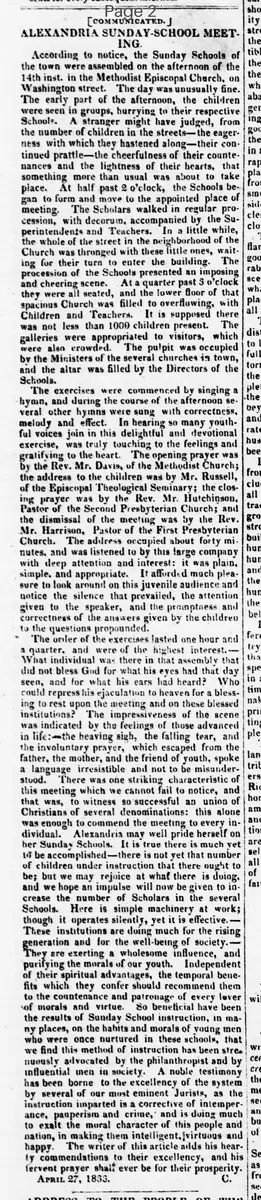
ALEXANDRIA SUNDAY-SCHOOL MEETING.
According to notice, the Sunday Schools of the town were assembled on the afternoon of the 14th inst. in the Methodist Episcopal Church, on Washington street. The day was unusually fine. The early part of the afternoon, the children were seen in groups, hurrying to their respective Schools. A stranger might have judged, from the number of children in the streets the eagerness with which they hastened along—their continued prattle—the cheerfulness of their countenances and the lightness of their hearts, that something more than usual was about to take place. At half past 2 o'clock, the Schools began to form and move to the appointed place of meeting.
The Scholars walked in regular procession, with decorum, accompanied by the Superintendents and Teachers. In a little while, the whole of the street in the neighborhood of the Church was thronged with these little ones, waiting for their turn to enter the building. The procession of the Schools presented an imposing and cheering scene. At a quarter past 3 o'clock they were all seated, and the lower floor of that spacious Church was filled to overflowing, with Children and Teachers. It is supposed there was not less than 1000 children present. The galleries were appropriated to visitors, which were also crowded. The pulpit was occupied by the Ministers of the several churches in town, and the altar was filled by the Directors of the Schools.
The exercises were commenced by singing a hymn, and during the course of the afternoon several other hymns were sung with correctness, melody and effect. In hearing so many youthful voices join in this delightful and devotional exercise, was truly touching to the feelings and gratifying to the heart. The opening prayer was by the Rev. Mr. Davis, of the Methodist Church; the address to the children was by Mr. Russell, of the Episcopal Theological Seminary; the closing prayer was by the Rev. Mr. Hutchinson, Pastor of the Second Presbyterian Church; and the dismissal of the meeting was by the Rev. Mr. Harrison, Pastor of the First Presbyterian Church. The address occupied about forty minutes, and was listened to by this large company with deep attention and interest: it was plain, simple, and appropriate. It afforded much pleasure to look around on this juvenile audience and notice the silence that prevailed, the attention given to the speaker, and the promptness and correctness of the answers given by the children to the questions propounded.
The order of the exercises lasted one hour and a quarter, and were of the highest interest. What individual was there in that assembly that did not bless God for what his eyes had that day seen, and for what his ears had heard? Who could repress his ejaculation to heaven for a blessing to rest upon the meeting and on these blessed institutions? The impressiveness of the scene was indicated by the feelings of those advanced in life: the heaving sigh, the falling tear, and the involuntary prayer, which escaped from the father, the mother, and the friend of youth, spoke a language irresistible and not to be misunderstood. There was one striking characteristic of this meeting which we cannot fail to notice, and that was, to witness so successful an union of Christians of several denominations: this alone was enough to commend the meeting to every individual. Alexandria may well pride herself on her Sunday Schools. It is true there is much yet to be accomplished—there is not yet that number of children under instruction that there ought to be; but we may rejoice at what there is doing, and we hope an impulse will now be given to increase the number of Scholars in the Several Schools. Here is simple machinery at work; though it operates silently, yet it is effective. These institutions are doing much for the rising generation and for the well-being of society. They are exerting a wholesome influence, and purifying the morals of our youth. Independent of their spiritual advantages, the temporal benefits which they confer should recommend them to the countenance and patronage of every lover of morals and virtue. So beneficial have been the results of Sunday School instruction, in many places, on the habits and morals of young men who were once nurtured in these schools, that we find this method of instruction has been strenuously advocated by the philanthropist and by influential men in society. A noble testimony has been borne to the excellency of the system by several of our most eminent Jurists, as the instruction imparted is a corrective of intemperance, pauperism and crime, and is doing much to exalt the moral character of this people and nation, in making them intelligent, virtuous and happy. The writer of this article adds his hearty commendations to their excellency, and his fervent prayer shall ever be for their prosperity.
APRIL 27, 1833.
C.
What sub-type of article is it?
What themes does it cover?
What keywords are associated?
What entities or persons were involved?
Where did it happen?
Story Details
Key Persons
Location
Alexandria, Methodist Episcopal Church On Washington Street
Event Date
Afternoon Of The 14th Inst., 1833
Story Details
Sunday schools of Alexandria assembled in the Methodist Episcopal Church for a meeting with over 1000 children, featuring hymns, prayers by Rev. Mr. Davis and Rev. Mr. Hutchinson, an address by Mr. Russell, and dismissal by Rev. Mr. Harrison. The event showcased unity among Christian denominations and the moral benefits of Sunday schools.