Thank you for visiting SNEWPapers!
Sign up free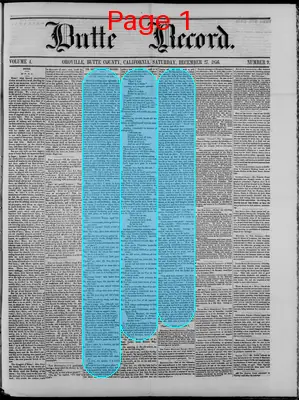
Editorial
December 27, 1856
Butte Record
Oroville, Bidwell, Butte County, California
What is this article about?
Reflective piece on the appeal of venerable English village churchyards, sharing serious and humorous epitaphs, and recounting a folk tale of Lady Anna Mount Edg cumbe's burial and revival due to grave robbers.
Clipping
OCR Quality
98%
Excellent
Full Text
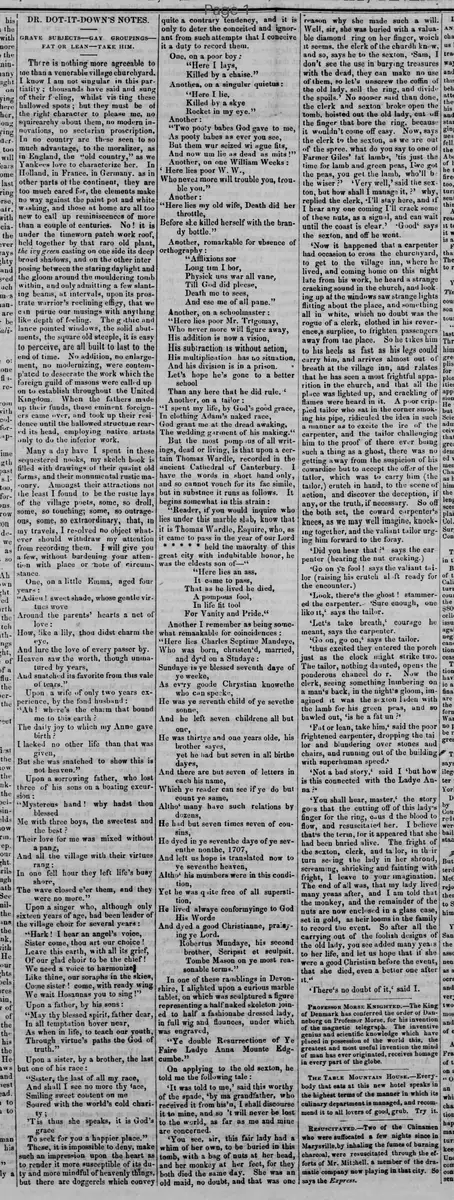
DR. DOT-IT-DOWN'S NOTES.
GRAVE SUBJECTS—GAY GROUPINGS—FAT OR LEAN—TAKE HIM.
There is nothing more agreeable to me than a venerable village churchyard. I know I am not singular in this partiality; thousands have said and sung of their feeling, whilst visiting these hallowed spots; but they must be of the right character to please me, no squirearchy about them, no modern innovations, no sectarian proscription. In no country are these seen to so much advantage, to the moralizer, as in England, the "old country," as we Yankees love to characterize her. In Holland, in France, in Germany, as in other parts of the continent, they are too much cared for, the elements make no way against the paint pot and white washing, and those at home are all too new to call up reminiscences of more than a couple of centuries. No! it is under the timeworn patch work roof, held together by that rare old plant, the ivy green casting on one side its deep broad shadows, and on the other interposing between the staring daylight and the gloom around the mouldering tomb within, and only admitting a few slanting beams, at intervals, upon its prostrate warrior's reclining effigy, that we can pursue our musings with anything like depth of feeling. The gothic and lance pointed windows, the solid abutments, the square old steeple, it is easy to perceive, are all built to last to the end of time. No addition, no enlargement, no modernizing, were contemplated to desecrate the work which the foreign guild of masons were called upon to establish throughout the United Kingdom. When the fathers made up their funds, these eminent foreigners came over, and took up their residence until the hallowed structure reared its head, employing native artists only to do the inferior work.
Many a day have I spent in these sequestered nooks, my sketch book is filled with drawings of their quaint old forms, and their monumental rustic masonry. Amongst their attractions not the least I found to be the rustic lays of the village poets, some, so droll, some, so touching; some, so outrageous, some, so extraordinary, that, in my travels, I resolved no object whatever should withdraw my attention from recording them. I will give you a few, without burdening your attention with place or note of circumstance.
One, on a little Emma, aged four years:
"Adieu! sweet shade, whose gentle virtues wove
Around the parents' hearts a net of love:
How, like a lily, thou didst charm the eye,
And lure the love of every passer by.
Heaven saw the worth, though immatured by years,
And snatched its favorite from this vale of tears."
Upon a wife of only two years experience, by the fond husband:
"Ah! where's the charm that bound me to this earth?
The daily joy to which my Anne gave birth?
I lacked no other life than that was given,
But she was snatched to show this is not heaven."
Upon a sorrowing father, who lost three of his sons on a boating excursion:
"Mysterious hand! why hadst thou blessed
Me with three boys, the sweetest and the best?
Their love for me was mixed without a pang,
And all the village with their virtues rang:
In one fell hour they left life's busy shore,
The wave closed o'er them, and they were no more."
Upon a singer who, although only sixteen years of age, had been leader of the village choir for several years:
Hark! I hear an angel's voice,
Sister come, thou art our choice!
Leave this earth, with all its grief,
Of our glad choir to be the chief!
We need a voice to harmonize
Like thine, our seraphs in the skies.
Come sister! come, with ready wing
We wait Hosannas you to sing!"
Upon a father, by his sons:
"May thy blessed spirit, father dear,
In all temptation hover near,
As when in life, to teach our youth,
Through virtue's paths the God of truth."
Upon a sister, by a brother, the last but one of his race:
"Sister, the last of all my race,
And shall I see no more thy face,
Smiling sweet content on me
Soured with the world's cold charity;
'Tis thus she speaks, it is God's grace
To seek for you a happier place."
These, it is impossible to deny, make such an impression upon the heart as to render it more susceptible of its duty and more mindful of heavenly things, but there are doggerels which convey quite a contrary tendency, and it is only to deter the conceited and ignorant from such attempts that I conceive it a duty to record them.
One, on a poor boy:
"Here I lays,
Killed by a chaise."
Another, on a singular quietus:
"Here I lie,
Killed by a skye
Rocket in my eye."
Another:
"Two pooty babes God gave to me,
As pooty babes as ever you see,
But them wur seized wi ague fits,
And now um lie as dead as mits!"
Another, on one William Weeks:
Here lies poor W. W.,
Who ne'er more will trouble you, trouble you."
Another:
"Here lies my old wife, Death did her throttle,
Before she killed herself with the brandy bottle."
Another, remarkable for absence of orthography:
"Afflictions sore
Long time I bore,
Physick uns war all vane
Till God did plecse
Death me to sees,
And ese me of all pane."
Another, on a schoolmaster:
"Here lies poor Mr. Trigonmay,
Who never more will figure away,
His addition is now a vision,
His subtraction is without action,
His multiplication has no situation,
And his division is in a prison.
Let's hope he's gone to a better school
Than any here that he did rule."
Another, on a tailor:
"I spent my life, by God's good grace,
In clothing Adam's naked race,
God grant me at the dread awaking,
The wedding garment of his making."
But the most pompous of all writings, dead or living, is that upon a certain Thomas Wardle, recorded in the ancient Cathedral of Canterbury. I have the words in short hand only, and so cannot vouch for its fac simile, but in substance it runs as follows. It begins somewhat in this strain:
"Reader, if you would inquire who lies under this marble slab, know that it is Thomas Wardle, Esquire, who, as it came to pass in the year of our Lord * * * * * held the mayoralty of this great city with indubitable honor, he was the eldest son of"
"Here lies an ass,
It came to pass,
That as he lived he died,
A pompous fool,
In life fit tool
For Vanity and Pride."
Another I remember as being somewhat remarkable for coincidences:
"Here lies Charles Septime Mandeye,
Who was born, christen'd, married, and dy'd on a Sundaye:
Sundaye is ye blessed seventh daye of ye weeke,
As ev'ry goode Chrystian knowethe who can specke,
He was ye seventh child of ye seventh sonne,
And he left seven childrene all but one,
He was thirtve and one years olde, his brother sayes,
Yet he had but seven in all birthe dayes,
And there are but seven of letters in each his name,
Which ye reader can see if ye do but count ye same,
Altho' many have such relations by dozens,
He had but seven times seven of cousins,
He dyed in ye seventh daye of ye seventh monethc, 1707,
And left us hope is translated now to ye seventh heaven,
Altho' his numbers were in this condition,
Yet he was quite free of all superstition,
He lived alwaye conforming to God
His Worde
And dyed a good Christianne, praising ye Lord.
Robertus Mundaye, his second brother, Scripsit et sculpsit.
Tombe Mason on ye most reasonable terms."
In one of these ramblings in Devonshire, I alighted upon a curious marble tablet, on which was sculptured a figure representing a half naked skeleton joined to half a fashionable dressed lady, in full wig and flounces, under which was engraved,
"Ye double Resurrectione of Ye Faire Ladye Anna Mount Edg cumbe."
On applying to the old sexton, he told me the following tale:
'It was told to me,' said this worthy of the spade, 'by ma grandfather, who received it from his'n, I shall discourse it to mine, and so 't will never be lost to the werld, as far as me and mine are concerned.
You see, sir, this fair lady had a whim of her own, to be buried in this tomb, with a bag of nuts at her head, and her monkey at her feet, for they both died the same day. She was an old maid, no doubt, and that was one reason why she made such a will.
Well, sir, she was buried with a valuable diamond ring on her finger, which it seems, the clerk of the church knew. and so, says he to the sexton, Sam, I don't see the use in burying treasures with the dead, they can make no use of them, so let's unscrew the coffin of the old lady, sell the ring, and divide the spoils.' No sooner said than done, the clerk and sexton broke open the tomb, hoisted out the old lady, cut off the finger that bore the ring, because it wouldn't come off easy. Now, says the clerk to the sexton, as we are out of the spree, what do you say to one of Farmer Giles' fat lambs, tis just the time for lamb and green peas, I've got the peas, you get the lamb, who'll be the wiser?' 'Very well,' said the sexton, but how shall I manage it,' 'why,' replied the clerk, 'I'll stay here, and if I hear any one coming I'll crack some of these nuts, as a signal, and can wait until the coast is clear.' 'Good' says the sexton, and off he went.
Now it happened that a carpenter had occasion to cross the churchyard, to get to the village inn, where he lived, and coming home on this night late from his work, he heard a strange cracking sound in the church, and looking up at the windows saw strange lights flitting about the place, and something all in white, which no doubt was the rogue of a clerk, clothed in his reverence's surplice, to frighten passengers away from the place. So he takes him to his heels as fast as his legs could carry him, and arrives almost out of breath at the village inn, and relates that he has seen a most frightful apparition in the church, and that all the place was lighted up, and crackling of flames were heard in it. A poor crippled tailor who sat in the corner smoking his pipe, ridiculed the idea in such a manner as to excite the ire of the carpenter, and the tailor challenging him to the proof of there ever being such a thing as a ghost, there was no getting away from the suspicion of his cowardice but to accept the offer of the tailor, which was to carry him (the tailor,) crutch in hand, to the scene of action, and discover the deception, if any, or the truth, if necessary. So off the both set, the coward carpenter's knees, as we may well imagine, knocking together, and the valiant tailor urging him forward to the foray.
'Did you hear that?' says the carpenter (hearing the nut cracking.)
'Go on ye fool!' says the valiant tailor (raising his crutch all ready for the encounter.)
'Look, there's the ghost!' stammered the carpenter. Sure enough, one like it,' says the tailor.
'Let's take breath,' courage he meant, says the carpenter.
Go on, go on,' says the tailor.
Thus excited they entered the porch just as the clock might strike two.
The tailor, nothing daunted, opens the ponderous chancel door. Now the clerk, seeing something lumbering on a man's back, in the night's gloom, imagined it was the sexton laden with the lamb for his green peas, and so bawled out, is he a fat un?
'Fat or lean, take him,' said the poor frightened carpenter, dropping the tailor and blundering over stones and chairs, and running out of the building with superhuman speed.
'Not a bad story,' said I but how is this connected with the Ladye Anna?
You shall hear, master, the story goes that the cutting off of this lady's finger for the ring, caused the blood to flow, and resuscitated her. I believe that's the term, for it appeared that she had been buried alive. The fright of the sexton, clerk, and tailor, in their turn seeing the lady in her shroud, screaming, shrieking and fainting with fright, I leave to your imagination.
The end of all was, that my lady lived many years after, and I am told that the monkey, and the remainder of the nuts are now enclosed in a glass case, set in gold, as heir looms in the family to record the event. So after all the carrying out of the foolish designs of the old lady, you see added many years to her life, and let us hope that if she were a good Christian before the event, that she died, even a better one after it.
There's no doubt of it,' said I.
GRAVE SUBJECTS—GAY GROUPINGS—FAT OR LEAN—TAKE HIM.
There is nothing more agreeable to me than a venerable village churchyard. I know I am not singular in this partiality; thousands have said and sung of their feeling, whilst visiting these hallowed spots; but they must be of the right character to please me, no squirearchy about them, no modern innovations, no sectarian proscription. In no country are these seen to so much advantage, to the moralizer, as in England, the "old country," as we Yankees love to characterize her. In Holland, in France, in Germany, as in other parts of the continent, they are too much cared for, the elements make no way against the paint pot and white washing, and those at home are all too new to call up reminiscences of more than a couple of centuries. No! it is under the timeworn patch work roof, held together by that rare old plant, the ivy green casting on one side its deep broad shadows, and on the other interposing between the staring daylight and the gloom around the mouldering tomb within, and only admitting a few slanting beams, at intervals, upon its prostrate warrior's reclining effigy, that we can pursue our musings with anything like depth of feeling. The gothic and lance pointed windows, the solid abutments, the square old steeple, it is easy to perceive, are all built to last to the end of time. No addition, no enlargement, no modernizing, were contemplated to desecrate the work which the foreign guild of masons were called upon to establish throughout the United Kingdom. When the fathers made up their funds, these eminent foreigners came over, and took up their residence until the hallowed structure reared its head, employing native artists only to do the inferior work.
Many a day have I spent in these sequestered nooks, my sketch book is filled with drawings of their quaint old forms, and their monumental rustic masonry. Amongst their attractions not the least I found to be the rustic lays of the village poets, some, so droll, some, so touching; some, so outrageous, some, so extraordinary, that, in my travels, I resolved no object whatever should withdraw my attention from recording them. I will give you a few, without burdening your attention with place or note of circumstance.
One, on a little Emma, aged four years:
"Adieu! sweet shade, whose gentle virtues wove
Around the parents' hearts a net of love:
How, like a lily, thou didst charm the eye,
And lure the love of every passer by.
Heaven saw the worth, though immatured by years,
And snatched its favorite from this vale of tears."
Upon a wife of only two years experience, by the fond husband:
"Ah! where's the charm that bound me to this earth?
The daily joy to which my Anne gave birth?
I lacked no other life than that was given,
But she was snatched to show this is not heaven."
Upon a sorrowing father, who lost three of his sons on a boating excursion:
"Mysterious hand! why hadst thou blessed
Me with three boys, the sweetest and the best?
Their love for me was mixed without a pang,
And all the village with their virtues rang:
In one fell hour they left life's busy shore,
The wave closed o'er them, and they were no more."
Upon a singer who, although only sixteen years of age, had been leader of the village choir for several years:
Hark! I hear an angel's voice,
Sister come, thou art our choice!
Leave this earth, with all its grief,
Of our glad choir to be the chief!
We need a voice to harmonize
Like thine, our seraphs in the skies.
Come sister! come, with ready wing
We wait Hosannas you to sing!"
Upon a father, by his sons:
"May thy blessed spirit, father dear,
In all temptation hover near,
As when in life, to teach our youth,
Through virtue's paths the God of truth."
Upon a sister, by a brother, the last but one of his race:
"Sister, the last of all my race,
And shall I see no more thy face,
Smiling sweet content on me
Soured with the world's cold charity;
'Tis thus she speaks, it is God's grace
To seek for you a happier place."
These, it is impossible to deny, make such an impression upon the heart as to render it more susceptible of its duty and more mindful of heavenly things, but there are doggerels which convey quite a contrary tendency, and it is only to deter the conceited and ignorant from such attempts that I conceive it a duty to record them.
One, on a poor boy:
"Here I lays,
Killed by a chaise."
Another, on a singular quietus:
"Here I lie,
Killed by a skye
Rocket in my eye."
Another:
"Two pooty babes God gave to me,
As pooty babes as ever you see,
But them wur seized wi ague fits,
And now um lie as dead as mits!"
Another, on one William Weeks:
Here lies poor W. W.,
Who ne'er more will trouble you, trouble you."
Another:
"Here lies my old wife, Death did her throttle,
Before she killed herself with the brandy bottle."
Another, remarkable for absence of orthography:
"Afflictions sore
Long time I bore,
Physick uns war all vane
Till God did plecse
Death me to sees,
And ese me of all pane."
Another, on a schoolmaster:
"Here lies poor Mr. Trigonmay,
Who never more will figure away,
His addition is now a vision,
His subtraction is without action,
His multiplication has no situation,
And his division is in a prison.
Let's hope he's gone to a better school
Than any here that he did rule."
Another, on a tailor:
"I spent my life, by God's good grace,
In clothing Adam's naked race,
God grant me at the dread awaking,
The wedding garment of his making."
But the most pompous of all writings, dead or living, is that upon a certain Thomas Wardle, recorded in the ancient Cathedral of Canterbury. I have the words in short hand only, and so cannot vouch for its fac simile, but in substance it runs as follows. It begins somewhat in this strain:
"Reader, if you would inquire who lies under this marble slab, know that it is Thomas Wardle, Esquire, who, as it came to pass in the year of our Lord * * * * * held the mayoralty of this great city with indubitable honor, he was the eldest son of"
"Here lies an ass,
It came to pass,
That as he lived he died,
A pompous fool,
In life fit tool
For Vanity and Pride."
Another I remember as being somewhat remarkable for coincidences:
"Here lies Charles Septime Mandeye,
Who was born, christen'd, married, and dy'd on a Sundaye:
Sundaye is ye blessed seventh daye of ye weeke,
As ev'ry goode Chrystian knowethe who can specke,
He was ye seventh child of ye seventh sonne,
And he left seven childrene all but one,
He was thirtve and one years olde, his brother sayes,
Yet he had but seven in all birthe dayes,
And there are but seven of letters in each his name,
Which ye reader can see if ye do but count ye same,
Altho' many have such relations by dozens,
He had but seven times seven of cousins,
He dyed in ye seventh daye of ye seventh monethc, 1707,
And left us hope is translated now to ye seventh heaven,
Altho' his numbers were in this condition,
Yet he was quite free of all superstition,
He lived alwaye conforming to God
His Worde
And dyed a good Christianne, praising ye Lord.
Robertus Mundaye, his second brother, Scripsit et sculpsit.
Tombe Mason on ye most reasonable terms."
In one of these ramblings in Devonshire, I alighted upon a curious marble tablet, on which was sculptured a figure representing a half naked skeleton joined to half a fashionable dressed lady, in full wig and flounces, under which was engraved,
"Ye double Resurrectione of Ye Faire Ladye Anna Mount Edg cumbe."
On applying to the old sexton, he told me the following tale:
'It was told to me,' said this worthy of the spade, 'by ma grandfather, who received it from his'n, I shall discourse it to mine, and so 't will never be lost to the werld, as far as me and mine are concerned.
You see, sir, this fair lady had a whim of her own, to be buried in this tomb, with a bag of nuts at her head, and her monkey at her feet, for they both died the same day. She was an old maid, no doubt, and that was one reason why she made such a will.
Well, sir, she was buried with a valuable diamond ring on her finger, which it seems, the clerk of the church knew. and so, says he to the sexton, Sam, I don't see the use in burying treasures with the dead, they can make no use of them, so let's unscrew the coffin of the old lady, sell the ring, and divide the spoils.' No sooner said than done, the clerk and sexton broke open the tomb, hoisted out the old lady, cut off the finger that bore the ring, because it wouldn't come off easy. Now, says the clerk to the sexton, as we are out of the spree, what do you say to one of Farmer Giles' fat lambs, tis just the time for lamb and green peas, I've got the peas, you get the lamb, who'll be the wiser?' 'Very well,' said the sexton, but how shall I manage it,' 'why,' replied the clerk, 'I'll stay here, and if I hear any one coming I'll crack some of these nuts, as a signal, and can wait until the coast is clear.' 'Good' says the sexton, and off he went.
Now it happened that a carpenter had occasion to cross the churchyard, to get to the village inn, where he lived, and coming home on this night late from his work, he heard a strange cracking sound in the church, and looking up at the windows saw strange lights flitting about the place, and something all in white, which no doubt was the rogue of a clerk, clothed in his reverence's surplice, to frighten passengers away from the place. So he takes him to his heels as fast as his legs could carry him, and arrives almost out of breath at the village inn, and relates that he has seen a most frightful apparition in the church, and that all the place was lighted up, and crackling of flames were heard in it. A poor crippled tailor who sat in the corner smoking his pipe, ridiculed the idea in such a manner as to excite the ire of the carpenter, and the tailor challenging him to the proof of there ever being such a thing as a ghost, there was no getting away from the suspicion of his cowardice but to accept the offer of the tailor, which was to carry him (the tailor,) crutch in hand, to the scene of action, and discover the deception, if any, or the truth, if necessary. So off the both set, the coward carpenter's knees, as we may well imagine, knocking together, and the valiant tailor urging him forward to the foray.
'Did you hear that?' says the carpenter (hearing the nut cracking.)
'Go on ye fool!' says the valiant tailor (raising his crutch all ready for the encounter.)
'Look, there's the ghost!' stammered the carpenter. Sure enough, one like it,' says the tailor.
'Let's take breath,' courage he meant, says the carpenter.
Go on, go on,' says the tailor.
Thus excited they entered the porch just as the clock might strike two.
The tailor, nothing daunted, opens the ponderous chancel door. Now the clerk, seeing something lumbering on a man's back, in the night's gloom, imagined it was the sexton laden with the lamb for his green peas, and so bawled out, is he a fat un?
'Fat or lean, take him,' said the poor frightened carpenter, dropping the tailor and blundering over stones and chairs, and running out of the building with superhuman speed.
'Not a bad story,' said I but how is this connected with the Ladye Anna?
You shall hear, master, the story goes that the cutting off of this lady's finger for the ring, caused the blood to flow, and resuscitated her. I believe that's the term, for it appeared that she had been buried alive. The fright of the sexton, clerk, and tailor, in their turn seeing the lady in her shroud, screaming, shrieking and fainting with fright, I leave to your imagination.
The end of all was, that my lady lived many years after, and I am told that the monkey, and the remainder of the nuts are now enclosed in a glass case, set in gold, as heir looms in the family to record the event. So after all the carrying out of the foolish designs of the old lady, you see added many years to her life, and let us hope that if she were a good Christian before the event, that she died, even a better one after it.
There's no doubt of it,' said I.
What sub-type of article is it?
Moral Or Religious
Satire
What keywords are associated?
Village Churchyards
Epitaphs
English Folklore
Death Morality
Humorous Inscriptions
Burial Tales
What entities or persons were involved?
Lady Anna Mount Edg Cumbe
Thomas Wardle
Dr. Dot It Down
Editorial Details
Primary Topic
Reflections On English Village Churchyards And Epitaphs
Stance / Tone
Nostalgic And Moralizing With Humorous Elements
Key Figures
Lady Anna Mount Edg Cumbe
Thomas Wardle
Dr. Dot It Down
Key Arguments
Epitaphs Can Impress The Heart Toward Heavenly Duties
Humorous Doggerels Deter Poor Poetic Attempts
Churchyard Visits Evoke Deep Musings On Mortality