Thank you for visiting SNEWPapers!
Sign up free
The Spirit Of The Age
Woodstock, Windsor County, Vermont
What is this article about?
Editorial from Kendall's Expositor criticizes a House of Representatives bill imposing 20% duties on consumer goods like tea, coffee, sugar, and salt, equating it to taking one-sixth of purchases, while exempting manufacturers and railroads; accuses Whigs of failing on retrenchment promises.
Merged-components note: These components form a continuous editorial critiquing the 'relief' bill and its tax implications on tea, coffee, and other goods, with the second part directly continuing the discussion from the first.
Clippings
1 of 2
OCR Quality
Full Text
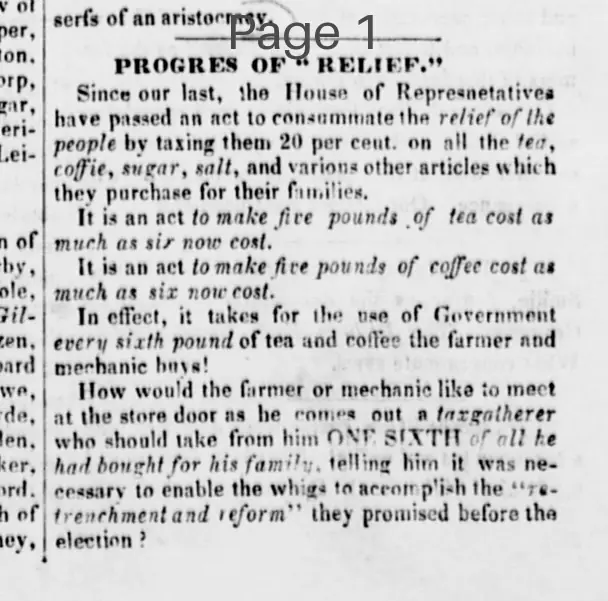
Since our last, the House of Representatives have passed an act to consummate the relief of the people by taxing them 20 per cent. on all the tea, coffee, sugar, salt, and various other articles which they purchase for their families.
It is an act to make five pounds of tea cost as much as six now cost.
It is an act to make five pounds of coffee cost as much as six now cost
In effect, it takes for the use of Government every sixth pound of tea and coffee the farmer and mechanic buys!
How would the farmer or mechanic like to meet at the store door as he comes out a taxgatherer who should take from him ONE SIXTH of all he had bought for his family, telling him it was necessary to enable the whigs to accomplish the "retrenchment and reform" they promised before the election?
This bill does worse than that! It makes the merchant pay the duty in the first instance. In the duty is part of the cost, and he must have profit upon that as well as upon the amount originally paid. Suppose the merchant's profit to be 20 per cent. then, on every dollar the farmer pays under this bill to his Government, he pays also 20 cents to the merchant. While it makes the farmer, mechanic, and all others pay 20 per cent. more than the fair cost on all they buy, it permits the rich manufacturers to bring in the articles they use in their manufactories free of duty! And while it permits the rail road companies to bring in their iron free of duty, it makes the farmer pay a heavy tax on every plow-share, hoe, scythe, axe, horse-shoe and nail that fastens it on. We shall trace the effects of this bill in its various ramifications, until our honest readers shall see a WHIG THIEF in every cup of tea and coffee they drink, and lurking around every bit of iron they use about their houses, their shops and their farms.—Kendall's Expositor.
What sub-type of article is it?
What keywords are associated?
What entities or persons were involved?
Editorial Details
Primary Topic
Critique Of Whig Tariff Bill On Consumer Goods
Stance / Tone
Strongly Anti Whig And Anti Tax
Key Figures
Key Arguments