Thank you for visiting SNEWPapers!
Sign up free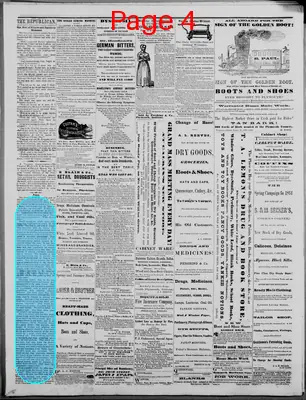
Editorial
September 8, 1864
Marshall County Republican
Plymouth, Marshall County, Indiana
What is this article about?
This Harper's Weekly editorial argues that negotiating peace with the Confederacy is futile, as rebels seek permanent disunion to preserve slavery, incompatible with Northern commitment to freedom. Only fighting through the war to compel submission offers a path to resolution.
Clipping
OCR Quality
95%
Excellent
Full Text
Peace.
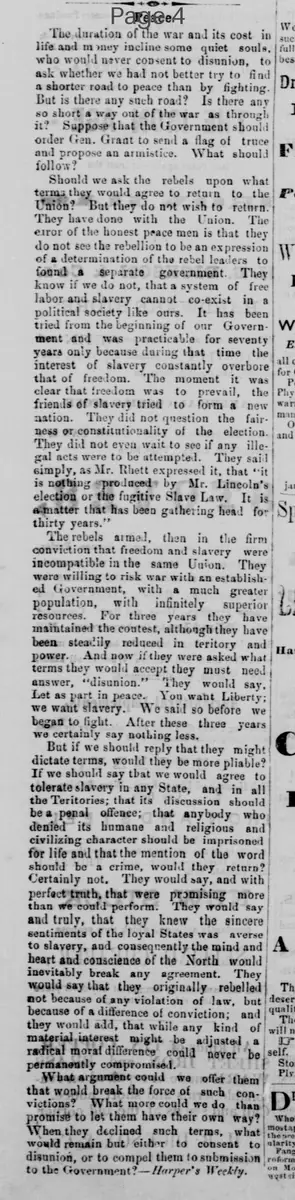
The duration of the war and its cost in life and money incline some quiet souls, who would never consent to disunion, to ask whether we had not better try to find a shorter road to peace than by fighting. But is there any such road? Is there any so short a way out of the war as through it? Suppose that the Government should order Gen. Grant to send a flag of truce and propose an armistice. What should follow?
Should we ask the rebels upon what terms they would agree to return to the Union? But they do not wish to return. They have done with the Union. The error of the honest peace men is that they do not see the rebellion to be an expression of a determination of the rebel leaders to found a separate government. They know if we do not, that a system of free labor and slavery cannot co-exist in a political society like ours. It has been tried from the beginning of our Government and was practicable for seventy years only because during that time the interest of slavery constantly overbore that of freedom. The moment it was clear that freedom was to prevail, the friends of slavery tried to form a new nation. They did not question the fairness or constitutionality of the election. They did not even wait to see if any illegal acts were to be attempted. They said simply, as Mr. Rhett expressed it, that it is nothing produced by Mr. Lincoln's election or the fugitive Slave Law. It is a matter that has been gathering head for thirty years."
The rebels armed, then in the firm conviction that freedom and slavery were incompatible in the same Union. They were willing to risk war with an established Government, with a much greater population, with infinitely superior resources. For three years they have maintained the contest, although they have been steadily reduced in territory and power. And now if they were asked what terms they would accept they must needs answer, "disunion." They would say. Let us part in peace. You want Liberty; we want slavery. We said so before we began to fight. After these three years we certainly say nothing less.
But if we should reply that they might dictate terms, would they be more pliable? If we should say that we would agree to tolerate slavery in any State, and in all the Territories; that its discussion should be a penal offence; that anybody who denied its humane and religious and civilizing character should be imprisoned for life and that the mention of the word should be a crime, would they return? Certainly not, They would say, and with perfect truth, that were promising more than we could perform. They would say and truly, that they knew the sincere sentiments of the loyal States was averse to slavery, and consequently the mind and heart and conscience of the North would inevitably break any agreement. They would say that they originally rebelled not because of any violation of law, but because of a difference of conviction; and they would add, that while any kind of material interest might be adjusted a radical moral difference could never be permanently compromised.
What argument could we offer them that would break the force of such convictions? What more could we do than promise to let them have their own way? When they declined such terms, what would remain but either to consent to disunion, or to compel them to submission to the Government?--Harper's Weekly.
The duration of the war and its cost in life and money incline some quiet souls, who would never consent to disunion, to ask whether we had not better try to find a shorter road to peace than by fighting. But is there any such road? Is there any so short a way out of the war as through it? Suppose that the Government should order Gen. Grant to send a flag of truce and propose an armistice. What should follow?
Should we ask the rebels upon what terms they would agree to return to the Union? But they do not wish to return. They have done with the Union. The error of the honest peace men is that they do not see the rebellion to be an expression of a determination of the rebel leaders to found a separate government. They know if we do not, that a system of free labor and slavery cannot co-exist in a political society like ours. It has been tried from the beginning of our Government and was practicable for seventy years only because during that time the interest of slavery constantly overbore that of freedom. The moment it was clear that freedom was to prevail, the friends of slavery tried to form a new nation. They did not question the fairness or constitutionality of the election. They did not even wait to see if any illegal acts were to be attempted. They said simply, as Mr. Rhett expressed it, that it is nothing produced by Mr. Lincoln's election or the fugitive Slave Law. It is a matter that has been gathering head for thirty years."
The rebels armed, then in the firm conviction that freedom and slavery were incompatible in the same Union. They were willing to risk war with an established Government, with a much greater population, with infinitely superior resources. For three years they have maintained the contest, although they have been steadily reduced in territory and power. And now if they were asked what terms they would accept they must needs answer, "disunion." They would say. Let us part in peace. You want Liberty; we want slavery. We said so before we began to fight. After these three years we certainly say nothing less.
But if we should reply that they might dictate terms, would they be more pliable? If we should say that we would agree to tolerate slavery in any State, and in all the Territories; that its discussion should be a penal offence; that anybody who denied its humane and religious and civilizing character should be imprisoned for life and that the mention of the word should be a crime, would they return? Certainly not, They would say, and with perfect truth, that were promising more than we could perform. They would say and truly, that they knew the sincere sentiments of the loyal States was averse to slavery, and consequently the mind and heart and conscience of the North would inevitably break any agreement. They would say that they originally rebelled not because of any violation of law, but because of a difference of conviction; and they would add, that while any kind of material interest might be adjusted a radical moral difference could never be permanently compromised.
What argument could we offer them that would break the force of such convictions? What more could we do than promise to let them have their own way? When they declined such terms, what would remain but either to consent to disunion, or to compel them to submission to the Government?--Harper's Weekly.
What sub-type of article is it?
War Or Peace
Slavery Abolition
What keywords are associated?
Civil War Peace
Disunion
Slavery Incompatibility
Rebel Convictions
Union Submission
Northern Freedom
What entities or persons were involved?
Gen. Grant
Rebels
Mr. Rhett
Mr. Lincoln
Government
Peace Men
Loyal States
North
Harper's Weekly
Editorial Details
Primary Topic
Futility Of Negotiating Peace With Rebels Seeking Disunion For Slavery
Stance / Tone
Pro Union Advocacy For Continuing The War To Victory
Key Figures
Gen. Grant
Rebels
Mr. Rhett
Mr. Lincoln
Government
Peace Men
Loyal States
North
Harper's Weekly
Key Arguments
Rebels Do Not Wish To Return To The Union But Seek Separate Government
Free Labor And Slavery Cannot Coexist In The Political Society
Rebellion Stems From Long Gathering Conviction Of Slavery's Incompatibility With Freedom
Rebels Would Demand Disunion Even After Three Years Of War
Northern Sentiments Against Slavery Would Prevent Any Lasting Agreement Tolerating It
Radical Moral Difference On Slavery Cannot Be Compromised
Only Submission To The Government Or Disunion Remain As Options