Thank you for visiting SNEWPapers!
Sign up free
Literary
September 25, 1830
Republican Herald
Providence, Providence County, Rhode Island
What is this article about?
An anecdote from 1819 recounts young Napoleon II, on New Year's Day, requesting from his grandfather, Emperor of Austria, 100,000 warriors to avenge his father's death when he turns 20. The Emperor, astonished, grants the pledge despite the instructor's non-involvement.
Clipping
OCR Quality
95%
Excellent
Full Text
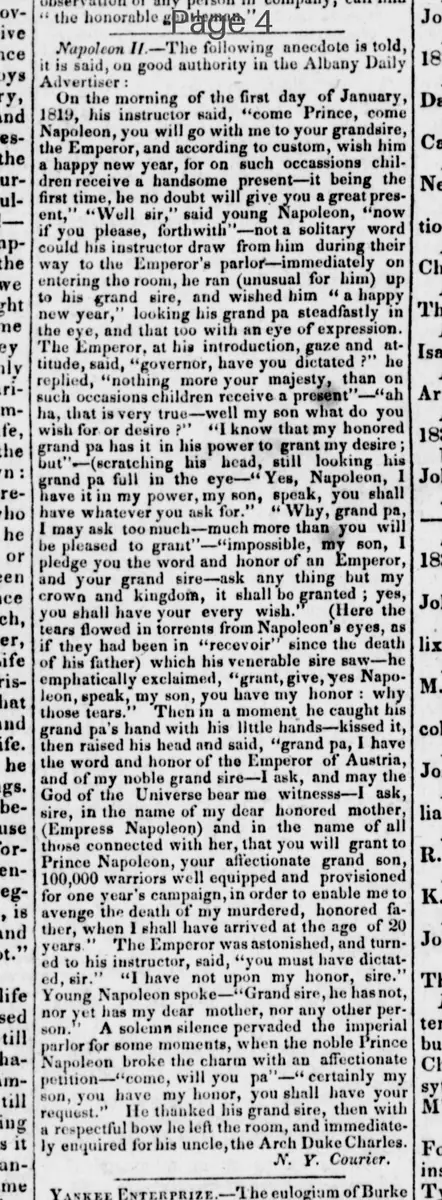
Napoleon II.—The following anecdote is told, it is said, on good authority in the Albany Daily Advertiser:
On the morning of the first day of January, 1819, his instructor said, "Come Prince, come Napoleon, you will go with me to your grandsire, the Emperor, and according to custom, wish him a happy new year, for on such occasions children receive a handsome present; it being the first time, he no doubt will give you a great present," "Well sir," said young Napoleon, "now if you please, forthwith"—not a solitary word could his instructor draw from him during their way to the Emperor's parlor—immediately on entering the room, he ran (unusual for him) up to his grand sire, and wished him "a happy new year," looking his grand pa steadfastly in the eye, and that too with an eye of expression. The Emperor, at his introduction, gaze and attitude, said, "governor, have you dictated?" he replied, "nothing more your majesty, than on such occasions children receive a present." "Ah ha, that is very true—well my son what do you wish for or desire?" "I know that my honored grand pa has it in his power to grant my desire; but"—(scratching his head, still looking his grand pa full in the eye—"Yes, Napoleon, I have it in my power, my son, speak, you shall have whatever you ask for." "Why, grand pa, I may ask too much—much more than you will be pleased to grant"—"impossible, my son, I pledge you the word and honor of an Emperor, and your grand sire—ask any thing but my crown and kingdom, it shall be granted; yes, you shall have your every wish." (Here the tears flowed in torrents from Napoleon's eyes, as if they had been in "recevoir" since the death of his father) which his venerable sire saw—he emphatically exclaimed, "grant, give, yes Napoleon, speak, my son, you have my honor: why those tears." Then in a moment he caught his grand pa's hand with his little hands—kissed it, then raised his head and said, "grand pa, I have the word and honor of the Emperor of Austria, and of my noble grand sire—I ask, and may the God of the Universe bear me witness—I ask, sire, in the name of my dear honored mother, (Empress Napoleon) and in the name of all those connected with her, that you will grant to Prince Napoleon, your affectionate grand son, 100,000 warriors well equipped and provisioned for one year's campaign, in order to enable me to avenge the death of my murdered, honored father, when I shall have arrived at the age of 20 years."
The Emperor was astonished, and turned to his instructor, said, "you must have dictated, sir." "I have not upon my honor, sire." Young Napoleon spoke—"Grand sire, he has not, nor yet has my dear mother, nor any other person."
A solemn silence pervaded the imperial parlor for some moments, when the noble Prince Napoleon broke the charm with an affectionate petition—"come, will you pa"—"certainly my son, you have my honor, you shall have your request." He thanked his grand sire, then with a respectful bow he left the room, and immediately enquired for his uncle, the Arch Duke Charles.
N. Y. Courier.
On the morning of the first day of January, 1819, his instructor said, "Come Prince, come Napoleon, you will go with me to your grandsire, the Emperor, and according to custom, wish him a happy new year, for on such occasions children receive a handsome present; it being the first time, he no doubt will give you a great present," "Well sir," said young Napoleon, "now if you please, forthwith"—not a solitary word could his instructor draw from him during their way to the Emperor's parlor—immediately on entering the room, he ran (unusual for him) up to his grand sire, and wished him "a happy new year," looking his grand pa steadfastly in the eye, and that too with an eye of expression. The Emperor, at his introduction, gaze and attitude, said, "governor, have you dictated?" he replied, "nothing more your majesty, than on such occasions children receive a present." "Ah ha, that is very true—well my son what do you wish for or desire?" "I know that my honored grand pa has it in his power to grant my desire; but"—(scratching his head, still looking his grand pa full in the eye—"Yes, Napoleon, I have it in my power, my son, speak, you shall have whatever you ask for." "Why, grand pa, I may ask too much—much more than you will be pleased to grant"—"impossible, my son, I pledge you the word and honor of an Emperor, and your grand sire—ask any thing but my crown and kingdom, it shall be granted; yes, you shall have your every wish." (Here the tears flowed in torrents from Napoleon's eyes, as if they had been in "recevoir" since the death of his father) which his venerable sire saw—he emphatically exclaimed, "grant, give, yes Napoleon, speak, my son, you have my honor: why those tears." Then in a moment he caught his grand pa's hand with his little hands—kissed it, then raised his head and said, "grand pa, I have the word and honor of the Emperor of Austria, and of my noble grand sire—I ask, and may the God of the Universe bear me witness—I ask, sire, in the name of my dear honored mother, (Empress Napoleon) and in the name of all those connected with her, that you will grant to Prince Napoleon, your affectionate grand son, 100,000 warriors well equipped and provisioned for one year's campaign, in order to enable me to avenge the death of my murdered, honored father, when I shall have arrived at the age of 20 years."
The Emperor was astonished, and turned to his instructor, said, "you must have dictated, sir." "I have not upon my honor, sire." Young Napoleon spoke—"Grand sire, he has not, nor yet has my dear mother, nor any other person."
A solemn silence pervaded the imperial parlor for some moments, when the noble Prince Napoleon broke the charm with an affectionate petition—"come, will you pa"—"certainly my son, you have my honor, you shall have your request." He thanked his grand sire, then with a respectful bow he left the room, and immediately enquired for his uncle, the Arch Duke Charles.
N. Y. Courier.
What sub-type of article is it?
Prose Fiction
What themes does it cover?
Political
War Peace
What keywords are associated?
Napoleon Ii
Anecdote
Emperor Austria
Avenge Father
New Year Wish
Warriors Request
What entities or persons were involved?
N. Y. Courier
Literary Details
Title
Napoleon Ii.
Author
N. Y. Courier
Subject
Anecdote Of Young Napoleon Ii Requesting Warriors To Avenge His Father On New Year's Day 1819
Form / Style
Narrative Anecdote In Prose
Key Lines
"I Ask, Sire, In The Name Of My Dear Honored Mother, (Empress Napoleon) And In The Name Of All Those Connected With Her, That You Will Grant To Prince Napoleon, Your Affectionate Grand Son, 100,000 Warriors Well Equipped And Provisioned For One Year's Campaign, In Order To Enable Me To Avenge The Death Of My Murdered, Honored Father, When I Shall Have Arrived At The Age Of 20 Years."