Thank you for visiting SNEWPapers!
Sign up free
The Daily Madisonian
Washington, District Of Columbia
What is this article about?
A large Democratic mass meeting at Bordentown, New Jersey, attended by over 1,200 people from various districts, featured processions, music, resolutions criticizing Whig policies like gerrymandering and high tariffs, and speeches praising John Tyler and Democratic principles.
Clipping
OCR Quality
Full Text
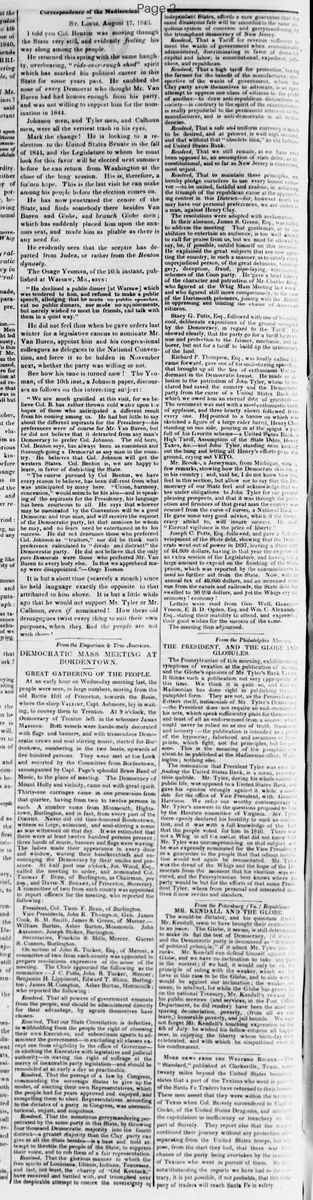
DEMOCRATIC MASS MEETING AT BORDENTOWN.
GREAT GATHERING OF THE PEOPLE.
At an early hour on Wednesday morning last, the people were seen, in large numbers, moving from the old Battle Hill of Princeton, towards the Basin, where the sloop Vallant, Capt. Ashmore, lay waiting, to convey them to Trenton. At 9 o'clock, the Democracy of Trenton left in the schooner James Madison. Both vessels were handsomely decorated with flags and banners, and with tremendous Democratic crews and soul stirring music, started for Bordentown, numbering in the two boats, upwards of five hundred persons. They were met at the Lock and escorted by the Committee from Bordentown, accompanied by Capt. Page's splendid Brass Band of Music, to the place of meeting. The Democracy of Mount Holly and vicinity, came out with great spirit. Thirty-one carriages came in one procession from that quarter, having from two to twelve persons in each. A number came from Monmouth, Hightstown, Burlington, and in fact, from every part of the District. Never did old time-honored Bordentown, witness so large, animated, and soul-stirring a scene as was witnessed on that day. It was estimated that there were at least twelve hundred persons present; three bands of music, banners and flags were waving. The ladies made their appearance in every door and window, waving their handkerchiefs and encouraging the Democracy by their smiles and presence. At half past one o'clock, Jos. Wood, Esq. called the meeting to order, and nominated Col. Thomas F. Bupp, of Burlington, as Chairman, pro tem., and David B. Bogart, of Princeton, Secretary. A committee of two from each county was appointed to report officers for the meeting, who reported the following:
President, Col. Thomas F. Bupp, of Burlington.
Vice Presidents, John R. Thompson, Gen. James Cook, R. M. Smith, James S. Green, of Mercer.— William Burtiss, Asher Burton, Monmouth. John Aaronson, Joseph Stokes, Burlington.
Secretaries, Franklin S. Mills, Mercer. Garret S. Cannon, Burlington.
On motion of John R. Tucker, Esq., of Mercer, a committee of two from each county was appointed to prepare resolutions expressive of the sense of the meeting. The Chair appointed the following as the committee: J. C. Potts, John R. Tucker, Mercer, Benjamin H. Lippincott, Edward T. Shinn, Burlington; James M. Compton, Asher Burton, Monmouth; who reported the following:
Resolved, That all powers of government emanate from the people, and should be administered directly for their advantage, by agents they themselves have chosen.
Resolved, That our State Constitution is defective, in withholding from the people the right of choosing their own Executive, and subordinate agents to administer the government—in excluding all classes except one from eligibility to the office of Governor—in clothing the Executive with legislative and judicial authority—in leaving the right of suffrage at the mercy of inexorable party legislation—and should be remodeled at as early a day as practicable.
Resolved, That the passage of a law by Congress, commanding the sovereign States to give up the modes, of electing their own Representatives, which the people had for years approved and enjoyed, and compelling them to elect Representatives according to the dictates of a party in Congress, was unconstitutional, unjust, and iniquitous.
Resolved, That the monstrous gerrymandering perpetrated by the same party in this State, by throwing four thousand Democratic majority into the fourth district—a greater majority than the Clay party can give in all the State besides—is a base and bold attempt to throttle the people of the State, to suppress their voice, and to rob them of a fair representation.
Resolved, That the glorious manner in which the free spirits of Louisiana, Illinois, Indiana, Tennessee, and last, not least, the chivalry of "Old Kentuck," have received and battled with, and triumphed over the despicable attempt to coerce the sovereignty of independent States, affords a sure guarantee that the same disastrous fate will be accorded to the same iniquitous system of coercion and gerrymandering, by the triumphant democracy of New Jersey.
Resolved, That a Tariff for revenue sufficient to meet the wants of government when economically administered, discriminating in favor of domestic capital and labor, is constitutional, expedient, judicious, and republican.
Resolved, That a high tariff for protection, taxing the farmer for the benefit of the manufacturer, irrespective of the wants of government, which the Clay party avow themselves to advocate, is at once unconstitutional, oppressive, and really prejudicial to the permanent interests of the manufacturer, and is anti-democratic in all its tendencies.
Resolved, That a safe and uniform currency is much to be desired, and at present, is well nigh secured, and that without that "obsolete idea," an old fashioned United States Bank.
Resolved, That we still remain, as we have ever been opposed to, an assumption of state debts, as unconstitutional, and so far as New Jersey is concerned, most unjust.
Resolved, That to maintain these principles, we hereby pledge ourselves to use every honest endeavor—to be united, faithful and zealous, in achieving the triumph of the republican cause at the approaching contest in this District—for, however much we may have our personal preferences, we are united to a man, against Henry Clay.
The resolutions were adopted with acclamation.
In their absence, James S. Green, Esq., was called to address the meeting. That gentleman, as to abilities to entertain an audience, is too well known to call for praise from us, but we must be allowed to say, he, if possible, outdid himself on this occasion. He explained the great subjects that are now agitating the country, in such a manner, as to satisfy every unprejudiced person, of the great delusions, humbuggery, deception, fraud, pipe-laying, vote-buying schemes of the Coon party. He gave a brief history of the character and patriotism of Mr. Charles King, who figured at the Whig Mass Meeting last week, and who figured still more conspicuously, in the case of the Dartmouth prisoners, joining with the British in oppressing and clanking the chains of American citizens.
Stacy G. Potts, Esq., followed with one of his solid, cool, deliberate expositions of the ground occupied by the Democracy, in regard to the Tariff. He showed clearly, that the party go for a tariff for revenue and protection to the farmer, mechanic, and laborer, but not for a tariff to build up the aristocracy of the land.
Richard P. Thompson, Esq., was loudly called for, came forward, gave one of his soul-stirring speeches that brought up all the fire of enthusiasm that was dormant in the Democratic breast. He made an allusion to the patriotism of John Tyler, whom he declared had saved the country and the Democratic party from the curse of a United States Bank for which we owed him an eternal debt of gratitude— The sentiment was met with a most enthusiastic burst of applause, and three hearty cheers followed from everyone. He pointed to a banner on which was sketched a figure of a large cider barrel, Henry Clay standing on one side, pouring in at the spigot a pail full of his favorite scheme—a United States Bank. High Tariff, Assumption of the State Debts, Heavy Taxes, &c.—and John Tyler, standing near kicking out the bung and letting all Henry's efforts go to the ground, crying out VETO.
Mr. Brooks, a Jerseyman, from Michigan, made a few remarks, showing how the Democrats stand in his country; and, said he, I do not know how you feel in this section, but allow me to say that the Democracy of our State feel and acknowledge that we are under obligations to John Tyler for our present pleasing prospects, and that it was through the patriotism and firmness of that great man the country was rescued from the curse of curses, a National Bank— He gave some very good advice, which if the Democracy attend to, will insure success. He said "Eternal vigilance is the price of liberty."
Joseph C. Potts, Esq. followed, and gave a full development of the State debt, showing that the Democrats went out of power in 1837, leaving a State debt of $64,000 dollars, having in that year the expense of an extra session of the Legislature, and having had large amount to expend on the finishing of the State prison, which was reported by the commissioners to need no further aid from the State. Now, with an annual tax of $40,000 dollars, and an increased revenue from the canals and railroads, the State debt has swelled to $900,000 dollars, and yet the Whigs cry out economy! economy.
Letters were read from Gen. Wall, Governor Vroom, E. B. D. Ogden, Esq. and Wm. C. Alexander Esq., stating their inability to attend, and expressing their good wishes for the success of the same.
The meeting then adjourned.
What sub-type of article is it?
What themes does it cover?
What keywords are associated?
What entities or persons were involved?
Where did it happen?
Story Details
Key Persons
Location
Bordentown, New Jersey
Event Date
Wednesday Morning Last
Story Details
Large gathering of Democrats from Princeton, Trenton, Mount Holly, and other areas arrived by boat and carriage for a mass meeting at Bordentown. Officers were elected, resolutions adopted criticizing state constitution defects, gerrymandering, high tariffs, and Whig policies while supporting revenue tariff and opposition to national bank. Speeches by James S. Green, Stacy G. Potts, Richard P. Thompson, Mr. Brooks, and Joseph C. Potts praised Democratic principles and John Tyler's vetoes. Letters from absent leaders read, meeting adjourned.