Thank you for visiting SNEWPapers!
Sign up free
Editorial
December 8, 1869
The New York Herald
New York, New York County, New York
What is this article about?
Editorial endorses President Grant's message on naturalization fraud, where foreigners gain U.S. citizenship to avoid native duties, urging diplomatic scrutiny and legislative reform to safeguard true citizens' rights.
Clipping
OCR Quality
100%
Excellent
Full Text
The President on Naturalization.
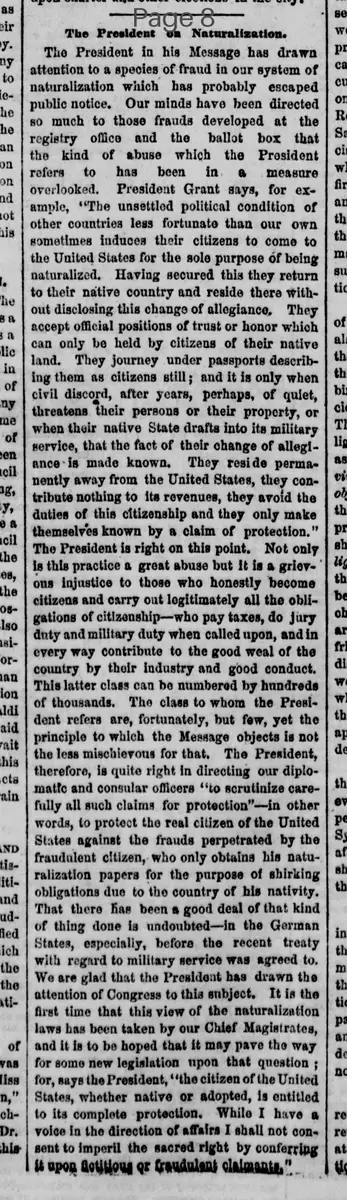
The President in his Message has drawn attention to a species of fraud in our system of naturalization which has probably escaped public notice. Our minds have been directed so much to those frauds developed at the registry office and the ballot box that the kind of abuse which the President refers to has been in a measure overlooked. President Grant says, for example, "The unsettled political condition of other countries less fortunate than our own sometimes induces their citizens to come to the United States for the sole purpose of being naturalized. Having secured this they return to their native country and reside there without disclosing this change of allegiance. They accept official positions of trust or honor which can only be held by citizens of their native land. They journey under passports describing them as citizens still; and it is only when civil discord, after years, perhaps, of quiet, threatens their persons or their property, or when their native State drafts into its military service, that the fact of their change of allegiance is made known. They reside permanently away from the United States, they contribute nothing to its revenues, they avoid the duties of this citizenship and they only make themselves known by a claim of protection." The President is right on this point. Not only is this practice a great abuse but it is a grievous injustice to those who honestly become citizens and carry out legitimately all the obligations of citizenship—who pay taxes, do jury duty and military duty when called upon, and in every way contribute to the good weal of the country by their industry and good conduct. This latter class can be numbered by hundreds of thousands. The class to whom the President refers are, fortunately, but few, yet the principle to which the Message objects is not the less mischievous for that. The President, therefore, is quite right in directing our diplomatic and consular officers "to scrutinize carefully all such claims for protection"—in other words, to protect the real citizen of the United States against the frauds perpetrated by the fraudulent citizen, who only obtains his naturalization papers for the purpose of shirking obligations due to the country of his nativity. That there has been a good deal of that kind of thing done is undoubted—in the German States, especially, before the recent treaty with regard to military service was agreed to. We are glad that the President has drawn the attention of Congress to this subject. It is the first time that this view of the naturalization laws has been taken by our Chief Magistrates, and it is to be hoped that it may pave the way for some new legislation upon that question; for, says the President, "the citizen of the United States, whether native or adopted, is entitled to its complete protection. While I have a voice in the direction of affairs I shall not consent to imperil the sacred right by conferring it upon fictitious or fraudulent claimants."
The President in his Message has drawn attention to a species of fraud in our system of naturalization which has probably escaped public notice. Our minds have been directed so much to those frauds developed at the registry office and the ballot box that the kind of abuse which the President refers to has been in a measure overlooked. President Grant says, for example, "The unsettled political condition of other countries less fortunate than our own sometimes induces their citizens to come to the United States for the sole purpose of being naturalized. Having secured this they return to their native country and reside there without disclosing this change of allegiance. They accept official positions of trust or honor which can only be held by citizens of their native land. They journey under passports describing them as citizens still; and it is only when civil discord, after years, perhaps, of quiet, threatens their persons or their property, or when their native State drafts into its military service, that the fact of their change of allegiance is made known. They reside permanently away from the United States, they contribute nothing to its revenues, they avoid the duties of this citizenship and they only make themselves known by a claim of protection." The President is right on this point. Not only is this practice a great abuse but it is a grievous injustice to those who honestly become citizens and carry out legitimately all the obligations of citizenship—who pay taxes, do jury duty and military duty when called upon, and in every way contribute to the good weal of the country by their industry and good conduct. This latter class can be numbered by hundreds of thousands. The class to whom the President refers are, fortunately, but few, yet the principle to which the Message objects is not the less mischievous for that. The President, therefore, is quite right in directing our diplomatic and consular officers "to scrutinize carefully all such claims for protection"—in other words, to protect the real citizen of the United States against the frauds perpetrated by the fraudulent citizen, who only obtains his naturalization papers for the purpose of shirking obligations due to the country of his nativity. That there has been a good deal of that kind of thing done is undoubted—in the German States, especially, before the recent treaty with regard to military service was agreed to. We are glad that the President has drawn the attention of Congress to this subject. It is the first time that this view of the naturalization laws has been taken by our Chief Magistrates, and it is to be hoped that it may pave the way for some new legislation upon that question; for, says the President, "the citizen of the United States, whether native or adopted, is entitled to its complete protection. While I have a voice in the direction of affairs I shall not consent to imperil the sacred right by conferring it upon fictitious or fraudulent claimants."
What sub-type of article is it?
Immigration
Legal Reform
What keywords are associated?
Naturalization Fraud
Citizenship Abuse
Presidential Message
Immigration Reform
Protection Claims
What entities or persons were involved?
President Grant
Congress
Diplomatic And Consular Officers
German States
Editorial Details
Primary Topic
Fraud In Naturalization Process
Stance / Tone
Supportive Of Presidential Scrutiny And Reform
Key Figures
President Grant
Congress
Diplomatic And Consular Officers
German States
Key Arguments
Fraudulent Naturalization Allows Individuals To Gain U.S. Citizenship Solely To Evade Obligations In Their Native Countries
Such Frauds Involve Accepting Positions In Native Lands While Claiming U.S. Protection Only When Needed
This Practice Injustices Honest Citizens Who Fulfill All Duties
President Directs Officers To Scrutinize Protection Claims
Calls For New Legislation To Protect Genuine Citizenship Rights