Thank you for visiting SNEWPapers!
Sign up free
The Day Book
Norfolk, Virginia
What is this article about?
On February 18, in the U.S. House, Rep. H. Winter Davis sought clarification on colleague Rep. Bowie's speech criticizing the American party for Baltimore election violence, which Bowie clarified was not personal. The House then discussed the Indian appropriation bill and the Kansas question, with Rep. Shorter defending Southern resistance to denying Kansas statehood over slavery. In the Senate, a bill for Kansas admission was reported with majority and minority views printed, and Sen. Gwin announced plans to address it soon.
Clipping
OCR Quality
Full Text
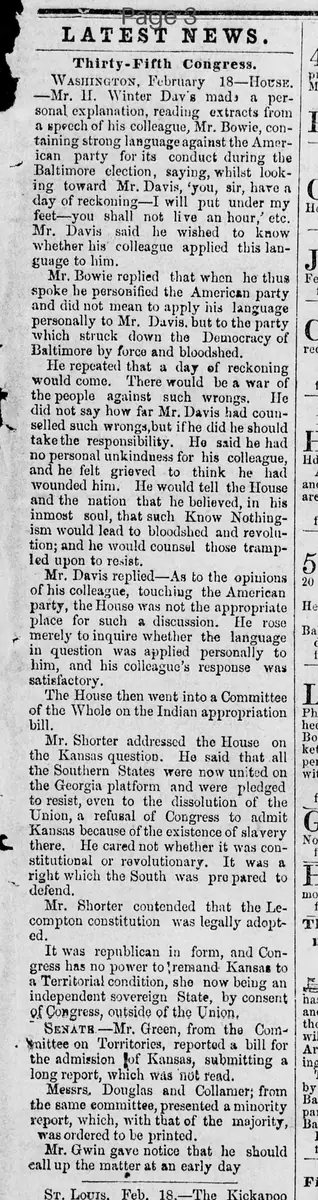
Thirty-Fifth Congress.
WASHINGTON, February 18—House.
Mr. H. Winter Davis made a personal explanation, reading extracts from a speech of his colleague, Mr. Bowie, containing strong language against the American party for its conduct during the Baltimore election, saying, whilst looking toward Mr. Davis, 'you, sir, have a day of reckoning—I will put under my feet—you shall not live an hour,' etc.
Mr. Davis said he wished to know whether his colleague applied this language to him.
Mr. Bowie replied that when he thus spoke he personified the American party and did not mean to apply his language personally to Mr. Davis, but to the party which struck down the Democracy of Baltimore by force and bloodshed.
He repeated that a day of reckoning would come. There would be a war of the people against such wrongs.
He did not say how far Mr. Davis had counselled such wrongs, but if he did he should take the responsibility. He said he had no personal unkindness for his colleague, and he felt grieved to think he had wounded him. He would tell the House and the nation that he believed, in his inmost soul, that such Know Nothingism would lead to bloodshed and revolution; and he would counsel those trampled upon to resist.
Mr. Davis replied—As to the opinions of his colleague, touching the American party, the House was not the appropriate place for such a discussion. He rose merely to inquire whether the language in question was applied personally to him, and his colleague's response was satisfactory.
The House then went into a Committee of the Whole on the Indian appropriation bill.
Mr. Shorter addressed the House on the Kansas question. He said that all the Southern States were now united on the Georgia platform and were pledged to resist, even to the dissolution of the Union, a refusal of Congress to admit Kansas because of the existence of slavery there. He cared not whether it was constitutional or revolutionary. It was a right which the South was prepared to defend.
Mr. Shorter contended that the Lecompton constitution was legally adopted.
It was republican in form, and Congress has no power to 'remand Kansas to a Territorial condition, she now being an independent sovereign State, by consent of Congress, outside of the Union.
SENATE.—Mr. Green, from the Committee on Territories, reported a bill for the admission of Kansas, submitting a long report, which was not read.
Messrs. Douglas and Collamer, from the same committee, presented a minority report, which, with that of the majority, was ordered to be printed.
Mr. Gwin gave notice that he should call up the matter at an early day.
What sub-type of article is it?
What keywords are associated?
What entities or persons were involved?
Where did it happen?
Domestic News Details
Primary Location
Washington
Event Date
February 18
Key Persons
Outcome
bowie clarified his remarks were not personal to davis; house entered committee of the whole on indian appropriation bill; shorter defended kansas admission under lecompton constitution; senate reported kansas admission bill with majority and minority reports ordered printed; gwin gave notice to call up the matter soon.
Event Details
In the House, Davis sought personal clarification on Bowie's speech criticizing the American party's role in Baltimore election violence, which Bowie attributed to the party generally and warned of future resistance and revolution. The House then discussed the Indian appropriation bill and the Kansas question, with Shorter asserting Southern unity to defend Kansas statehood despite slavery. In the Senate, the Committee on Territories reported a bill for Kansas admission, with minority views from Douglas and Collamer, and Gwin announced intent to address it.