Thank you for visiting SNEWPapers!
Sign up free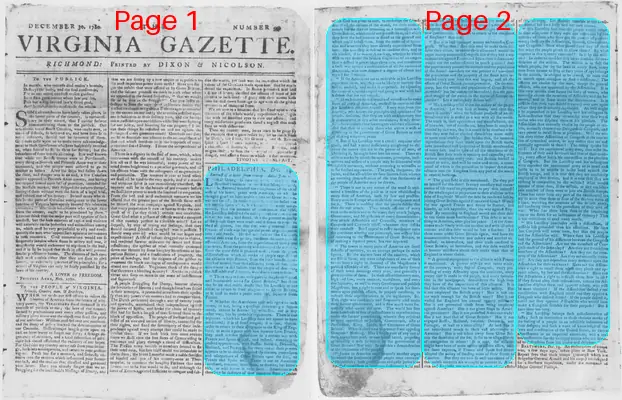
The Virginia Gazette
Richmond, Williamsburg, Richmond County, Virginia
What is this article about?
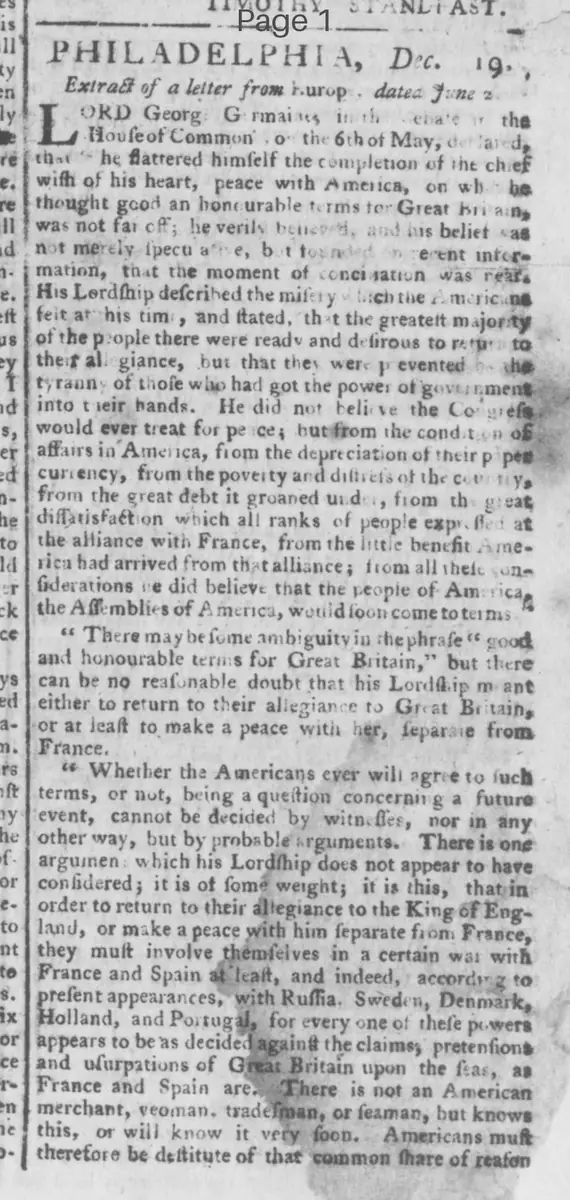
An editorial excerpt from a European letter critiques Lord George Germain's May 6 speech in the House of Commons, where he claimed peace with America was near due to American miseries and desire to return to British allegiance. The author argues Americans are united in independence, value their French alliance, and reject reconciliation, citing press freedom, town meetings, juries, and assemblies as evidence of public sentiment.
Merged-components note: Direct textual continuation across pages; combines foreign news extract with analytical opinion piece, best unified under editorial label.
Clippings
1 of 2
OCR Quality
Full Text
Extract of a letter from Europe, dated June 2.
LORD GEORGE GERMAIN, in his place in the
House of Commons, on the 6th of May, said
that he flattered himself the completion of the chief
wish of his heart, peace with America, on what he
thought good and honourable terms for Great Britain
was not far off; he verily believed, and his belief was
not merely speculative, but founded in recent information,
that the moment of conciliation was near.
His Lordship described the miseries which the Americans
felt at his time, and stated, that the greatest majority
of the people there were ready and desirous to return to
their allegiance, but that these were prevented by it; cannot those who had got the power of government
into their hands. He did not believe the Congress
would ever treat for peace; but from the condition of
affairs in America, from the depreciation of their paper
currency, from the poverty and difficulties of the city
from the great debt it groaned under, from the great
dissatisfaction which all ranks of people expressed at
the alliance with France, from the little benefit Americans
had arrived from that alliance; from all these considerations he did believe that the people of America,
the Assemblies of America, would soon come to terms.
"There may be some ambiguity in the phrase" good
and honourable terms for Great Britain," but there
can be no reasonable doubt that his Lordship meant
either to return to their allegiance to Great Britain,
or at least to make a peace with her, separate from
France.
"Whether the Americans ever will agree to such
terms, or not, being a question concerning a future
event, cannot be decided by witnesses, nor in any
other way, but by probable arguments. There is one
argument which his Lordship does not appear to have
considered; it is of some weight; it is this, that in
order to return to their allegiance to the King of England,
or make a peace with him separate from France,
they must involve themselves in a certain war with
France and Spain at least, and indeed, according to
present appearances, with Russia, Sweden, Denmark,
Holland, and Portugal, for every one of these powers
appears to be as decided against the claims, pretensions
and usurpations of Great Britain upon the seas, as
France and Spain are. There is not an American
merchant, yeoman, tradesman, or seaman, but knows
this, or will know it very soon. Americans must
therefore be destitute of that common share of reason
which God has given to men, to exchange the friendship of all the nations of the world, for their enmity, merely for the sake of returning to a connection with Great Britain, which could not protect them, and which they have the best reasons to dread as the greatest evil which could befall them, from the unheard of tyrannies and cruelties they have already experienced from her. His Lordship is desired to consider this, and to ask himself, if he was an American, whether he would wish to run under the broken fragments of an empire that is dashed in pieces like a china vase, and commence a fresh war against a combination of all the nations of the world, who now discover a degree of esteem and regard for America.
"If the Americans are as miserable as his Lordship represents them, will they not be likely to increase that misery tenfold, and make it perpetual, by espousing the cause of a ruined empire and going to war with half a dozen that are not ruined.
"If we believe the testimonies of witnesses who come from all parts of America, we shall be convinced that his Lordship deceives himself. Every man from that country, who knows the principles and opinions of the people, declares, that they are with an unanimity that is unexampled in any other revolution; firmly determined to maintain their sovereignty and their alliances; and that there is nobody there who utters a wish of returning to the government of Great Britain or even of making a separate peace.
"But if his Lordship was a candid enquirer after truth, and had a mind sufficiently enlightened to discover the means that are in the power of all men, of obtaining it, he might have seen his error. There are certain marks by which the opinions, principles, inclinations and wishes of a people may be discovered with infallible certainty, without recurring to witnesses or to far fetched arguments. The press, the towns, the juries, and the assemblies are four sources from whence an unerring demonstration of the true sentiments of the people of America may be drawn.
"There is not in any nation of the world a more unlimited a freedom of the press as is now established in every state of America, both by law and practice. Every man in Europe who reads their newspapers must see it. There is nothing that the people dislike that they do not attack. They attack officers of every rank in the militia and in the army; they attack Judges, Governours, and Magistrates of every denomination; they attack Assemblies and Councils, members of Congress and Congress itself, whenever they dislike their conduct. But I appeal to every newspaper upon the continent whether one paragraph, one wish or hint of returning to the government of Great Britain, or of making a separate peace, has ever appeared.
"The towns in many parts of America are small districts of territory, on an average perhaps six miles square. By the ancient laws of the country, which are still in force, any seven inhabitants of one of these towns have a right to demand of the Magistrates a publick assembly of all. There are necessarily several of these town meetings every year, and generally a great number of them. In these assemblies every man, high and low, every yeoman, tradesman, and every day labourer, as well as every Gentleman and publick Magistrate, has a right to vote and to speak his sentiments upon publick affairs, to propose measures, to instruct their representatives in the legislature, &c. This right was constantly and frequently used under their former government, and is now much more frequently used under the new. The world has seen some hundreds of sets of instructions to representatives under the former government, wherein they enjoined an open opposition to Judges, Governours, acts of Parliament, King, Lords, and Commons of Great Britain. What is there now to prevent from opposing Congress? Nothing. Has a single vote of any one of these towns been read, or one speech heard, proposing or uttering a wish to return to the government of Great Britain? Not one. Is not this a demonstration of the sentiments of the people!
"Juries in America were formerly another organ by which the sentiments of the people were conveyed to the publick; both grand juries and petit juries have expressed themselves in language sufficiently bold and free against acts of Parliament and the conduct of Great Britain. But has any ever uttered a word against Congress or the Assemblies, or the judges under their new government, or a wish to return to the obedience of England? Not one,
"But it is said the paper money embarrasses Congress. What then? does this tend to make them dissolve their union, to violate their alliances? would the paper money embarrass Congress less if they had a war to maintain against France and Spain than it does now? would not the embarrassment be much greater? does the paper money prevent the increase and the population of the states? no—does the war prevent it? no—both the population and the property of the states have increased every year since this war began, and all the efforts of Great Britain cannot prevent it. On the contrary, has the wealth and population of Great Britain increased? has her commerce increased? has the political weight of the nation in the scales of Europe increased? Let a melancholy Briton tell.
"His Lordship talks about the misery of the people in America. Let him look at home, and then say, where is misery! when the hideous prospect of an internal civil war is added to a war with all the world. The truth is, that agriculture and manufactures, not of luxuries, but of necessaries, have been so much increased by this war, that it is much to be doubted whether they ever fed or clothed themselves more easily or more comfortably. But besides this, the immense depredations they have made upon the British trade, have introduced vast quantities of British merchandize of every sort, and in spite of all the exertions of the British fleet their trade is opening and extending with various countries every year, and Britain herself is forced to aid it, and will be more and more, a recent proof of which is the permission to import American tobacco into the kingdom from any part of the world in neutral bottom.
"The great debt is also mentioned. Do they pay an interest for this debt? Is every necessary and convenience of life taxed to perpetuity to pay this interest? Is the whole equal in proportion to their abilities to the debt of England? Would the debt be rendered less by joining Great Britain against France and Spain? Would the war against France and Spain be shorter, less bloody, or less expensive, than the war against England? By returning to England would not their debt be ten times more burdensome? This debt is as nothing to America, once give her peace. Let the Americans trade freely with one another and with all other nations and this debt would be but a feather. Let them come under Great Britain again, and have the communication between one colony and another obstructed, as heretofore, and their trade confined to Great Britain, as heretofore, and this debt would be an heavier millstone about their necks than that of England is about theirs.
A general repugnance to the alliance with France is mentioned. A greater mistake was never made; on the contrary, every step of Congress, every proceeding of every Assembly upon the continent, every prayer that is made in the pulpit, and every speculation in the newspapers, demonstrate the high sense they have of the importance of this alliance. It is said that this alliance has been of little utility. Has it not employed the British army? Has it not cut out work enough for the British navy? Has it not wasted for England her annual twenty millions? Has it not prevented those from being employed against America? Has it not given scope to American privateers? Has it not protected American trade? Has it not hurt that of Great Britain? Has it not engaged Russia, Holland, Sweden, Denmark, and Portugal, at least to a neutrality? At least has it not contributed much to these vast advantages to America? Has it not taken away from Great Britain the dominion of the sea, so far as to allow liberty of navigation to others? It is true, the alliance might have been of more utility to all the allies, with the same expense if France and Spain had sooner adopted the policy of sending more of their forces to America. But they are now so well convinced of it, that unless miracles are wrought to prevent it, America and England too will soon see more of the effects of this alliance. Let Britain tremble at the consequences of her own folly and her own crimes.
"His Lordship says that the people would return to their allegiance if they were not restrained by the tyranny of those who have got the powers of government; these are the Assemblies, Senates, Governours, and Congress. Now what power have any of these but what the people please to allow them? By what engines is this tyranny exercised? Is it by the militia? In order to consider this let us consider the constitution of the militia. The militia is in fact the whole people, for by the laws of every state, every man from sixteen to fifty or sixty years of age belongs to the militia, is obliged to be armed, to train and to march upon occasion or find a substitute. The officers are chosen by the men, except the general officers, who are appointed by the Assemblies It is this very militia that forms the body of voters, who annually choose the members of Assembly and the Senators, and in some States the Governours. Is it possible that these men should tyrannize over men upon whom they are so entirely dependant. As well might it be reproached to his Lordship and his colleagues in Administration that they tyrannized over their royal master who can displace them at his pleasure. The Assemblies thus annually chosen by the people or militia, annually choose their Delegates in Congress, and have power to recall them at pleasure. Will the militia obey either Assemblies or Congress in the execution of tyrannical orders, or any orders that are not generally agreeable to them? The thing speaks for itself. Is it the continental army then, that is the instrument of their own servitude and that of their country; every officer holds his commission at the pleasure of Congress. But his Lordship and his colleagues often represent the continental army as so small and feeble as to be unable to make head against the British troops, and it is true that they are constantly employed in that service, and it is true that they are nothing in comparison to the militia? what would become of them then, if the militia, or any considerable number of them were to join the British troops. There has never been any part of the continental army in more than three or four of the thirteen states at a time, watching the motions of the British army and confining them to the protection of their men of war.
What has there been then in the remaining nine or ten states for an instrument of tyranny? This is too ridiculous to need many words.
"His Lordship concludes with a distinction, if possible less grounded than his assertions. He says that Congress will never treat, but that the people and the Assemblies will. Where does his Lordship find the ground of his difference between the Congress and the Assemblies? Are not the members of Congress made of the same clay? Are they not themselves members of the Assemblies? Are they not the creatures of the Assemblies? Are they not annually created? Are they not dependant every moment upon the Assemblies for their existence? Have not the Assemblies a right to recall them when they please and appoint others, by law and the constitution? Have not the Assemblies a right to instruct them how to act? If they do not obey these instructions, cannot the Assemblies displace them and appoint others, who will be more obedient? If the Assemblies desired a reconciliation with England could not they appoint a Congress who desired it too? If the people desired it, could not they appoint Assemblies who would soon make a Congress suitable to their purpose? But I have been too long.
"His Lordship betrays such misinformation of facts; such an inattention to those obvious marks of the feeling of a people as an infallible indication of their designs; and such a want of knowledge of the laws and constitution of the United States, as excite astonishment in an impartial examiner, and a real commiseration for the unhappy nation who are devoted to destruction from his errors and delusions."
What sub-type of article is it?
What keywords are associated?
What entities or persons were involved?
Editorial Details
Primary Topic
Critique Of Lord George Germain's Optimistic Views On American Reconciliation With Britain
Stance / Tone
Strongly Supportive Of American Independence And Alliances, Dismissive Of British Claims
Key Figures
Key Arguments