Thank you for visiting SNEWPapers!
Sign up free
Editorial
September 11, 1826
The Virginian
Lynchburg, Virginia
What is this article about?
Editorial from Lynchburg praises W.C. Bryant's poetry and urges recognition of American genius. It then critiques the Charlottesville Gazette's editor for inconsistent constitutional arguments on federal powers over roads, canals, and banking, while defending Mr. Clay's integrity against the Gazette's attacks.
Clipping
OCR Quality
85%
Good
Full Text
LYNCHBURG, SEPTEMBER 7.
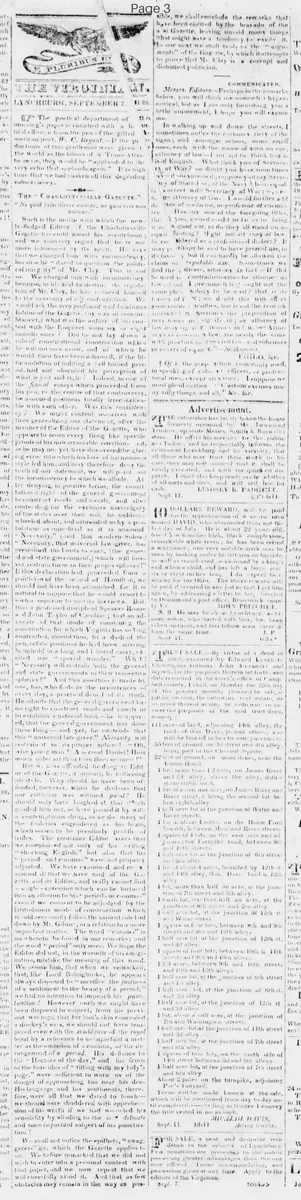
The poetical department of this morning's paper is enriched with a beautiful ode from the pen of the gifted American bard, W. C. Bryant. - If the productions of this gentleman were given to the world as the labors of a Trans. Atlantic genius, they would be 'applauded to the very echo that applauds again.' It is high time that we had shaken off this degrading subserviency.
The 'Charlottesville Gazette.'
'Ne quid false dicere audeat, ne quid veri non audeat.'
Such is the motto with which the newly-fledged Editor of the Charlottesville Gazette has emblazoned his escutcheon: and we sincerely regret that he is not more influenced by its spirit. He says that we charged him with meanness merely, because he 'dared to question the political integrity' of Mr. Clay. This is not so. We charged him with inconsistency because, in his zeal to destroy the reputation of Mr. Clay, he has reduced himself to the necessity of self contradiction. We would ask the very profound and luminous Editor of the Gazette, (by way of reminder) what was the nature of his contest with the Enquirer some six or eight months since? Did he not lay down a rule of constitutional construction which he will not now avow, and of which he would then have been ashamed, if the hireling adulation of writing a self tuned panegyric, had not obscured his perception of what is just and right? Indeed, in one of the fiscal essays which proceeded from his pen, in the course of that controversy, he assumed positions totally irreconcilable with each other. Was this consistency? We might content ourselves with those generalizing our statement, after the manner of the Editor of the Gazette, who appears to scorn every thing like specific proofs of his unwarrantable assertions but, as he may not yet have discovered the glaring error into which his love of harmonious style led him, and may therefore deny the truth of our statement, we will point out the inconsistency to which we allude. After denying, in positive terms, the constitutional right of the general government to construct roads and canals, and after contending for the exclusive sovereignty of the states over their soil, he suddenly wheeled about, and astounded us by a pistol shot as sophistical as it is unsound. 'Necessity,' (said this modern Solon) 'Necessity, that universal law-giver, has prescribed the limits to each, (the general and state government,) which will forever restrain them in their proper spheres!' If this declaration had proceeded from a politician of the school of Hamilton, we should not have been so astonished for it is natural to suppose that he would resort to such desperate quackery to heal his wounds. But that a professed disciple of Spencer Roane and John Taylor of Caroline; that an advocate of that mode of construing the constitution for which Virginia has so long contended, should thus, by a dash of the pen, refute positions he had been striving to uphold in a long and labored essay, excited our 'special wonder.' What 'Necessity will restrain both the general and state governments within their respective spheres!' And this assertion- made by one, too, who finds in the occurrences of every day, a practical denial of its truth. He admits that the general government has no right to construct roads and canals or to establish a national bank- he is aware, that the general government has done these things- and yet, he contends that this 'universal lawgiver,' Necessity, will restrain it in its proper sphere! 'Oh, wise young man! A second Daniel! How much older art thou than thy years!' But we have offended the doughty Editor of the Gazette, it appears, by criticizing his style. Why should he have been offended, however, when he declares that our criticism was without point? It should only have laughed at that if it had not goaded him, or have passed it by with a contemptuous shrug as we do many of the follies engendered in his brain, which seems to be peculiarly prolific of them. The ridiculous Editor avers that we complained not only of his writing 'shocking English,' but also that his 'periods and commas' were not properly adjusted. We have examined and re-examined it that we have said of the Gazette and its Editor, and really cannot find a single expression which can be tortured into an allusion to his 'periods or commas-' even if we consent to be adjudged by the latitudinous mode of construction which would necessarily follow the sapient rule laid down by Mr. Gilmer, in relation to a more important matter. The word 'comma' is nowhere to be found in our remarks; and the word 'period' only once. We hope the Editor did not, in the warmth of this indignation, mistake the meaning of this word. We assure him, that when we remarked, that, like Lord Bolingbroke, he appears always disposed to 'sacrifice the justness of a sentiment to the beauty of a period,' we had no intention to impeach his punctuation! However much we might have been disposed to suspect, from his previous writings, that his lion's skin concealed a donkey's ears, we should not have tempted even with the semblance of the royal beast by a reference to so important a matter as the omission of a comma, or the derangement of a period. His defiance to the 'Hectors of the day,' and his scorn of the bare idea of 'tilting with my lady's paper,' were sufficient to warn us of the danger of approaching too near his den. His language and his sentiments, therefore, were all that we dared to touch- we should have shuddered with apprehension of his wrath if we had wounded his sensibility by alluding to the more delicate and more important subject of his punctuation!
We shall not notice the epithets, 'swaggerers' &c. which the Gazette applies to us. We before remarked that we did not wish to enter into a personal contest with that paper, and we now repeat that we will cheerfully avoid it. And that as few obstacles may remain in the way as possible, we shall conclude the remarks that have been elicited by the bravado of the last Gazette, leaving unsaid many things that might have a tendency to excite it. In our next we shall reply to the 'arguments' of the Gazette, by which it attempts to prove that Mr. Clay is a corrupt and dishonorable politician.
The poetical department of this morning's paper is enriched with a beautiful ode from the pen of the gifted American bard, W. C. Bryant. - If the productions of this gentleman were given to the world as the labors of a Trans. Atlantic genius, they would be 'applauded to the very echo that applauds again.' It is high time that we had shaken off this degrading subserviency.
The 'Charlottesville Gazette.'
'Ne quid false dicere audeat, ne quid veri non audeat.'
Such is the motto with which the newly-fledged Editor of the Charlottesville Gazette has emblazoned his escutcheon: and we sincerely regret that he is not more influenced by its spirit. He says that we charged him with meanness merely, because he 'dared to question the political integrity' of Mr. Clay. This is not so. We charged him with inconsistency because, in his zeal to destroy the reputation of Mr. Clay, he has reduced himself to the necessity of self contradiction. We would ask the very profound and luminous Editor of the Gazette, (by way of reminder) what was the nature of his contest with the Enquirer some six or eight months since? Did he not lay down a rule of constitutional construction which he will not now avow, and of which he would then have been ashamed, if the hireling adulation of writing a self tuned panegyric, had not obscured his perception of what is just and right? Indeed, in one of the fiscal essays which proceeded from his pen, in the course of that controversy, he assumed positions totally irreconcilable with each other. Was this consistency? We might content ourselves with those generalizing our statement, after the manner of the Editor of the Gazette, who appears to scorn every thing like specific proofs of his unwarrantable assertions but, as he may not yet have discovered the glaring error into which his love of harmonious style led him, and may therefore deny the truth of our statement, we will point out the inconsistency to which we allude. After denying, in positive terms, the constitutional right of the general government to construct roads and canals, and after contending for the exclusive sovereignty of the states over their soil, he suddenly wheeled about, and astounded us by a pistol shot as sophistical as it is unsound. 'Necessity,' (said this modern Solon) 'Necessity, that universal law-giver, has prescribed the limits to each, (the general and state government,) which will forever restrain them in their proper spheres!' If this declaration had proceeded from a politician of the school of Hamilton, we should not have been so astonished for it is natural to suppose that he would resort to such desperate quackery to heal his wounds. But that a professed disciple of Spencer Roane and John Taylor of Caroline; that an advocate of that mode of construing the constitution for which Virginia has so long contended, should thus, by a dash of the pen, refute positions he had been striving to uphold in a long and labored essay, excited our 'special wonder.' What 'Necessity will restrain both the general and state governments within their respective spheres!' And this assertion- made by one, too, who finds in the occurrences of every day, a practical denial of its truth. He admits that the general government has no right to construct roads and canals or to establish a national bank- he is aware, that the general government has done these things- and yet, he contends that this 'universal lawgiver,' Necessity, will restrain it in its proper sphere! 'Oh, wise young man! A second Daniel! How much older art thou than thy years!' But we have offended the doughty Editor of the Gazette, it appears, by criticizing his style. Why should he have been offended, however, when he declares that our criticism was without point? It should only have laughed at that if it had not goaded him, or have passed it by with a contemptuous shrug as we do many of the follies engendered in his brain, which seems to be peculiarly prolific of them. The ridiculous Editor avers that we complained not only of his writing 'shocking English,' but also that his 'periods and commas' were not properly adjusted. We have examined and re-examined it that we have said of the Gazette and its Editor, and really cannot find a single expression which can be tortured into an allusion to his 'periods or commas-' even if we consent to be adjudged by the latitudinous mode of construction which would necessarily follow the sapient rule laid down by Mr. Gilmer, in relation to a more important matter. The word 'comma' is nowhere to be found in our remarks; and the word 'period' only once. We hope the Editor did not, in the warmth of this indignation, mistake the meaning of this word. We assure him, that when we remarked, that, like Lord Bolingbroke, he appears always disposed to 'sacrifice the justness of a sentiment to the beauty of a period,' we had no intention to impeach his punctuation! However much we might have been disposed to suspect, from his previous writings, that his lion's skin concealed a donkey's ears, we should not have tempted even with the semblance of the royal beast by a reference to so important a matter as the omission of a comma, or the derangement of a period. His defiance to the 'Hectors of the day,' and his scorn of the bare idea of 'tilting with my lady's paper,' were sufficient to warn us of the danger of approaching too near his den. His language and his sentiments, therefore, were all that we dared to touch- we should have shuddered with apprehension of his wrath if we had wounded his sensibility by alluding to the more delicate and more important subject of his punctuation!
We shall not notice the epithets, 'swaggerers' &c. which the Gazette applies to us. We before remarked that we did not wish to enter into a personal contest with that paper, and we now repeat that we will cheerfully avoid it. And that as few obstacles may remain in the way as possible, we shall conclude the remarks that have been elicited by the bravado of the last Gazette, leaving unsaid many things that might have a tendency to excite it. In our next we shall reply to the 'arguments' of the Gazette, by which it attempts to prove that Mr. Clay is a corrupt and dishonorable politician.
What sub-type of article is it?
Partisan Politics
Constitutional
Infrastructure
What keywords are associated?
Political Inconsistency
Constitutional Construction
Mr Clay Integrity
Internal Improvements
Roads Canals
Charlottesville Gazette
American Poetry
W C Bryant
What entities or persons were involved?
W. C. Bryant
Charlottesville Gazette
Editor Of The Gazette
Mr. Clay
Enquirer
Spencer Roane
John Taylor Of Caroline
Hamilton
Lord Bolingbroke
Mr. Gilmer
Editorial Details
Primary Topic
Critique Of Charlottesville Gazette Editor's Inconsistency On Constitutional Construction And Mr. Clay's Integrity
Stance / Tone
Sarcastic And Critical Defense Against Attacks On Mr. Clay
Key Figures
W. C. Bryant
Charlottesville Gazette
Editor Of The Gazette
Mr. Clay
Enquirer
Spencer Roane
John Taylor Of Caroline
Hamilton
Lord Bolingbroke
Mr. Gilmer
Key Arguments
Gazette Editor Charged With Inconsistency In Constitutional Views On Federal Powers
Denial Of Federal Right To Build Roads And Canals Contradicted By Invoking 'Necessity' As Restraint
Previous Contest With Enquirer Showed Irreconcilable Positions In Fiscal Essays
Criticism Of Gazette's Style And Lack Of Specific Proofs
Defense Against Misinterpretation Of Punctuation Critique
Refusal To Engage In Personal Contest, Promising Reply To Arguments On Mr. Clay