Thank you for visiting SNEWPapers!
Sign up free
Editorial
January 31, 1800
Gazette Of The United States, & Philadelphia Daily Advertiser
Philadelphia, Philadelphia County, Pennsylvania
What is this article about?
Governor Thomas M'Kean of Pennsylvania responds defensively to the Senate's critical address, defending his pre-office statements on political opponents, his appointment powers, and urging harmony between government branches. Dated January 23, 1800, signed January 28, 1800.
Clipping
OCR Quality
98%
Excellent
Full Text
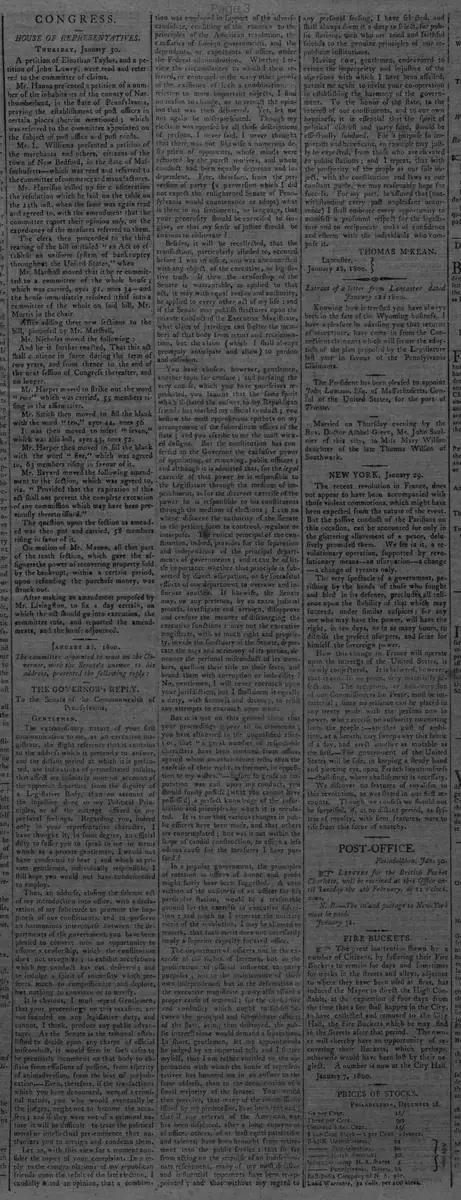
JANUARY 23, 1800.
The committee appointed to wait on the Governor, with the Senate's answer to his address, presented the following reply:
THE GOVERNOR's REPLY.
To the Senate of the Commonwealth of Pennsylvania,
GENTLEMEN,
The extraordinary nature of your first communication to me, as an executive magistrate, the slight reference that it contains to the address which it pretends to answer, and the distant period at which it is presented, are indications of premeditated insults, that affect me infinitely more on account of the apparent departure from the dignity of a Legislative Body, than on account of the injustice done to my Political Principles, or of the outrage offered to my personal feelings. Regarding you, indeed only in your representative character, I have thought it, in some degree, an official duty to suffer you to speak to me in terms which as a private gentleman, I would not have consented to hear; and which as private gentlemen, individually responsible, I still hope you would not have condescended to employ.
Thus, an address, closing the solemn act of my introduction into office, with a declaration of my solicitude to promote the happiness of our constituents, and to preserve an harmonious intercourse between the departments of the government, you have been pleased to convert into an opportunity to assume a censorship, which the constitution does not recognize; to exhibit accusations which my conduct has not deserved; and to indulge a spirit of animosity which presents much to compassionate and deplore, but nothing to convince or to terrify.
It is obvious, I must repeat Gentlemen, that your proceedings on this occasion, are not founded on any legislative duty, and cannot, I think, produce any public advantage. As the Senate is the tribunal established to decide upon any charge of official misconduct, it would seem in such cases to be peculiarly incumbent on that body to abstain from effusions of passion, from asperity of animadversion, from the bias of prejudication. Even, therefore, if the transactions which you have denounced, were of a criminal nature, you who would eventually be the judges, ought not to become the accusers; and if they were not of a criminal nature it will be difficult to trace the political moral or intellectual pre-eminence that authorizes you to arraign and condemn them.
Let us, with this view for a moment consider the topics of your complaint. In a reply to the congratulations of my republican friends upon the result of the late election, I candidly stated an opinion, that a combination was employed in support of the adverse candidate, consisting of the enemies to the principles of the American revolution, the satellites of foreign governments, and the dependents, or expectants of office, under the Federal administration. Whether I review the circumstances to which I then referred, or contemplate the many other proofs of the existence of such a combination, in relation to more important objects, I find no reason to change, or to retract the opinion that was then delivered. Yet, let me not again be misrepresented. Though my election was opposed by all those descriptions of persons, I never said, I never thought that there was not likewise a numerous description of opponents, whose minds were actuated by the purest motives, and whose conduct had been equally decorous and independent. Free, therefore, from the perversion of party (a perversion which I did not expect the enlightened Senate of Pennsylvania would countenance or adopt) what is there in my sentiments, or language, that your generosity should be exercised to forgive, or that my sense of justice should be anxious to obliterate?
Besides, it will be recollected, that the transaction, particularly alluded to, occurred before I was in office, and was unconnected with any object of the executive, or legislative trust. If then the censorship of the Senate is warrantable, as applied to that act, it may with equal reason and authority, be applied to every other act of my life: and if the Senate may publish strictures upon the private conduct of the Executive Magistrate, what claim of privilege can shelter the members of that body from retort and recrimination, but the claim (which I shall always promptly anticipate and allow) to pardon and oblivion.
You have chosen, however, gentlemen, another topic for censure; and pursuing the very course, which you have yourselves reprobated, you lament that the same spirit which dictated the answer to my Republican friends has marked my official conduct; you bestow the most opprobrious epithets on my arrangement of the subordinate offices of the state; and you ascribe to me the most wicked designs. But the constitution has conferred on the Governor the exclusive power of appointing, or removing, public officers; and although it is admitted that, for the legal exercise of that power he is responsible to the Legislature through the medium of impeachment, as for the discreet exercise of the power he is responsible to his constituents through the medium of elections; I can nowhere discover the authority of the Senate in the present form to control, regulate or interpose. The radical principle of the constitution, indeed, provides for the separation and independence of the principal departments of government; and it can be of little importance whether that principle is subverted by direct usurpation, or by successful efforts of one department to overawe and influence another. If likewise, the Senate may, on any pretence, by an extra judicial process, investigate and arraign, disapprove and censure the manner of discharging the executive functions: may not the executive magistrate, with as much right and propriety, invade the sanctuary of the Senate, depreciate the rage and acrimony of its parties, denounce the personal misconduct of its members, question their title to their seats, and brand them with corruption or imbecility?
No, gentlemen, I will never encroach upon your jurisdiction, but I shall deem it equally a duty, with firmness and decency, to resist any attempts to encroach upon mine.
But it is not on this ground alone that your proceedings appear to be erroneous; you have also erred in the unqualified assertion, that "a great number of respectable characters have been removed from office, against whom no other blame rests, than the exercise of their right, as freemen, in opposition to my wishes." Before so gross an imputation was cast upon my conduct, you should surely possess (what you cannot have possessed) a perfect knowledge of the information and principles by which it is regulated. It is true that various changes in public officers have been made, and that others are contemplated; but was it not within the scope of candid construction, to assign a less odious cause for the measures I have pursued?
In a popular government, the principles of rotation in offices of honor and profit might fairly have been suggested. A conviction of the unfitness of an officer for his particular station, would be a reasonable ground for the exercise of executive discretion: and much as I venerate the military merit of the revolution, I may be allowed to remark, that such merit does not necessarily imply a superior capacity for civil office.
The deportment of officers not in the exercise of the rights of freemen, but in the prostitution of official influence to party purposes; not in the maintenance of their own independence, but in the defamation of the executive magistrate; may also afford a proper cause of removal: or the confidence and cordiality which ought to subsist between the principal and subordinate officers of the state, being thus destroyed, the public interest alone would demand a separation.
In short, gentlemen, let my appointments be judged by an impartial test, and I flatter myself, that I am rather entitled to the approbation with which the house of representatives has honored me in an answer to the same address, than to the denunciation of a small majority of the senate. You would then perceive, that many of the commissions issued by my predecessor, have been renewed; that if any veteran of the American war has been displaced, after a long enjoyment of office, others, of at least equal patriotism and talents, have been brought from retirement into the public service: that so far from acting on the impulse of an indiscriminate resentment, many of my most decisive and influential opponents have been re-appointed; and that without any regard to any personal feeling, I have elected, and shall always deem it a duty to elect, for public stations, men who are tried and faithful friends to the genuine principles of our republican institutions.
Having now, gentlemen, endeavored to evince the impropriety and injustice of the aspersions with which I have been assailed, permit me again to invite your co-operation in establishing the harmony of the government. To the honor of the state, to the interest of our constituents, and to our own happiness, it is essential that the spirit of political distrust and party feud, should be effectually subdued. For a purpose so important and beneficent, an example may justly be expected, from those who are elevated to public stations; and I repeat, that with the prosperity of the people as our sole object, with the constitution and laws as our constant guide, we may reasonably hope for success. For my part, be assured that (notwithstanding every past unpleasant occurrence) I shall embrace every opportunity to manifest a profound respect for the legislature and to reciprocate marks of confidence and esteem with the individuals who compose it.
THOMAS M'KEAN.
Lancaster,
January 28, 1800.
The committee appointed to wait on the Governor, with the Senate's answer to his address, presented the following reply:
THE GOVERNOR's REPLY.
To the Senate of the Commonwealth of Pennsylvania,
GENTLEMEN,
The extraordinary nature of your first communication to me, as an executive magistrate, the slight reference that it contains to the address which it pretends to answer, and the distant period at which it is presented, are indications of premeditated insults, that affect me infinitely more on account of the apparent departure from the dignity of a Legislative Body, than on account of the injustice done to my Political Principles, or of the outrage offered to my personal feelings. Regarding you, indeed only in your representative character, I have thought it, in some degree, an official duty to suffer you to speak to me in terms which as a private gentleman, I would not have consented to hear; and which as private gentlemen, individually responsible, I still hope you would not have condescended to employ.
Thus, an address, closing the solemn act of my introduction into office, with a declaration of my solicitude to promote the happiness of our constituents, and to preserve an harmonious intercourse between the departments of the government, you have been pleased to convert into an opportunity to assume a censorship, which the constitution does not recognize; to exhibit accusations which my conduct has not deserved; and to indulge a spirit of animosity which presents much to compassionate and deplore, but nothing to convince or to terrify.
It is obvious, I must repeat Gentlemen, that your proceedings on this occasion, are not founded on any legislative duty, and cannot, I think, produce any public advantage. As the Senate is the tribunal established to decide upon any charge of official misconduct, it would seem in such cases to be peculiarly incumbent on that body to abstain from effusions of passion, from asperity of animadversion, from the bias of prejudication. Even, therefore, if the transactions which you have denounced, were of a criminal nature, you who would eventually be the judges, ought not to become the accusers; and if they were not of a criminal nature it will be difficult to trace the political moral or intellectual pre-eminence that authorizes you to arraign and condemn them.
Let us, with this view for a moment consider the topics of your complaint. In a reply to the congratulations of my republican friends upon the result of the late election, I candidly stated an opinion, that a combination was employed in support of the adverse candidate, consisting of the enemies to the principles of the American revolution, the satellites of foreign governments, and the dependents, or expectants of office, under the Federal administration. Whether I review the circumstances to which I then referred, or contemplate the many other proofs of the existence of such a combination, in relation to more important objects, I find no reason to change, or to retract the opinion that was then delivered. Yet, let me not again be misrepresented. Though my election was opposed by all those descriptions of persons, I never said, I never thought that there was not likewise a numerous description of opponents, whose minds were actuated by the purest motives, and whose conduct had been equally decorous and independent. Free, therefore, from the perversion of party (a perversion which I did not expect the enlightened Senate of Pennsylvania would countenance or adopt) what is there in my sentiments, or language, that your generosity should be exercised to forgive, or that my sense of justice should be anxious to obliterate?
Besides, it will be recollected, that the transaction, particularly alluded to, occurred before I was in office, and was unconnected with any object of the executive, or legislative trust. If then the censorship of the Senate is warrantable, as applied to that act, it may with equal reason and authority, be applied to every other act of my life: and if the Senate may publish strictures upon the private conduct of the Executive Magistrate, what claim of privilege can shelter the members of that body from retort and recrimination, but the claim (which I shall always promptly anticipate and allow) to pardon and oblivion.
You have chosen, however, gentlemen, another topic for censure; and pursuing the very course, which you have yourselves reprobated, you lament that the same spirit which dictated the answer to my Republican friends has marked my official conduct; you bestow the most opprobrious epithets on my arrangement of the subordinate offices of the state; and you ascribe to me the most wicked designs. But the constitution has conferred on the Governor the exclusive power of appointing, or removing, public officers; and although it is admitted that, for the legal exercise of that power he is responsible to the Legislature through the medium of impeachment, as for the discreet exercise of the power he is responsible to his constituents through the medium of elections; I can nowhere discover the authority of the Senate in the present form to control, regulate or interpose. The radical principle of the constitution, indeed, provides for the separation and independence of the principal departments of government; and it can be of little importance whether that principle is subverted by direct usurpation, or by successful efforts of one department to overawe and influence another. If likewise, the Senate may, on any pretence, by an extra judicial process, investigate and arraign, disapprove and censure the manner of discharging the executive functions: may not the executive magistrate, with as much right and propriety, invade the sanctuary of the Senate, depreciate the rage and acrimony of its parties, denounce the personal misconduct of its members, question their title to their seats, and brand them with corruption or imbecility?
No, gentlemen, I will never encroach upon your jurisdiction, but I shall deem it equally a duty, with firmness and decency, to resist any attempts to encroach upon mine.
But it is not on this ground alone that your proceedings appear to be erroneous; you have also erred in the unqualified assertion, that "a great number of respectable characters have been removed from office, against whom no other blame rests, than the exercise of their right, as freemen, in opposition to my wishes." Before so gross an imputation was cast upon my conduct, you should surely possess (what you cannot have possessed) a perfect knowledge of the information and principles by which it is regulated. It is true that various changes in public officers have been made, and that others are contemplated; but was it not within the scope of candid construction, to assign a less odious cause for the measures I have pursued?
In a popular government, the principles of rotation in offices of honor and profit might fairly have been suggested. A conviction of the unfitness of an officer for his particular station, would be a reasonable ground for the exercise of executive discretion: and much as I venerate the military merit of the revolution, I may be allowed to remark, that such merit does not necessarily imply a superior capacity for civil office.
The deportment of officers not in the exercise of the rights of freemen, but in the prostitution of official influence to party purposes; not in the maintenance of their own independence, but in the defamation of the executive magistrate; may also afford a proper cause of removal: or the confidence and cordiality which ought to subsist between the principal and subordinate officers of the state, being thus destroyed, the public interest alone would demand a separation.
In short, gentlemen, let my appointments be judged by an impartial test, and I flatter myself, that I am rather entitled to the approbation with which the house of representatives has honored me in an answer to the same address, than to the denunciation of a small majority of the senate. You would then perceive, that many of the commissions issued by my predecessor, have been renewed; that if any veteran of the American war has been displaced, after a long enjoyment of office, others, of at least equal patriotism and talents, have been brought from retirement into the public service: that so far from acting on the impulse of an indiscriminate resentment, many of my most decisive and influential opponents have been re-appointed; and that without any regard to any personal feeling, I have elected, and shall always deem it a duty to elect, for public stations, men who are tried and faithful friends to the genuine principles of our republican institutions.
Having now, gentlemen, endeavored to evince the impropriety and injustice of the aspersions with which I have been assailed, permit me again to invite your co-operation in establishing the harmony of the government. To the honor of the state, to the interest of our constituents, and to our own happiness, it is essential that the spirit of political distrust and party feud, should be effectually subdued. For a purpose so important and beneficent, an example may justly be expected, from those who are elevated to public stations; and I repeat, that with the prosperity of the people as our sole object, with the constitution and laws as our constant guide, we may reasonably hope for success. For my part, be assured that (notwithstanding every past unpleasant occurrence) I shall embrace every opportunity to manifest a profound respect for the legislature and to reciprocate marks of confidence and esteem with the individuals who compose it.
THOMAS M'KEAN.
Lancaster,
January 28, 1800.
What sub-type of article is it?
Partisan Politics
Constitutional
What keywords are associated?
Governor Reply
Senate Censure
Executive Appointments
Partisan Animosity
Constitutional Separation
Political Harmony
What entities or persons were involved?
Thomas M'kean
Senate Of The Commonwealth Of Pennsylvania
House Of Representatives
Editorial Details
Primary Topic
Governor's Reply Defending Against Senate's Criticisms On Election Statements And Appointments
Stance / Tone
Defensive And Assertive In Upholding Executive Independence
Key Figures
Thomas M'kean
Senate Of The Commonwealth Of Pennsylvania
House Of Representatives
Key Arguments
Senate's Address Constitutes Premeditated Insults And Unconstitutional Censorship
Governor's Pre Office Statements On Political Opponents Were Candid And Not Retractable
Constitution Grants Exclusive Executive Power Over Appointments And Removals
Senate Lacks Authority To Censure Executive Conduct Outside Impeachment
Appointments Based On Rotation, Fitness, And Republican Principles, Not Mere Opposition
Urges Cooperation To Subdue Party Feud And Promote Governmental Harmony