Thank you for visiting SNEWPapers!
Sign up free
Letter to Editor
August 14, 1817
Daily National Intelligencer
Washington, District Of Columbia
What is this article about?
Cato argues for a strong U.S. navy to deter foreign aggression and protect commerce, criticizing limited defensive policies as insufficient against superior naval powers like Britain. He envisions America achieving pre-eminence, responding to past impressments and blockades.
Clipping
OCR Quality
95%
Excellent
Full Text
FOR THE NATIONAL INTELLIGENCER
THE NAVY.
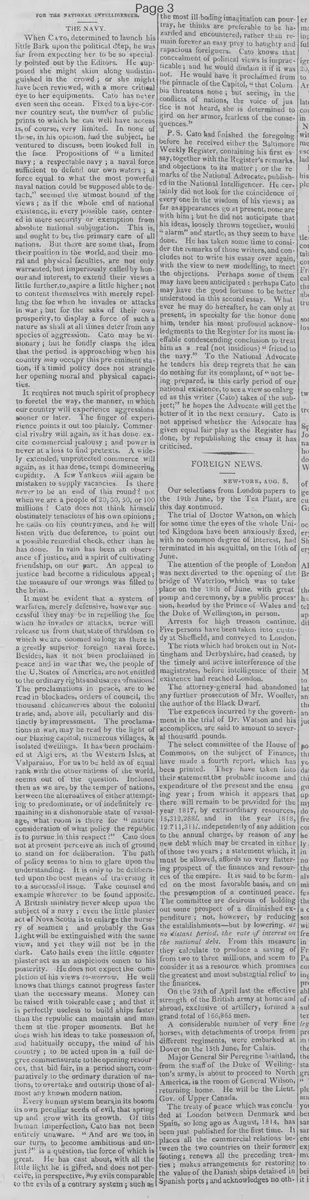
When Cato, determined to launch his little Bark upon the political deep, he was far from expecting her to be so specially pointed out by the Editors. He supposed she might skim along undistinguished in the crowd; or she might have been reviewed, with a more critical eye to her equipments. Cato has never even seen the ocean. Fixed to a bye-corner country seat, the number of public prints to which he can well have access is, of course, very limited. In none of those, in his opinion, had the subject, he ventured to discuss, been looked full in the face. Propositions of "a limited navy; a respectable navy; a naval force sufficient to defend our own waters; a force equal to what the most powerful naval nation could be supposed able to detach," seemed the utmost bound of the views; as if the whole end of national existence, in every possible case, centered in mere security or exemption from absolute national subjugation. This is, and ought to be, the primary care of all nations. But there are some that, from their position in the world, and their moral and physical faculties, are not only warranted, but imperiously called by honor and interest, to extend their views a little further, to aspire a little higher; not to content themselves with merely repelling the foe when he invades or attacks in war; but for the sake of their own prosperity, to display a force of such a nature as shall at all times deter from any species of aggression. Cato may be visionary; but he fondly clasps the idea that the period is approaching when his country may occupy this pre-eminent station, if a timid policy does not strangle her opening moral and physical capacities.
It requires not much spirit of prophecy to foretel the way, the manner, in which our country will experience aggressions sooner or later. The finger of experience points it out too plainly. Commercial rivalry will again, as it has done, excite commercial jealousy; and power is never at a loss to find pretexts. A widely extended, unprotected commerce will again, as it has done, tempt domineering cupidity. A few Yankees will again be mistaken to supply vacancies. Is there never to be an end of this round? not when we are a people of 20, 30, 50, or 100 millions? Cato does not think himself obstinately tenacious of his own opinions; he calls on his countrymen, and he will listen with due deference, to point out a possible remedial check, other than he has done. In vain has been an observance of justice, and a spirit of cultivating friendship, on our part. An appeal to justice had become a ridiculous appeal; the measure of our wrongs was filled to the brim.
It must be evident that a system of warfares, merely defensive, however successful they may be in repelling the foe when he invades or attacks, never will release us from that state of thraldom to which we are doomed so long as there is a greatly superior foreign naval force. Besides, has it not been proclaimed in peace and in war that we, the people of the U. States of America, are not entitled to the ordinary rights and usages of nations? The proclamations in peace, are to be read in blockades, orders of council, the thousand chicaneries about the colonial trade, and, above all, peculiarly and distinctly by impressment. The proclamations in war, may be read by the light of our blazing capitol, numerous villages, & isolated dwellings. It has been proclaimed at Algiers, at the Western Isles, at Valparaiso. For us to be held as of equal rank with the other nations of the world, seems out of the question. Inclosed then as we are, by the temper of nations, between the alternatives of either attempting to predominate, or of indefinitely remaining in a dishonorable state of vassalage, what room is there for "mature consideration of what policy the republic is to pursue in this respect?" Cato does not at present perceive an inch of ground to stand on for deliberation. The path of policy seems to him to glare upon the understanding. It is only to be deliberated upon the best means of traversing it to a successful issue. Take counsel and example wherever to be found apposite.
A British ministry never sleep upon the subject of a navy: even the little plaster act of Nova Scotia is to enlarge the nursery of seamen; and probably the Gas Light will be extinguished with the same view, and yet they will not be in the dark. Cato hails even the little counter plaster act as an auspicious omen to his posterity. He does not expect the completion of his views to-morrow. He well knows that things cannot progress faster than the necessary means. Money can be raised with tolerable ease: and that it is perfectly useless to build ships faster than the republic can maintain and man them at the proper moments. But he does wish his ideas to take possession of, and habitually occupy, the mind of his country; to be acted upon in a full degree commensurate to the opening resources, that bid fair, in a period short, comparatively to the ordinary duration of nations, to overtake and outstrip those of almost any known modern nation.
Every human system bears in its bosom its own peculiar seeds of evil, that spring up and grow with its growth. Of this human imperfection, Cato has not been entirely unaware. "And are we too, in our turn, to become ambitious and unjust?" is a question, the force of which is great. He has cast about, with all the little light he is gifted, and does not perceive, in perspective, any evils comparable to the evils of a contrary system; such as the most ill-boding imagination can portray, he thinks are preferable to be hazarded and encountered, rather than remain forever an easy prey to haughty and rapacious foreigners. Cato knows that concealment of political views is impracticable: and he would disdain it if it was not. He would have it proclaimed from the pinnacle of the Capitol, "that Columbia threatens none; but seeing, in the conflicts of nations, the voice of justice is not heard, she is determined to gird on her armor, fearless of the consequences."
P.S. Cato had finished the foregoing before he received either the Baltimore Weekly Register, containing his first essay, together with the Register's remarks and objections to its matter; or the remarks of the National Advocate, published in the National Intelligencer. He certainly did not look for the coincidence of every one in the wisdom of his views; as far as appearances go at present, none are with him; but he did not anticipate that his ideas, loosely thrown together, would "alarm" and startle, as they seem to have done. He has taken some time to consider the remarks of those writers, and concludes not to write his essay over again, with the view to new modelling, to meet the objections. Perhaps some of them may have been anticipated: perhaps Cato may have the good fortune to be better understood in this second essay. Whatever he may do hereafter, he can only at present, in specialty for the honor done him, tender his most profound acknowledgments to the Register for its most ineffable condescending conclusion to treat him as a real (not insidious) "friend to the navy." To the National Advocate he tenders his deep regrets that he can do nothing for its complaint, of "not being prepared, in this early period of our national existence, to see a view so enlarged as this writer (Cato) takes of the subject;" he hopes the Advocate will get the better of it in the next century. Cato is not apprised whether the Advocate has given equal fair play as the Register has done, by republishing the essay it has criticised.
THE NAVY.
When Cato, determined to launch his little Bark upon the political deep, he was far from expecting her to be so specially pointed out by the Editors. He supposed she might skim along undistinguished in the crowd; or she might have been reviewed, with a more critical eye to her equipments. Cato has never even seen the ocean. Fixed to a bye-corner country seat, the number of public prints to which he can well have access is, of course, very limited. In none of those, in his opinion, had the subject, he ventured to discuss, been looked full in the face. Propositions of "a limited navy; a respectable navy; a naval force sufficient to defend our own waters; a force equal to what the most powerful naval nation could be supposed able to detach," seemed the utmost bound of the views; as if the whole end of national existence, in every possible case, centered in mere security or exemption from absolute national subjugation. This is, and ought to be, the primary care of all nations. But there are some that, from their position in the world, and their moral and physical faculties, are not only warranted, but imperiously called by honor and interest, to extend their views a little further, to aspire a little higher; not to content themselves with merely repelling the foe when he invades or attacks in war; but for the sake of their own prosperity, to display a force of such a nature as shall at all times deter from any species of aggression. Cato may be visionary; but he fondly clasps the idea that the period is approaching when his country may occupy this pre-eminent station, if a timid policy does not strangle her opening moral and physical capacities.
It requires not much spirit of prophecy to foretel the way, the manner, in which our country will experience aggressions sooner or later. The finger of experience points it out too plainly. Commercial rivalry will again, as it has done, excite commercial jealousy; and power is never at a loss to find pretexts. A widely extended, unprotected commerce will again, as it has done, tempt domineering cupidity. A few Yankees will again be mistaken to supply vacancies. Is there never to be an end of this round? not when we are a people of 20, 30, 50, or 100 millions? Cato does not think himself obstinately tenacious of his own opinions; he calls on his countrymen, and he will listen with due deference, to point out a possible remedial check, other than he has done. In vain has been an observance of justice, and a spirit of cultivating friendship, on our part. An appeal to justice had become a ridiculous appeal; the measure of our wrongs was filled to the brim.
It must be evident that a system of warfares, merely defensive, however successful they may be in repelling the foe when he invades or attacks, never will release us from that state of thraldom to which we are doomed so long as there is a greatly superior foreign naval force. Besides, has it not been proclaimed in peace and in war that we, the people of the U. States of America, are not entitled to the ordinary rights and usages of nations? The proclamations in peace, are to be read in blockades, orders of council, the thousand chicaneries about the colonial trade, and, above all, peculiarly and distinctly by impressment. The proclamations in war, may be read by the light of our blazing capitol, numerous villages, & isolated dwellings. It has been proclaimed at Algiers, at the Western Isles, at Valparaiso. For us to be held as of equal rank with the other nations of the world, seems out of the question. Inclosed then as we are, by the temper of nations, between the alternatives of either attempting to predominate, or of indefinitely remaining in a dishonorable state of vassalage, what room is there for "mature consideration of what policy the republic is to pursue in this respect?" Cato does not at present perceive an inch of ground to stand on for deliberation. The path of policy seems to him to glare upon the understanding. It is only to be deliberated upon the best means of traversing it to a successful issue. Take counsel and example wherever to be found apposite.
A British ministry never sleep upon the subject of a navy: even the little plaster act of Nova Scotia is to enlarge the nursery of seamen; and probably the Gas Light will be extinguished with the same view, and yet they will not be in the dark. Cato hails even the little counter plaster act as an auspicious omen to his posterity. He does not expect the completion of his views to-morrow. He well knows that things cannot progress faster than the necessary means. Money can be raised with tolerable ease: and that it is perfectly useless to build ships faster than the republic can maintain and man them at the proper moments. But he does wish his ideas to take possession of, and habitually occupy, the mind of his country; to be acted upon in a full degree commensurate to the opening resources, that bid fair, in a period short, comparatively to the ordinary duration of nations, to overtake and outstrip those of almost any known modern nation.
Every human system bears in its bosom its own peculiar seeds of evil, that spring up and grow with its growth. Of this human imperfection, Cato has not been entirely unaware. "And are we too, in our turn, to become ambitious and unjust?" is a question, the force of which is great. He has cast about, with all the little light he is gifted, and does not perceive, in perspective, any evils comparable to the evils of a contrary system; such as the most ill-boding imagination can portray, he thinks are preferable to be hazarded and encountered, rather than remain forever an easy prey to haughty and rapacious foreigners. Cato knows that concealment of political views is impracticable: and he would disdain it if it was not. He would have it proclaimed from the pinnacle of the Capitol, "that Columbia threatens none; but seeing, in the conflicts of nations, the voice of justice is not heard, she is determined to gird on her armor, fearless of the consequences."
P.S. Cato had finished the foregoing before he received either the Baltimore Weekly Register, containing his first essay, together with the Register's remarks and objections to its matter; or the remarks of the National Advocate, published in the National Intelligencer. He certainly did not look for the coincidence of every one in the wisdom of his views; as far as appearances go at present, none are with him; but he did not anticipate that his ideas, loosely thrown together, would "alarm" and startle, as they seem to have done. He has taken some time to consider the remarks of those writers, and concludes not to write his essay over again, with the view to new modelling, to meet the objections. Perhaps some of them may have been anticipated: perhaps Cato may have the good fortune to be better understood in this second essay. Whatever he may do hereafter, he can only at present, in specialty for the honor done him, tender his most profound acknowledgments to the Register for its most ineffable condescending conclusion to treat him as a real (not insidious) "friend to the navy." To the National Advocate he tenders his deep regrets that he can do nothing for its complaint, of "not being prepared, in this early period of our national existence, to see a view so enlarged as this writer (Cato) takes of the subject;" he hopes the Advocate will get the better of it in the next century. Cato is not apprised whether the Advocate has given equal fair play as the Register has done, by republishing the essay it has criticised.
What sub-type of article is it?
Persuasive
Political
Provocative
What themes does it cover?
Military War
Politics
Commerce Trade
What keywords are associated?
Navy Expansion
Us Defense Policy
British Aggression
Commercial Protection
Impressment
National Preeminence
What entities or persons were involved?
Cato
National Intelligencer
Letter to Editor Details
Author
Cato
Recipient
National Intelligencer
Main Argument
the united states must develop a powerful navy to deter aggression, protect commerce, and achieve pre-eminence among nations, rather than relying on limited defensive forces that leave it vulnerable to superior powers like britain.
Notable Details
References To Impressment, Blockades, And War Of 1812 Burning Of Capitol
Critique Of British Naval Policies And Colonial Trade Restrictions
Response To Criticisms From Baltimore Weekly Register And National Advocate
Acknowledgment Of Potential Ambition But Preference Over Vassalage