Thank you for visiting SNEWPapers!
Sign up free
Grand Rapids Morning Telegram
Grand Rapids, Kent County, Michigan
What is this article about?
The 1885 Indiana legislative session closed after passing numerous local bills, appropriations, statute amendments, and a new tax law. The Governor vetoed a minority representation bill, which was overridden. Apportionment favored Republicans, prohibition efforts were sidelined, and the session was praised for avoiding controversial measures. Key figures included Speakers Clark and Sellers, and Rep. Ford.
Clipping
OCR Quality
Full Text
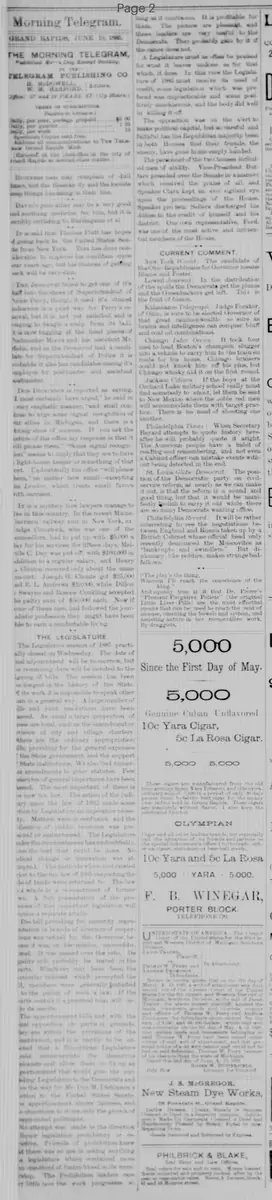
The Legislative session of 1885 practically closed on Monday. The date of final adjournment will be tomorrow, but the remaining hours will be devoted to the signing of bills. This session has been one of the longest in the history of the State and of its work it is impossible to speak otherwise than favorably. A long number of bills and joint resolutions have been passed. A good large proportion of them are local, each to the amendment or revision of city and village charters. There are the ordinary appropriations providing for the general expenses of this State government and the support of State institutions. We have finally numerous amendments to prior statutes. Few measures of general interest have been passed. The most important of these is the new tax law. The action of the judiciary upon the law of last winter by the Legislature is an imperative necessity. Matters were in a confused condition and the decision of public revenue was prescribed or emasculated. The Legislature under the circumstances has undoubtedly done the best that could be done. No radical change or innovation was attempted. The method which had acted for the tax has of two repetitions the act of last year was returned to the law which was in a settlement of former. A bill presentation of the issues of this important Legislature will require a separate article.
The bill pending for minority representation in the boards of directors of corporations was vetoed by the Governor. He gave in his opinion anticipation of veto. It was passed over the refusal. Its legality will probably be tested in the courts. Western men have been about the similar burdens which prompted the members were generally gratified to the policy of a la carte. If the act stands it a practical trial will be in the merits.
The apportionment bill has met with the unqualified partisan grab bag within the limits of the constitution, and it is hardly to know of any Republican Legislature which more nearly relates those lines anxiety and all these to fit an apportionment that would give the next Legislature to the Democrats and win the war for it in Indiana section of the national state senate in apportionment shares favors and sometimes it is truly the high seas of mops-o-tel politeness.
No attempt was made in the direction of liquor legislation prohibitors or breweries. Friends of prohibition knew that there was no use working anything in a Legislature whose attendants were more than one third of foreign blood too warm rabid. The Prohibition leaders are by little harm the work progressing along as a campaign. It is profitable for them. The picnics are pleasant, and their leaders are very useful to the Democrats. They probably gain by it if the cause were not.
A Legislature must as often be praised for what it leaves undone as for what it does. In this view the Legislature of this year receives a meed of credit, some legislation which was preferred was impracticable and some policies aimed thereat must, and the body did well in killing it off. The opposition was on the alert to make political capital, but so careful and faithful has the Republican majority been in both houses that their friends, the enemy, have gone home empty handed. The personnel of the two houses included men of ability. Vice President Butler presided over the Senate in a manner which received the praise of all, and Speaker Clark kept an ever vigilant eye upon the proceedings of the House. Speaker pro tem Sellers discharged his duties to the credit of himself and his district. Our own representative, Ford, was one of the most active and influential members of the House.
What sub-type of article is it?
What keywords are associated?
What entities or persons were involved?
Where did it happen?
Domestic News Details
Primary Location
Indiana
Event Date
1885
Key Persons
Outcome
numerous local bills, appropriations, and statute amendments passed; new tax law enacted; minority representation bill vetoed but overridden; apportionment bill passed favoring republicans; no prohibition legislation attempted.
Event Details
The 1885 legislative session, one of the longest in state history, closed with passage of many local bills amending city and village charters, ordinary appropriations for state government and institutions, and numerous amendments to prior statutes. Few general interest measures passed, most notably a new tax law addressing confused revenue conditions without radical changes. A bill for minority representation in corporate boards was vetoed by the Governor but passed over veto, likely to be tested in courts. The apportionment bill drew partisan criticism but stayed within constitutional limits, benefiting Republicans. No liquor or prohibition legislation was pursued due to the legislature's composition. The session was praised for avoiding impracticable or controversial policies, with Republican majority maintaining careful control. Senate presided by Vice President Butler, House by Speaker Clark, pro tem Sellers, and active member Ford.