Thank you for visiting SNEWPapers!
Sign up free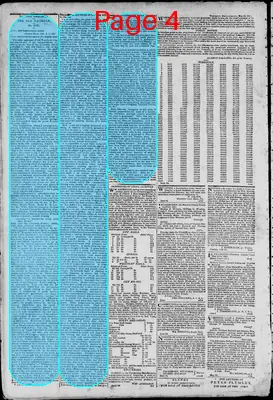
Literary
July 5, 1811
The Enquirer
Richmond, Henrico County, Virginia
What is this article about?
In this essay, 'The Old Bachelor' compares the revolutionary generation's intellectual giants like Hamilton, Franklin, and Henry to the current 'puny race of dwarfs,' urging modern Americans to emulate their forebears' patriotism, rigorous education, and virtuous public service, especially in law and governance.
Clipping
OCR Quality
95%
Excellent
Full Text
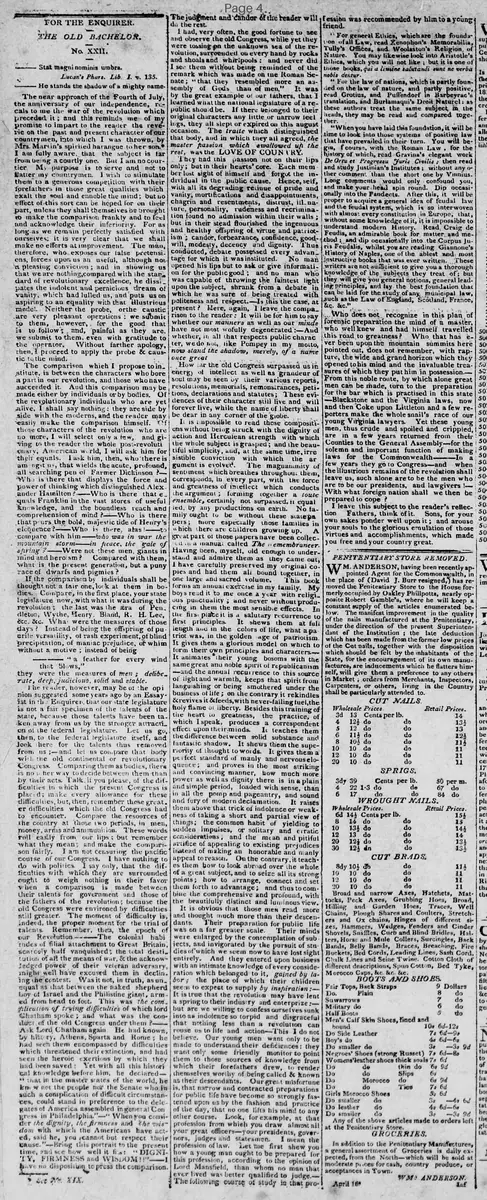
FOR THE ENQUIRER.
THE OLD BACHELOR.
No. XXII.
I stat magni nominis umbra.
Lucan's Phars. Lib. I. v. 135.
He stands the shadow of a mighty name
The near approach of the Fourth of July,
the anniversary of our independence, recalls
to me the war of the revolution which
preceded it; and this reminds me of my
promise to impart to the reader the reverie
on the past and present character of our
countrymen, into which I was thrown, by
Mrs. Martin's spirited harangue to her son.*
I am fully aware that the subject is far
from being a courtly one. But I am no court-
tier. My purpose is to serve and not to
flatter my countrymen. I wish to stimulate
them to a generous competition with their
forefathers in those great qualities which
exalt the soul and ennoble the mind; but no
effect of this sort can be hoped for on their
part, unless they shall themselves be brought
to make the comparison frankly and to feel
and acknowledge their inferiority. For as
long as we remain perfectly satisfied with
ourselves; it is very clear that we shall
make no efforts at improvement. The man,
therefore, who exposes our false pretensions,
forces upon us a useful, although not
a pleasing conviction; and in showing us
that we are nothing, compared with the standard
of revolutionary excellence, he dissipates
the indolent and pernicious dream of
vanity, which had lulled us, and puts us on
aspiring to an equality with that illustrious
model. Neither the probe, nor the caustic
are very pleasant operations: we submit
to them, however, for the good that
is to follow; and, painful as they are.
we submit to them, even with gratitude to
the operator. Without farther apology,
then, I proceed to apply the probe & caustic
to the mind
The comparison which I propose to institute,
is between the characters who bore
a part in our revolution, and those who have
succeeded it. And this comparison may be
made either by individuals or by bodies. Of
the revolutionary individuals who are yet
alive, I shall say nothing: they are side by
side with the moderns, and the reader may
easily make the comparison himself. Of
those characters of the revolution who are
no more, I will select only a few, and giving
to the reader the whole post-revolutionary
American world, I will ask him for
their equals. I ask him, then, who there is
amongst us, that wields the acute, profound,
all searching pen of Farmer Dickinson -
Who is there that displays the force and
power of thinking which distinguished Alexander
Hamilton? - Who is there that equals Franklin in the vast stores of useful
knowledge, and the boundless reach and
comprehension of mind? Who is there
that pours the bold, majestic tide of Henry's
eloquence? -- Who is there, alas! - to
compare with him
-who was in war the
mountain storm -
in peace, the gale of
inspiring? -- Were not these men giants in
mind and heroism?
Compared with them,
what is the present generation, but a puny
race of dwarfs and pigmies?
If the comparison by individuals shall be
thought not a fair one, look at them in bodies.
Compare, in the first place, your state
legislature now, with what it was during the
revolution; the last was the era of Pendleton,
Wythe, Henry, Bland, R. H. Lee,
&tc. &c. What were the measures of those
days? Instead of being the offspring of puerile
versatility, of rash experiment, of blind
precipitation, of maniac prejudice, of whim
without a motive; instead of being
a
feather for every wind
that blows,
they were the measures of men; deliberate,
deep, judicious, solid and stable.
The reader, however, may be of the opinion
suggested some years ago by an Essayist
in the Enquirer, that our state legislature
is not a fair specimen of the talents of the
state, because those talents have been taken
away from us by the stronger attraction
of the federal legislature. Let us go,
then, to the federal legislature itself, and
look here for the talents thus removed
from us; - and let us compare that body
with the old continental or revolutionary
Congress. Comparing them as bodies, there
is no other way to decide between them than
by their acts. Talk, if you please, of the difficulties
in which the present Congress is
placed; make every allowance for these
difficulties, but, then, remember those greater
difficulties which the old Congress had
to encounter. Compare the resources of
the country at those two periods, in men,
money, arms and ammunition. These words
roll easily from our lips: but remember
what they mean; and make the comparison
fairly. I am not censuring the pacific
course of our Congress. I have nothing to
do with politics. I say only, that the difficulties
with which they are surrounded
ought to weigh nothing in their favor
when a comparison is made between
their talents for government and those of
the fathers of the revolution; because the
old Congress were environed by difficulties
still greater. The moment of difficulty is,
indeed, the proper moment for the trial of
talents. Remember, then, the epoch of
our Revolution. --- The colonial habits
of filial attachment to Great Britain
scarcely half vanquished; the total destitution
of all the means of war, & the acknowledged
power of their veteran adversary,
might well have excused them in declining
the contest. Was it not, in truth, as unequal
as that between the naked shepherd
boy of Israel and the Philistine giant, armed
from head to foot. This was the complication
of trying difficulties of which Lord
Chatham spoke; and what was the conduct
of the old Congress under them? -
Ask Lord Chatham again. He had known,
by history, Athens, Sparta and Rome; he
had seen them encompassed by difficulties
which threatened their extinction, and had
seen the heroic exertions by which they
had been saved: Yet with all this historical
knowledge before him, he declared -
"that in the master states of the world, he
knew not the people nor the Senate who in
such a complication of difficult circumstances,
could stand in preference to the delegates
of America assembled in general Congress
in Philadelphia." -- "When you consider
the dignity, the firmness and the wisdom
with which the Americans have acted,
said he, you cannot but respect their
cause." -- Bring this portrait to the present
time, and see how well it fits: "DIGNITY,"
FIRMNESS and WISDOM!!" - I
have no disposition to press the comparison.
The judgment and Candor of the reader will
do the rest.
I had, very often, the good fortune to see
and observe the old Congress, while yet they
were tossing on the unknown sea of the revolution,
surrounded on every hand by rocks
and shoals and whirlpools: and never did
I see them without being reminded of the
remark which was made on the Roman Senate;
"that they resembled more an assembly
of Gods than of men." It was
by the great example of our fathers, that I
learned what the national legislature of a republic
should be. If there belonged to their
original characters any little or narrow feelings,
they all slept or expired on this august
occasion. The trait which distinguished
that body, and in which they all agreed, the
master passion which swallowed up the
rest, was the LOVE OF COUNTRY.
They had this passion not on their lips
only; but in their hearts' core. Each member
lost sight of himself and forgot the individual
in the public cause. Hence, self,
with all its degrading retinue of pride and
vanity, mortifications and disappointments,
chagrin and resentments, distrust, ill-nature,
personality, rudeness and recrimination
found no admission within their walls;
but in their stead flourished the ingenuous
and healthy offspring of virtue and patriotism;
candor, forbearance, confidence, good-
will, modesty, decency and dignity. Thus
conducted, debate possessed every advantage
for which it was instituted. No man
opened his lips but to ask or give information
for the public good; and no man who
was capable of throwing the faintest light
upon the subject, shrank from a debate in
which he was sure of being treated with
politeness and respect. -- Is this the case, at
present? Here, again, I leave the comparison
to the reader: It will be for him to say
whether our manners as well as our minds
have not most woefully degenerated: And
whether, in all that respects public character,
we do not, like Pompey in my motto,
now stand the shadow, merely, of a name
once great
How far the old Congress surpassed us in
energy of intellect as well as grandeur of
soul may be seen by their various reports,
resolutions, memorials, remonstrances, petitions,
declarations and statutes. These evidences
of their character still live and will
forever live, while the name of liberty shall
be dear in any corner of the globe.
It is impossible to read those compositions
without being struck with the dignity of
action and Herculean strength with which
the whole subject is grasped; and the beautiful
simplicity, and, at the same time, irresistible
conviction with which the argument
is evolved. The magnanimity of
sentiment which breathes throughout them,
corresponds, in every part, with the force
and greatness of intellect which conducts
the argument; forming together a tout ensemble,
certainly not surpassed or equalled
by any productions on earth. No family
ought to be without these state papers;
more especially those families in
which there are children growing up. A
great part of those papers have been collected
in a manual called The Remembrancer.
Having been, myself, old enough to understand
and admire them as they came out,
I have carefully preserved my original copies
and had them all bound together, in
one large and sacred volume. This book
forms an annual exercise in my family. My
boys read it to me once a year with religious
punctuality; and never without producing
in them the most sensible effects. In
the first place it is a salutary recurrence to
first principles. It shows them at full
length and in the colors of life, what a patriot
was, in the golden age of patriotism.
It gives them a glorious model on which to
form their own principles and characters.
It animates their young bosoms with the
same great and noble spirit of republicanism
-- and the annual recurrence to this source
of light and warmth, keeps that spirit from
languishing or being smothered under the
business of life; on the contrary it rekindles
& revives it & feeds, with never-failing fuel, the
holy flame of liberty. Besides this training of
the heart to greatness, the practice,
of
which I speak, produces a correspondent
effect upon their minds. It teaches them
the difference between solid substance and
fantastic shadow. It shows them the superiority
of thought to words. It gives them a
perfect standard of manly and nervous eloquence;
and proves in the most striking
and convincing manner, how much more
power as well as dignity there is in a plain
and simple period, loaded with sense, than
in all the pomp and pageantry, and sound
and fury of modern declamation. It raises
them above that trick of indolence or weakness
of taking a short and partial view of
things: the common habit of yielding to
sudden impulses, or solitary and erratic
considerations; and the mean and pitiful
artifice of appealing to existing prejudices
instead of making an honorable and manly
appeal to reason. On the contrary, it teaches
them how to look abroad over the whole
of a great subject, and to seize all its strong
points; how to arrange, connect and set
them forth to advantage; and thus to combine
the comprehensive and profound, with
the beautifully distinct and luminous view.
It is obvious that those men read more
and thought much more than their descendants.
Their preparation for public life
was on a far greater scale. Their minds
were enlarged by the contemplation of subjects,
and invigorated by the pursuit of studies
of which we seem now to have lost sight
entirely. And they entered upon business
with an intimate knowledge of every consideration
which belonged to it, gained by labor;
the place of which their children
seem to expect to supply by inspiration: -
It is true that the revolution may have lent
a spring to their industry and enterprise: -
but are we willing to confess ourselves sunk
into an indolence so torpid and disgraceful
that nothing less than a revolution can
rouse us to life and action -- This I do not
believe. Our young men want only to be
made to understand their deficiencies: they
want only some friendly monitor to point
them to those sources of knowledge from
which their forefathers drew, to render
themselves worthy of being called & known
as their descendants. Our great misfortune
is, that narrow and contracted preparations
for public life have become so strongly fastened
upon us by the fashion and practice
of the day, that no one lifts his mind to any
other course. Look, for example, at that
profession from which you draw almost all
your great officers -- your presidents, governors,
judges and statesmen. I mean the
profession of law. Let me first show you
how a young man ought to be prepared for
this profession, according to the opinion of
Lord Mansfield, than whom no man that
ever lived was better qualified to judge. --
The following course of study in that profession
was recommended by him to a young
friend.
"For general Ethics, which are the foundation
of all Law, read Xenophon's Memorabilia,
Tully's Offices, and Woolaston's Religion, of
Nature. You may likewise look into Aristotle's
Ethics, which you will not like; but it is one of
those books, cui a limine salutandi sunt ne verba
nobis dentur.
"For the law of nations, which is partly founded
on the law of nature, and partly positive,
read Grotius, and Puffendorf in Barbeyrac's
translation, and Burlamaqui's Droit Naturel: as
these authors treat the same subject in the
heads, they may be read and compared together.
"When you have laid this foundation, it will be
time to look into those systems of positive law
that have prevailed in their turn. You will begin,
of course, with the Roman Law. for the
history of which, read Gravina's elegant work
De Ortu et Progressu Juris Civilis; then read
and study Justinian's Institutes; without any other
comment than the short one by Vinnius.
Long comments would only confound you,
and make your head spin round. Dip occasionally
into the Pandects. After this, it will be
proper to acquire a general idea of feudal law
and the feudal system, which is so interwoven
with almost every constitution in Europe, that,
without some knowledge of it, it is impossible to
understand modern History. Read Craig de
Feudis, an admirable book for matter and method:
and dip occasionally into the Corpus Juris
Feudalis, whilst you are reading Giannone's
History of Naples, one of the ablest and most
instructive books that was ever written. ... These
writers are not sufficient to give you a thorough
knowledge of the subjects they treat of; but
they will give you general notions, general leading
principles, and lay the best foundation that
can be laid for the study of any municipal law,
such as the Law of England, Scotland, France,
&c. &c."
Who does not recognize in this plan of
forensic preparation the mind of a master,
who well knew and had himself travelled
this road to greatness? Who that has ever
been upon the mountain summits here
pointed out, does not remember, with rapture,
the wide and grand horizon which they
opened to his mind and the invaluable treasures
of which they put him in possession. --
From this noble route, by which alone great
men can be made, turn to the preparation
for the bar which is practised in this state
Blackstone and the Virginia laws, now
and then Coke upon Littleton and a few reporters
make the whole snail's pace of our
young Virginia lawyers. Yet these young
men, thus crude and spoiled and crippled,
are in a few years returned from their
Counties to the General Assembly -- for the
solemn and important function of making
laws for the Commonwealth -- In
a
few years they go to Congress -- and when
the illustrious remains of the revolution shall
leave us, such alone are to be the men who
are to be our presidents, and lawgivers! --
With what foreign nation shall we then be
prepared to cope?
I leave this subject to the reader's reflection.
Fathers, think of it. Sons, for your
own sakes ponder well upon it; and arouse
your souls to the glorious emulation of those
virtues and accomplishments, which made
you free and your country great.
THE OLD BACHELOR.
No. XXII.
I stat magni nominis umbra.
Lucan's Phars. Lib. I. v. 135.
He stands the shadow of a mighty name
The near approach of the Fourth of July,
the anniversary of our independence, recalls
to me the war of the revolution which
preceded it; and this reminds me of my
promise to impart to the reader the reverie
on the past and present character of our
countrymen, into which I was thrown, by
Mrs. Martin's spirited harangue to her son.*
I am fully aware that the subject is far
from being a courtly one. But I am no court-
tier. My purpose is to serve and not to
flatter my countrymen. I wish to stimulate
them to a generous competition with their
forefathers in those great qualities which
exalt the soul and ennoble the mind; but no
effect of this sort can be hoped for on their
part, unless they shall themselves be brought
to make the comparison frankly and to feel
and acknowledge their inferiority. For as
long as we remain perfectly satisfied with
ourselves; it is very clear that we shall
make no efforts at improvement. The man,
therefore, who exposes our false pretensions,
forces upon us a useful, although not
a pleasing conviction; and in showing us
that we are nothing, compared with the standard
of revolutionary excellence, he dissipates
the indolent and pernicious dream of
vanity, which had lulled us, and puts us on
aspiring to an equality with that illustrious
model. Neither the probe, nor the caustic
are very pleasant operations: we submit
to them, however, for the good that
is to follow; and, painful as they are.
we submit to them, even with gratitude to
the operator. Without farther apology,
then, I proceed to apply the probe & caustic
to the mind
The comparison which I propose to institute,
is between the characters who bore
a part in our revolution, and those who have
succeeded it. And this comparison may be
made either by individuals or by bodies. Of
the revolutionary individuals who are yet
alive, I shall say nothing: they are side by
side with the moderns, and the reader may
easily make the comparison himself. Of
those characters of the revolution who are
no more, I will select only a few, and giving
to the reader the whole post-revolutionary
American world, I will ask him for
their equals. I ask him, then, who there is
amongst us, that wields the acute, profound,
all searching pen of Farmer Dickinson -
Who is there that displays the force and
power of thinking which distinguished Alexander
Hamilton? - Who is there that equals Franklin in the vast stores of useful
knowledge, and the boundless reach and
comprehension of mind? Who is there
that pours the bold, majestic tide of Henry's
eloquence? -- Who is there, alas! - to
compare with him
-who was in war the
mountain storm -
in peace, the gale of
inspiring? -- Were not these men giants in
mind and heroism?
Compared with them,
what is the present generation, but a puny
race of dwarfs and pigmies?
If the comparison by individuals shall be
thought not a fair one, look at them in bodies.
Compare, in the first place, your state
legislature now, with what it was during the
revolution; the last was the era of Pendleton,
Wythe, Henry, Bland, R. H. Lee,
&tc. &c. What were the measures of those
days? Instead of being the offspring of puerile
versatility, of rash experiment, of blind
precipitation, of maniac prejudice, of whim
without a motive; instead of being
a
feather for every wind
that blows,
they were the measures of men; deliberate,
deep, judicious, solid and stable.
The reader, however, may be of the opinion
suggested some years ago by an Essayist
in the Enquirer, that our state legislature
is not a fair specimen of the talents of the
state, because those talents have been taken
away from us by the stronger attraction
of the federal legislature. Let us go,
then, to the federal legislature itself, and
look here for the talents thus removed
from us; - and let us compare that body
with the old continental or revolutionary
Congress. Comparing them as bodies, there
is no other way to decide between them than
by their acts. Talk, if you please, of the difficulties
in which the present Congress is
placed; make every allowance for these
difficulties, but, then, remember those greater
difficulties which the old Congress had
to encounter. Compare the resources of
the country at those two periods, in men,
money, arms and ammunition. These words
roll easily from our lips: but remember
what they mean; and make the comparison
fairly. I am not censuring the pacific
course of our Congress. I have nothing to
do with politics. I say only, that the difficulties
with which they are surrounded
ought to weigh nothing in their favor
when a comparison is made between
their talents for government and those of
the fathers of the revolution; because the
old Congress were environed by difficulties
still greater. The moment of difficulty is,
indeed, the proper moment for the trial of
talents. Remember, then, the epoch of
our Revolution. --- The colonial habits
of filial attachment to Great Britain
scarcely half vanquished; the total destitution
of all the means of war, & the acknowledged
power of their veteran adversary,
might well have excused them in declining
the contest. Was it not, in truth, as unequal
as that between the naked shepherd
boy of Israel and the Philistine giant, armed
from head to foot. This was the complication
of trying difficulties of which Lord
Chatham spoke; and what was the conduct
of the old Congress under them? -
Ask Lord Chatham again. He had known,
by history, Athens, Sparta and Rome; he
had seen them encompassed by difficulties
which threatened their extinction, and had
seen the heroic exertions by which they
had been saved: Yet with all this historical
knowledge before him, he declared -
"that in the master states of the world, he
knew not the people nor the Senate who in
such a complication of difficult circumstances,
could stand in preference to the delegates
of America assembled in general Congress
in Philadelphia." -- "When you consider
the dignity, the firmness and the wisdom
with which the Americans have acted,
said he, you cannot but respect their
cause." -- Bring this portrait to the present
time, and see how well it fits: "DIGNITY,"
FIRMNESS and WISDOM!!" - I
have no disposition to press the comparison.
The judgment and Candor of the reader will
do the rest.
I had, very often, the good fortune to see
and observe the old Congress, while yet they
were tossing on the unknown sea of the revolution,
surrounded on every hand by rocks
and shoals and whirlpools: and never did
I see them without being reminded of the
remark which was made on the Roman Senate;
"that they resembled more an assembly
of Gods than of men." It was
by the great example of our fathers, that I
learned what the national legislature of a republic
should be. If there belonged to their
original characters any little or narrow feelings,
they all slept or expired on this august
occasion. The trait which distinguished
that body, and in which they all agreed, the
master passion which swallowed up the
rest, was the LOVE OF COUNTRY.
They had this passion not on their lips
only; but in their hearts' core. Each member
lost sight of himself and forgot the individual
in the public cause. Hence, self,
with all its degrading retinue of pride and
vanity, mortifications and disappointments,
chagrin and resentments, distrust, ill-nature,
personality, rudeness and recrimination
found no admission within their walls;
but in their stead flourished the ingenuous
and healthy offspring of virtue and patriotism;
candor, forbearance, confidence, good-
will, modesty, decency and dignity. Thus
conducted, debate possessed every advantage
for which it was instituted. No man
opened his lips but to ask or give information
for the public good; and no man who
was capable of throwing the faintest light
upon the subject, shrank from a debate in
which he was sure of being treated with
politeness and respect. -- Is this the case, at
present? Here, again, I leave the comparison
to the reader: It will be for him to say
whether our manners as well as our minds
have not most woefully degenerated: And
whether, in all that respects public character,
we do not, like Pompey in my motto,
now stand the shadow, merely, of a name
once great
How far the old Congress surpassed us in
energy of intellect as well as grandeur of
soul may be seen by their various reports,
resolutions, memorials, remonstrances, petitions,
declarations and statutes. These evidences
of their character still live and will
forever live, while the name of liberty shall
be dear in any corner of the globe.
It is impossible to read those compositions
without being struck with the dignity of
action and Herculean strength with which
the whole subject is grasped; and the beautiful
simplicity, and, at the same time, irresistible
conviction with which the argument
is evolved. The magnanimity of
sentiment which breathes throughout them,
corresponds, in every part, with the force
and greatness of intellect which conducts
the argument; forming together a tout ensemble,
certainly not surpassed or equalled
by any productions on earth. No family
ought to be without these state papers;
more especially those families in
which there are children growing up. A
great part of those papers have been collected
in a manual called The Remembrancer.
Having been, myself, old enough to understand
and admire them as they came out,
I have carefully preserved my original copies
and had them all bound together, in
one large and sacred volume. This book
forms an annual exercise in my family. My
boys read it to me once a year with religious
punctuality; and never without producing
in them the most sensible effects. In
the first place it is a salutary recurrence to
first principles. It shows them at full
length and in the colors of life, what a patriot
was, in the golden age of patriotism.
It gives them a glorious model on which to
form their own principles and characters.
It animates their young bosoms with the
same great and noble spirit of republicanism
-- and the annual recurrence to this source
of light and warmth, keeps that spirit from
languishing or being smothered under the
business of life; on the contrary it rekindles
& revives it & feeds, with never-failing fuel, the
holy flame of liberty. Besides this training of
the heart to greatness, the practice,
of
which I speak, produces a correspondent
effect upon their minds. It teaches them
the difference between solid substance and
fantastic shadow. It shows them the superiority
of thought to words. It gives them a
perfect standard of manly and nervous eloquence;
and proves in the most striking
and convincing manner, how much more
power as well as dignity there is in a plain
and simple period, loaded with sense, than
in all the pomp and pageantry, and sound
and fury of modern declamation. It raises
them above that trick of indolence or weakness
of taking a short and partial view of
things: the common habit of yielding to
sudden impulses, or solitary and erratic
considerations; and the mean and pitiful
artifice of appealing to existing prejudices
instead of making an honorable and manly
appeal to reason. On the contrary, it teaches
them how to look abroad over the whole
of a great subject, and to seize all its strong
points; how to arrange, connect and set
them forth to advantage; and thus to combine
the comprehensive and profound, with
the beautifully distinct and luminous view.
It is obvious that those men read more
and thought much more than their descendants.
Their preparation for public life
was on a far greater scale. Their minds
were enlarged by the contemplation of subjects,
and invigorated by the pursuit of studies
of which we seem now to have lost sight
entirely. And they entered upon business
with an intimate knowledge of every consideration
which belonged to it, gained by labor;
the place of which their children
seem to expect to supply by inspiration: -
It is true that the revolution may have lent
a spring to their industry and enterprise: -
but are we willing to confess ourselves sunk
into an indolence so torpid and disgraceful
that nothing less than a revolution can
rouse us to life and action -- This I do not
believe. Our young men want only to be
made to understand their deficiencies: they
want only some friendly monitor to point
them to those sources of knowledge from
which their forefathers drew, to render
themselves worthy of being called & known
as their descendants. Our great misfortune
is, that narrow and contracted preparations
for public life have become so strongly fastened
upon us by the fashion and practice
of the day, that no one lifts his mind to any
other course. Look, for example, at that
profession from which you draw almost all
your great officers -- your presidents, governors,
judges and statesmen. I mean the
profession of law. Let me first show you
how a young man ought to be prepared for
this profession, according to the opinion of
Lord Mansfield, than whom no man that
ever lived was better qualified to judge. --
The following course of study in that profession
was recommended by him to a young
friend.
"For general Ethics, which are the foundation
of all Law, read Xenophon's Memorabilia,
Tully's Offices, and Woolaston's Religion, of
Nature. You may likewise look into Aristotle's
Ethics, which you will not like; but it is one of
those books, cui a limine salutandi sunt ne verba
nobis dentur.
"For the law of nations, which is partly founded
on the law of nature, and partly positive,
read Grotius, and Puffendorf in Barbeyrac's
translation, and Burlamaqui's Droit Naturel: as
these authors treat the same subject in the
heads, they may be read and compared together.
"When you have laid this foundation, it will be
time to look into those systems of positive law
that have prevailed in their turn. You will begin,
of course, with the Roman Law. for the
history of which, read Gravina's elegant work
De Ortu et Progressu Juris Civilis; then read
and study Justinian's Institutes; without any other
comment than the short one by Vinnius.
Long comments would only confound you,
and make your head spin round. Dip occasionally
into the Pandects. After this, it will be
proper to acquire a general idea of feudal law
and the feudal system, which is so interwoven
with almost every constitution in Europe, that,
without some knowledge of it, it is impossible to
understand modern History. Read Craig de
Feudis, an admirable book for matter and method:
and dip occasionally into the Corpus Juris
Feudalis, whilst you are reading Giannone's
History of Naples, one of the ablest and most
instructive books that was ever written. ... These
writers are not sufficient to give you a thorough
knowledge of the subjects they treat of; but
they will give you general notions, general leading
principles, and lay the best foundation that
can be laid for the study of any municipal law,
such as the Law of England, Scotland, France,
&c. &c."
Who does not recognize in this plan of
forensic preparation the mind of a master,
who well knew and had himself travelled
this road to greatness? Who that has ever
been upon the mountain summits here
pointed out, does not remember, with rapture,
the wide and grand horizon which they
opened to his mind and the invaluable treasures
of which they put him in possession. --
From this noble route, by which alone great
men can be made, turn to the preparation
for the bar which is practised in this state
Blackstone and the Virginia laws, now
and then Coke upon Littleton and a few reporters
make the whole snail's pace of our
young Virginia lawyers. Yet these young
men, thus crude and spoiled and crippled,
are in a few years returned from their
Counties to the General Assembly -- for the
solemn and important function of making
laws for the Commonwealth -- In
a
few years they go to Congress -- and when
the illustrious remains of the revolution shall
leave us, such alone are to be the men who
are to be our presidents, and lawgivers! --
With what foreign nation shall we then be
prepared to cope?
I leave this subject to the reader's reflection.
Fathers, think of it. Sons, for your
own sakes ponder well upon it; and arouse
your souls to the glorious emulation of those
virtues and accomplishments, which made
you free and your country great.
What sub-type of article is it?
Essay
Satire
What themes does it cover?
Political
Patriotism
Liberty Freedom
What keywords are associated?
Revolutionary Comparison
American Character
Patriotism
Public Virtue
Legal Education
Congressional Dignity
Fourth Of July
What entities or persons were involved?
The Old Bachelor
Literary Details
Title
The Old Bachelor. No. Xxii.
Author
The Old Bachelor
Subject
Reverie On The Past And Present Character Of Our Countrymen, Recalled By The Fourth Of July And Mrs. Martin's Harangue
Key Lines
I Stat Magni Nominis Umbra. Lucan's Phars. Lib. I. V. 135. He Stands The Shadow Of A Mighty Name
Were Not These Men Giants In Mind And Heroism? Compared With Them, What Is The Present Generation, But A Puny Race Of Dwarfs And Pigmies?
"That In The Master States Of The World, He Knew Not The People Nor The Senate Who In Such A Complication Of Difficult Circumstances, Could Stand In Preference To The Delegates Of America Assembled In General Congress In Philadelphia."
The Trait Which Distinguished That Body, And In Which They All Agreed, The Master Passion Which Swallowed Up The Rest, Was The Love Of Country.
Fathers, Think Of It. Sons, For Your Own Sakes Ponder Well Upon It; And Arouse Your Souls To The Glorious Emulation Of Those Virtues And Accomplishments, Which Made You Free And Your Country Great.